Control Juice, Wine, and Beer Quality in Real Time with NIR Transmission Spectroscopy
Learn how to control NIR transmission spectroscopy in beverage QC — path length, temperature, and calibration models for juice, wine, and beer.
· 11 min read · Vitaly Kirkpatrick
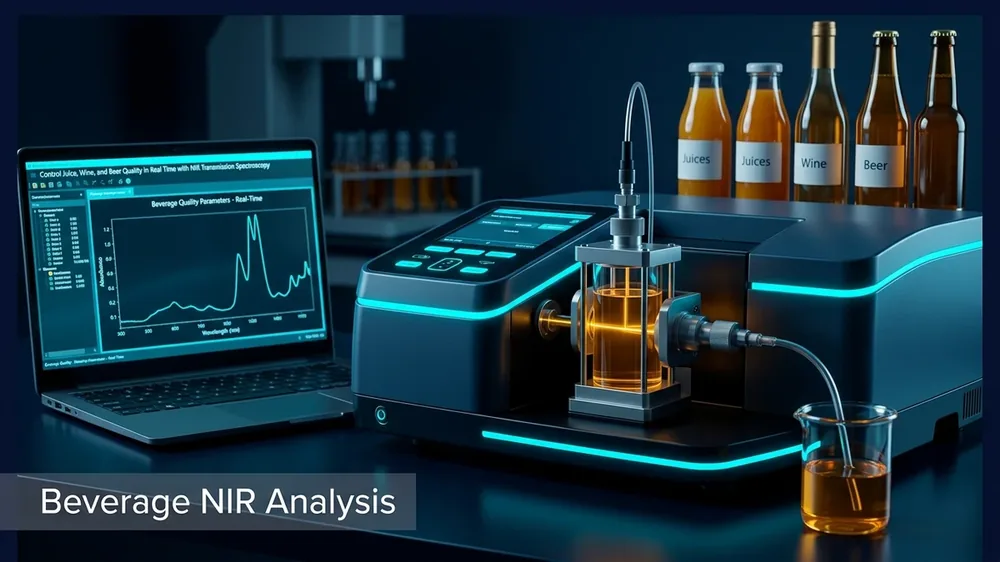
Control NIR Measurement in Beverage Production: How It Works and Why It Matters
To control NIR measurement in juice, wine, and beer production, you need more than fast hardware — you need the right transmission setup, fixed path lengths, and temperature-managed samples. A juice processor running titration on every incoming tanker burns about 45 minutes of lab time per load. By the time results come back, the truck is already docked and the production line is waiting. That is the core problem with wet chemistry alone in beverage QC: the answer arrives after the decision window has closed. NIR transmission spectroscopy solves this directly. For juice processors, wineries, and breweries, NIR has become the standard quality control tool because speed and accuracy in liquid measurement matter too much to leave to slower methods.
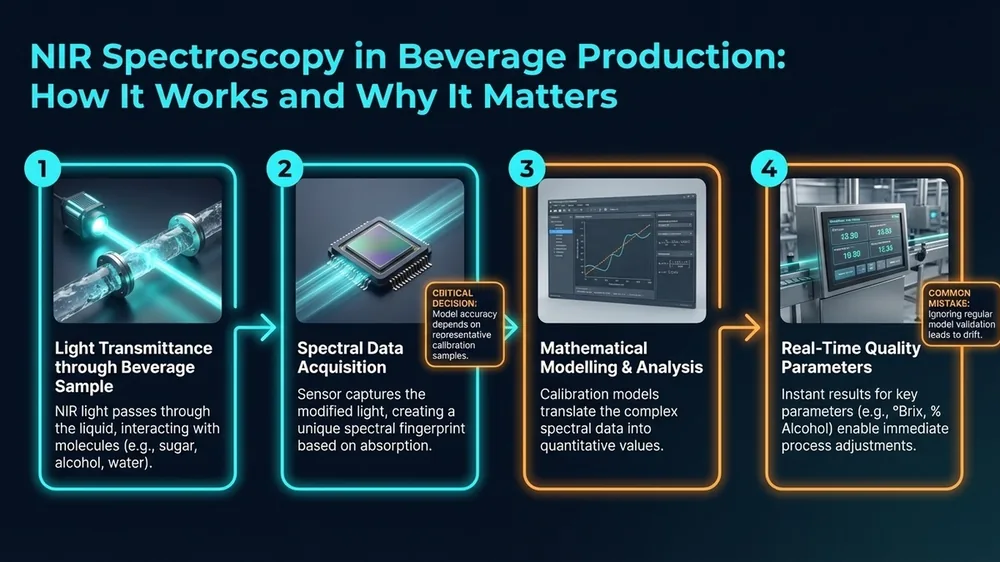
The case for NIR in beverage QC comes down to three things: speed, accuracy, and the ability to handle liquid sample chemistry without destroying the sample. A well-configured NIR system in a juice plant returns a Brix, pH, and acidity reading in under 30 seconds. That is not a marginal improvement. It changes which decisions can actually be made in real time — at the dock, before the truck leaves or the batch moves forward.
Why NIR Beverage Measurement Requires a Different Approach Than Solids
Liquid measurement is more demanding than grain measurement. The instrument setup reflects that difference. Liquids are mixtures of dissolved compounds, suspended particles, and water. Water carries strong, broad absorption bands that dominate the NIR spectrum. Traditional lab methods for beverage quality are slow, often destructive, and consume reagents on every run. NIR addresses all three of those problems — but only when configured correctly for liquid work.
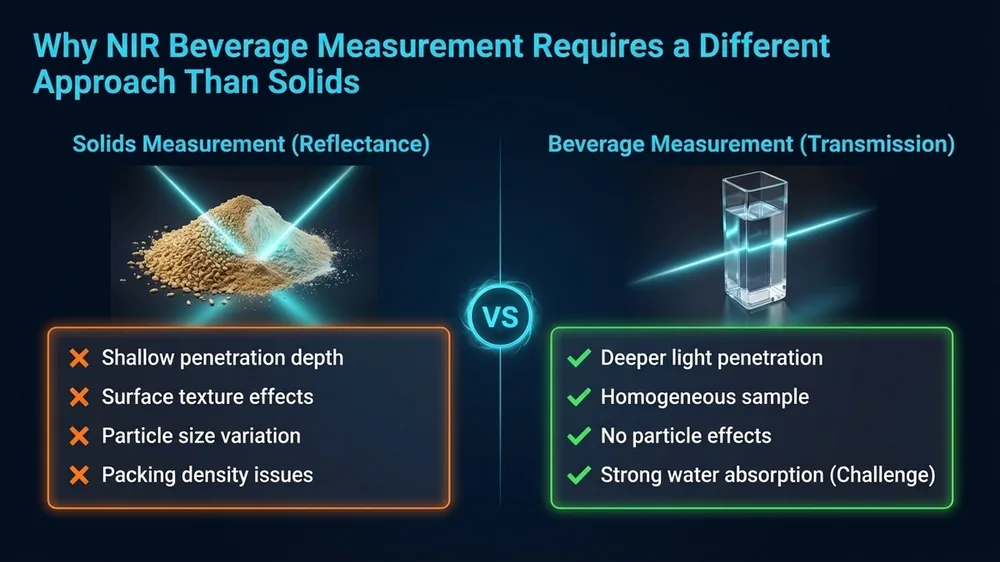
The key difference is measurement geometry. With solids, reflectance works well — light bounces off the surface and returns to the detector. With most liquids, transmission mode is needed: light passes completely through the sample. That changes which instrument configurations are valid, what path length the setup demands, and how sample temperature must be handled.
An instrument built for a flour mill will not transfer to a beverage line without meaningful changes. Do not assume otherwise — that assumption costs calibration time and, eventually, out-of-spec product. For a broader look at how instrument geometry affects measurement choices, see our guide on NIR instrument design: light sources, wavelength selection, and core components.
Transmission Mode: Why Path Length Determines Your Results
Get the path length wrong and your calibration fails — not visibly, but quietly. Predictions look plausible but drift steadily away from reference values. In transmission mode, the distance light travels through the sample directly controls signal quality. Too short a path and there is insufficient spectral information. Too long and the light gets absorbed before it reaches the detector.
For clear liquids like wine or juice, typical path lengths run from 1–10 mm. The exact value depends on the sample's NIR absorbance profile.
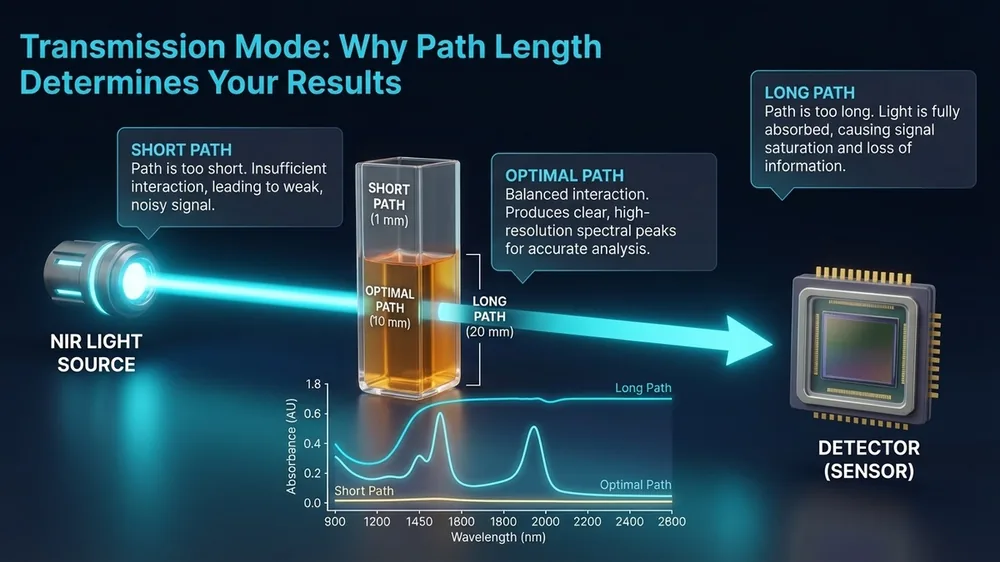
Think of path length like the focal length on a camera lens — change it and the whole image shifts, even if nothing else moves. Your calibration is built at a specific path length, and it expects that exact path length on every scan. This is why beverage setups need precision cuvettes or flow cells with defined, fixed path lengths.
The same sample measured in a 2 mm cell versus a 5 mm cell produces different spectra. Your calibration must be built with the exact path length used in production. No workarounds, no approximations.
To understand the underlying physics governing how path length affects absorbance, our article on Beer-Lambert Law and when NIR results are reliable covers the relationship in practical detail.
Note: Path length is not just a setup detail — it is a calibration variable. If the flow cell is replaced or modified, the calibration needs revalidation against the new geometry.
How Temperature Affects NIR Accuracy in Beverage Measurements
Water's NIR absorption bands shift with temperature. Even a 2–3°C difference between calibration samples and production samples introduces measurable prediction error. This is a common source of calibration drift at juice plants where samples arrive straight from cold storage.
A sample measured at 8°C when the calibration was built at 20°C will produce predictions that look reasonable — until a reference check reveals the model has drifted outside internal spec. That gap is temperature, not instrument fault.
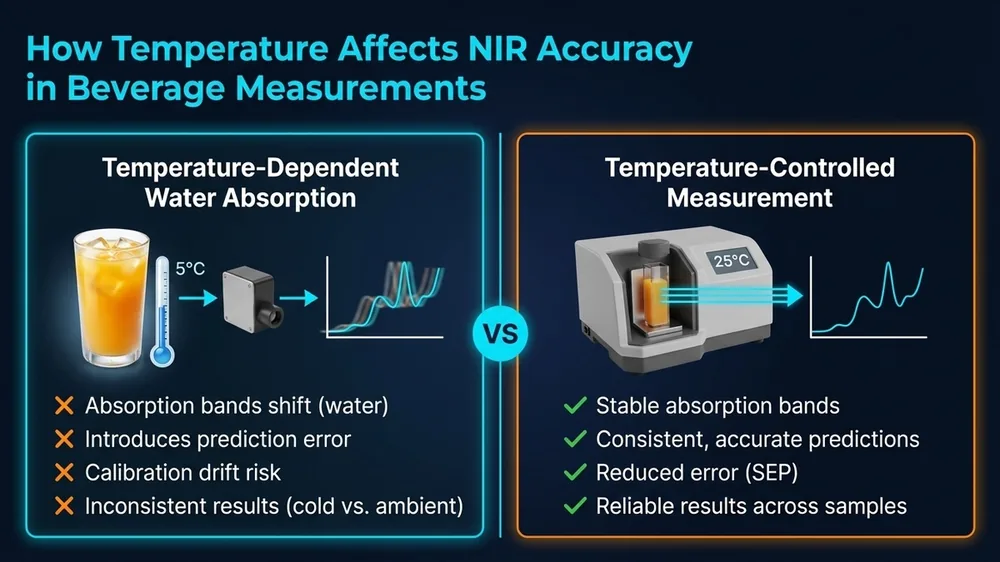
Two options exist. First, standardize sample temperature to within ±1°C before every measurement. Second, build temperature variation into the calibration model from the start. The first approach works well for at-line systems with controlled sample handling. The second suits inline systems where temperature cannot be held steady.
For a full breakdown of temperature control strategies for NIR liquid measurements, see our article on why sample temperature affects NIR results and how to control it.
Watch out: Temperature drift is the most common reason a beverage calibration performs well in validation but drifts in production. Before chasing instrument faults or calibration errors, check whether your samples are temperature-controlled. That single variable resolves the majority of these cases.
Where NIR Adds Value Across Beverage Production
A common mistake QA teams make is treating NIR as a single end-of-line check. In beverage production, there are at least four points where it adds measurable value. Each point has different requirements for sample presentation, path length, and calibration design. Deploying at only one point leaves real value unrealized.
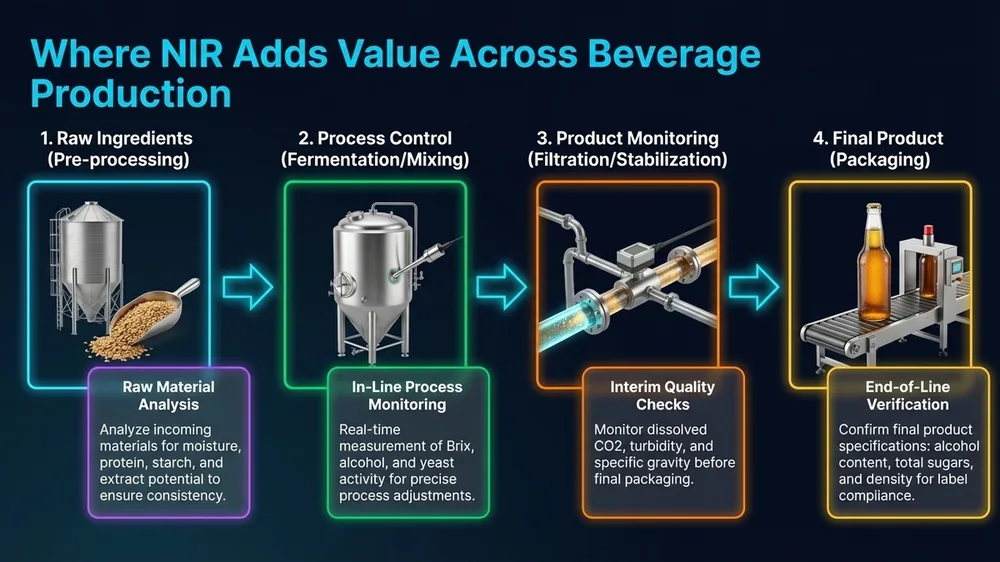
Think about how a well-run feed mill operates: incoming raw materials, intermediate process checks, blend verification, and finished product sign-off. Beverage plants follow the same logic. Here is how that maps in practice:
- Incoming raw ingredients — Verify sugar concentration, pH, and moisture in fruit juices or malt before acceptance. Rejecting an out-of-spec tanker at the dock costs far less than reformulating a failed batch downstream.
- Pre-fermentation checks — Confirm Brix and dissolved solids before fermentation begins. Starting with the wrong substrate concentration means fermentation kinetics are off from minute one.
- In-process fermentation monitoring — Track alcohol development, residual sugar, and CO₂ without pulling destructive samples every hour. A validated model with a flow cell checks these parameters every few minutes.
- Finished product verification — Final alcohol, sugar, pH, and color parameters before release. This is the last gate before the product reaches a bottle or a keg.
Each measurement point needs its own calibration model, sample handling protocol, and validation against reference methods. Stretching one model across all four points is a shortcut that will not hold under real production variation. Expansion is possible, but there is no way to shortcut the individual validation work at each stage.
Each production stage in beverage manufacturing represents a distinct measurement environment. A calibration model built for finished wine will not reliably predict parameters mid-fermentation — the sample matrix is too different to share a single model.
Wine Quality Monitoring with NIR
Harvest timing at a mid-sized winery creates a real measurement problem. Brix readings are needed across multiple lots, multiple times per day, across weeks of incoming fruit. Running every sample through a refractometer and titration does not scale. Wineries that have switched to at-line NIR for intake and cellar monitoring consistently report the same outcome: they get equivalent data faster, without interrupting processes or waiting on a lab queue.
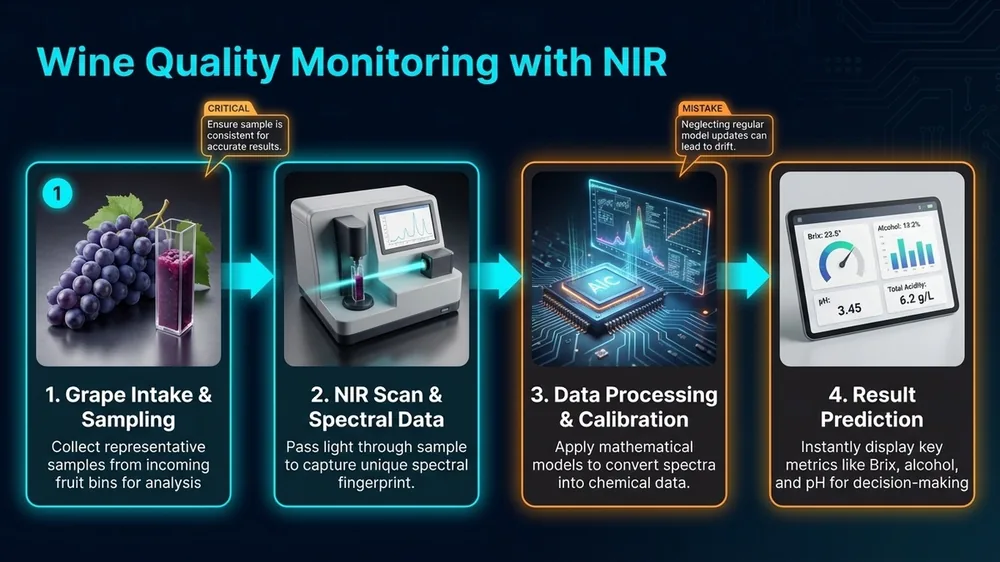
At a winery processing 200 or more tons per day during crush, that speed difference directly affects blend decisions worth tens of thousands of dollars per lot. From grape intake through fermentation monitoring, NIR tracks Brix, alcohol, pH, and total acidity without opening barrels or pulling destructive samples.
The instrument pays for itself fastest at the two points where bad data causes the most damage: incoming fruit acceptance and pre-fermentation substrate verification. Start there, validate those two models thoroughly, then expand. That sequencing prevents the common mistake of deploying too broadly before the basic calibration work is solid.
For realistic accuracy targets in beverage applications, the article on NIR accuracy and calibration for beverage quality control covers the numbers directly.
One failure mode worth noting: wineries that run NIR on barrel samples pulled at varying temperatures across a cellar. Barrel-to-barrel temperature differences of 4–6°C are common in poorly climate-controlled facilities. If sample handling does not account for that variation, alcohol predictions will drift. The problem will not surface until a finished lot fails release testing. Standardize sample temperature at the point of collection, not just at the instrument.
Beer and Juice Applications: Where the Same Principles Apply
The same three constraints — path length, temperature, and per-stage calibration — apply directly to beer and juice operations. The parameters being tracked differ, but the measurement discipline required is identical.
In a brewery, NIR monitors original gravity, alcohol by volume, bitterness units, and residual extract across mashing, fermentation, and conditioning. Missing any one of those checkpoints with a poorly configured model leads to batch corrections that cost more in time and materials than the NIR program itself. For juice processors, the focus shifts to Brix, titratable acidity, pH, and color — but the flow cell geometry and temperature requirements are the same.
Juice operations benefit particularly from at-line NIR at the receiving dock. A truck carrying concentrate that tests outside specification can be rejected in minutes rather than hours. At intake volumes typical of large juice processors — dozens of tankers per day during harvest season — that speed translates directly into scheduling efficiency and raw material cost control.
For a practical look at how NIR fits into broader quality assurance workflows across food and beverage operations, see our overview of NIR spectroscopy in food quality assurance: where it fits and where it falls short.
Getting NIR Transmission Right: The Three Non-Negotiables
Beverage NIR is not plug-and-play. The operations that get the best results share three consistent practices. Miss any one of them and the speed advantage disappears into troubleshooting time.
Fixed path length. Every flow cell or cuvette must match the geometry used during calibration. If hardware changes, the calibration must be revalidated. There is no shortcut here.
Temperature control. Standardize sample temperature to within ±1°C at the point of measurement, or build temperature variation explicitly into the calibration model. Do both if possible.
Separate calibration models per production stage. Incoming fruit, fermenting must, and finished wine are three different sample matrices. Each requires its own validated model. A single model stretched across all three will drift at the stage where the matrix differs most from the calibration set.
Get those three things right and the speed advantage is real — Brix, pH, alcohol, and acidity in under 30 seconds per sample, at every production stage that matters. For teams building a new beverage NIR program, working through calibration development before deployment is the step most likely to determine long-term success. Our overview of NIR calibration: why it is essential and how it works is a practical starting point for that process.
Free tool — Beer-Lambert Calculator: The Beer-Lambert Calculator works the absorbance = ε·b·c relationship in both directions — useful when sizing path length for a new sample type or sanity-checking a calibration curve. Open the Beer-Lambert Calculator →
SpectroScience students get access to the NIR Troubleshooting Guide — systematic approach to diagnosing poor predictions, instrument drift, and calibration failures. Available as a free download in the student resource library.
Access the PDF libraryNIR Fundamentals Course — Lesson 15: Beverages & Specialty Crops
This lesson focuses on the specific applications of NIR spectroscopy in the beverage industry, detailing how it effectively measures key quality parameters like Brix, alcohol, and pH in real-time. It emphasizes the advantages of NIR over traditional methods, particularly in terms of speed and non-destructive analysis, which are crucial for maintaining quality control in juice, wine, and beer production.
Explore Lesson 15 in the NIR Fundamentals courseWant to Master NIR Spectroscopy?
Our 32-lesson online course covers everything from Beer-Lambert Law to PLS calibration — built for food, grain, feed, and dairy professionals.