NIR Spectroscopy in Food Quality Assurance: Where It Fits and Where It Falls Short
Learn where NIR spectroscopy fits in food quality assurance — grain, dairy, meat, and bakery — and where wet chemistry and safety testing must take over.
· 11 min read · Vitaly Kirkpatrick
NIR Spectroscopy in Food Quality Assurance: Where It Fits and Where It Falls Short
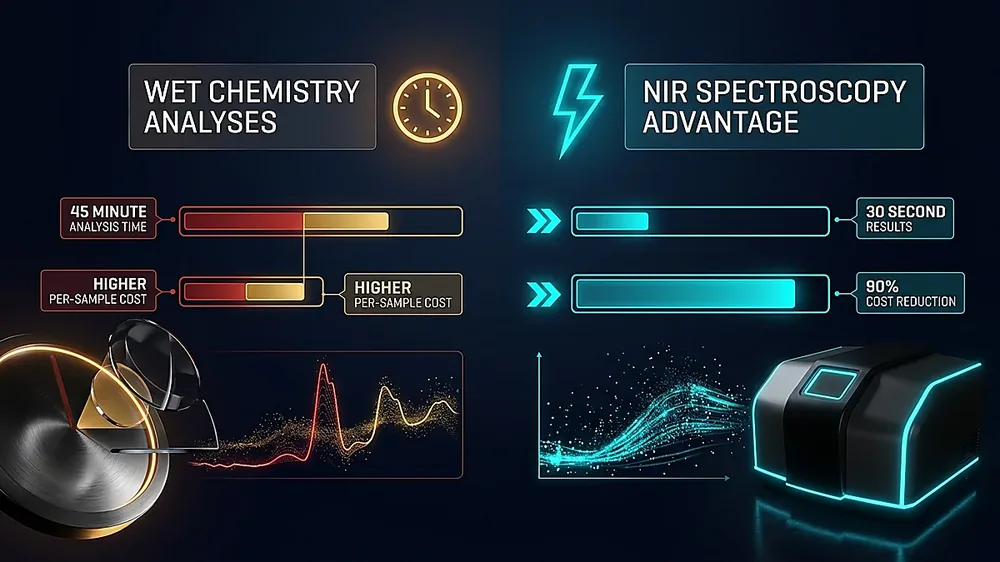
A grain elevator receiving 50 truckloads of corn a day can't wait 45 minutes per sample for wet chemistry results. A dairy intake lab running milk fat and protein on every incoming tanker can't hold product while Kjeldahl runs. That's the real reason NIR gets deployed — speed at scale. But speed without an honest picture of what NIR can and can't do leaves gaps in your quality system that auditors and safety incidents will eventually find. Here's where it earns its place, and where you still need traditional chemistry to back it up.
Understanding NIR Spectroscopy in Food Production
NIR works by measuring how near-infrared light — in the 780–2500 nm range — gets absorbed by molecular bonds in your sample. The key absorption bands in practice: water at roughly 1450 nm and 1940 nm, protein at around 2180 nm and 2300 nm, fat at approximately 2310 nm. Those wavelengths are the foundation of nearly every grain, dairy, and feed calibration you'll encounter in the field.
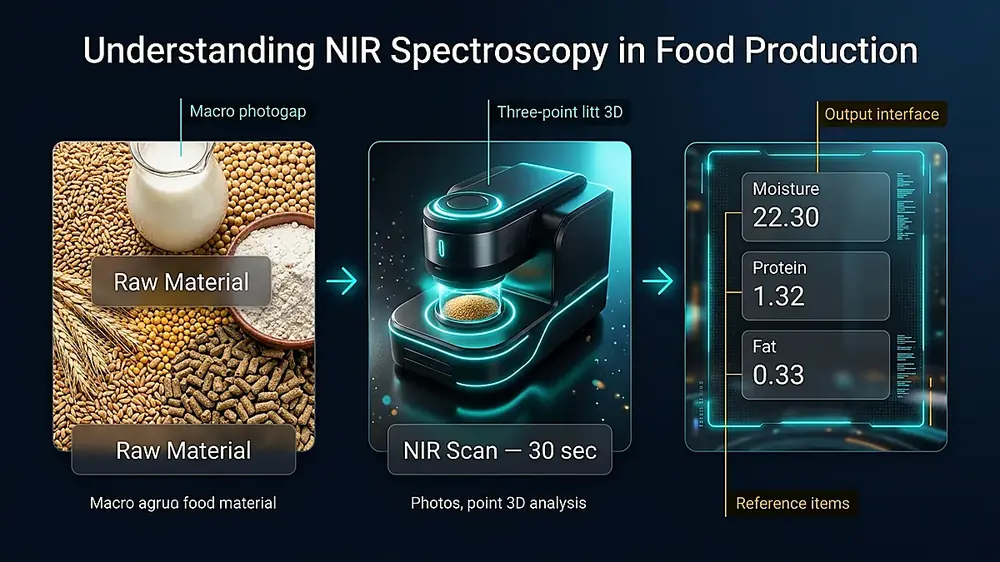
In grain processing, NIR measures moisture, protein, and oil content in seconds. No solvents, no sample destruction, no waiting on lab turnaround. Prediction accuracy is never a flat number, though. Well-maintained calibrations on major constituents like protein, fat, and moisture typically show R² values above 0.90 and RMSEP values that stay close to the reference method error. That's parameter-specific, and it's only as good as your calibration data and the reference chemistry behind it.
Think of a PLS calibration model like training a receiving technician to recognize a regular supplier's grain by smell, color, and feel. Reliable over time — but only if they trained on a wide range of samples and had someone knowledgeable grading each one. Feed the model bad reference data, or train it on a narrow sample set, and its predictions drift the same way a poorly trained technician makes mistakes.
Every NIR result comes from a chemometric model — typically Partial Least Squares regression (PLS), though you'll also see Principal Component Regression (PCR) and Multiple Linear Regression (MLR) in older setups. Model performance is reported using RMSEC, RMSECV, RMSEP, R², and RPD. If someone hands you an NIR result without the model statistics behind it, that number doesn't tell you much. For a detailed breakdown of which statistics actually matter, see The 5 Stats That Actually Matter for NIR Model Evaluation.
Instrument type matters too. Most grain elevators and feed mills run either dispersive grating instruments or FT-NIR systems. Dispersive instruments scan wavelengths sequentially and cover the full 780–2500 nm range well. FT-NIR uses an interferometer to capture the full spectrum simultaneously — it handles sample movement better and transfers calibrations more reliably between instruments. Filter-based analyzers are simpler and cheaper, but they only measure at fixed wavelengths, which limits flexibility. For dairy and grain applications, dispersive and FT-NIR systems perform comparably in prediction accuracy. The choice usually comes down to your production environment and budget.
Enhancing Quality Control in Bakeries
Bakeries use NIR to control flour quality and monitor final baked goods — specifically protein content, moisture, and ash. Getting protein right in flour directly affects dough elasticity and rise. A lot of what looks like a recipe problem in a bakery is actually an incoming raw material problem that nobody caught at intake.
At-line NIR screening of incoming flour — checking protein, moisture, and ash before it hits the mixer — catches out-of-spec lots early. That matters because rework on mixed dough is expensive, and returned finished product is worse. Operations that screen flour at receiving rather than relying on supplier certificates of analysis report tighter product consistency and fewer mixer adjustments.
NIR also screens for physical adulteration in raw materials, though confirming identity adulteration still requires reference chemistry or DNA-based methods.
One thing that often surprises bakery QC managers: the ROI on NIR at flour intake isn't just about catching bad lots. It's about adjusting water addition and mix time before problems compound. A protein swing of even 0.5% in incoming flour changes absorption characteristics enough to shift your finished loaf weight. Catching that at intake takes seconds with NIR. Catching it after mixing costs you a batch.
Economic Benefits and Future Trends
The cost reduction case for NIR isn't abstract. In feed mills, NIR analysis of incoming ingredients — moisture, protein, fat, ash, NDF, ADF — lets nutritionists formulate tighter. You're not over-fortifying on expensive amino acids because you actually know what's in the raw material batch, not what the spec sheet says.
That cuts external lab turnaround costs, reduces dependence on chemical solvents, and shortens the time between receiving and release. The mechanism is consistent across operations: real-time compositional data means fewer formulation errors and less wasted ingredient spend. For a clear picture of how those savings add up, the real cost reduction breakdown for NIR raw material savings walks through the numbers in practical terms.
Portable and handheld NIR devices are expanding the reach of at-line testing. Smaller producers who couldn't justify a lab-based analyzer a decade ago are now running at-line checks with compact instruments that connect to cloud-based calibration management. That trend is pushing NIR further up the supply chain — toward farm-level receiving and small-batch processors.
Integration with IoT monitoring systems is also moving from pilot to standard in larger operations. Continuous inline sensors now feed composition data directly into process control systems, closing the loop between measurement and adjustment in real time.
Practical Tips for Implementing NIR Spectroscopy
- Start with a pilot program focused on your highest-volume analyte — moisture or protein in your primary raw material — before expanding to a full panel.
- Train your staff not just to operate the instrument but to read model statistics. If your RMSEP on protein suddenly doubles, that's a drift signal, not a batch problem.
- Regularly check RMSEP and bias against fresh reference data — at minimum quarterly, more often if your raw material sources change or your production environment shifts seasonally.
- Work with an NIR specialist to build your calibration sample set from your actual production range. A model calibrated on someone else's grain doesn't predict yours reliably.
One practical step that often gets skipped: document your calibration update history and keep it accessible for your auditors. Your incoming inspection rejection protocol only holds up in an audit if you can show the calibration behind it was current and validated against wet chemistry. That documentation gap has cost operations their NIR-based inspection approval more than once.
NIR in Meat and Poultry QA
Ground beef and processed poultry are high-throughput, tight-spec environments — exactly where NIR earns its keep. In ground beef, NIR calibrations reliably cover fat content from 5% to 30% and moisture from 50% to 70%. That lets processors hold product composition to label spec without running Soxhlet on every batch.
For poultry, protein content is the key parameter, with typical calibration models covering 18% to 25% protein. Trimming verification — confirming lean-to-fat ratios in processed cuts — is another application where NIR reduces manual error and speeds line release.
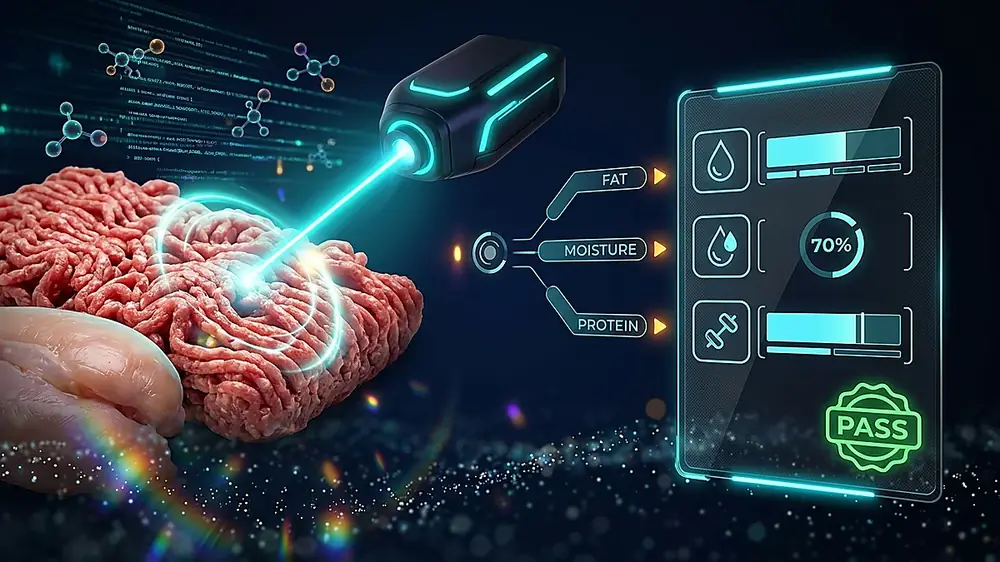
Inline NIR systems give you real-time monitoring on the processing line, which is what high-throughput plants need. At-line analyzers offer flexibility for spot checks without committing to a full inline installation.
What NIR won't do in either setup: detect freshness or spoilage. Microbial load, oxidation state, pathogen presence — none of those produce spectral signals NIR can distinguish from the food matrix at the contamination levels that matter for safety. Pathogen detection needs PCR or plating. Spoilage assessment needs sensory or microbiological evaluation. NIR results in meat and poultry QA work alongside those methods, not instead of them.
Dairy Processing Quality Control
Dairy intake is one of the strongest use cases for NIR in food manufacturing. Milk fat from 2% to 6% and protein from 2.5% to 4% — those are the ranges your intake calibration needs to cover. A well-maintained model handles them with accuracy that meets most standardization specs. That lets you adjust blends before processing rather than discovering the fat content is off after pasteurization.
In cheese production, moisture control during curd and finishing stages directly affects ripening, texture, and shelf life. NIR measuring moisture within ±0.5% at those stages gives process operators real data to act on, not just end-of-batch confirmations.
For milk powder, the dryer outlet is the critical control point. Caking and microbial growth both become risks if moisture climbs above spec. Inline NIR sensors at the dryer outlet provide continuous readings in the 2% to 6% range and flag deviations before a full batch goes off-spec.
Plants that skip calibration updates after processing changes — seasonal raw milk composition shifts, new supplier lines — see drift that erodes that control. Your calibration model needs to reflect what's actually moving through your line right now, not what was moving through it when the model was first built. The article on NIR calibration validation pitfalls and keeping performance reliable over time covers exactly how to manage that ongoing drift risk.
Where NIR Falls Short in Food QA
NIR is fast and non-destructive. That combination makes it genuinely useful for compositional screening. But "useful for compositional screening" is not the same as "covers your food safety requirements." Those are different things, and confusing them is where operations get into trouble.
NIR measures bulk molecular bond vibrations — O-H, C-H, N-H — across the 780–2500 nm range. Microbial cells at typical contamination levels produce spectral signals far too weak to distinguish from the food matrix. Pathogens, spoilage organisms, metals, pesticide residues, allergens — none of them show up reliably in NIR spectra at the concentrations that matter for food safety.
Pesticide residues often need detection limits in the parts-per-billion range. That's ICP-MS or chromatography territory, not NIR. Allergen quantification needs immunoassays or DNA-based tests. These aren't workarounds for NIR's limitations — they're the right tools for what those analytes require.
Operations that try to replace those specific tests with NIR don't save money. They create liability. Use NIR where it's strong: high-frequency compositional screening, formulation verification, incoming raw material checks on your primary parameters. Back it up with wet chemistry and microbiological testing where food safety demands it. That's a complete quality system — NIR is one layer of it, not the whole thing. And knowing exactly which layer it covers is what keeps your quality program defensible when an auditor asks.
Free tool — NIR ROI Calculator: Plug your sample volume, current method cost, and analyte spec into the SpectroScience NIR ROI Calculator to see annual savings and payback period for your operation. Open the ROI Calculator →
Free tool — Calibration Metrics Calculator: Enter your reference values and NIR predictions in the Calibration Metrics Calculator to compute RMSEP, RPD, R², and bias the way our course teaches it — with interpretation thresholds for grain, dairy, and feed. Open the Metrics Calculator →
Free tool — NIR Glossary: Unfamiliar with a term? The SpectroScience NIR Glossary defines every chemometrics, calibration, and instrument term used in this article in plain language with worked examples. Open the Glossary →
SpectroScience students get access to the NIR Quick Reference Guide — wavelength assignments, key absorption peaks, and common parameter ranges for food and feed analysis. Available as a free download in the student resource library.
Access the PDF libraryFree tool — Beer-Lambert Calculator: The Beer-Lambert Calculator works the absorbance = ε·b·c relationship in both directions — useful when sizing path length for a new sample type or sanity-checking a calibration curve. Open the Beer-Lambert Calculator →
NIR Fundamentals Course — Lesson 11: NIR and Lab Reference Methods
This lesson covers the relationship between NIR spectroscopy and traditional lab reference methods, emphasizing the importance of calibration and validation in ensuring accurate measurements. It provides insights into how to effectively integrate NIR results with conventional methods to fill any gaps in quality assurance processes.
Explore Lesson 11 in the NIR Fundamentals courseWant to Master NIR Spectroscopy?
Our 32-lesson online course covers everything from Beer-Lambert Law to PLS calibration — built for food, grain, feed, and dairy professionals.