NIR Accuracy and Calibration for Beverage Quality Control
Get accurate NIR measurements in beverage production. Learn Brix, alcohol, pH, and moisture accuracy expectations — and how to build calibrations that hold up.
· 7 min read · Vitaly Kirkpatrick
Quality managers often ask me whether NIR can realistically replace a wet chemistry panel on juice, wine, or beer lines. The short answer: yes — but only if your calibration is built for production conditions, not just the lab bench. Getting there requires understanding what accuracy looks like in liquid matrices, where moisture and water activity diverge, and what it actually costs when a pH error makes it to the bottling line.
NIR Accuracy in Beverage Applications: What to Expect
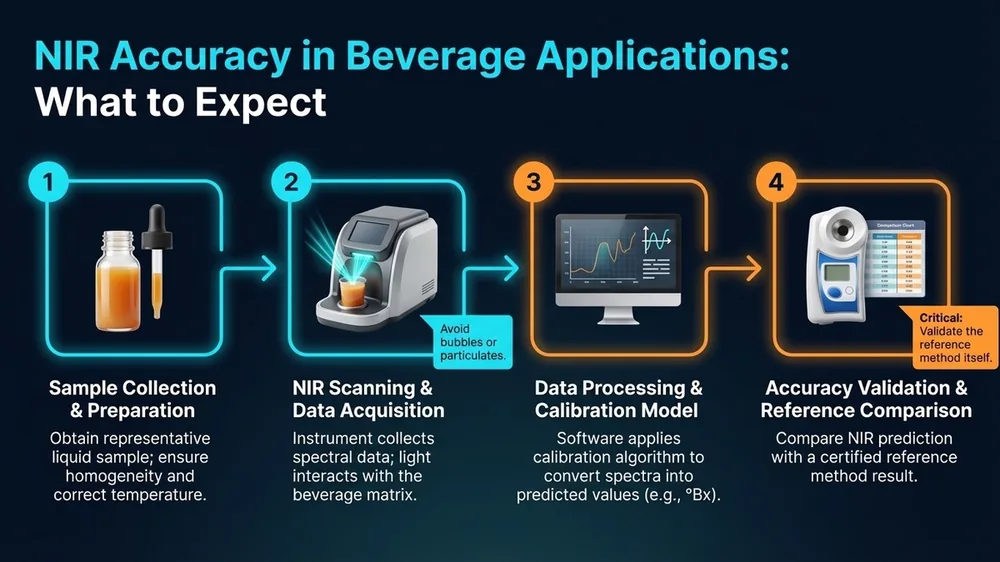
Quality managers and lab directors ask me this regularly: "How accurate is it, really?" Here's what you can realistically expect from a properly validated NIR system in beverage applications:
| Parameter | Beverage Type | Typical NIR RMSEP | Reference Method |
|---|---|---|---|
| Brix (°Bx) | Juice, wine, beer | ±0.1–0.3 °Bx | Refractometry |
| Alcohol (% v/v) | Wine, beer, spirits | ±0.1–0.2% | Distillation/GC |
| pH | Wine, juice | ±0.10–0.20 pH units | Potentiometry |
| Moisture (% w/w) | Concentrated extracts | ±0.1–0.3% | Karl Fischer / Oven dry |
| Total acidity (g/L) | Wine, vinegar | ±0.1–0.3 g/L | Titration |
These numbers assume a properly built calibration with representative sample diversity, validated against AOAC-equivalent reference methods. For alcohol content specifically — a regulatory labeling requirement in most markets — your NIR system needs to be validated against the appropriate official reference method — distillation or GC for alcohol, potentiometry for pH, refractometry for Brix. Without that, it's a screening tool, not a release method.
Moisture Content vs. Water Activity: Know Which One Your Process Needs
This distinction trips up a lot of teams moving from dry ingredients into liquid or semi-liquid beverage components. NIR measures moisture content reliably. It does not measure water activity (Aw) directly — and in concentrated beverage ingredients, that difference matters.
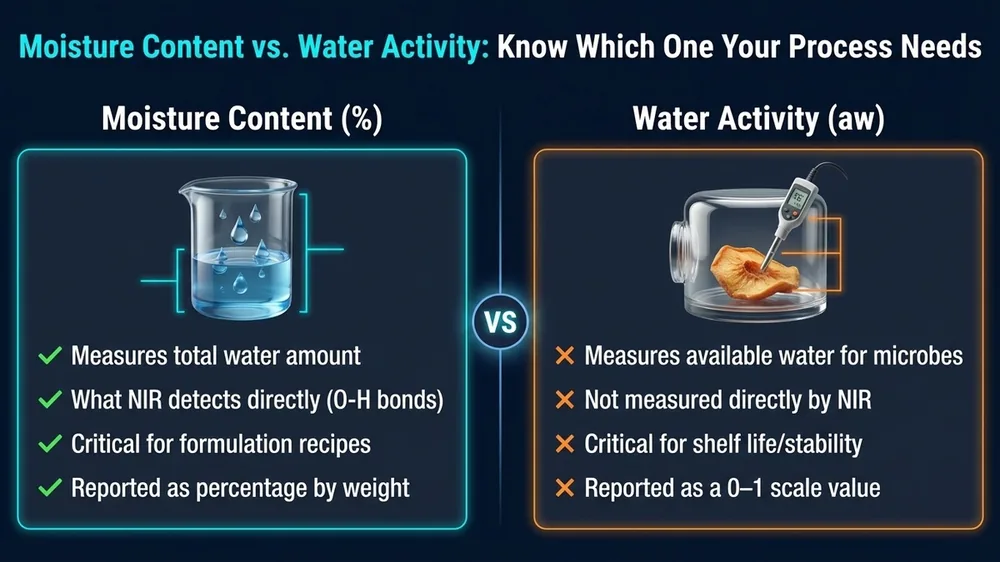
A 12% moisture concentrated extract can have a water activity of 0.60 (shelf stable, no microbial risk) or 0.75 (active mold risk) depending entirely on ingredient composition and solute concentration. Same moisture reading, very different spoilage risk. NIR gives you an accurate moisture number in both cases. But if your quality decision is about microbial stability, you need an Aw meter running alongside it.
Think of it this way: moisture content tells you how much water is present, but water activity tells you how available that water is to microorganisms. They're related, but they're not interchangeable. Your NIR application needs to be designed around whichever one actually drives your quality or safety decision — not whichever one is easier to measure.
For most liquid beverages at normal dilution, moisture content is the meaningful metric. For concentrated syrups, extracts, or semi-finished ingredients held in storage before processing, water activity is the safety-critical parameter. Know which decision you're actually making before you spec your measurement approach.
Building a Beverage NIR Calibration That Holds Up in Production
A calibration built in the lab on neat samples will fail in production if it doesn't account for real-world variation. Temperature drift is the most common cause, but turbidity changes during fermentation, CO₂ bubble interference in carbonated beverages, and batch-to-batch variation in raw materials all affect your spectral baseline.
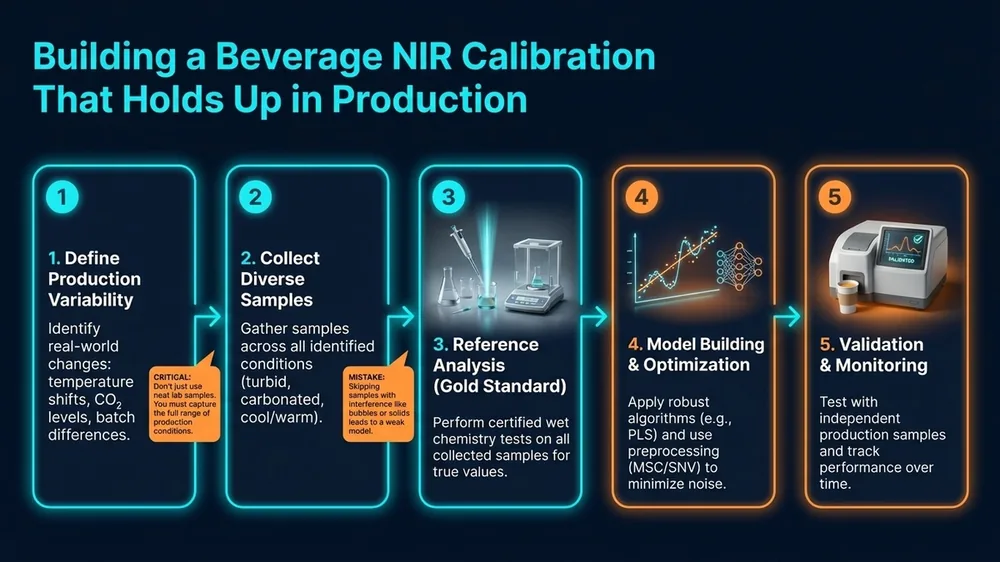
Here's a practical checklist for building a beverage NIR calibration that doesn't fall apart three months in:
- 1Collect samples across the full range of production variability — don't grab 20 samples from one good week. You need seasonal variation, supplier variation, and process variation represented in the calibration set.
- 2Control or model temperature — standardize sample temperature to ±1°C before measurement, or include temperature as a covariate in your calibration model. Anything less invites drift.
- 3Validate against the right reference method — for regulatory parameters, that means AOAC-approved or equivalent methods. For internal quality parameters, use your lab's gold standard and document it formally.
- 4Set up ongoing calibration maintenance — add new samples to the model as production conditions evolve. A calibration is an ongoing asset that needs maintenance like any other instrument in your lab.
- 5Define clear out-of-model warnings — use your instrument's spectral residual or Mahalanobis distance outputs to flag samples outside the calibration space. Don't let the model silently extrapolate on unusual samples.
One failure mode I see repeatedly during plant visits: a calibration gets built during a single production season, then the winery or juice processor switches to a new fruit supplier six months later. Spectral baseline shifts. Predictions start drifting. The team assumes the instrument is broken. It's not — the calibration just never saw that supplier's fruit. Build broad from the start, or budget time to expand the model when your raw material base changes.
The Cost Case for NIR in Beverage Quality Control
Plant managers and operations directors respond to numbers, so here they are. A traditional wet chemistry panel on a wine or juice sample — titration, refractometry, pH, and alcohol by distillation — takes 45 to 90 minutes per sample and consumes reagents on every run. A trained analyst running 20 samples a day is spending most of their shift on repetitive measurement work.
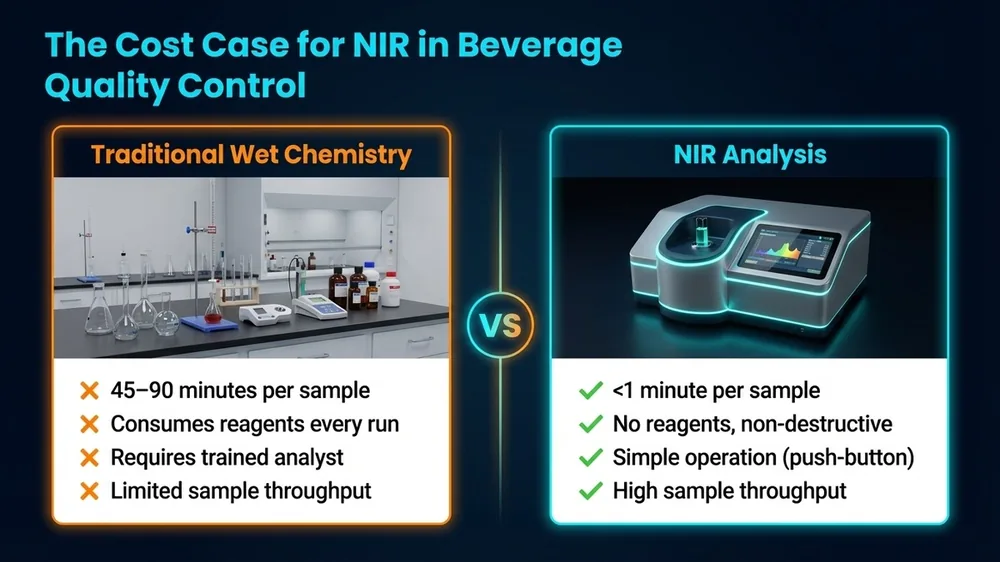
An at-line NIR system with a validated calibration runs the same panel in under 60 seconds with no reagents, and production staff can operate it after basic training. In a mid-sized winery or juice processing plant running 50 to 100 QC samples per day, labor and reagent savings typically pay back the instrument cost within 18 to 24 months.
The more important number is what NIR prevents. A single out-of-spec batch of wine reaching bottling before a pH error is caught can mean recall costs, label compliance failures, and retailer chargebacks that dwarf the annual operating cost of an NIR system. The speed advantage — catching a problem in real time rather than after a 90-minute lab cycle — is where the real value is. And that's before you count the analyst hours your lab gets back for work that actually needs human judgment.
Where to Go Next on NIR in Liquid and Beverage Applications
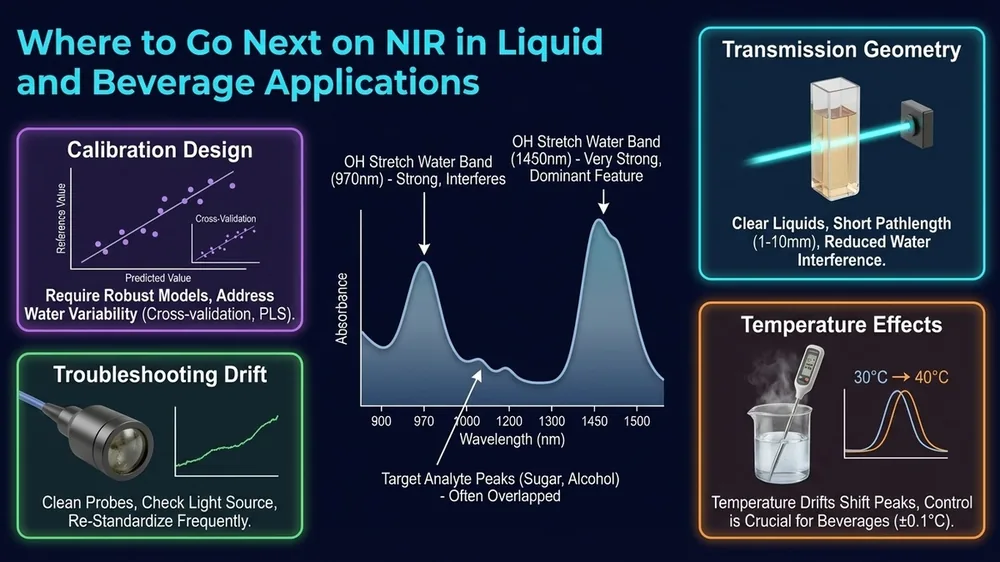
Understanding how NIR behaves in liquid matrices — transmission geometry, water interference, temperature effects, calibration design — requires more than a quick overview. Whether you're evaluating NIR for your first beverage application or troubleshooting a calibration that's drifted, getting the fundamentals right is what separates a system that performs for five years from one that gets shelved after six months.
If your team is just starting to evaluate at-line NIR for a juice or wine line, start with your highest-volume QC parameter — usually Brix or alcohol — and build that single calibration well before expanding. A narrow, well-validated calibration beats a wide, poorly validated one every time. Your auditors will thank you, and so will your production team when the system is still performing reliably two years from now.
Further Reading
Selected references drawn from the NIR Accuracy Course supplemental materials.
SpectroScience students get access to the Calibration Validation Tracker — track RMSECV, RMSEP, bias, and slope correction across calibration updates and instrument transfers. Available as a free download in the student resource library.
Access the Excel library- New Food Magazine. (2024). Rapid and non-destructive quality control in food and beverages. This article highlights NIR spectroscopy as a reliable quality control tool for identifying ingredients, analyzing compositions for labeling, and ensuring food safety. https://www.newfoodmagazine.com/article/243932/understanding-nir-spectroscopy-food-testing/
- NIR-Online Process Analyzers (leading instrument manufacturer, accessed March ). (2026). Online/Inline NIR Process Control. This page outlines the features and benefits of online/inline NIR instruments for real-time process control, emphasizing continuous monitoring of key parameters like moisture, fat, and protein to maximize production efficiency and ensure product quality. https://www.buchi.com/en/products/instruments/nir-online-process-analyzer
- Benchtop NIR Analyzers (leading instrument manufacturer, accessed March ). (2026). Benchtop and At-line NIR Analyzers. This resource describes the versatility of benchtop and at-line NIR instruments for analyzing various sample types (grains, powders, liquids) in laboratory and industrial settings, highlighting their accuracy and ease of use for improving processing decisions. https://www.perkinelmer.com/category/benchtop-nir-analyzers
- Why Control Temperature for More Accurate and Reproducible NIR Results (, leading instrument manufacturer). (2024). Impact of Temperature on NIR Predictions. This source explains that temperature a lot influences NIR spectra and prediction outcomes. Controlling sample temperature or implementing temperature correction is needed for improving accuracy and reproducibility. https://www.metrohm.com/en/discover/blog/2024/nirs-temperature-control.html
Free tool — Calibration Metrics Calculator: Enter your reference values and NIR predictions in the Calibration Metrics Calculator to compute RMSEP, RPD, R², and bias the way our course teaches it — with interpretation thresholds for grain, dairy, and feed. Open the Metrics Calculator →
Free tool — Model Diagnostics Calculator: Drop your spectra and predictions into the Model Diagnostics Calculator to flag outliers via Mahalanobis distance, use, and Q-residuals — the same diagnostics we walk through in Lesson 25. Open the Diagnostics Calculator →
NIR Fundamentals Course — Lesson 15: Beverages & Specialty Crops
This lesson focuses on the specific applications of NIR in the beverage industry, detailing how to effectively implement NIR technology for quality control in various liquid products. It emphasizes the importance of developing robust calibrations and understanding the unique challenges posed by liquid matrices to ensure accurate and reliable measurement results.
Explore Lesson 15 in the NIR Fundamentals courseWant to Master NIR Spectroscopy?
Our 32-lesson online course covers everything from Beer-Lambert Law to PLS calibration — built for food, grain, feed, and dairy professionals.