NIR Calibration: Why It's Essential and How It Works
NIR calibration explained: how models are built, validated, and maintained for accurate food and feed quality predictions. Practical guide from SpectroScience.
· 7 min read · Vitaly Kirkpatrick
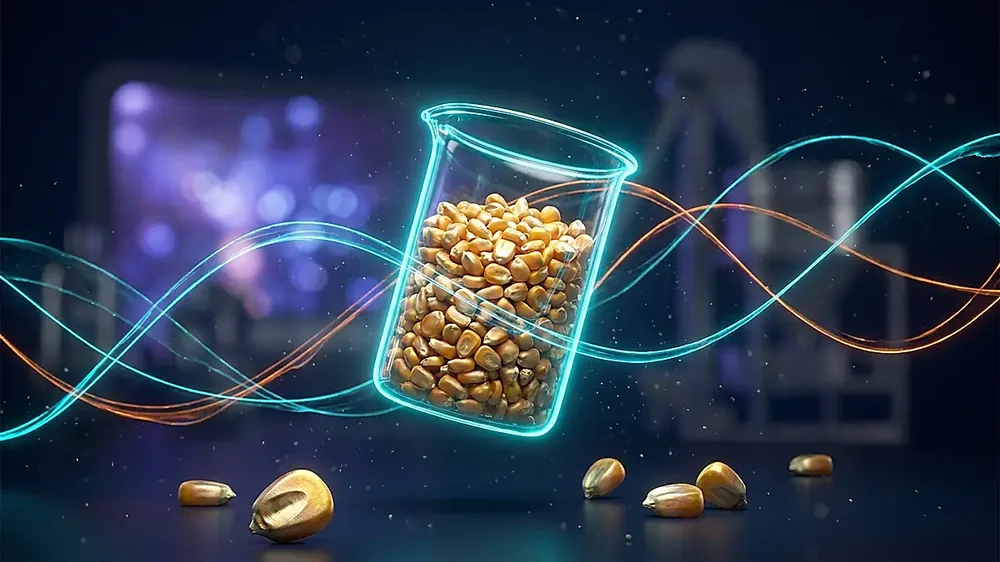
How NIR Calibration Turns Spectra Into Chemical Predictions
A grain elevator I work with was running a vendor-supplied corn protein calibration for two seasons before anyone checked it against local Kjeldahl data. When they finally did, they found a consistent 0.4% positive bias — which meant they'd been accepting loads they should have docked, and in some cases overpaying by enough to matter at volume. That's what happens when calibration gets treated as a one-time setup rather than an active part of your NIR program. Understanding why NIR calibration works the way it does — and what breaks it — is the difference between an instrument that earns its keep and one that quietly costs you money. This article covers how calibration works, what the model-building process looks like step by step, and what it takes to keep your calibration accurate when raw materials shift, instruments age, and specs tighten.
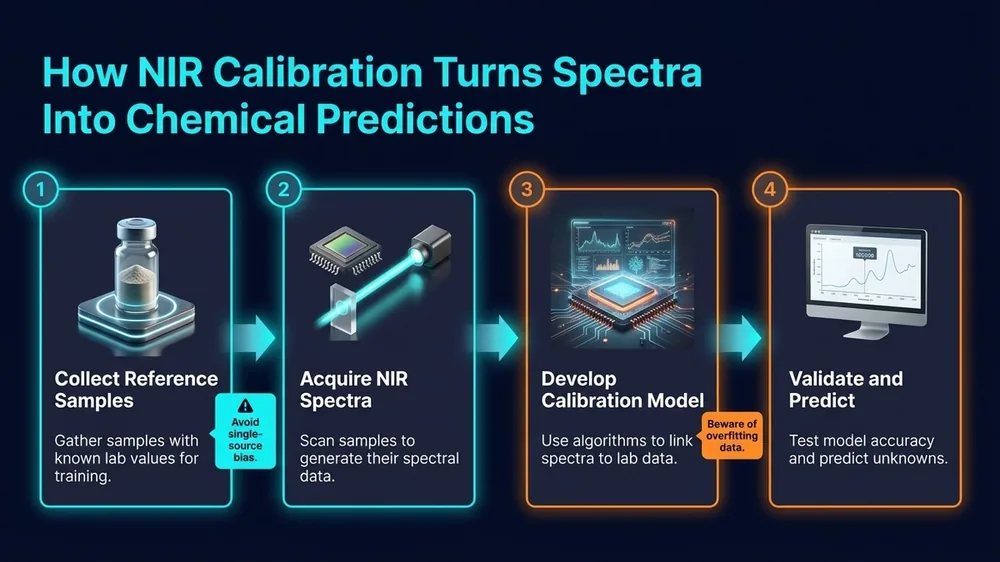
Why NIR Spectroscopy Can't Work Without Calibration
Most analytical methods have a direct relationship between measurement and result. A scale gives weight. A pH meter gives pH. NIR doesn't work that way. It measures how molecules absorb near-infrared light — and that signal is layered, overlapping, and impossible to read directly. For a deeper look at the underlying physics, NIR Spectroscopy: How It Works, What It Measures, and Where It Has Limits provides needed context on why calibration is built into the method from the start.
Your instrument needs a mathematical model to translate spectral data into numbers you can actually use for production decisions. That model doesn't come built in. It has to be built — deliberately, with representative samples and accurate reference values.
Note: Unlike direct-reading instruments, NIR analyzers require a calibration model specific to each matrix and measurement conditions. A model built on wheat cannot simply be applied to barley, and a model trained on one instrument may not transfer directly to another without recalibration or standardization.
Think of it like a busy room where a dozen people are all talking at once. The NIR spectrum is exactly that — moisture, protein, fat, and fiber all contributing overlapping signals simultaneously. Calibration teaches the instrument to pick out each voice and assign a number to it. That translation step isn't optional. It's the entire mechanism by which NIR produces usable analytical data.
Overlapping Absorption Bands: The Core Technical Challenge
Moisture and protein both absorb near 1940 nm. If absorbance rises at that wavelength, it's not clear which constituent changed — or whether both did. That's the basic problem NIR calibration has to solve. The same challenge applies across other constituents: fat and starch share absorption regions near 2100 nm, and fiber bands overlap with both moisture and carbohydrate signals. In a compound feed containing eight to twelve ingredients, those overlaps multiply fast.
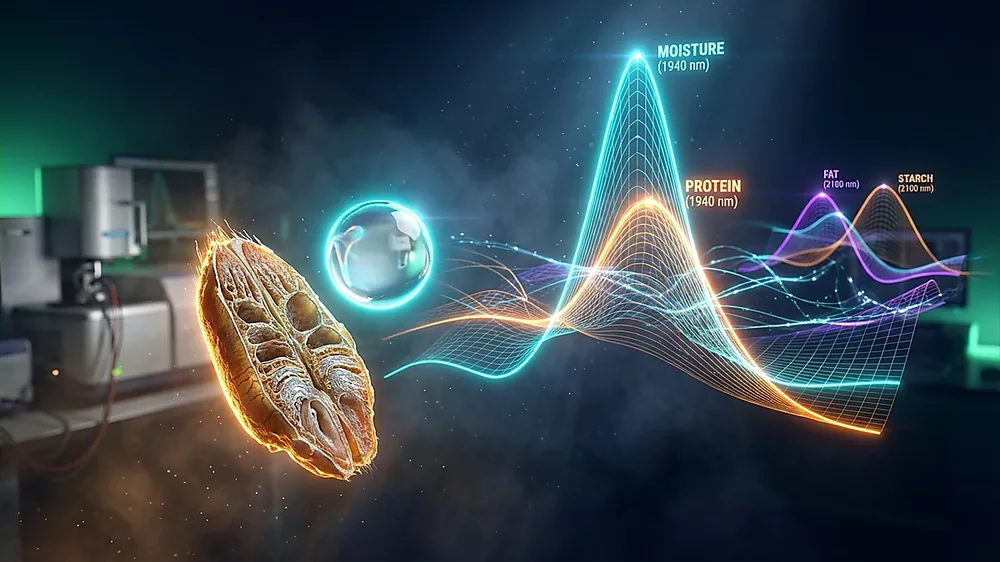
Calibration uses statistical models to untangle those overlaps. It looks across the full spectrum — typically 1100 nm to 2500 nm — not just one wavelength, to find patterns that separate each chemical component. A single band is never enough. Understanding how molecules produce these overlapping signals in the first place is covered in Why Do Molecules Vibrate — and How Does NIR Use That to Predict Composition?, which explains the overtone and combination band structure that makes full-spectrum modeling necessary.
NIR calibration works by exploiting patterns across hundreds of wavelengths simultaneously — not by reading any single absorption band. This full-spectrum approach is what allows it to separate overlapping chemical signals that no single wavelength could distinguish on its own.
In practical terms, a PLS model for soybean meal protein might draw on spectral variation between 1600 nm and 2300 nm across multiple overlapping regions — not because protein has one clean band in that range, but because the combination of many weak signals, treated mathematically as a pattern, provides reliable predictive power. That's why NIR calibration requires statistical methods rather than simple peak-height measurements.
High-Dimensional Data: More Than Any Analyst Can Handle Manually
A single NIR scan can contain 500 to 2,000 data points — absorbance values across hundreds of wavelengths. No analyst can work through that many variables at once. Calibration algorithms are built for exactly this purpose. They reduce the complexity and focus on the spectral features that actually predict what you're measuring.
Think of PLS like teaching a technician to recognize a regular customer's voice on the phone — they're not processing every acoustic frequency consciously, they're picking up on a pattern across dozens of cues at once. In practice, a PLS model for wheat protein might use 6 to 10 latent variables to describe the relevant spectral variation — reducing a 1,000-point spectrum down to a handful of mathematically constructed dimensions that capture most of the predictive information. The remaining variation gets treated as noise and excluded.
This dimensionality reduction is also what protects against overfitting — a model that memorizes the calibration set rather than learning the underlying chemistry. An overfitted model performs well on training data and poorly on new samples. Cross-validation during model development is the standard tool for catching overfitting before it becomes a production problem. A deeper treatment of how chemometric methods manage dimensionality is available in Why NIR Spectroscopy Needs Chemometrics: PLS, PCR, and Key Techniques Explained.
Small Signals That Carry Real Information
Sometimes the useful chemistry hides in tiny shifts in spectral shape. In oilseed processing, the difference between 18% and 21% oil content may appear as a subtle slope change across several hundred nanometers — not a spike at a single wavelength. These shifts aren't visible to the eye. Calibration models find these patterns by mathematically correlating spectra with known reference values from wet chemistry.
This is also why your calibration quality depends so heavily on the precision of your reference methods. A reference dataset with ±0.3% variability due to poor Kjeldahl technique will produce a model that can't perform better than ±0.3% — no matter how advanced the chemometrics. The signal is only as clean as the data used to define it. In feed milling applications where protein specs carry financial penalties, that ceiling on model performance has direct commercial consequences. A reference dataset built on poorly controlled Kjeldahl replicates will embed that imprecision permanently into every future prediction the model makes.
How a NIR Calibration Model Is Built
Building a calibration model follows a clear sequence. Each step matters. Skipping or rushing any one of them creates problems that show up later — often at the worst possible time.
Step 1 — Collect Representative Samples
The calibration set must reflect the real variation in the product. That means samples from different suppliers, different seasons, different moisture levels, and different growing regions. A minimum of 50 to 100 samples is common for a single-constituent model. More complex matrices or multi-constituent models typically require 150 or more. Samples that only cover a narrow range will produce a model that fails outside that range.
For grain receiving applications, that means including samples from multiple harvest years and origin regions. A corn protein model built only on grain from one region will fail when your facility starts sourcing from a different geography. Your calibration set should also intentionally include samples near the specification limits — these are the values that matter most for accept/reject decisions, and they must be well-represented in the training data. Including samples that span the full expected range plus a reasonable buffer beyond specification limits is standard practice in well-managed NIR programs.
Step 2 — Run Reference Analysis
Each sample in the calibration set needs an accurate reference value from a validated wet chemistry method. For protein, that means Kjeldahl or Dumas. For moisture, oven drying. For fat, Soxhlet extraction or Randall extraction. For fiber, the Van Soest NDF/ADF methods (or the AOAC Official Methods derived from them — including the standard ADF and amylase-treated NDF protocols specified in the relevant AOAC fiber method for your matrix). Your NIR model is only as good as the reference data it was trained on. Errors in reference values go directly into the model — there's no way to correct for them after the fact.
Reference laboratories should be running skill-tested methods. If you're using in-house reference analysis, duplicate runs and control samples should be standard practice. A coefficient of variation above 2% on reference duplicates is a warning sign that reference data quality will limit model performance. For parameters like fat in dairy products or protein in finished feed, submitting a subset of calibration samples to an external reference laboratory for independent verification adds a valuable quality check before model training begins.
Step 3 — Collect NIR Spectra
Spectra are collected under the same conditions that will be used in production — same sample presentation, same temperature range, same instrument. Inconsistent sample presentation is one of the most common sources of calibration error in food and feed applications. Particle size, packing density, sample temperature, and surface uniformity all affect the spectrum independently of composition. A ground sample at 15°C and the same sample at 28°C will produce detectably different spectra, and if that variation isn't represented in your calibration set, prediction errors will follow. Detailed guidance on controlling these variables is available in NIR Sample Presentation and Environmental Control for Consistent Spectra.
For intact grain scanning at a receiving scale, that means collecting spectra with the same fill depth and flow rate that production uses. For ground or milled samples, it means standardizing grind time, screen size, and sample cup fill protocol — and documenting all of it so the same conditions can be reproduced during routine use.
Step 4 — Build and Validate the Model
The statistical model — most commonly a partial least squares (PLS) regression — is built by correlating spectral data with reference values. Cross-validation is used during development to estimate how well the model will perform on new samples. Key statistics to track include RMSECV (root mean square error of cross-validation) and RMSEP (root mean square error of prediction). A good model shows these values close to each other and close to the reference method's own repeatability limit.
The ratio of performance to deviation (RPD) is another useful benchmark during model development. An RPD above 3.0 is generally considered acceptable for screening applications. For tight process control decisions, RPD values of 5.0 or higher are preferred. Models with RPD below 2.0 should not be used for quantitative predictions — they don't have the discriminating power for meaningful measurement.
Outlier detection is also part of this stage. Samples with unusual spectra — due to contamination, preparation errors, or genuinely atypical composition — should be identified and either investigated or removed before final model training. Keeping outliers in the calibration set introduces noise that reduces performance for all future predictions. use outliers — samples that are far from the spectral center of the calibration set — are particularly damaging because they can distort the regression coefficients in ways that reduce accuracy across the entire composition range.
Preprocessing Spectra Before Model Building
Raw NIR spectra often carry variation that has nothing to do with composition — baseline offsets from sample-to-sample scattering differences, multiplicative effects from particle size variation, and slope drift across the wavelength range. Spectral preprocessing removes or reduces these non-compositional effects before the model sees the data.
Standard normalization (SNV), multiplicative scatter correction (MSC), and derivative transforms are the most widely used preprocessing methods. First and second derivatives are particularly effective at sharpening spectral features and removing baseline drift. The choice of preprocessing isn't arbitrary — it should be selected based on the specific physical sources of variation in your sample matrix. For powders and ground materials, SNV combined with a second derivative is a common starting point. For whole grain or intact seed scanning, MSC is often more appropriate.
The wrong preprocessing choice can degrade model performance as much as poor sample selection. Preprocessing decisions should be documented and kept consistent between calibration development and routine prediction — a model built with second-derivative preprocessing will produce incorrect results if run on raw spectra during production use.
Keeping a NIR Calibration Accurate Over Time
A calibration that performs well on day one can drift. Raw material sources shift. Seasonal variation changes sample composition. Instruments age. Any of these factors can push predictions outside acceptable limits if your calibration isn't actively maintained.
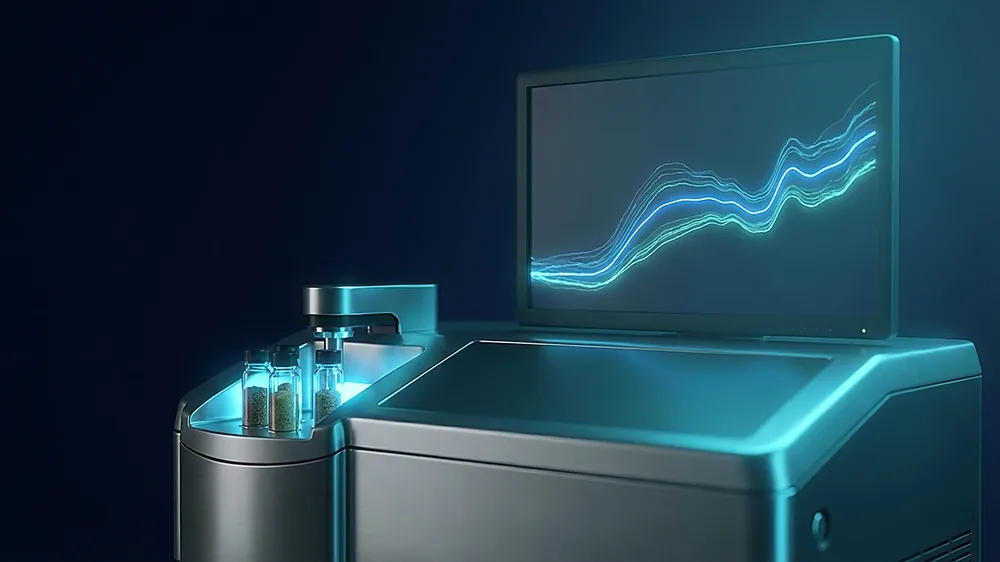
Routine monitoring is the practical answer. That means running a set of check samples — materials with known reference values — on a scheduled basis. Weekly checks are common in high-throughput grain and feed operations. Monthly checks may be sufficient for lower-volume applications. When bias starts creeping in, slope and bias correction can bring the model back into line without a full rebuild.
Full calibration updates — adding new samples and retraining the model — are needed when your product range changes materially. If your facility starts sourcing from a new region or processing a new variety, the calibration set should be expanded to cover it. When a new harvest season introduces composition profiles not seen in the original training data, update samples should be collected, analyzed by reference methods, and incorporated into the model before new-crop material becomes routine. A practical rule of thumb used in many grain operations: collect 20 to 30 new-crop samples from the first two weeks of harvest, run reference analysis, and evaluate prediction residuals before committing to the new season's volume.
Practical benchmark: In grain and oilseed applications, a well-maintained protein calibration typically achieves RMSEP values between 0.15% and 0.35% on a dry matter basis — performance close to the repeatability of the Dumas reference method itself. Moisture calibrations in cereal grains typically achieve RMSEP values between 0.10% and 0.25% when sample preparation is well controlled.
Documentation and Change Control for Calibration Models
Every calibration model in production use should have a documented record: the samples used to build it, the reference methods and laboratory that produced the reference values, the preprocessing and algorithm settings, and the validation statistics at the time of deployment. Without this record, diagnosing future problems becomes much harder — and showing compliance to your auditors or customers becomes impossible.

Change control applies to calibrations just as it does to other quality processes. When a model is updated, log the update with a version number, the reason for the change, and the validation results that confirmed the updated model was fit for use before it went into production. In feed mill environments where NIR is used for regulatory compliance, this documentation isn't optional — it's part of the audit trail. A structured approach to managing calibration records in regulated settings is discussed in NIR Spectroscopy in Dairy, Feed Mills, and Regulatory Compliance.
When Calibration Problems Show Up in Production
Calibration problems rarely announce themselves clearly. More often they appear as unexplained variability in product specs, increased rejection rates at receiving, or customer complaints that don't match your internal QC data. Catching these patterns early — before they cause real operational impact — requires consistent monitoring and a clear diagnostic process.

Common failure modes include model drift from raw material changes, instrument drift from detector aging or lamp degradation, and calibration range violations when products fall outside the composition range covered by the training data. Each has a different diagnostic signature and a different corrective path. The approach to distinguishing between them step by step is covered in Diagnosing NIR Calibration Problems: A step-by-step Approach.
One particularly common mistake is assuming a calibration problem is an instrument problem — or vice versa. Running a set of certified reference standards can quickly rule out instrument drift as the cause. If the instrument performs correctly on standards but predictions on production samples are biased, the calibration is the issue. If standards also show error, the instrument needs service before any calibration work begins.
A second common mistake is applying a global or vendor-supplied calibration to a matrix it wasn't built for. A vendor calibration for corn protein, for example, performs adequately on samples from the same growing region the vendor used — and poorly on samples from a different region with different soil chemistry and varietal mix. Global calibrations are a starting point, not a permanent solution. Always validate them against locally sourced samples with local reference analysis before using them for production decisions.
Calibration Transfer Between Instruments
Facilities running multiple NIR instruments — at different receiving locations, or replacing an aging unit — face the added challenge of calibration transfer. No two instruments, even from the same manufacturer and model line, produce perfectly identical spectra. Optical tolerances, detector aging, and light source variations all introduce instrument-to-instrument differences.
Calibration transfer approaches range from mathematical standardization algorithms to full recalibration on the new instrument using a subset of transfer samples. The choice depends on how similar the instruments are, how critical the application is, and what validation documentation is required. For regulated applications — particularly where NIR is used to meet labeling or feed mill compliance requirements — full validation on each instrument is typically required regardless of transfer method.
A practical intermediate approach used in multi-site grain operations is to maintain a set of 15 to 25 transfer samples — materials with stable composition and well-characterized reference values — that can be run on any instrument in the network. Comparing predictions across instruments on those samples gives you a quantitative measure of how well the calibration transferred and flags any instrument that needs attention before it's used for production decisions.
SpectroScience students gain access to the Calibration Validation Tracker — track RMSECV, RMSEP, bias, and slope correction across calibration updates and instrument transfers. Available as a free download in the student resource library.
Access the Excel libraryFree tool — Calibration Metrics Calculator: Enter your reference values and NIR predictions in the Calibration Metrics Calculator to compute RMSEP, RPD, R², and bias the way our course teaches it — with interpretation thresholds for grain, dairy, and feed. Open the Metrics Calculator →
Free tool — Model Diagnostics Calculator: Drop your spectra and predictions into the Model Diagnostics Calculator to flag outliers via Mahalanobis distance, use, and Q-residuals — the same diagnostics we walk through in Lesson 25. Open the Diagnostics Calculator →
SpectroScience students get access to the Calibration Validation Tracker — track RMSECV, RMSEP, bias, and slope correction across calibration updates and instrument transfers. Available as a free download in the student resource library.
Access the Excel libraryNIR Fundamentals Course — Lesson 23: Introduction to Calibration
This lesson provides an in-depth look at the calibration process for NIR spectroscopy, detailing how to develop and maintain accurate models. It emphasizes the importance of continuous calibration adjustments to ensure reliable predictions as conditions change in production environments.
Explore Lesson 23 in the NIR Fundamentals courseWant to Master NIR Spectroscopy?
Our 32-lesson online course covers everything from Beer-Lambert Law to PLS calibration — built for food, grain, feed, and dairy professionals.