How Beer-Lambert Law Determines When Your NIR Results Are Reliable — and When They're Not
Learn how the Beer-Lambert Law works in NIR spectroscopy, what A=εbc means in practice, and where it breaks down in food and feed analysis.
· 6 min read · Vitaly Kirkpatrick
A result your instrument delivers in 12 seconds can cost you an entire batch if the math behind it is breaking down. The Beer-Lambert Law is that math — and knowing where it fails is the difference between a QA manager who catches calibration problems early and one who ships bad product waiting for the reference lab to flag it. For grain handlers, feed mill managers, and oilseed processors, this is practical knowledge, not theory.
How the Beer-Lambert Law Works in NIR Spectroscopy
Spectroscopic analysis measures how much light a sample absorbs at specific wavelengths. The Beer-Lambert Law is the mathematical principle connecting those absorption measurements to real concentrations — protein, moisture, fat, starch. Understanding what the law says, where it holds, and where it breaks down determines whether your calibration can be trusted across the full range of production conditions.
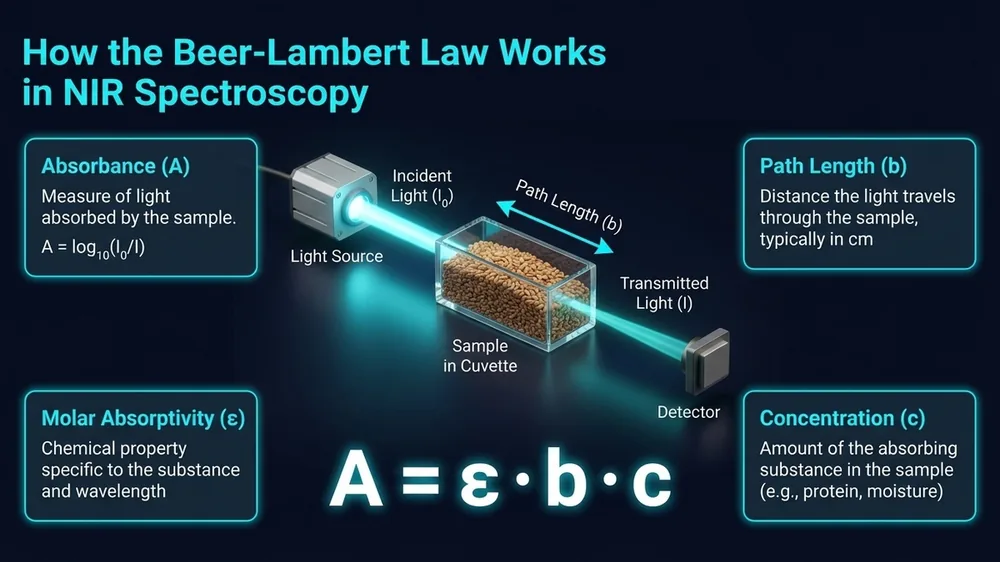
This principle has been the foundation of quantitative spectroscopic analysis in animal feed milling, dairy processing, meat and poultry plants, and oilseed crushing operations for decades. It explains why calibration behaves as it does — and why it sometimes falls short. A working understanding helps QA managers diagnose calibration drift, interpret residuals, and make better decisions about when to rebuild versus retrain a model. For a broader overview of what NIR measures and where it has known limits, see NIR Spectroscopy in Food and Feed: What It Measures and Where It Fails.
What the Beer-Lambert Law Actually Says
More substance in a sample means more light absorbed at the wavelengths that substance responds to. Greater path length through the sample means more absorption. That's the whole idea — and the simplicity is what makes it powerful.
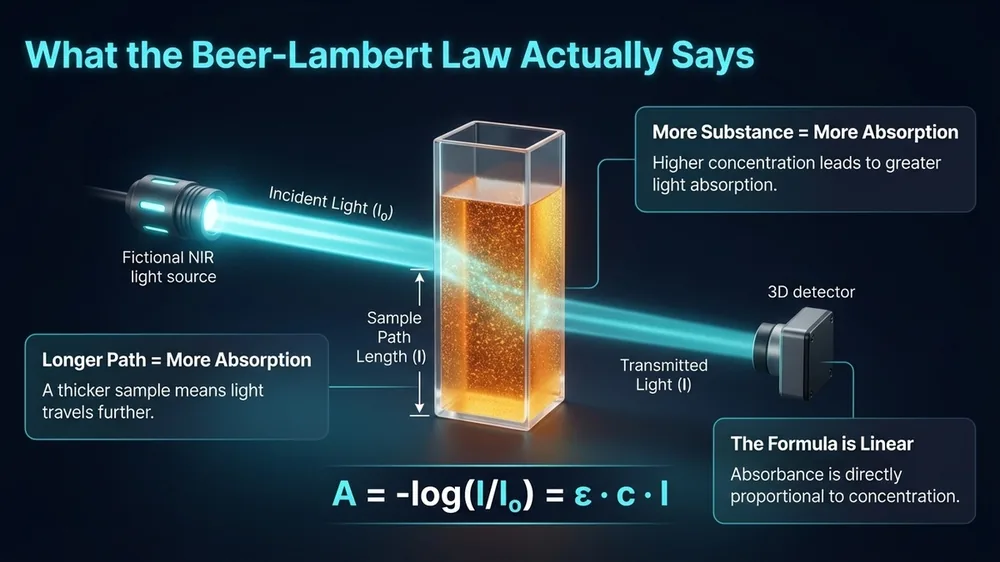
In NIR analysis, near-infrared radiation covers roughly 780 to 2500 nanometers. When NIR light hits a sample, molecules like water, protein, and fat absorb energy at predictable wavelengths. Water absorbs strongly near 1450 nm and 1940 nm. Protein responds around 2050 nm and 2170 nm. Fat shows characteristic bands near 1725 nm. The Beer-Lambert Law provides the math to convert those absorption readings into concentration values that can be acted on.
Think of it like a toll booth counter on a highway: the more vehicles passing through, the higher the count. The law works the same way — more absorbing molecules in the light path means a higher absorbance reading, and that reading maps back to a concentration number your team can act on at intake or during production.
This relationship is what makes spectroscopic analysis a quantitative tool rather than just a qualitative one. Without it, the instrument detects spectral differences but can't reliably convert them into numbers like 12.4% moisture or 34.1% crude protein. That conversion from spectral signal to reportable result depends entirely on the linear relationship between absorbance and concentration holding across your measurement range.
Breaking Down A = εbc
The equation is A = εbc. Each term has a specific meaning — and once they're understood, calibration behavior stops feeling like a black box.
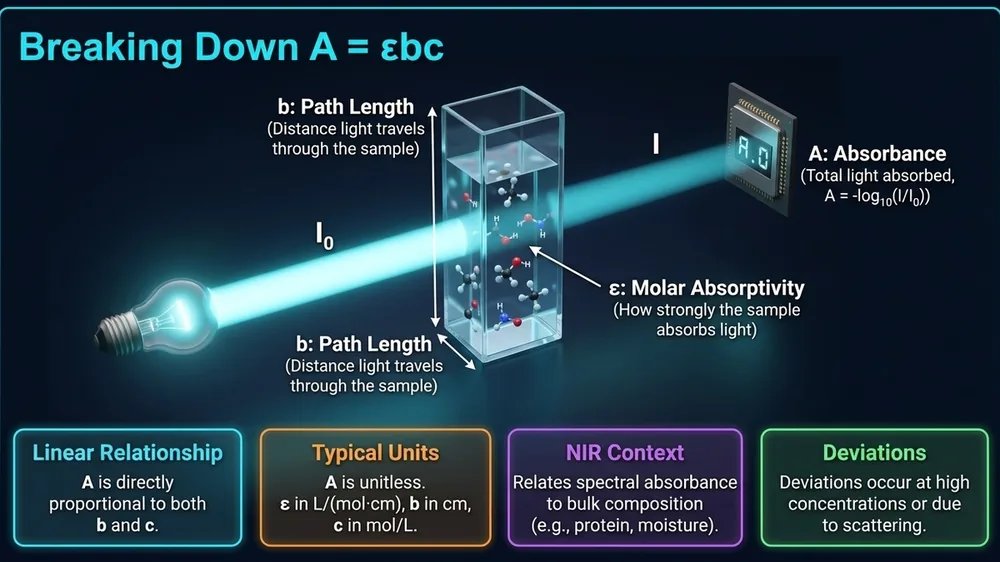
- A (Absorbance): What the instrument measures. It's a dimensionless ratio — how much light went in versus how much came out. Expressed as the negative log of transmittance: A = -log(T).
- ε (Molar Absorptivity): A constant for a specific substance at a specific wavelength. Every compound has its own spectral fingerprint. This is what makes analysis selective between, say, protein and starch even when both are present in the same grain sample.
- b (Path Length): The distance light travels through the sample, usually measured in centimeters. Longer path means more molecular interactions and higher absorbance readings. In reflectance mode instruments common in grain and feed, effective path length depends on particle size and how light penetrates the sample surface.
- c (Concentration): The amount of the absorbing substance in the sample. This is what every prediction solves for.
If ε and b are known, c can be calculated directly from measured absorbance. That's the foundation of quantitative NIR analysis. In practice, ε is determined during calibration using reference samples with known concentrations — typically 50 to 100 samples minimum for a robust food or feed calibration, with 150 or more preferred for ingredients with high natural variability like distillers grains or co-products.
The Beer-Lambert law provides a direct, linear link between what the instrument measures (absorbance) and what needs to be known (concentration). Every calibration model built in NIR spectroscopy rests on this relationship — and every deviation from linearity in your calibration can usually be traced back to a condition where the law breaks down.
Where Beer-Lambert Breaks Down
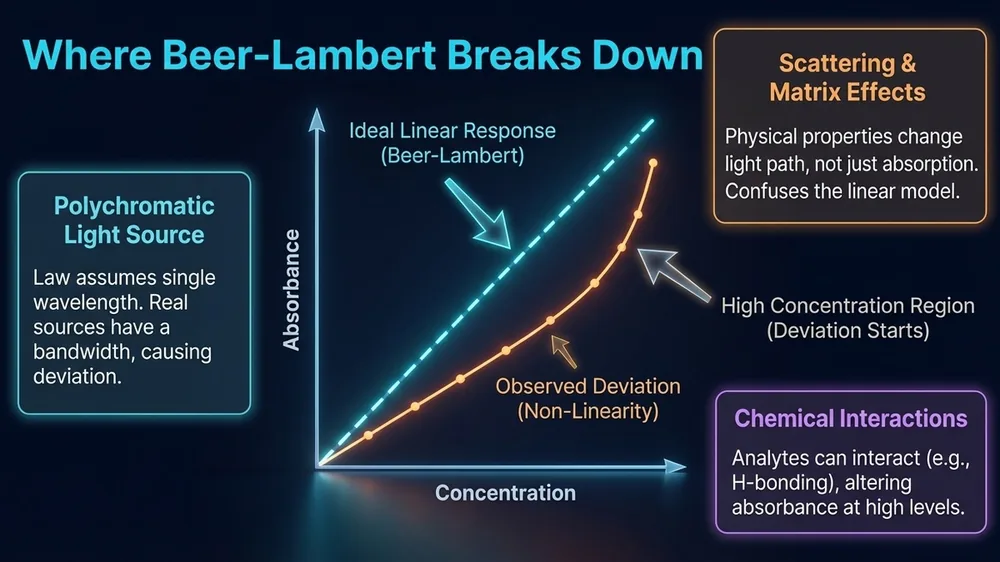
Push outside the conditions where the law holds and calibration degrades: non-linearity appears, prediction errors rise, and results stop matching reference lab findings. Identifying which breakdown mechanism is at work determines the correct response — and the wrong diagnosis leads to the wrong fix.
Polychromatic Light
Beer-Lambert assumes a single, pure wavelength. Real instruments use a narrow bandwidth — not a perfect monochromatic point. For most food and feed applications this isn't a major issue, but it introduces small cumulative error, especially with broad, overlapping absorption bands. Filter-based instruments that isolate only 6 to 19 wavelengths are more susceptible to this than FT-NIR or full-range dispersive instruments, which use hundreds of data points across the spectrum to compensate through multivariate modeling.
High Concentrations
At high concentrations, molecules start interacting with each other rather than behaving independently. That changes how they absorb light, and the absorbance-concentration relationship turns non-linear. At a feed mill running fish meal at 12% fat and above — alongside full-fat soybeans and high-fat distillers grains — this appeared as curved residuals in calibration that no amount of retraining fixed. The reference sample set lacked coverage at the upper fat range. Adding samples at the center of the distribution didn't help. The fix was specifically targeting reference samples that pushed into the high-concentration region where the non-linearity emerged.
Quality managers often ask me why their fat predictions look fine on the calibration report but drift high on certain incoming loads. Nine times out of ten, the reference sample set didn't cover the upper end of the concentration range your actual production ingredients reach. That's a sampling problem, not an instrument problem — and it's worth auditing your calibration set before you start swapping wavelengths or adjusting slopes.
Complex Sample Matrices
The law assumes the absorbing substance behaves independently — no chemical or physical interaction with other components. In real food and feed samples, that's never a clean situation. Moisture interacts with protein binding sites. Fat distribution and droplet size affect scatter. Particle size in ground grain shifts the effective path length. The matrix shapes the spectra in ways simple Beer-Lambert math can't account for alone.
This is precisely why multivariate calibration — not single-wavelength Beer-Lambert calculations — is what actually works in practice. Techniques like partial least squares (PLS) regression account for these interactions directly, modeling the full spectral pattern rather than relying on a single absorption band. For a deeper look at why these statistical methods are needed, Why NIR Spectroscopy Needs Chemometrics: PLS, PCR, and Key Techniques Explained covers PLS, principal component regression, and how each handles matrix complexity.
Instrument Factors
Stray light, detector nonlinearity, and poor wavelength resolution all cause deviations from Beer-Lambert behavior. Stray light — radiation reaching the detector at wavelengths other than those intended — artificially compresses absorbance readings at high absorption regions, exactly where non-linearity is most problematic. At a dairy processing plant, an instrument that hadn't completed a wavelength calibration check in over a year showed a consistent moisture bias in cheese powder of approximately 0.4 percentage points. The team chased it as a calibration drift problem for weeks. Instrument diagnostics eventually identified the root cause: a wavelength registration shift of less than 2 nm — enough to misalign the water absorption band and compress the absorbance reading. Regular instrument maintenance, reference scans, and standardization checks catch this before it becomes a product quality event.
How These Breakdowns Show Up in Practice
None of these failure modes appear as obvious errors on a display. They show up as patterns in calibration residuals, as bias that shifts with ingredient type, or as SEC values that look acceptable but SECV values that are meaningfully worse. Catching these patterns before a calibration goes into production saves real rework downstream. A curved residual plot — where residuals go positive at high concentrations and negative at low ones, or the reverse — is the clearest visual signal of a Beer-Lambert violation. Random scatter in residuals is expected; structure in residuals points to a problem with the mathematical assumptions behind the model.
When I work with clients reviewing calibration performance, the first thing I ask to see isn't the R² value — it's the residual plot. Your R² can look fine at 0.98 while a curved residual pattern quietly signals that the model is overestimating at one end of the range and underestimating at the other. That's the kind of bias that gets your lab into trouble on a high-fat incoming load or a low-moisture finished product check.
For teams working through calibration performance problems step by step, Diagnosing NIR Calibration Problems: A step-by-step Approach provides a approach for identifying root causes before they affect your product quality or your audit results.
Free tool — Calibration Metrics Calculator: Enter your reference values and NIR predictions in the Calibration Metrics Calculator to compute RMSEP, RPD, R², and bias the way our course teaches it — with interpretation thresholds for grain, dairy, and feed. Open the Metrics Calculator →
Free tool — Beer-Lambert Calculator: The Beer-Lambert Calculator works the absorbance = ε·b·c relationship in both directions — useful when sizing path length for a new sample type or sanity-checking a calibration curve. Open the Beer-Lambert Calculator →
SpectroScience students get access to the NIR Glossary — definitions for 80+ NIR and chemometrics terms used in calibration, validation, and spectral analysis. Available as a free download in the student resource library.
Access the PDF libraryNIR Fundamentals Course — Lesson 23: Introduction to Calibration
This lesson covers the fundamentals of calibration in NIR spectroscopy, emphasizing the importance of establishing reliable models based on the Beer-Lambert Law. It explains how to create and validate these calibrations to ensure accurate results, which is crucial for maintaining quality control in food and feed analysis.
Explore Lesson 23 in the NIR Fundamentals courseWant to Master NIR Spectroscopy?
Our 32-lesson online course covers everything from Beer-Lambert Law to PLS calibration — built for food, grain, feed, and dairy professionals.