NIR Instrument Design: Light Sources, Wavelength Selection, and Core Components
Master NIR instrument design with a practical breakdown of light sources, wavelength selectors, detectors, and how each component affects accuracy in food and…
· 6 min read · Vitaly Kirkpatrick
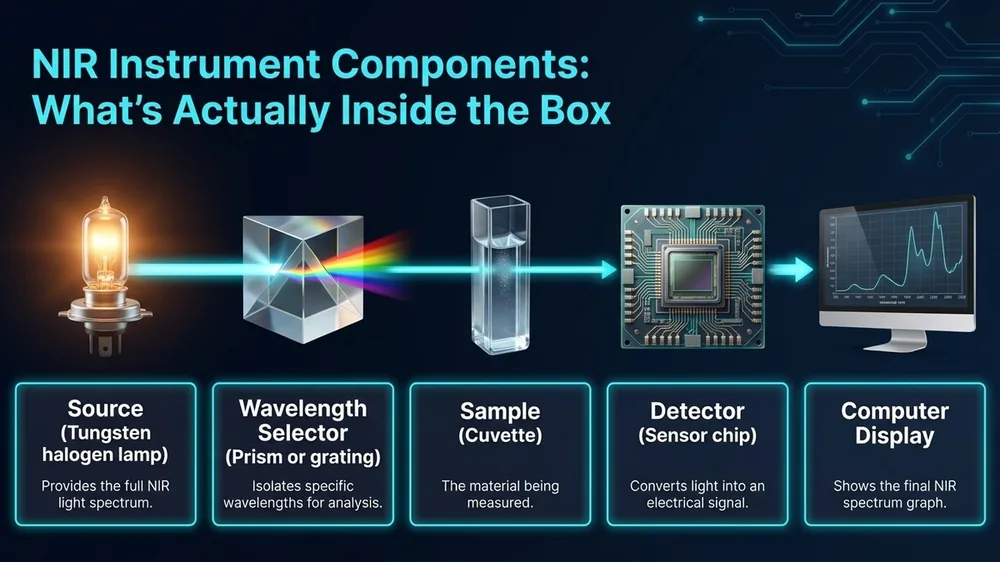
NIR Instrument Design: What's Actually Inside the Box
Here's the thing — when an NIR analyzer throws an unexpected result at a grain elevator, most people's first instinct is to blame the sample or the calibration. I've watched quality managers spend half a day chasing a ghost problem when a dirty reflectance window was the whole story. Understanding NIR instrument design — what's physically inside that box and what each part does — is what separates a five-minute fix from a half-day of expensive confusion. This article walks through each core component: light source, wavelength selector, sample interface, detector, and signal processor. For a broader look at how these components connect to the physics of near-infrared light, see our overview of how NIR spectroscopy works: physics, chemometrics, and instrument design.
The Five Core NIR Instrument Components
Every NIR spectrometer shares five needed parts: the light source, wavelength selector, sample interface, detector, and signal processor. Think of it like a relay race — each component hands off to the next, and if any one runner stumbles, the whole team loses time. If any part fails or degrades, the whole measurement suffers. A detailed component-by-component breakdown is also available in our article on how NIR instruments work: key components and what they do.
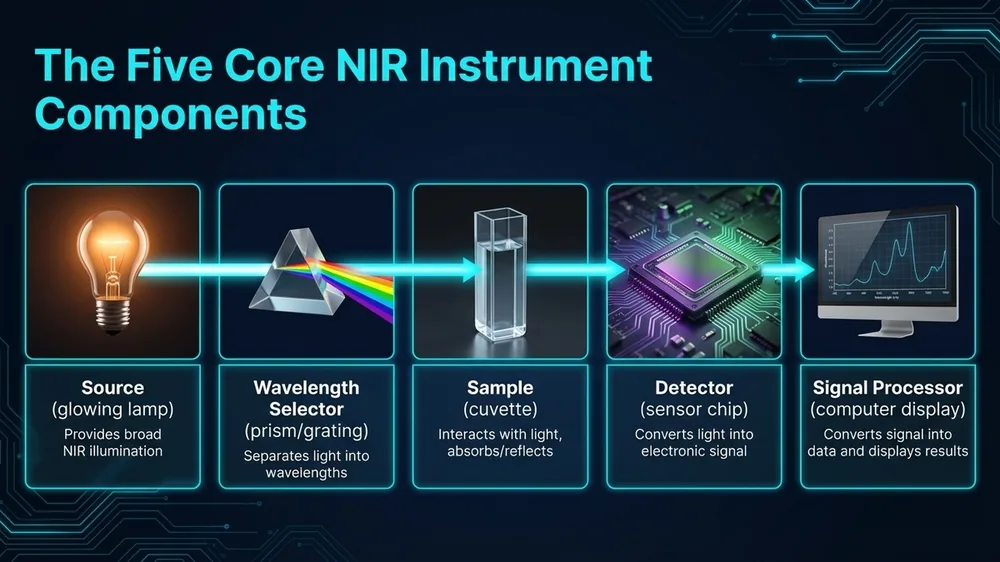
NIR instrument components form a chain — light source, wavelength selector, sample interface, detector, and signal processor. A weakness anywhere in that chain degrades the final result. Effective troubleshooting means thinking about the whole system, not just the last step.
The light source emits near-infrared radiation that interacts with the sample. In grain moisture testing, water absorbs strongly around 1450 nm and 1940 nm. The wavelength selector isolates those specific regions from the full light output.
The sample interface — a reflectance window or transmission cell — ensures consistent contact between light and sample. The detector converts photons into an electrical signal. The signal processor then cleans that signal, correcting for noise and baseline shifts.
In high-throughput grain receiving operations, where dozens of trucks move through in a single shift, a contaminated interface can silently skew results across an entire day's intake before anyone notices a pattern. That's not a calibration problem. That's a hardware problem — and your lab pays for it in credibility with the production team.
Watch out: A contaminated or scratched reflectance window produces a signal drop that looks exactly like real compositional variation. Before investigating the sample, check and clean the interface first.
Light Sources: How NIR Instrument Design Generates Its Signal
Two light sources dominate NIR instruments: tungsten halogen lamps and LEDs. Each serves a different purpose, and the choice has a direct impact on instrument capability and your maintenance schedule.
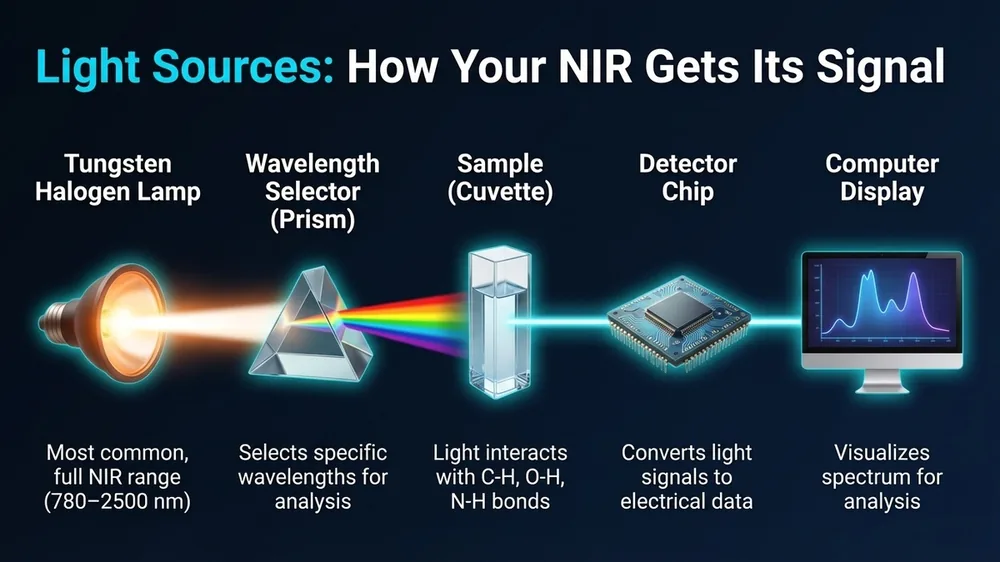
Tungsten halogen lamps cover the full NIR range — roughly 780 to 2500 nm. They deliver broad, intense output, making them the standard in feed and grain labs where detailed spectral analysis matters. Expect 2,000 to 5,000 hours of service life before intensity drops enough to affect accuracy. These lamps also need a warm-up period — typically 15 to 30 minutes — to stabilize output before measurements begin. Skipping that warm-up is one of the most common sources of drift I see during plant visits. It shows up as unexplained result scatter in the first samples of the day, and it's completely avoidable.
LEDs last far longer — often 50,000 or more hours — and reach full output instantly. That makes them practical for portable instruments used in the field, such as checking forage quality at harvest or screening incoming oilseed loads at the scale. The trade-off is narrow spectral coverage. LEDs emit at specific wavelengths rather than across a continuous spectrum, so they suit targeted measurements rather than broad compositional scans.
For a stationary lab analyzing multiple parameters across a wide spectral range, a tungsten halogen lamp provides the flexibility your calibration needs. For field use where quick, targeted readings matter most, LEDs hold up better under real-world conditions. A feed mill running protein, fat, moisture, and fiber on twenty or more ingredient types per day almost always relies on a tungsten halogen system for the spectral breadth those simultaneous predictions require.
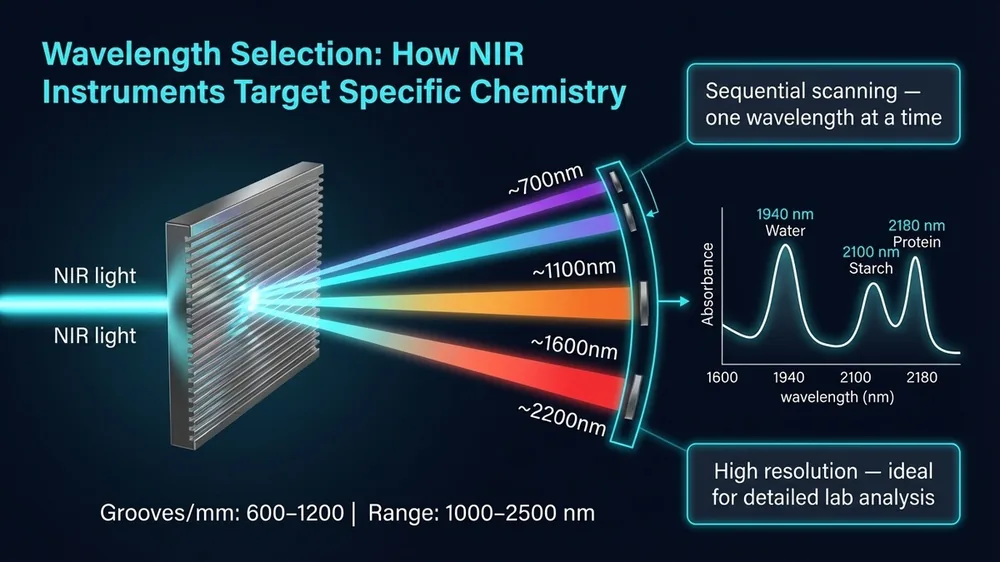
Wavelength Selection: How NIR Instruments Target Specific Chemistry
The wavelength selector isolates the parts of the NIR spectrum that carry the chemical information needed for a given measurement. There are three main approaches used in commercial NIR instrument design today.
Dispersive Gratings
A diffraction grating separates light into a spectrum, and the detector scans across that spectrum at high resolution. This approach works well for detailed analyses — distinguishing protein fractions in a feed ingredient application, for example. It's the method found in most full-range lab instruments and supports broad NIR calibration development across many parameters. Dispersive grating instruments can typically resolve spectral features separated by as little as 1 to 2 nm, which matters when overlapping absorption bands from protein and moisture need to be separated mathematically.
Interference Filters
Filters pass only specific wavelengths. Fixed filters are simple and reliable — well suited for routine grain moisture checks at a few key wavelengths. A filter-based moisture meter at a grain elevator can run thousands of samples per week with minimal operator intervention because the measurement task is narrow and well defined. Acousto-optic tunable filters (AOTFs) can switch wavelengths electronically, providing more flexibility without introducing moving parts that can wear or misalign over time.
Fourier-Transform (FT) Techniques
FT-NIR instruments collect all wavelengths simultaneously using an interferometer. Software converts the resulting interference pattern into full spectral data. These systems deliver excellent signal quality and wavelength accuracy — often to within 0.01 nm — making them the instrument of choice when calibration transfer between labs or instruments is a priority. They cost more, need controlled environments, and are sensitive to vibration, which makes them less practical outside a dedicated lab setting. For a side-by-side comparison of all three technology types, see our article on NIR technology types: FT-NIR, dispersive, and filter-based compared.
For field moisture checks, a filter-based instrument usually does the job well. For detailed compositional work in a controlled lab, a dispersive grating system provides the resolution and spectral range required. Getting this match right before you buy saves a lot of painful conversations after the instrument arrives on your floor.
Detectors and Signal Processors: Completing the Measurement Chain
The detector is where photons become data. In NIR instruments, the two most common detector materials are silicon (Si) and indium gallium arsenide (InGaAs). Silicon detectors cover the short-wave NIR region — roughly 780 to 1100 nm — and are cost-effective for applications concentrated in that range, including some moisture and sugar measurements. InGaAs detectors extend coverage to 1700 nm or beyond, capturing the key absorption bands for protein, fat, and moisture that feed and grain analysis depends on. Extended InGaAs detectors push coverage to 2500 nm, though at a a lot higher cost.
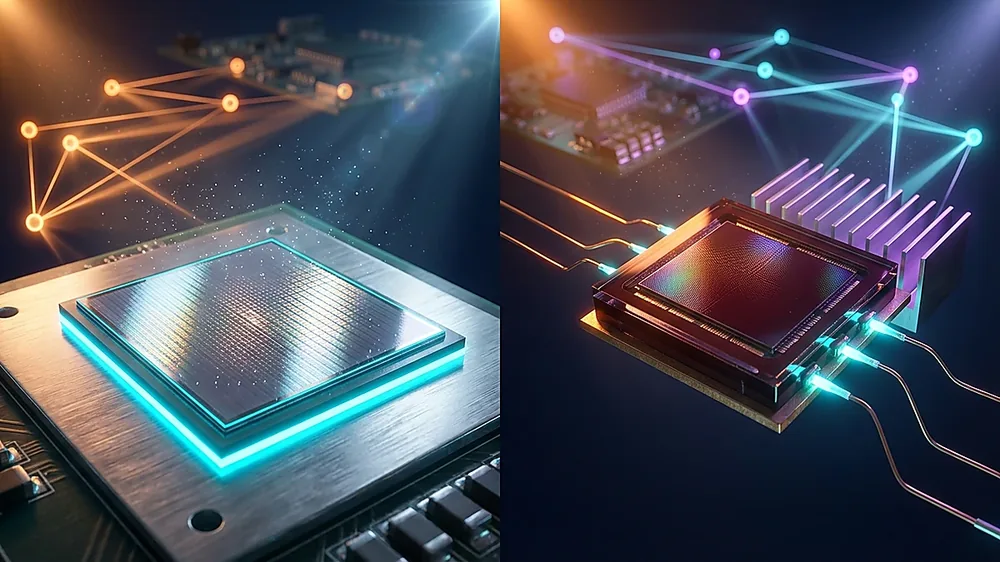
Signal-to-noise ratio (SNR) is the key detector performance metric. A higher SNR means the instrument can detect smaller differences in absorption — which translates directly to tighter prediction limits in your calibration. A detector with poor SNR forces calibration developers to average more scans per sample to achieve acceptable precision, slowing throughput in high-volume labs. That's a real operational cost, not just a spec-sheet concern.
The signal processor applies mathematical corrections — baseline adjustments, scatter corrections, and noise filtering — before the spectrum reaches the chemometric model. In modern instruments, this processing happens in milliseconds. But the processor settings interact with your calibration. An instrument transferred from one facility to another may need recalibration if the signal processing parameters differ, even when both instruments are nominally the same model. I've seen that catch people off guard more than once during instrument moves between plant locations.
How NIR Instrument Design Affects Measurement Accuracy
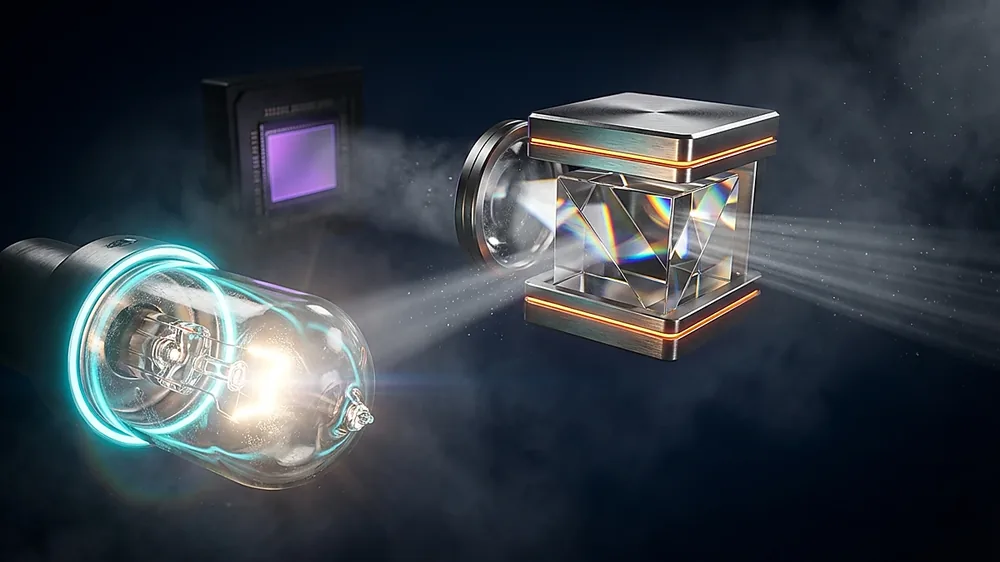
Every hardware choice in NIR instrument design carries a direct consequence for measurement accuracy. The light source determines spectral range and stability over time. The wavelength selector controls resolution and the ability to distinguish closely overlapping chemical signals. The detector governs sensitivity and the signal-to-noise ratio that in the end limits precision.
In practical terms, a lab running a full feed formulation panel — protein, fat, moisture, fiber, and starch — needs a different instrument configuration than a mill running a single moisture check on incoming grain. Matching instrument design to application requirements avoids both under-investment and over-specification. A common mistake I see: someone purchases a portable filter-based instrument for a lab that eventually needs full-spectrum calibrations, then discovers the instrument can't support the required parameter set after the purchase is complete. That's an expensive lesson.
When instrument components are well matched to the measurement task, calibration development is easier, drift is more predictable, and troubleshooting is faster. Instrument qualification checks — verifying lamp intensity, wavelength accuracy, and detector linearity on a scheduled basis — are the operational habits that keep hardware performance from quietly eroding your result quality between service visits. Don't wait for a customer complaint to find out your lamp has been fading for three months.
NIR instrument design is not one-size-fits-all. Light source type, wavelength selection method, and detector technology all interact with the specific chemistry being measured. Aligning those hardware choices with the application is the foundation of reliable NIR results.
Free tool — As-Is ↔ Dry Matter Converter: Use the As-Is ↔ Dry Matter Converter to translate any analyte value between as-received and moisture-free basis without doing the algebra by hand. Open the Converter →
Free tool — NIR Glossary: Unfamiliar with a term? The SpectroScience NIR Glossary defines every chemometrics, calibration, and instrument term used in this article in plain language with worked examples. Open the Glossary →
SpectroScience students get access to the NIR Troubleshooting Guide — systematic approach to diagnosing poor predictions, instrument drift, and calibration failures. Available as a free download in the student resource library.
Access the PDF libraryNIR Fundamentals Course — Lesson 17: Inside the NIR Instrument
This lesson provides an in-depth look at the core components of NIR instruments, detailing how each part functions and interacts within the system. Understanding these components is crucial for troubleshooting and ensuring accurate measurements in grain and feed analysis.
Explore Lesson 17 in the NIR Fundamentals courseWant to Master NIR Spectroscopy?
Our 32-lesson online course covers everything from Beer-Lambert Law to PLS calibration — built for food, grain, feed, and dairy professionals.