Advanced NIR Data Analysis: Methods Beyond Basic Chemometrics
Learn which NIR chemometrics method fits your application — PLS, PCR, SVM, or ANN — with real benchmarks for food, feed, and grain labs.
· 12 min read · Vitaly Kirkpatrick

Advanced NIR Chemometrics: When Standard Methods Aren't Enough
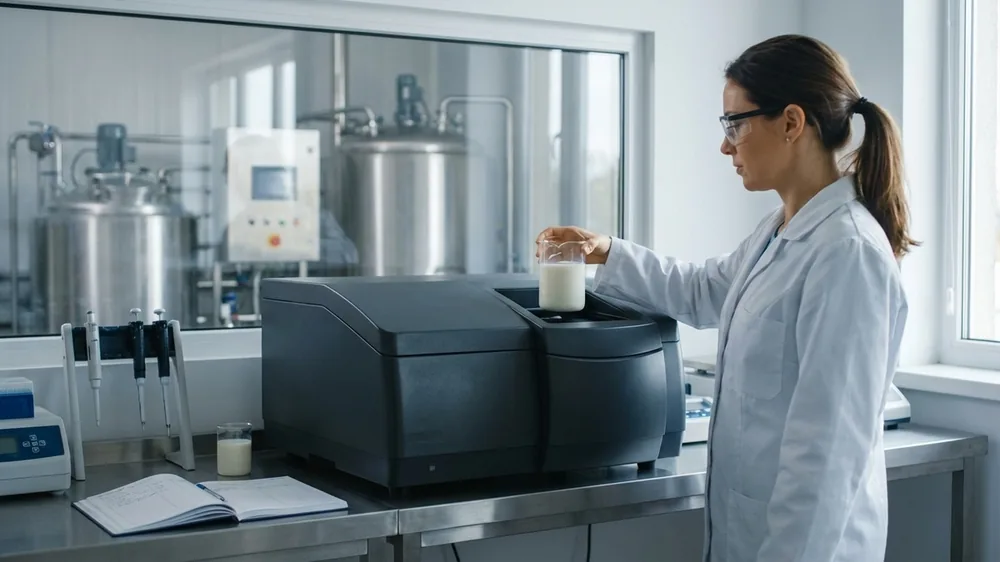
NIR chemometrics is the engine behind every reliable prediction your instrument makes — but the method you choose matters as much as the calibration itself. Quality managers often ask why their NIR program keeps needing firefighting even after a solid calibration build. Nine times out of ten, the answer is the same: the method doesn't match the complexity of the matrix. Standard PLS handles moisture in grain, protein in soy, and fat in dairy well. It's built for exactly that. But when you're dealing with overlapping spectral features in a complex pet food blend — or trying to sync predictions across six instruments at different feed mill locations — the basic approach starts showing cracks. Knowing which tool fits which problem is what separates a reliable NIR program from one that consumes your lab team's time. For teams still getting grounded in the fundamentals, why NIR spectroscopy needs chemometrics and the key techniques explained is worth reading before going further here.
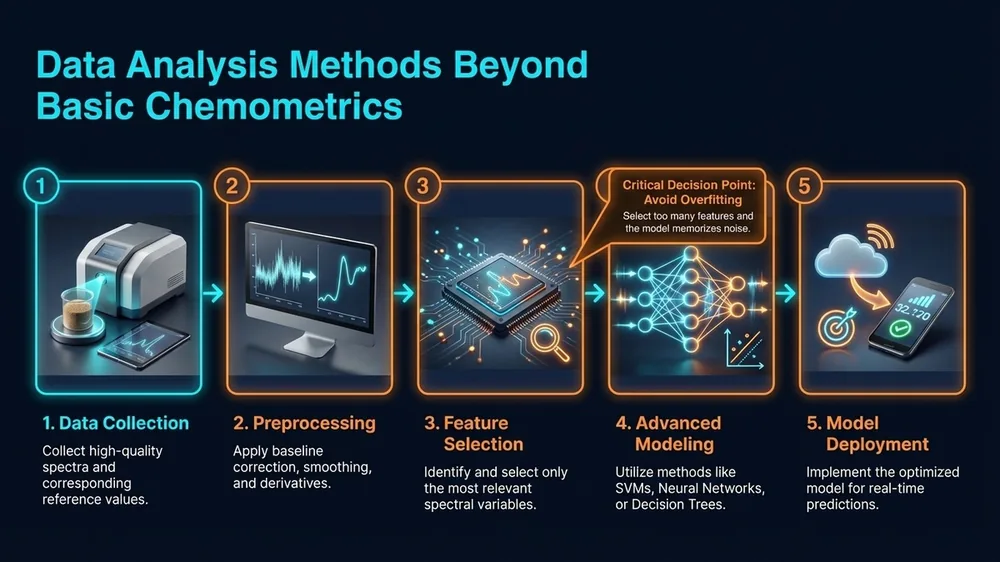
Data Analysis Methods Beyond Basic Chemometrics
PLS regression is the right place to start for most NIR quantitative work. It handles the core cases well. But when spectral data get complex, noisy, or non-linear, PLS alone can leave real information on the table. The methods below aren't meant to replace PLS. They're for situations where PLS hits a wall — and you need to know which door to open next.
PLS: More Capable Than You Might Think
Think of PLS like a technician who has learned to recognize a regular supplier's grain by smell, color, and feel — not just one cue in isolation. Modern PLS algorithms extract latent variables that maximize covariance between spectral data and the target property. That works even when wavelengths far outnumber samples. The simultaneous decomposition of spectra and reference values helps separate overlapping signals common in complex food blends and mixed ingredient streams.
PLS is the right starting point for most quantitative work in your lab. Its main limitation is the assumption of mostly linear relationships. When that breaks down — heterogeneous materials, wide moisture ranges, variable particle sizes — bias creeps into predictions at the edges of your calibration range.
A well-structured calibration set covering 80–100+ samples across the full range of expected variation will outperform a 500-sample set with poor diversity almost every time. More samples don't save a poorly designed set. For a deeper look at how model structure affects outcomes, building NIR calibration models and avoiding common chemometric mistakes covers the design decisions that matter most.
Principal Component Regression (PCR): Filtering Before Predicting
PCR takes a two-step approach. It first compresses spectral data into principal components — the main directions of variation. Then it builds regression against those components. That separation helps when instrument noise or environmental variability is masking the chemical signal you're after.
PCR works well when only a few underlying factors are driving spectral variation. Feed mill QC teams have found PCR models easier to interpret during troubleshooting. The principal components map more directly to physical or chemical sources of variation than PLS factors do. When a model behaves unexpectedly and you need to trace the source, PCR's structure often makes diagnosis faster.
Neural Networks: Handling Non-Linear Data
Some relationships in spectral data aren't linear. This is especially true with highly variable raw materials or complex product matrices. Artificial neural networks (ANNs) can model non-linear interactions that PLS won't capture. Deep learning architectures take this further by discovering hierarchical patterns across the spectrum automatically.
Convolutional neural networks (CNNs) are effective at picking up local spectral features. Recurrent neural networks (RNNs) work well for sequential data, like real-time process monitoring. The trade-off is data volume. You typically need thousands of samples — not hundreds — plus careful validation to avoid overfitting.
A grain cooperative running continuous receiving operations across a full season might accumulate the 3,000–5,000 scans needed for a credible ANN deployment. A small feed mill running 50 samples per month won't reach that threshold. Deploying a neural network on insufficient data produces a model that looks good in validation and falls apart in production.
Watch out: Neural networks require much larger training datasets than PLS — often 2,000–5,000+ samples for reliable performance. Deploying them with insufficient data produces models that appear solid in validation but fail once they hit real production conditions.
Support Vector Machines: Classification Problems
When the goal is classification — authentic vs. adulterated, on-spec vs. off-spec, variety A vs. variety B — support vector machines (SVMs) are worth considering. SVMs find the best boundary separating classes in high-dimensional spectral space. A built-in margin makes them less sensitive to outliers than other approaches.
Quality managers at oilseed processors have used SVMs successfully for species authentication and contaminant screening. They handle high-dimensional NIR data well and can model non-linear class boundaries through kernel functions.
For classification tasks with smaller training sets — 200–2,000 samples — SVMs often outperform neural networks. They're less likely to overfit when data is limited. An SVM built with 400 verified canola and sunflower spectra has proven more operationally reliable than a neural network trained on the same dataset in several documented oilseed authentication programs.
PLS is the right starting point for most quantitative NIR work. Use SVMs when classifying samples. Reach for neural networks only when large datasets and confirmed non-linearity are both present. Don't add complexity until you know you need it.
Spectral Preprocessing: The Step That Determines Whether Any Method Works
No amount of advanced modeling recovers lost information from poorly preprocessed spectra. Before you pick a chemometric method, your preprocessing pipeline deserves equal attention. The most common approaches used in food and feed NIR data analysis include:

- Standard Normal Variate (SNV) — corrects for scatter effects caused by particle size differences. Needed for ground grain, meal, and flour applications where particle size varies between samples.
- Multiplicative Scatter Correction (MSC) — similar goal to SNV, but corrects relative to a reference spectrum rather than each individual scan. Works well when a stable reference material is available.
- Savitzky-Golay derivatives (1st and 2nd) — resolve overlapping absorption peaks and remove baseline offsets. First derivatives are used more commonly. Second derivatives increase sensitivity to peak position but also amplify noise.
- Mean centering and variance scaling — ensures no single wavelength region dominates the model purely because of intensity differences rather than chemical relevance.
A common mistake in feed mill QC programs is applying the same preprocessing routine to every matrix regardless of its physical characteristics. A model built for whole soybeans needs different preprocessing than one built for soy meal. Getting this step right often improves prediction accuracy more than switching from PLS to a more complex algorithm.
Your preprocessing choices are not a formality. They shape everything downstream. For a closer look at how physical sample properties interact with spectral quality, NIR sample preparation and why it determines results explains the connection between sample handling and model reliability.
Calibration Maintenance: Keeping Models Accurate Over Time
Building a good model is only half the job. Raw material sources shift. Seasonal moisture swings alter spectral baselines. Instruments age. If your NIR data analysis workflow doesn't include a maintenance plan, drift will appear before you notice — and by then, off-spec product may already be out the door.
Here are the strategies we recommend for teams running multi-site operations:
- Run regular bias checks — compare NIR predictions against wet chemistry reference values at least monthly. A consistent bias of more than 0.2–0.3 times the target SEP is a signal to act.
- Log outlier flags — most NIR software flags samples that fall outside the calibration space. Tracking those flags over time can reveal shifts in input materials before they cause downstream quality problems.
- Update with new samples strategically — not every flagged sample should go into the calibration set. Prioritize samples that fill genuine gaps in the existing sample space. Quality over quantity.
- Audit reference method consistency — if bias appears suddenly after a period of stable performance, check whether the reference lab changed analysts, reagents, or equipment before assuming your NIR model is at fault.
This scenario is common in the field: a grain processor updating their moisture model every quarter but still seeing seasonal bias. The issue wasn't the model. It was that their reference lab method had a temperature sensitivity that hadn't been accounted for. NIR data analysis problems aren't always NIR problems. Sometimes the reference data is the weak link.
Teams that want a structured approach to working through these issues will find NIR calibration validation pitfalls and keeping performance reliable over time directly applicable to ongoing maintenance decisions.
Transferring Calibrations Across Instruments and Sites
Multi-site operations face a specific challenge. A calibration built on one instrument may not perform well on another — even if both are the same model from the same manufacturer. Small differences in detector response, lamp aging, and optical alignment accumulate into meaningful spectral offsets. This is calibration transfer, and it's one of the more technically demanding areas of NIR chemometrics.
The main approaches used in the food and feed industry include:
- Direct standardization — measures a set of transfer standards on both instruments and applies a mathematical correction that maps one instrument's responses onto the other. Effective when instruments are well-maintained and the transfer standard set covers the relevant spectral range.
- Piecewise direct standardization (PDS) — applies the correction wavelength-by-wavelength rather than globally. More computationally intensive, but better suited to instruments with localized differences in spectral response.
- Slope and bias correction — simpler than full standardization. Compares NIR predictions against reference values on the target instrument and applies a linear correction. Works well for small inter-instrument offsets but isn't sufficient when differences are larger or spectrally complex.
A dairy cooperative running the same fat and protein models across eight processing sites found that direct standardization with 20 transfer samples reduced inter-site prediction bias from 0.18% to below 0.05% for milk fat. That brought all sites into alignment without rebuilding individual models for each location. It's a meaningful result with a relatively small investment in transfer samples.
For inline dairy monitoring applications where consistency across instruments matters especially, NIR in dairy processing and real-time inline monitoring explains why instrument harmonization is fundamental to program reliability.
Choosing the Right NIR Chemometrics Method for Your Application
The right NIR chemometrics method depends on three things: data volume, the linearity of the relationship, and whether you're predicting a value or assigning a category. Don't let tool complexity drive the decision. Let your data and your problem drive it.
Here's a practical starting framework:
- PLS — fewer than 500 samples, mostly linear response, quantitative prediction. Start here in almost every case.
- PCR — similar conditions to PLS, but you have noisy instruments or want cleaner interpretation of spectral factors.
- SVM — classification tasks, moderate dataset size (200–2,000 samples), non-linear class boundaries.
- ANN / Deep learning — large datasets (2,000+ samples), confirmed non-linearity, with the computational resources and validation expertise to do it properly.
Operations that spend months building neural network models — when a well-tuned PLS with proper preprocessing would have done the job in a week — are a common sight in the field. Advanced doesn't always mean better. And it definitely doesn't mean faster. Match the method to the problem, not to what sounds impressive in a report.
The facilities that get the most from their NIR investment treat data analysis as an ongoing discipline, not a one-time setup task. Regular model reviews, reference method audits, and a clear escalation path when predictions start drifting — those habits keep your NIR program delivering year after year. The method you choose on day one matters less than the maintenance discipline you build around it.
Free tool — Calibration Metrics Calculator: Enter your reference values and NIR predictions in the Calibration Metrics Calculator to compute RMSEP, RPD, R², and bias the way our course teaches it — with interpretation thresholds for grain, dairy, and feed. Open the Metrics Calculator →
Free tool — Model Diagnostics Calculator: Drop your spectra and predictions into the Model Diagnostics Calculator to flag outliers via Mahalanobis distance, leverage, and Q-residuals — the same diagnostics we walk through in Lesson 25. Open the Diagnostics Calculator →
SpectroScience students get access to the Chemometrics Cheat Sheet — PLS, PCR, cross-validation, RMSECV, RMSEP, and R² explained with practical interpretation guidelines. Available as a free download in the student resource library.
Access the PDF libraryNIR Fundamentals Course — Lesson 29: Advanced NIR Techniques
This lesson explores advanced NIR techniques that extend beyond standard PLS regression, addressing complex data scenarios. It covers alternative methods like neural networks and SVMs, which can improve prediction accuracy in challenging matrices.
Explore Lesson 29 in the NIR Fundamentals courseWant to Master NIR Spectroscopy?
Our 32-lesson online course covers everything from Beer-Lambert Law to PLS calibration — built for food, grain, feed, and dairy professionals.