Measure Fat, Protein, and Moisture in Dairy Streams Instantly With Inline NIR
Learn how inline NIR lets dairy processors measure fat, protein, moisture, and lactose in real time — with practical guidance on calibration, installation…
· 10 min read · Vitaly Kirkpatrick
How NIR Inline Monitoring Works in Dairy Processing
On a standardization loop running 50,000 liters per hour, a 0.1% fat deviation doesn't stay small. By the time a manual lab result comes back, that off-spec product has already run through most of a shift. That's the problem inline NIR solves — it puts composition data at the control point, not on a lab bench 45 minutes later.
The physics works like this: near-infrared light in the 780 to 2500 nanometer range hits the product — milk, cream, whey — and some gets absorbed, some reflected or transmitted. That absorption pattern maps directly to the C-H, O-H, and N-H molecular bonds in the sample. Those bonds are the molecular signature of each component.
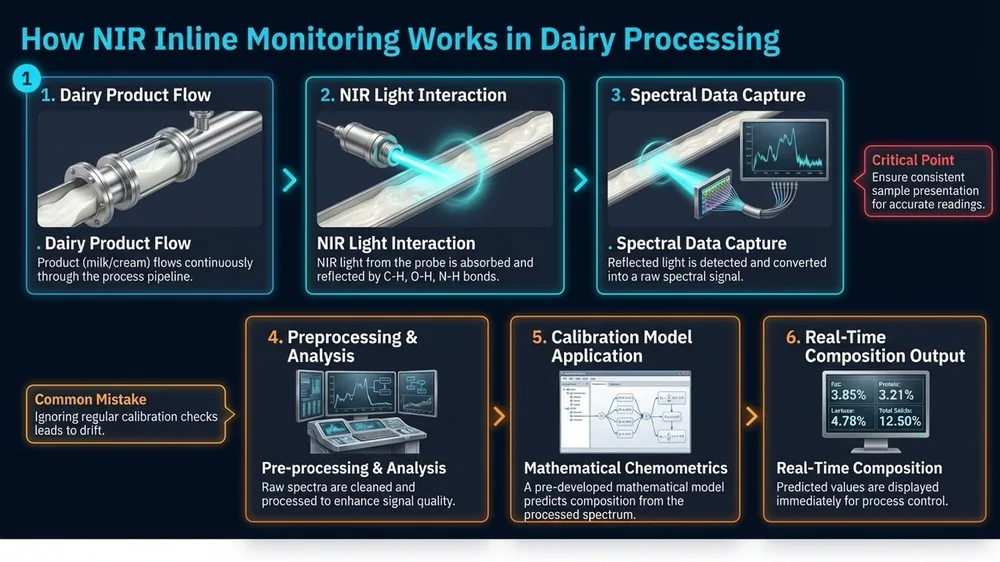
The instrument captures a full spectrum across hundreds of wavelengths in under a second. That raw spectrum doesn't directly read "3.6% fat." That's where chemometrics comes in.
Statistical methods like Partial Least Squares (PLS) correlate spectral data with lab reference values, building a predictive model. Think of a PLS calibration model like a highly experienced standardization operator who's learned to recognize exactly what a composition shift looks like — not by tasting the product, but by reading the light pattern alone. Once that model is in place, every scan delivers a composition prediction in real time. Your calibration is the intelligence behind every number the instrument reports.
The instrument measures light interactions — it's the chemometric calibration model that translates those interactions into composition values. The accuracy of every inline reading depends on the quality of that model, not just the hardware.
What NIR Measures in a Dairy Plant
Raw milk intake is where variability enters the process — and where catching it early matters most. Fat content can range from under 3% to over 5% depending on the herd and season. Without real-time measurement, standardization is always reacting instead of controlling.
On a loop running 50,000 liters per hour, a 0.1% fat deviation adds up fast. Catching it early prevents giveaway and keeps composition on target across the full shift. Your standardization team can't act on data they don't have yet.
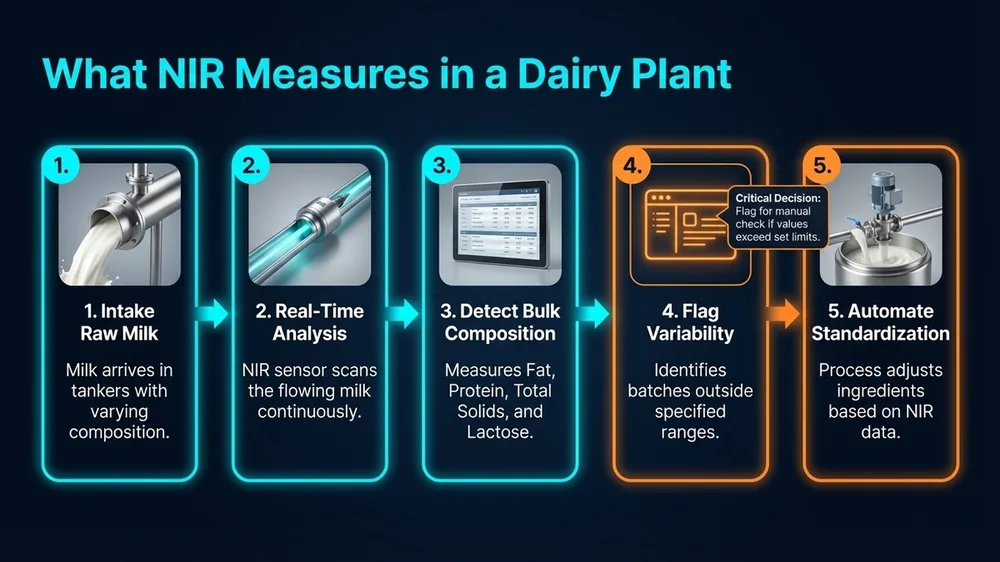
Whey processing is another area where inline measurement earns its place. Protein concentration in whey streams shifts throughout a run. When producing whey protein concentrate or isolate, operators need to know when levels change so they can adjust ultrafiltration or diafiltration in time.
A lab result that arrives 30 minutes later does not prevent a bad cut — it documents one.
A lab result that arrives 30 minutes later does not prevent a bad cut — it documents one.
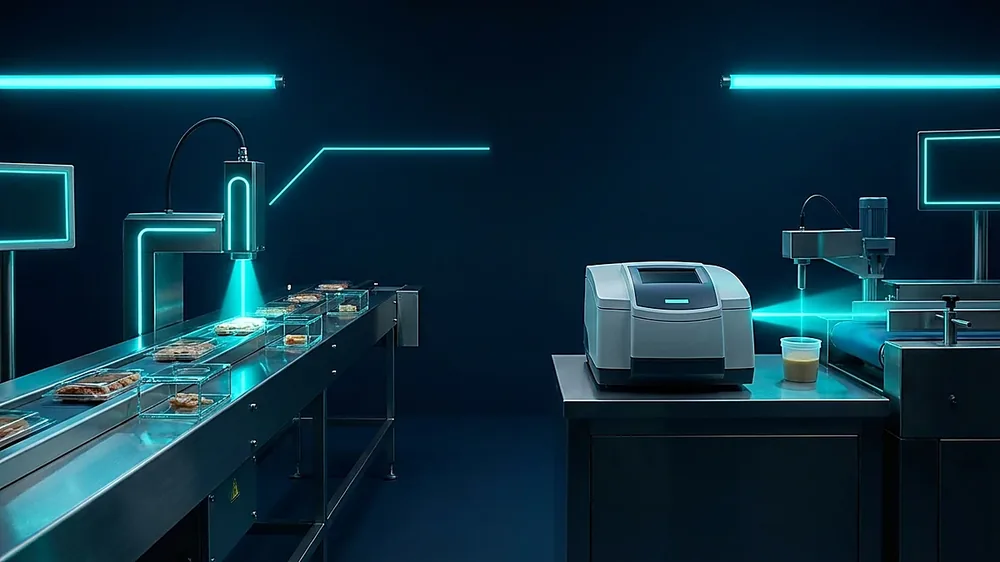
Beyond standardization and whey cuts, NIR inline monitoring also supports cream separation, pasteurization checks, and finished product verification before packaging. Each of these control points benefits from the same principle: real-time data replaces reactive sampling. For a broader view of how NIR fits across food and feed operations, see our overview of where NIR spectroscopy fits in grain, feed, and food operations.
Inline vs. At-Line NIR: Which One Fits Your Process
Choose inline when continuous control is non-negotiable. Standardization loops, cream separation, any step where composition drifts in real time and automated adjustments are in play — those require inline. Everything else is a candidate for at-line.
The instrument must handle CIP cycles, pressure, and temperature swings. In practice, installations fail not because of the NIR optics, but because the flow cell or probe wasn't specified correctly for the cleaning chemistry. One dairy processor running an aggressive caustic CIP cycle experienced six months of drifting results — the issue traced back to a flow cell material that degraded under that cleaning regime, not the optic. Installation specifications matter as much as instrument choice.
Watch out: Inline NIR failures are often mechanical, not optical. Specifying the wrong flow cell material or probe geometry for your CIP chemistry causes failures that look like instrument drift but trace back to hardware degradation at the process connection.
At-line fits incoming raw milk checks, finished product verification, or any point where grab sampling is already part of the workflow. It delivers speed over wet chemistry without the complexity of a full inline installation.
Many smaller plants run at-line for most QC work and only go inline at their highest-volume, highest-risk control point. That's a practical starting position for operations building out their NIR monitoring program in stages. For a structured comparison of instrument formats, see our guide on NIR instrument selection for grain, feed, and dairy operations.
Advantages and Limitations of NIR in Dairy and Food Applications
What NIR Does Well
Speed is the obvious advantage. Results come in seconds, not hours. That matters when real-time process decisions are on the table.
The method is non-destructive — the sample passes through unchanged. No reagents, no waste stream, no bench chemistry. For fluid dairy products, that means no sample prep and no disposal overhead.
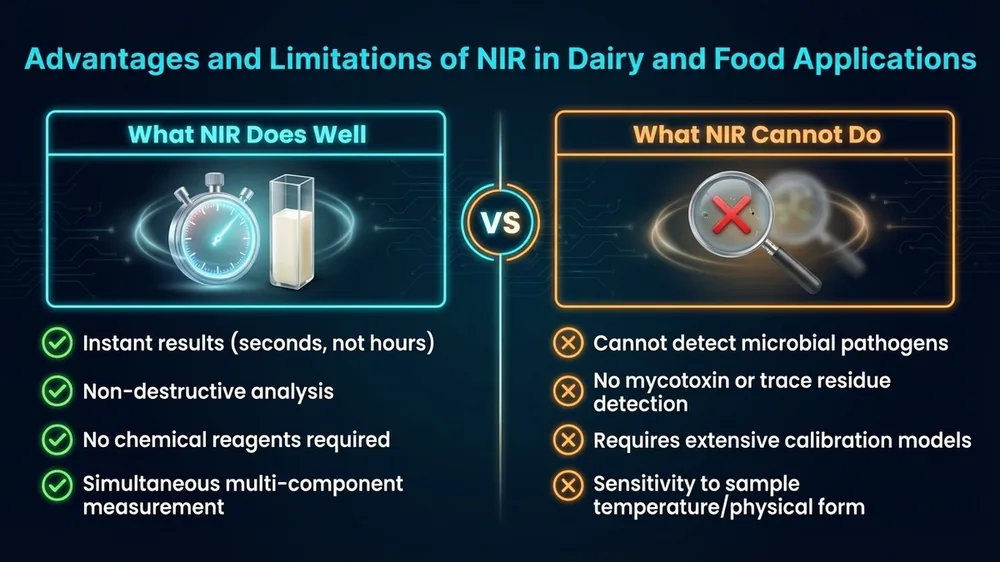
Simultaneous multi-parameter measurement is another real advantage. One scan returns fat, protein, moisture, and lactose at the same time — compare that to running four separate wet chemistry methods. For high-throughput operations, that difference in turnaround time is material.
NIR also reduces reliance on manual sampling. Fewer grab samples means less labor, lower reagent costs, and fewer opportunities for sampling error to introduce variation into your QC records.
What You Need to Plan For
NIR is an indirect method. Fat isn't measured directly — the instrument measures how light interacts with the molecular bonds associated with fat. Accuracy depends entirely on the calibration model. That model must reflect what actually runs through your plant.
A solid calibration requires representative reference samples covering the full production range. A model built on summer milk will show bias when the plant runs winter milk with a different fatty acid profile. That bias doesn't announce itself — it drifts quietly until someone runs a reference check. When I work with clients on inline dairy installations, this is the failure mode that surprises people most: the inline numbers look stable for months, then a sudden offset appears. The cause is almost always a seasonal or supplier shift that the original calibration didn't cover.
Temperature consistency also matters more inline than most expect. Product at 4°C reads differently than the same product at 15°C. Temperature compensation is built into most modern dairy NIR instruments, but it must be verified for the specific matrix in use.
Drifting inline results often trace back to a faulty temperature probe on the flow cell — not the NIR optic. Checking that first saves a lot of troubleshooting time. For a deeper look at how temperature affects NIR readings, see our article on why sample temperature affects NIR results and how to control it.
Calibration and Reference Methods: What Stays and What Changes
Inline NIR doesn't eliminate wet chemistry. It changes how wet chemistry is used.
Reference methods — Soxhlet for fat, Kjeldahl for protein, Karl Fischer for moisture — remain the foundation for building and validating calibration models. They also remain necessary for regulatory compliance and periodic model verification. What changes is frequency. Instead of running 40 lab samples per shift, teams run 10 to confirm the inline reading stays on track.
That efficiency comes from extending what the lab covers, not from cutting corners on lab practice. Calibration models need ongoing maintenance as raw material sources shift, seasonal variation enters the supply chain, or processing conditions change. For a structured look at how calibration models are built and validated, see our article on NIR calibration: why it is needed and how it works.
A calibration model is only as good as the reference data behind it. If your Soxhlet or Kjeldahl data carries lab error, that error transfers directly into the NIR model. Reference method quality sets the ceiling on inline NIR accuracy.
What Inline NIR Monitoring Actually Changes in a Dairy Operation
Here's the thing: the real shift isn't the instrument — it's when the data arrives. Composition data gets to the control point before a problem compounds, not after. Standardization tightens. Whey processing runs more consistently. Incoming milk acceptance becomes faster and more defensible to your auditors.
Process decisions no longer wait on lab results — the data is already at the control point.
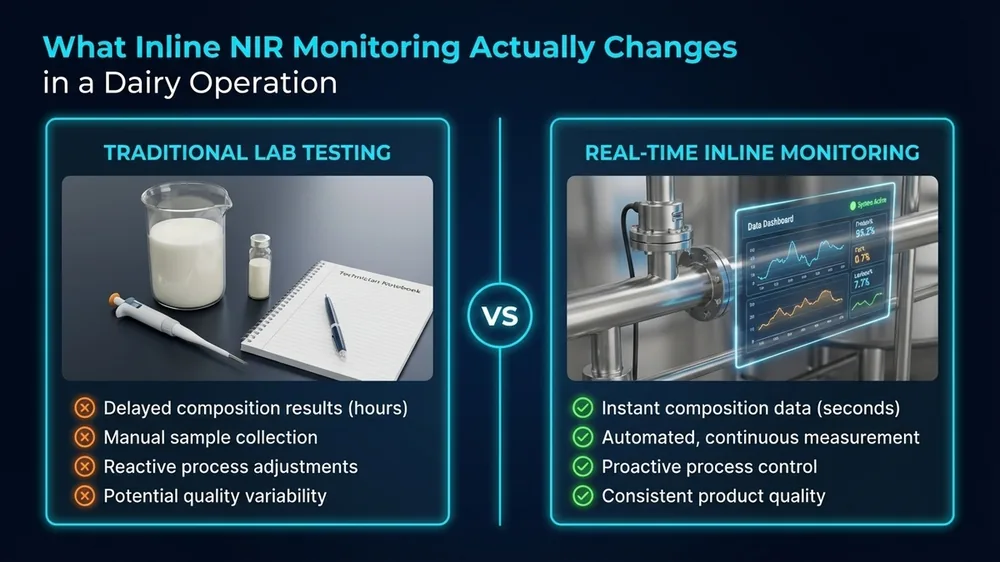
Inline monitoring doesn't replace reference methods. Wet chemistry remains necessary for calibration maintenance and regulatory compliance. What it changes is the balance of work — and the speed at which quality decisions can be made.
The operations getting the most from inline NIR aren't always the ones with the newest hardware. They're the ones that identified their highest-risk control point first, got that installation right, and built outward from there. Start by identifying your highest-volume control point — typically a standardization loop or a whey cut decision. Ask whether your current sampling frequency there is fast enough to catch a real composition shift before it costs product. If the answer is no, that's where inline NIR pays for itself first.
Continue Learning
Further Reading
Selected references and resources related to this article, drawn from the NIR Accuracy Course supplemental materials.
- Review of near-infrared spectroscopy as a process analytical technology for real-time product monitoring in dairy processing. (n.d.). Focuses on the use of NIR spectroscopy as a PAT tool for real-time monitoring in the dairy industry.
- NIR-Online Process Analyzers (leading instrument manufacturer, accessed March 2026). Online/Inline NIR Process Control. Outlines the features and benefits of online/inline NIR instruments for real-time process control, emphasizing continuous monitoring of moisture, fat, and protein to maximize production efficiency and ensure product quality.
SpectroScience students get access to the NIR Quality Checklist — pre-scan checklist covering warm-up, reference scan, sample condition, and environmental factors. Available as a free download in the student resource library.
Access the PDF libraryFree tool — NIR Glossary: Unfamiliar with a term? The SpectroScience NIR Glossary defines every chemometrics, calibration, and instrument term used in this article in plain language with worked examples. Open the Glossary →
Free tool — Calibration Metrics Calculator: Enter your reference values and NIR predictions in the Calibration Metrics Calculator to compute RMSEP, RPD, R², and bias the way our course teaches it — with interpretation thresholds for grain, dairy, and feed. Open the Metrics Calculator →
NIR Fundamentals Course — Lesson 22: What Is Chemometrics?
This lesson covers the principles of chemometrics, which are essential for developing predictive models that correlate spectral data with laboratory reference values. Understanding these statistical methods is crucial for dairy operations to accurately interpret NIR data and make informed decisions on product composition in real-time.
Explore Lesson 22 in the NIR Fundamentals courseWant to Master NIR Spectroscopy?
Our 32-lesson online course covers everything from Beer-Lambert Law to PLS calibration — built for food, grain, feed, and dairy professionals.