NIR Spectroscopy: Where It Fits in Grain, Feed, and Food Operations
Learn where NIR spectroscopy fits in grain, feed, and food operations — and where it fails. Covers starch, drift, calibration transfer, and outlier detection.
· 12 min read · Vitaly Kirkpatrick
NIR Limitations in Food and Feed Operations: When to Run a Reference Check
A feed mill was reporting corn protein at 8.9% for three straight months. Same supplier, same variety — everything looked consistent. Then a routine Kjeldahl check came back at 8.1%. That 0.8% gap had been quietly skewing least-cost formulation for an entire quarter. The NIR instrument wasn't broken. It was running outside its valid calibration range, and no protocol existed to catch it. That's the kind of problem that doesn't announce itself until it's already expensive.
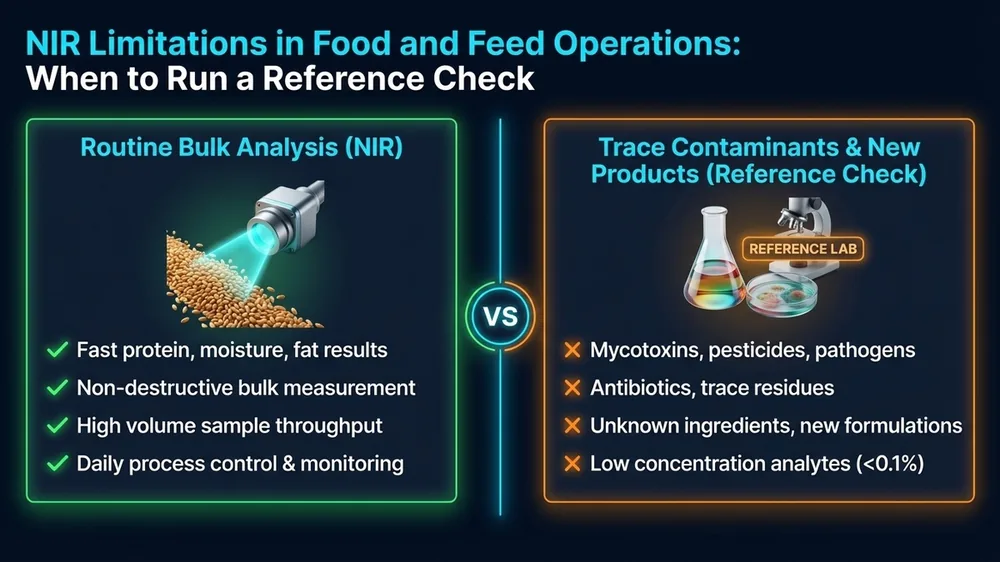
NIR spectroscopy is fast, non-destructive, and reliable — within limits your QA team needs to understand before trusting the data. The most common NIR problems I see at grain processors, feed mills, and dairy operations aren't instrument failures. They're situations where the technique was trusted outside its valid range, and nobody caught it in time. This article covers the four NIR limitations that come up most often — and lays out a practical approach for knowing when to run a complementary reference method.
How NIR Spectroscopy Works
The NIR region spans roughly 780 nm to 2500 nm. That's where molecular overtone and combination vibrations occur. Those vibrations are the analytical basis that makes moisture, protein, fat, and starch prediction possible without wet chemistry.
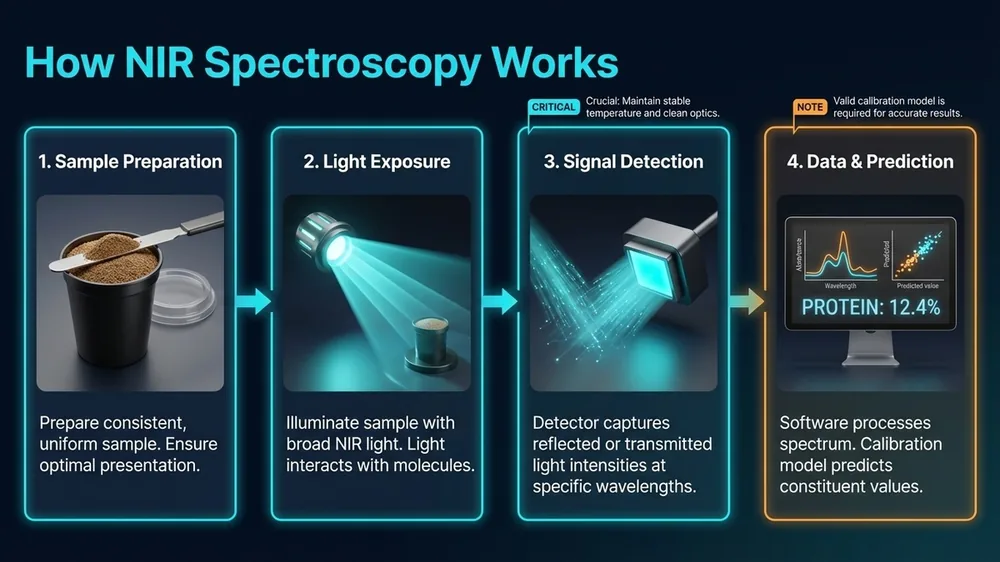
Think of it this way: each molecular bond absorbs NIR light at specific wavelengths the same way a tuning fork responds to a specific frequency. Your calibration learns to associate those absorption patterns with known concentrations. When it works, results are fast and accurate. When a sample falls outside what the calibration was trained on, the instrument still reports a number — and that number might be wrong.
The Beer-Lambert Law (A = εlc) describes a linear relationship between absorbance and concentration. That relationship holds only within a limited range. At high concentrations, it becomes non-linear. That's one reason your calibration must be built using samples that span the full range you actually see in production. For a deeper look at the underlying physics and instrument components, see our overview of NIR Spectroscopy in Food & Feed QA: How It Works, What It Measures, and Where It Fails.
Where NIR Fits in Grain, Feed, and Food Operations
Quality managers often ask me how broadly a single calibration can apply across ingredient sources. The answer depends on how well the calibration sample set captures variability in those ingredients. That's where many facilities run into trouble. They assume a calibration built on last year's soybean meal will perform equally well on a new supplier's product with a different processing history. It won't — not without validation.
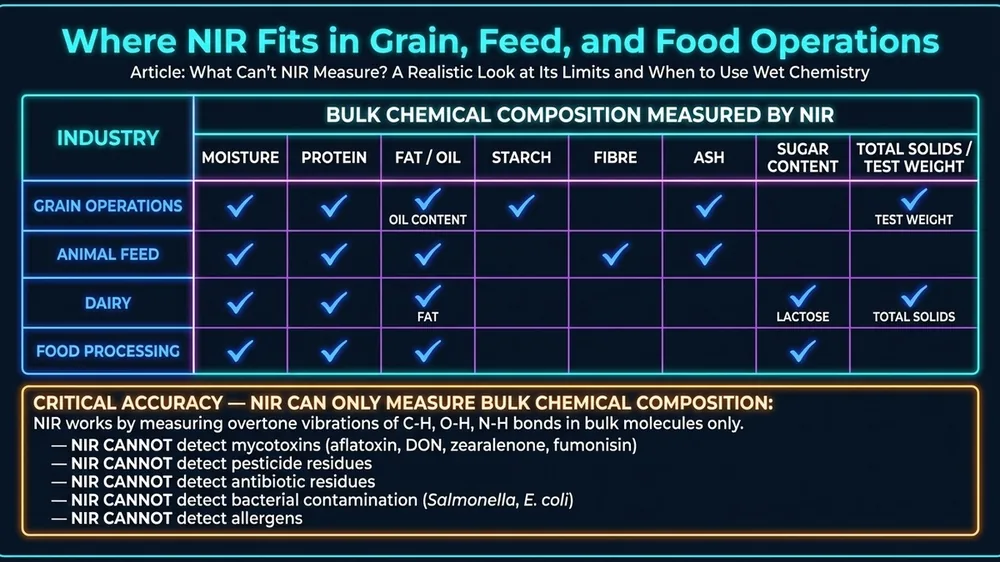
NIR earns its place at grain elevators, pet food lines, oilseed processors, and dairy ingredient operations. At a grain elevator receiving 200 trucks per day, a 30-second NIR result versus a 45-minute oven moisture determination isn't a convenience — it's an operational necessity. At a feed mill blending a 12-ingredient ration, real-time protein and fat data from incoming corn, soy, and distillers grains directly affects least-cost formulation accuracy.
Understanding where NIR fits in those workflows — and where it doesn't belong — separates facilities that get consistent value from those that periodically get burned by it. For a practical breakdown of how NIR performs across receiving, processing, and finished product stages, see NIR Spectroscopy Applications: Where It Pays for Itself in Food and Feed.
NIR doesn't fail at random. It fails predictably — at the edges of calibration space, after instrument drift, and when sample physical state changes. Knowing the failure modes lets QA teams build systems that catch problems before they reach product data.
The Cost of Getting NIR Placement Wrong
Placing NIR at the wrong point in a process — or expecting it to measure parameters it isn't suited for — creates costs that are harder to see than a failed instrument. A feed mill that relies on NIR to flag aflatoxin in incoming corn will miss every positive sample. A grain elevator running a single calibration across spring wheat, winter wheat, and durum without validation will report protein errors wide enough to affect grading decisions. And neither situation shows up as an "instrument problem" on any maintenance log.
The financial exposure is real. A 0.5% protein error on a 50,000-bushel wheat purchase, priced at a $0.05-per-bushel protein premium, represents a $2,500 discrepancy on a single transaction. Multiply that across a season and step-by-step NIR bias at intake becomes a material line item — one that rarely shows up labeled as an NIR problem on any report.
Getting NIR placement right starts with knowing what it measures reliably, what it can't measure at all, and what falls in between. For a structured look at those boundaries, see NIR Spectroscopy in Food and Feed: What It Measures and Where It Fails — it covers the full breakdown by application and matrix type.
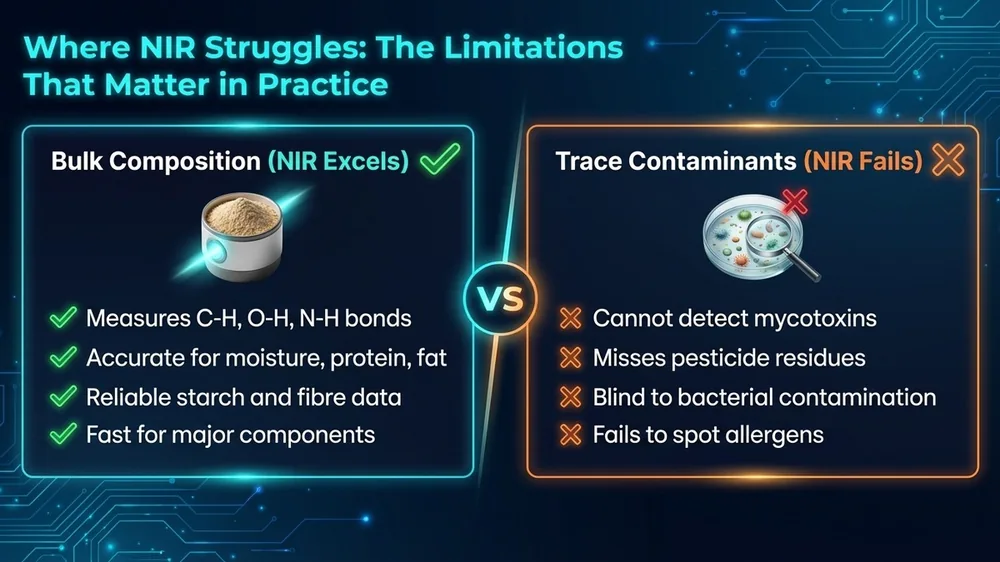
Where NIR Struggles: The Limitations That Matter in Practice
The analysts who get burned by NIR aren't the ones who use it too much. They're the ones who don't know where it stops working. Here are the four areas where NIR consistently falls short — and what to do about each one.
1. Starch Prediction Is Harder Than It Looks
Starch is one of the most requested NIR predictions in grain and feed work. It's also one of the hardest to get right. The challenge isn't just chemistry — physics plays a role too.
Starch granule crystallinity affects the NIR signal independently of starch content. Change the gelatinization state of a sample even slightly — through heat or shifts in water activity — and the instrument sees a very different spectrum for the same starch concentration. It's like trying to recognize someone's voice when they're whispering versus shouting. Same person, completely different signal. Your calibration doesn't know which version it's dealing with.
Starch-protein-moisture interactions create non-linearities in even well-built PLS models. Prediction errors can reach 2–4% absolute on a difficult sample day. In corn destined for wet milling, where starch yield is the primary economic driver, that error range translates directly into formulation cost and co-product value miscalculation.
Field tip: In grain matrices, predicting starch directly isn't advisable. Predict it by difference: 100% minus protein, fat, moisture, and ash. The sum-to-100% constraint acts as a built-in accuracy check. If direct starch NIR is required, validate against enzymatic reference methods quarterly — not annually.
2. Instrument Drift Is Gradual and Easy to Miss
Even high-quality NIR instruments experience wavelength accuracy drift of 0.5–1 nm over two years. That sounds small. It isn't.
At 1 nm of drift in the 2100–2200 nm region, protein prediction errors in wheat can reach 0.3–0.5%. That margin is enough to misgrade grain at intake. Here's the part that catches people off guard: an instrument may still pass its daily qualification check while silently drifting on the exact wavelengths your protein calibration depends on most. The qualification check and the calibration are not looking at the same thing.
InGaAs detector arrays compound this problem. They lose sensitivity unevenly across the detector surface as they age, producing wavelength-dependent bias that's easy to miss if only a single-point performance check is running. Tungsten-halogen lamps — the most common NIR light source in benchtop units — also change output profile over their service life. Intensity shifts are partially compensated by referencing routines, but wavelength-specific intensity decay outside the reference correction window can introduce step-by-step bias. That bias often shows up in fat and starch predictions before protein, because of where the wavelength drift intersects absorption bands.
Watch out: Run a full wavelength verification against a certified standard — not just a noise or signal check — at least every six months. Log the results and trend them over time. Drift caught at 0.3 nm is a recalibration conversation. Drift caught at 1.2 nm is a crisis.
3. Calibration Transfer Between Instruments Is Not Automatic
This issue catches facilities off guard regularly. A solid calibration is built on a master instrument. A second unit arrives — same make, same model — and the assumption is that loading the calibration file is all that's needed. That assumption is wrong.
A model built on instrument A will fail on instrument B without deliberate standardization. This holds even when both instruments came off the same production line in the same month. Same model number doesn't mean same optical fingerprint.
Facilities running two or three NIR units across shifts or plant locations must account for the full cost of calibration ownership. That includes transfer validation, the reference samples needed to verify each transfer, and analyst time to troubleshoot failures. In a network of five instruments, an unmanaged transfer problem can cost a QA team 40–60 hours of remediation work before the error ever shows up in product data. Slope and bias correction is the minimum transfer tool — but it corrects only linear offsets. Instruments with different detector configurations or optical path geometries may require full spectral standardization using piecewise direct standardization (PDS) before a transferred calibration performs acceptably. For a full walkthrough of transfer methods and validation steps, see How to Transfer NIR Calibration Between Instruments Effectively.
A model built on instrument A will fail on instrument B without deliberate standardization — even when both came off the same production line in the same month.
4. Outliers That Do Not Announce Themselves
Not all outliers flag themselves. The dangerous ones sit just outside calibration space but inside the instrument's measurement range. The instrument reports a number. The number looks plausible. Nobody checks.
Three distinct sources generate these quiet outliers:
- Real sample anomalies — contamination, wrong raw material, or adulteration
- Instrument artifacts — lamp flicker, dirty optical window, or fiber optic damage
- Reference method errors — transcription mistakes, sample mix-ups, or analyst error
The first category is actually useful. NIR catching contamination is a discovery, not a failure. The second and third categories corrupt calibrations and erode prediction accuracy over time — often without obvious symptoms.
In a feed mill running 15 raw material checks per shift, even a 2% quiet outlier rate means roughly one suspicious result every two shifts. If those results get entered into the calibration update database without review, your model performance degrades over 6–12 months. That degradation looks like gradual instrument decline — not a data quality problem. Your auditors won't see it that way when they ask for calibration maintenance records.
Note: Mahalanobis distance (H statistic) is the primary screening tool. Set an alarm threshold at H > 3 for routine flagging. Any sample hitting H > 6 should be investigated before the result is reported or acted on. High-H samples shouldn't simply be deleted from the calibration set. Understanding why they appear is a needed first step.
Building a Practical Reference Check Protocol
Knowing the failure modes is only half the work. The other half is building a decision system that triggers reference method verification before errors reach product data. A practical reference check protocol has four components:
- Outlier flagging thresholds. Set H statistic and spectral residual limits appropriate to each matrix. These should be calibration-specific, not instrument defaults.
- Scheduled validation samples. Run certified reference materials or retained plant samples at defined intervals — daily for high-volume grain receiving, weekly for finished feed products. Compare NIR predictions against reference method results and track bias over time.
- Trigger criteria for immediate verification. Define the conditions that stop routine NIR reporting and require wet chemistry confirmation before data is used in grading or formulation decisions. Examples: three consecutive H-flag samples, a sudden shift in mean prediction for a stable ingredient, or a result outside historical range for that supplier.
- Escalation path. When NIR and reference method disagree beyond a defined threshold, escalate rather than average. The source of the disagreement — instrument, sample, or reference method — needs to be identified before either result is used.
Facilities without formal trigger criteria rely on analyst judgment. That's inconsistent across shifts and personnel. A written protocol makes the decision process repeatable and auditable. When your auditors ask how NIR-wet chemistry disagreements are handled, "we use our best judgment" is not the answer that keeps a program credible.
Deploy NIR where it genuinely fits the matrix and parameter range. Build your trigger criteria before they're needed. Treat every quiet outlier as a question worth answering. That's what separates a NIR program that holds up under pressure from one that slowly erodes confidence in the data. For guidance on building a validation program that supports those decisions, see How to Validate NIR Against Wet Chemistry: Setting Up a Parallel Testing Program.
Free tool — Calibration Metrics Calculator: Enter your reference values and NIR predictions in the Calibration Metrics Calculator to compute RMSEP, RPD, R², and bias the way our course teaches it — with interpretation thresholds for grain, dairy, and feed. Open the Metrics Calculator →
Free tool — Beer-Lambert Calculator: The Beer-Lambert Calculator works the absorbance = ε·b·c relationship in both directions — useful when sizing path length for a new sample type or sanity-checking a calibration curve. Open the Beer-Lambert Calculator →
Free tool — Model Diagnostics Calculator: Drop your spectra and predictions into the Model Diagnostics Calculator to flag outliers via Mahalanobis distance, leverage, and Q-residuals — the same diagnostics we walk through in Lesson 25. Open the Diagnostics Calculator →
SpectroScience students get access to the NIR Quality Checklist — pre-scan checklist covering warm-up, reference scan, sample condition, and environmental factors. Available as a free download in the student resource library.
Access the PDF libraryNIR Fundamentals Course — Lesson 11: NIR and Lab Reference Methods
This lesson focuses on the relationship between NIR spectroscopy and lab reference methods, emphasizing the importance of using complementary techniques to validate NIR results. It provides practical guidance on when and how to implement reference checks to ensure data accuracy in grain and feed operations.
Explore Lesson 11 in the NIR Fundamentals courseWant to Master NIR Spectroscopy?
Our 32-lesson online course covers everything from Beer-Lambert Law to PLS calibration — built for food, grain, feed, and dairy professionals.