How NIR Spectroscopy Measures Oil, Protein, and Moisture in Oilseed Processing
Learn how NIR spectroscopy measures oil, protein, and moisture in oilseed processing — with real accuracy benchmarks, deployment tips, and calibration guidance.
· 13 min read · Vitaly Kirkpatrick
How NIR Spectroscopy Fits into Oilseed Processing

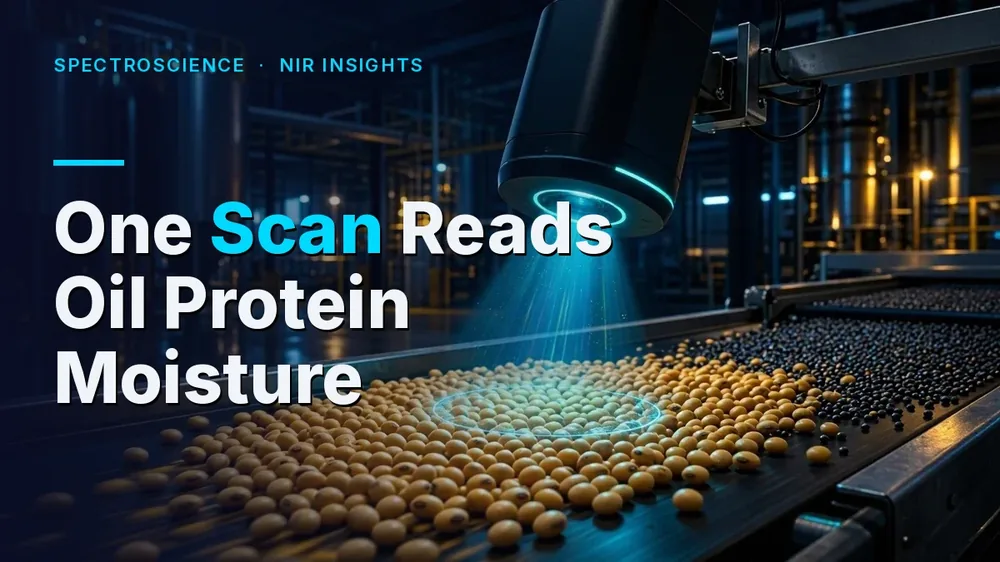
NIR spectroscopy addresses one of the most costly gaps in oilseed quality control: the delay between a process upset and the moment someone knows about it. At a continuous canola extraction operation, a shift-end composite sample can take four to six hours to reach the reference lab. By then, several tons of off-spec meal have already moved down the line. NIR spectroscopy closes that gap to under 30 seconds per scan. That is not a marketing claim — it is the result seen at commercial oilseed facilities when the program is set up correctly.
Oil, protein, and moisture can all be measured from a single scan. No reagents, no sample destruction. For an oilseed crusher or a feed mill receiving soy meal, that speed changes what decisions are possible at intake and during processing. But speed alone does not deliver accuracy. The calibration model does. And that is where most programs either hold up or fall apart.
What the Near-Infrared Region Is
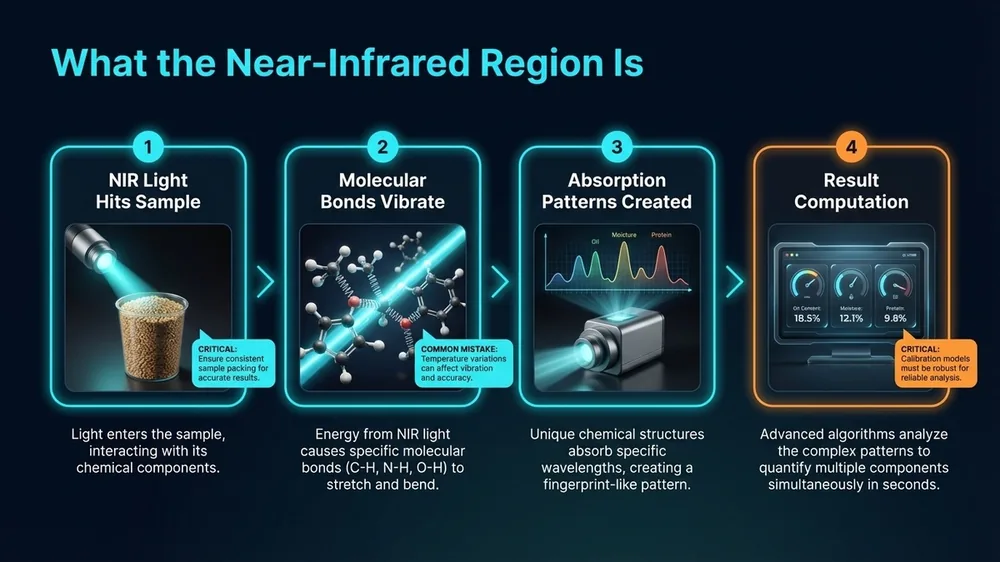
NIR light spans wavelengths from roughly 780 to 2500 nanometers — just beyond what the human eye can detect. When that light hits a sample, it causes molecular bonds to vibrate. Those vibrations produce absorption patterns that are unique to specific chemical compounds.
C-H bonds, N-H bonds, and O-H bonds each absorb light at a characteristic part of the spectrum. That is how the instrument distinguishes oil from protein from moisture. For a closer look at why molecular bonds vibrate and how NIR uses that behavior to predict composition, see our article on how NIR reads molecular bonds to measure protein, moisture, and fat in grain and feed.
NIR is also non-destructive. The sample stays intact. For incoming grain or finished meal, that matters — the same sample can be re-analyzed or retained as a reference if a result is disputed.
Note: NIR's non-destructive nature means the same sample can be analyzed multiple times or retained for reference — a significant advantage over wet chemistry methods that consume the sample entirely.
How NIR Measures Oil, Protein, and Moisture
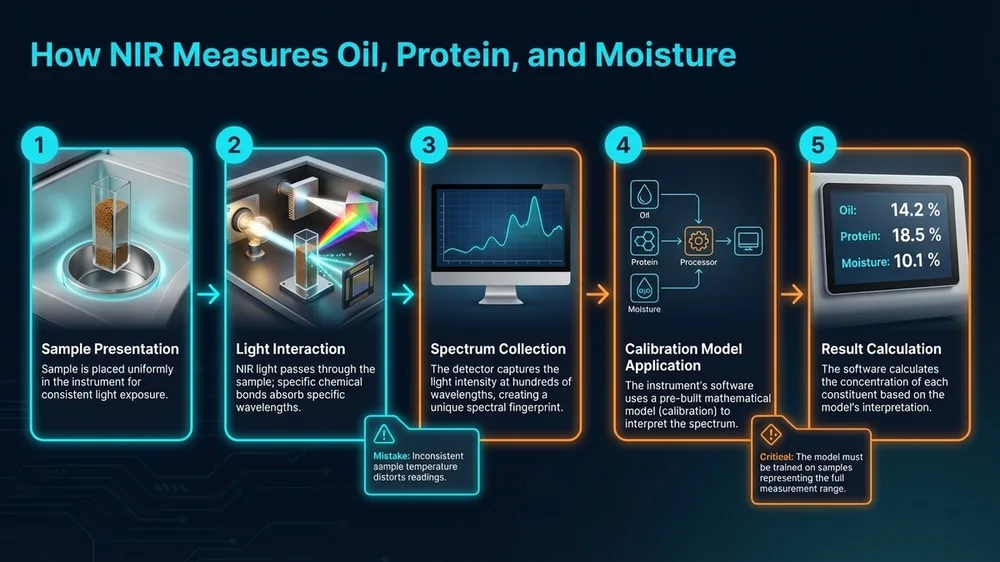
C-H bonds — the ones that dominate fat and oil chemistry — absorb strongly in one spectral region. N-H bonds, tracked when measuring protein, absorb in another. O-H bonds drive the moisture reading.
No single wavelength tells the full story. The instrument measures light absorption across the full spectrum and builds a pattern from that data. It is the pattern across hundreds of wavelengths that makes the measurement reliable — not any single peak.
Think of it like recognizing a colleague's voice on a noisy plant floor. You are not listening for one word. You are picking up on a whole pattern of pitch, rhythm, and tone that is unique to that person. The NIR calibration model works the same way. It is trained to recognize the spectral signature of a 45% protein soybean meal versus a 43% one, even when the spectral differences are subtle.
The instrument does not give a direct chemical readout. It needs a calibration model built against reference lab values. That model is the translation layer between the spectral pattern and the number on the screen. When built on samples that cover real process variation, a well-maintained calibration holds up for years. For a practical breakdown of how calibration development works, see our guide on why NIR calibration is essential and how it works.
The calibration model is what separates a reliable NIR result from a meaningless one. The instrument measures light — the model translates that into chemistry. When built on representative samples that cover the full process variation, it will hold up for years.
What NIR Accuracy Looks Like in Oilseed Applications
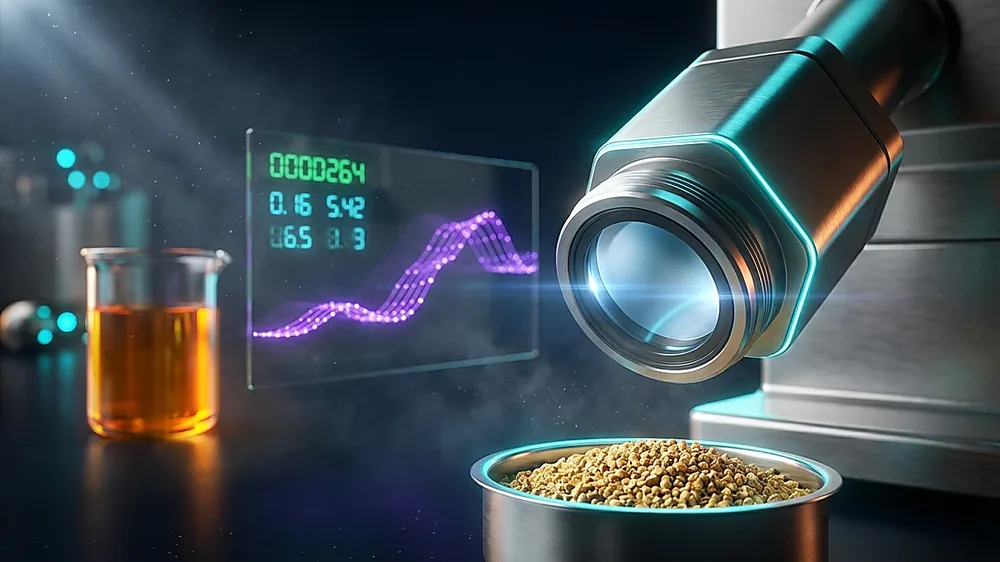
Before deploying NIR in an oilseed facility, it is important to understand what realistic accuracy looks like. Not vendor brochure numbers — what well-maintained calibrations actually deliver in production.
For soybean meal protein measured against Kjeldahl reference values, calibrations routinely achieve a standard error of prediction (SEP) of 0.3–0.5 percentage points at the 44–48% crude protein range. For canola meal oil residual, SEP values of 0.2–0.4% on a dry basis are achievable with inline sensors properly positioned after the extraction stage.
Moisture calibrations tend to perform tightest of the three parameters. In whole soybeans and canola seed at typical intake moisture ranges of 8–14%, SEP values below 0.3% are common with well-maintained instruments and consistent sample presentation.
These numbers reflect performance in commercial oilseed facilities using calibrations maintained with regular updates and proper reference method alignment. The benchmarks shift when sample matrices change. Expeller-pressed meal and solvent-extracted meal behave differently in the NIR. Those two matrices may require separate calibration files rather than one shared model.
Benchmark reference: For soybean meal protein, a SEP of 0.3–0.5 percentage points against Kjeldahl is a realistic target for production-grade NIR calibrations. Values above 0.8% typically indicate calibration drift, sample presentation issues, or an under-represented training set.
Where NIR Gets Used in Oilseed and Food Operations
Incoming Grain and Oilseed Intake
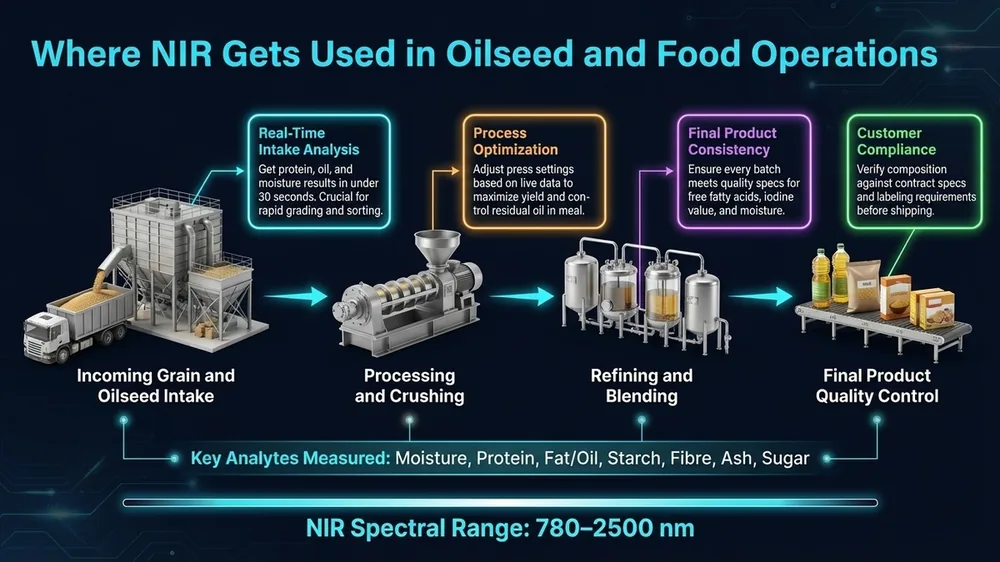
At a grain elevator or oilseed receiving station, NIR delivers protein, oil, and moisture results on incoming loads in under 30 seconds. That speed matters for grading, blending decisions, and knowing what is going into the crush. A truck does not need to wait for the reference lab.
Many facilities purchasing on contracted protein specifications have no fast way to verify loads at intake. That is the gap NIR fills immediately. For a detailed look at how NIR integrates into grain receiving workflows — including sampling protocols and throughput considerations — see the article on how NIR transforms grain receiving decisions at the intake point.
Crush Process Monitoring
In a continuous extraction operation, a process upset that would take hours to catch with grab samples and wet chemistry shows up in the NIR trend line within minutes. That is where inline NIR delivers its clearest value at the crush.
In continuous canola extraction, early detection of oil residual spikes has prevented significant product loss at commercial facilities. Positioning the sensor on the meal conveyor right after the extraction stage — not at load-out — gives operators the most response time.
Hexane solvent extraction operations targeting below 1% residual oil in meal depend on this real-time feedback. When NIR detects residual oil trending above 0.8%, operators can adjust solvent-to-flake ratios or conveyor speeds before the batch moves to desolventizing. Without inline NIR, the same deviation might only surface during a shift-end composite sample — by which time several tons of off-spec meal have already accumulated.
Field tip: Position the inline NIR sensor on the meal conveyor immediately after the extraction stage, not at load-out. The earlier an oil residual spike is detected, the more time there is to adjust the process before out-of-spec product accumulates.
Finished Meal Protein and Feed Quality
Soybean meal going into feed formulations must meet protein specifications. NIR on the finished meal line — or at load-out — is now standard practice at most commercial feed mills. Most facilities run NIR on every batch of incoming soy meal, not just spot-checks.
At a typical 44–48% crude protein specification, a half-point deviation affects both formula cost and animal performance. Catching that deviation before the batch ships is far less expensive than a reformulation after the fact.
Beyond soy, NIR is routinely used on canola meal (typically 36–38% crude protein), sunflower meal, and cottonseed meal in commercial feed mill operations. Each commodity requires its own calibration file. A sunflower meal calibration will not perform reliably on canola meal, even though both are oilseed co-products. Managing these calibration files and keeping them current is one of the ongoing operational responsibilities that separates well-run NIR programs from ones that drift into unreliability over time.
Oil Quality and Refinery Monitoring
On the oil side, NIR spectroscopy can measure free fatty acid content, moisture, and in some configurations, iodine value. These measurements will not always match reference method precision at every facility. But they are accurate enough for process control decisions.
Free fatty acid (FFA) monitoring is particularly valuable in crude degummed soybean oil. FFA content above 0.5% signals potential refining losses. NIR sensors positioned on the crude oil line after centrifugal separation give refinery operators real-time FFA trends. This allows caustic dosing adjustments before losses compound. Reference titration for FFA takes 20–30 minutes per sample. NIR delivers the same directional information continuously.
In oilseed processing plants, inline NIR is also used to catch degumming upsets before they reach the refinery. Avoiding that rework alone often justifies the cost of the instrument.
Agricultural Grain Quality
Beyond the crush, NIR spectroscopy is widely used for assessing grain quality at harvest and in storage. Moisture and protein in wheat, oil in sunflower, glucosinolates in canola — these are routine NIR measurements at commercial grain facilities. The speed enables decisions at intake rather than waiting on the reference lab, which can take hours or days.
Glucosinolate measurement in canola deserves specific mention. Traditional reference analysis for glucosinolates requires wet chemistry with a turnaround of several hours. NIR-based glucosinolate screening is fast enough to support variety segregation at a grain elevator — a commercially significant capability where conventional crushing facilities pay a premium for low-glucosinolate seed. NIR makes that segregation economically practical at scale.
Instrument Types and Deployment Considerations

Not all NIR instruments are suited to every oilseed application. Benchtop instruments work well for lab-based intake sampling and finished meal quality release. Inline process sensors are built to handle the dust, vibration, and temperature variation of a production environment. Portable units offer flexibility for spot-checking across a facility without fixed installation costs.
The instrument type affects calibration strategy, maintenance requirements, and how results feed into process control systems. An FT-NIR benchtop in the lab requires a different sampling workflow than a diffuse reflectance inline sensor mounted above a meal conveyor.
The choice should be driven by where the measurement decision is actually made — not by what is cheapest to purchase. For a structured comparison of instrument types and their trade-offs, see our article on NIR instrument selection for grain, feed, and dairy operations — from benchtop to inline.
Deployment principle: Match the instrument type to the decision point, not to the purchase budget. An inline sensor that cannot survive the production environment will deliver less value than a well-maintained benchtop unit — even if the benchtop requires additional sample handling steps.
Where NIR Has Limits in Oilseed Analysis

NIR measures indirect signals. It detects the spectral fingerprint of molecules within a matrix — not the molecules themselves. That distinction has real consequences.
Amino acid profile is one area where NIR's limitations matter for oilseed meal buyers. NIR can measure total crude protein reliably. But distinguishing lysine content from total protein within a complex meal matrix requires either wet chemistry confirmation or a carefully built, dedicated amino acid calibration. Most commercial NIR systems used in oilseed facilities do not have validated amino acid calibrations at the accuracy level needed for nutritional formulation decisions.
Particle size variation is another real constraint. Meal ground to different degrees within the same batch will produce different spectral scatter patterns — not because the composition changed, but because the physical structure changed. This is why sample preparation discipline matters as much as instrument quality. Grinding to a consistent particle size before scanning is a standard requirement for benchtop systems. Inline sensors handle this differently through spectral preprocessing in the calibration model.
Temperature effects on spectra are well documented. Samples arriving cold from outdoor storage in winter produce different baseline spectral responses than warm samples scanned in a temperature-controlled lab. Failing to account for temperature variation during calibration development is one of the most common reasons oilseed facility NIR programs underperform during seasonal transitions. In facility assessments, seasonal protein reading drift has been traced back entirely to this issue — not instrument failure, not calibration age, simply cold grain hitting a model that was never trained on cold grain.
The practical takeaway: set up your NIR program with the same discipline applied to any reference method. Define the sample prep procedure. Document the calibration scope. Build temperature variation into the training set from the start. Do that, and NIR results in oilseed applications will hold up through seasonal changes and process shifts that would otherwise send the numbers sideways. For more on how temperature affects your readings and what to do about it, see our article on why sample temperature affects NIR results and how to control it.
Free tool — NIR Glossary: Unfamiliar with a term? The SpectroScience NIR Glossary defines every chemometrics, calibration, and instrument term used in this article in plain language with worked examples. Open the Glossary →
SpectroScience students get access to the NIR Sample Prep Guide — particle size, moisture, temperature, and presentation requirements for consistent NIR results. Available as a free download in the student resource library.
Access the PDF libraryNIR Fundamentals Course — Lesson 13: NIR in Agriculture
This lesson explores the application of NIR spectroscopy specifically in agriculture, including oilseed processing. It details how NIR can enhance quality control by providing rapid, accurate measurements of key parameters like oil, protein, and moisture, which are critical for maintaining product standards.
Explore Lesson 13 in the NIR Fundamentals courseWant to Master NIR Spectroscopy?
Our 32-lesson online course covers everything from Beer-Lambert Law to PLS calibration — built for food, grain, feed, and dairy professionals.