Building NIR Calibration Models and Avoiding Common Chemometric Mistakes
Learn the practical steps for building calibration models that hold up in production — covering PLS, overfitting, reference data quality, and model drift in…
· 9 min read · Vitaly Kirkpatrick
Building NIR Calibration Models and Avoiding Common Chemometric Mistakes
A feed mill I visited last year had an NIR instrument sitting idle because the calibration kept producing results their QC manager didn't trust. The model looked fine on paper — good R² during development — but on production samples it was off by enough to affect formulation decisions. That's a familiar story. The instrument wasn't the problem. The calibration development process was. Getting a model to hold up in production requires discipline at every step, and most of the failure modes I see in the field have nothing to do with the hardware.
How NIR Calibration Models Are Built
Building a reliable calibration isn't a one-step process. Each stage depends on the one before it, so skipping steps or rushing any phase creates problems that compound later. Your calibration is only as strong as its weakest link in this chain.
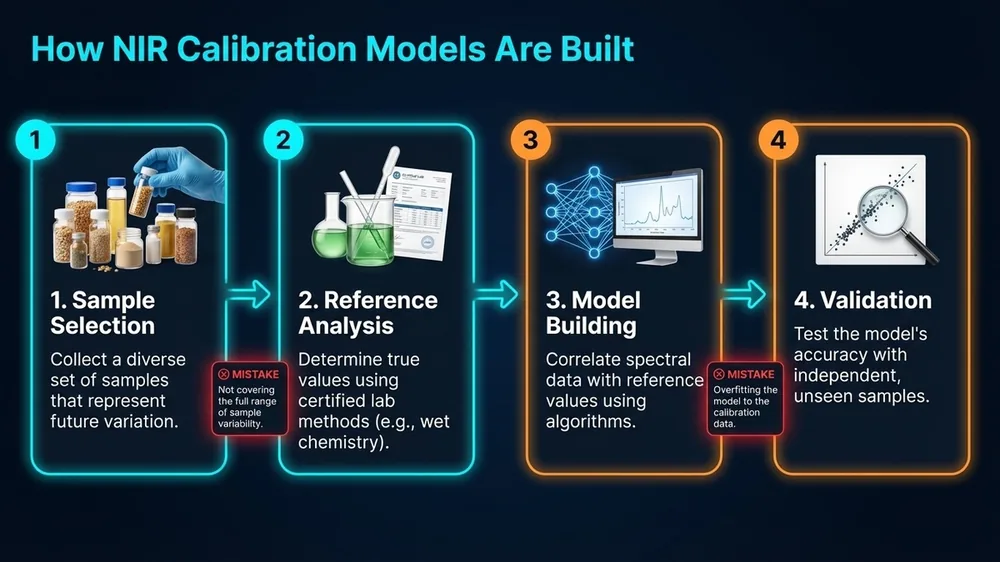
- 1Data collection — Gather NIR spectra from a representative, diverse sample set along with accurate reference values from wet chemistry. Most applications need at least 50–100 well-distributed samples to cover the full range of variation. The model is only as good as the reference data behind it.
- 2Pre-processing — Apply mathematical treatments to remove noise and correct for physical variation. Techniques like Savitzky-Golay smoothing, Multiplicative Scatter Correction (MSC), and Standard Normal Variate (SNV) are standard here. Pre-processing choices have a large effect on final model accuracy.
- 3Model building — Select the chemometric algorithm and refine its parameters. The goal is to capture the real chemical signal without fitting noise into the model. Partial Least Squares (PLS) regression is the most widely used approach in food and feed applications.
- 4Validation — Test the model on independent samples it has never seen. Cross-validation and external validation both play a role. This step determines whether the model is ready to use in production. A model that hasn't been validated independently is not ready to deploy.
- 5Deployment — Implement the validated model for routine analysis. At this point, your NIR instrument delivers fast, reliable results at the instrument rather than waiting on the lab.
For a deeper look at PLS regression and how it handles spectral overlap in complex matrices, see our step-by-step PLS regression guide for food and feed calibration.
Common Mistakes in NIR Chemometric Modeling
The most common trap in building calibration models is overfitting. This happens when a model fits the training data too closely — including its noise — and then performs poorly on new samples. Think of it like a student who memorizes every answer from last year's exam word for word: perfect score on the practice run, completely lost when the real questions are slightly different. The model looks excellent on paper but falls apart in production.
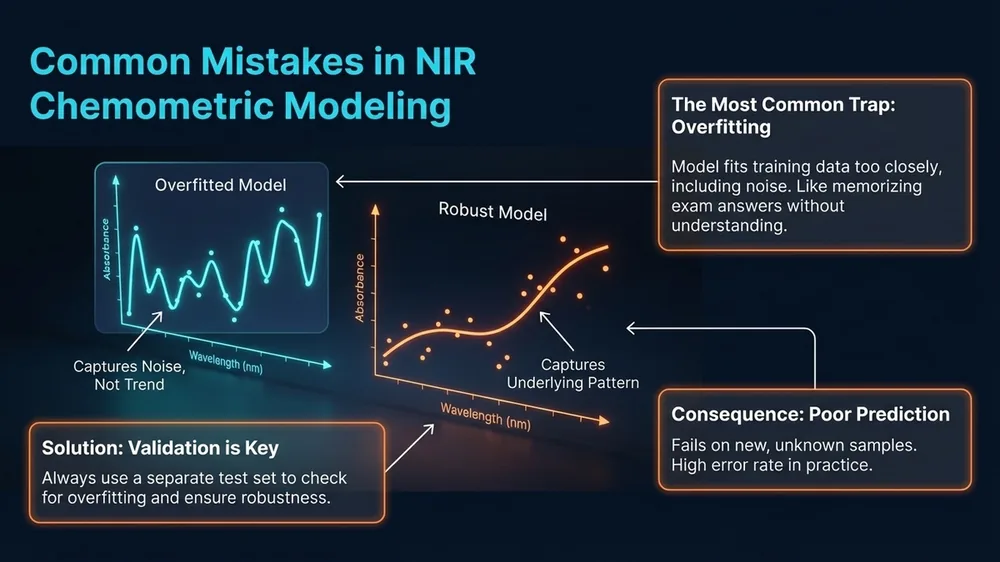
Watch out: Overfitting is the most common modeling mistake in NIR chemometrics. If your model shows excellent fit on training samples but large errors on new ones, you've captured noise rather than chemistry. Always hold back a genuinely independent validation set — samples not used in any part of model development — before declaring your model ready.
Beyond overfitting, several other issues come up regularly when QC teams work through calibration development:
- Poor reference data: If your wet chemistry reference values are inaccurate or inconsistent, no chemometric method will fix that. The model learns from those values — bad input produces a bad model. Reference method quality directly limits how accurate your NIR predictions can be.
- Ignoring model boundaries: Every calibration has limits. It's valid for the range of concentrations, sample types, and physical conditions it was built on. Applying it outside that range is how unexplained results appear. When new sample types arrive, the model needs to be extended — not stretched.
- No ongoing monitoring: Raw materials change. Process conditions shift. A model that worked well six months ago may have drifted. Regular prediction checks on reference samples catch drift before it affects production decisions.
Our article on NIR calibration overfitting and three validation methods covers cross-validation, external validation, and test-set validation in detail — including when each approach is appropriate.
Field tip: Keep a small set of well-characterised QC samples with known reference values and run them through your model on a regular schedule. A gradual drift in prediction error almost always signals that raw materials or process conditions have shifted. Catch it early and you can update the model before it affects production decisions.
Why Reference Data Quality Sets the Ceiling
No matter how advanced the chemometric algorithm, NIR calibration accuracy can't exceed the quality of the reference method used to build it. That's one of the most underappreciated constraints I see when working with teams on calibration development for routine use.
Here's a concrete example. If your Kjeldahl protein values have a repeatability of ±0.3%, your NIR model can't realistically achieve better than that — even with 200 calibration samples and well-tuned PLS settings. The reference error becomes a hard floor on prediction error. You can't model your way past it.
This matters most when labs switch reference labs, change analysts, or update procedures mid-calibration. Any of those changes can introduce a step-change bias into the reference dataset, which the model will faithfully learn and reproduce. Your auditors won't see it coming, and neither will your formulation team — until the protein numbers stop making sense.
For a detailed look at how reference method error propagates into NIR predictions, see our article on why your reference method limits NIR accuracy.
Keeping Calibration Models Stable Over Time
Building a good calibration model is only part of the task. Keeping it performing reliably over months and years requires active management. I've seen well-built models degrade silently over a single harvest cycle when no one was tracking prediction statistics.
Raw material suppliers change. Harvest conditions vary year to year. Seasonal moisture swings affect physical sample properties. Each of these shifts can push new production samples outside the chemical or physical range the model was trained on. When that happens, predictions degrade — sometimes slowly, sometimes suddenly.
Practical steps that keep calibration models stable include:
- Scheduled QC checks: Run certified reference samples monthly and track RMSEP and bias over time. A control chart approach makes drift visible before it becomes a problem.
- Sample set expansion: When new raw material sources or grades are introduced, collect spectra and reference values and add them to the calibration set. Don't assume the existing model will extrapolate correctly.
- Slope and bias correction: For minor drift, slope and bias corrections applied to existing predictions can restore accuracy without rebuilding the full model. This is a practical short-term fix while a fuller update is prepared.
- Instrument checks: Wavelength accuracy and photometric noise checks confirm that instrument performance hasn't changed. Model drift and instrument drift look similar in prediction error — separate them before assuming the model needs updating.
Getting More from Your NIR Instrument
Chemometrics is the backbone of NIR spectroscopy. It turns spectral patterns into usable results for quality control and process monitoring in grain handling, feed manufacturing, dairy, and oilseed processing. Understanding these techniques — not just running the software — is what separates teams that get consistent results from those chasing unexplained prediction errors.
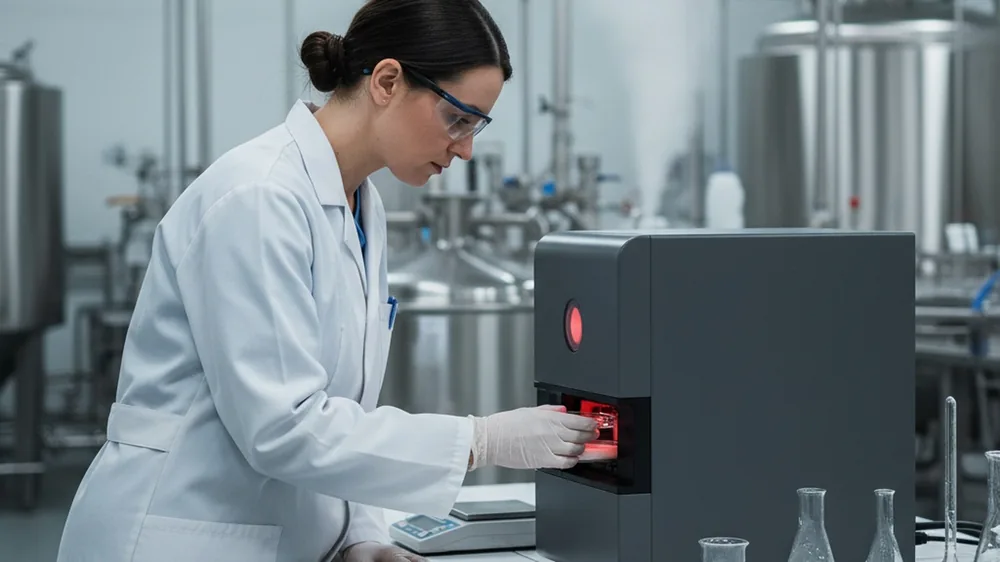
When I work with clients who are getting the most from their instruments, they're not just collecting prediction numbers. They're reviewing spectral diagnostics, tracking calibration statistics over time, and connecting NIR outputs directly to purchasing, formulation, and blending decisions. That's the difference between a fast lab test and a real process monitoring tool. Our guide to NIR calibration model best practices covers seven habits that keep models performing reliably across seasonal changes and supplier variation.
Here's the practical takeaway: if your calibration was built more than 12 months ago and you haven't run a single QC check against reference samples, you don't actually know what your instrument is reporting today. Set up a monthly check with five to ten well-characterised samples, plot the RMSEP on a control chart, and you'll catch problems early enough to fix them without a production disruption.
Related Articles
- How to Know When NIR Outperforms Wet Chemistry in Feed and Grain Quality Testing — A practical decision guide on when to use NIR instead of wet chemistry, including specific analyte and matrix guidance.
Continue Learning
Further Reading
Selected references drawn from the NIR Accuracy Course supplemental materials.
- (n.d.). Accurate Analysis: NIRS versus Wet Chemistry. Forage Lab technical comparison paper https://www.foragelab.com/media/accurate%20analysis%20nirs%20versus%20wet%20chemistry.pdf
- (n.d.). ISO 6492:1999. Animal feeding stuffs — Determination of fat content (Soxhlet) https://www.iso.org/standard/12770.html
- (n.d.). The Role of Chemometrics in Enhancing the Accuracy of Analytical Data in Complex Mixtures. This article provides a general overview of how chemometrics, including PCA and PLS, improves the accuracy of analytical data. https://www.walshmedicalmedia.com/open-access/the-role-of-chemometrics-in-enhancing-the-accuracy-of-analytical-data-in-complex-mixtures-131404.html
- (n.d.). AOAC International. Official methods of analysis for food and agricultural products https://www.aoac.org/official-methods-of-analysis/
SpectroScience students get access to the Calibration Validation Tracker — track RMSECV, RMSEP, bias, and slope correction across calibration updates and instrument transfers. Available as a free download in the student resource library.
Access the Excel libraryFree tool — NIR Feasibility Checker: The NIR Feasibility Checker walks you through five questions about your sample and analyte and tells you whether NIR is the right tool — or whether wet chemistry will still beat it for your matrix. Open the Feasibility Checker →
Free tool — NIR Glossary: Unfamiliar with a term? The SpectroScience NIR Glossary defines every chemometrics, calibration, and instrument term used in this article in plain language with worked examples. Open the Glossary →
Free tool — Calibration Metrics Calculator: Enter your reference values and NIR predictions in the Calibration Metrics Calculator to compute RMSEP, RPD, R², and bias the way our course teaches it — with interpretation thresholds for grain, dairy, and feed. Open the Metrics Calculator →
Free tool — Beer-Lambert Calculator: The Beer-Lambert Calculator works the absorbance = ε·b·c relationship in both directions — useful when sizing path length for a new sample type or sanity-checking a calibration curve. Open the Beer-Lambert Calculator →
NIR Fundamentals Course — Lesson 23: Introduction to Calibration
This lesson provides an in-depth look at the calibration process in NIR spectroscopy, emphasizing the importance of selecting appropriate algorithms and refining parameters. It complements the article by detailing how to ensure that the calibration model accurately reflects the chemical signals of the samples being analyzed.
Explore Lesson 23 in the NIR Fundamentals CourseWant to Master NIR Spectroscopy?
Our 32-lesson online course covers everything from Beer-Lambert Law to PLS calibration — built for food, grain, feed, and dairy professionals.