NIR Calibration Validation Pitfalls and Keeping Performance Reliable Over Time
Learn the most common NIR calibration validation pitfalls and how to keep predictions accurate over time in food, feed, and grain operations.
· 8 min read · Vitaly Kirkpatrick
NIR calibration programs often perform well for months before predictions start drifting — and when they do, the root cause is rarely the instrument. More often, a validation gap was present from the start, waiting for conditions to expose it. A calibration that looked strong on paper can fail because the training samples did not represent the material arriving in a different season, or because the reference lab had a technician change that nobody logged. These are not hypothetical problems. They show up regularly in food and feed operations, and they are preventable.
\nCommon Pitfalls That Undermine Validation
\nA calibration can clear every internal benchmark and still fall apart in production. Here is where programs most often go wrong:
\n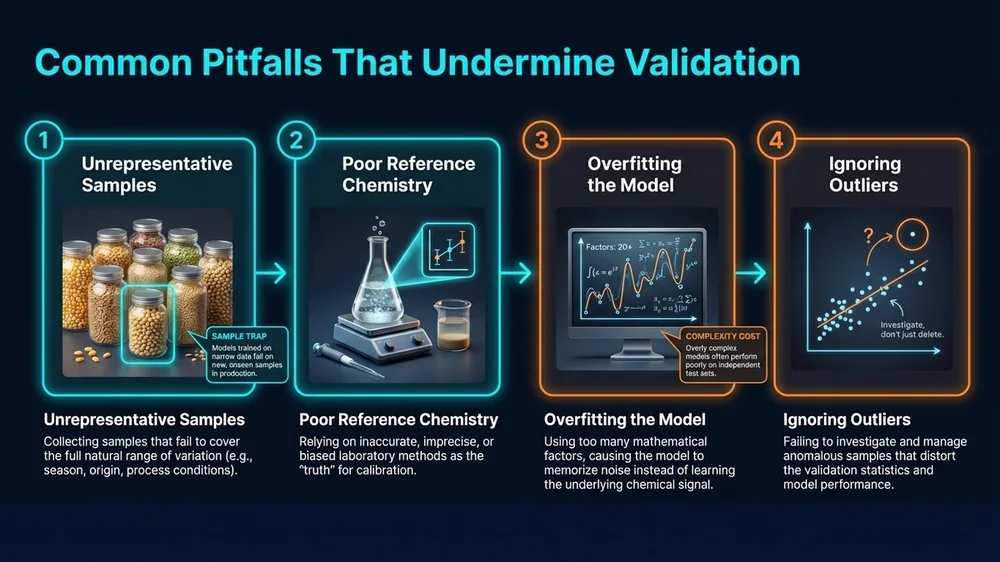
| Pitfall | Why It Matters | How to Avoid |
|---|---|---|
| Using calibration samples that don't represent future samples | Model fails on samples outside its experience | Collect diverse, representative samples spanning expected ranges |
| Reference method errors | Model learns wrong "truth," producing consistently wrong predictions | Ensure precise, accurate reference methods and quality control |
| Ignoring outliers without investigation | Potential hidden issues degrade model performance | Analyze and understand outliers rather than discarding them blindly |
| Relying solely on internal cross-validation | Overestimates model accuracy | Always perform independent external validation |
Think of a calibration model like a technician who has only ever seen wheat from one supplier. Put a new variety from a different growing region in front of them and their judgment breaks down. Not because they are bad at the job, but because their experience does not cover the new situation. That is exactly what happens when a training set is not diverse enough. The model predicts confidently — and predicts wrong.
\nReference method errors deserve their own attention. If Kjeldahl results carry a consistent 0.3% positive bias — because digestion time drifted, for example — the NIR model learns that bias as truth. Every prediction carries that error forward, invisibly, into every batch decision the lab makes. This kind of problem has cost grain elevators real money in protein giveaway before anyone traced it back to the wet chemistry bench. For a deeper look at how reference method accuracy limits what NIR can achieve, see our article on why your reference method limits NIR accuracy.
\nCross-validation alone gives a false sense of security. It reuses the same samples for training and testing. This inflates R² and makes RMSEP look tighter than it really is. Every calibration needs an independent external validation set — samples the model has never seen — before it is trusted with production decisions. Our article on NIR calibration overfitting and three validation methods walks through how to structure that process correctly.
\nKeeping Your Calibration Reliable Over Time
\nValidation is not a one-time checkbox. Raw materials shift with seasons and suppliers. Instrument optical components age. Any of those changes can move predictions off target without triggering an obvious alarm.
\nThe programs that stay accurate share one habit: they run routine performance checks with control samples of known values. They track residuals over time — not just glance at them.
\n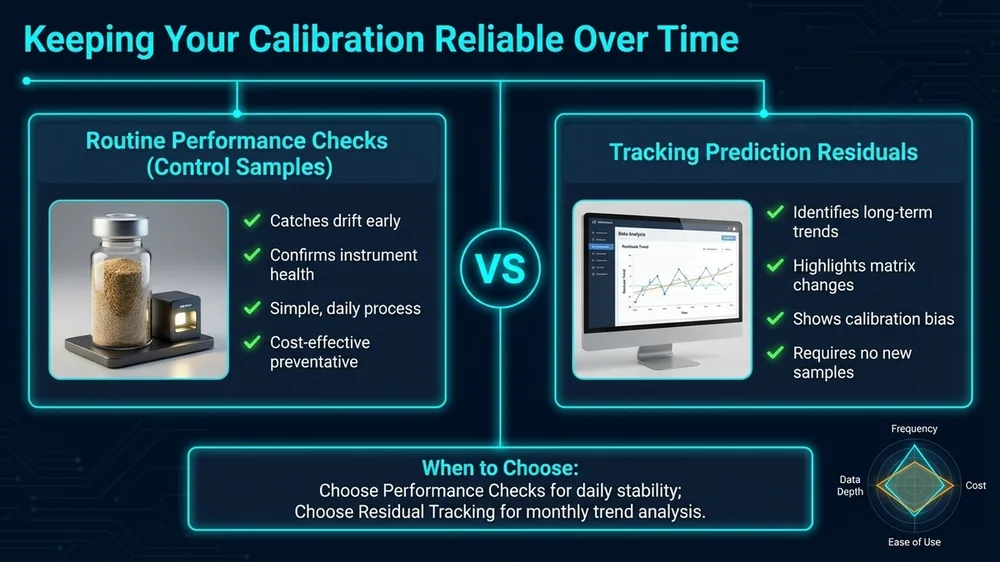
Field tip: Maintain a small set of well-characterized, stable control samples — ideally from multiple points across your constituent range — and run them on a fixed schedule. Charting those residuals over weeks and months gives you an early-warning system for instrument drift or model degradation. This approach is far more sensitive than waiting for complaints about results.
Control charting NIR residuals works the same way a flour mill charts particle size. A single out-of-range result may be noise. A trend of three or four consecutive results drifting in the same direction — even if each is still within spec — is a signal. Catching drift at that stage, before it crosses your acceptance threshold, is the difference between a 30-minute recalibration and a full model rebuild.
\nWhen residuals start widening, act before production raises a complaint. Collect new samples from the current material, add them to the dataset, retrain, and validate again. Proactive updates done on a schedule — rather than in response to a crisis — keep predictions trustworthy across seasons, supplier changes, and equipment wear. Our article on reducing NIR calibration drift for better QC covers practical update schedules in more detail.
\nOne area that does not receive enough attention: documentation. Auditors will want a full history of calibration versions, validation results, and the dates changes were made. A well-maintained calibration log is also the best defense if a customer disputes a batch result. It shows exactly what the instrument was predicting, against what reference standard, on that specific date.
\nValidation Is Your Calibration's Safety Net
\nNIR calibration is the engine behind every prediction an analyzer makes. Without proper validation — cross-validation, external testing, residual analysis, and bias checks — the operation is trusting a model that has not been tested against the real world.
\nValidation shows where a calibration holds up and where it does not. That knowledge determines when to trust the number and when to pull a wet chemistry check.
\n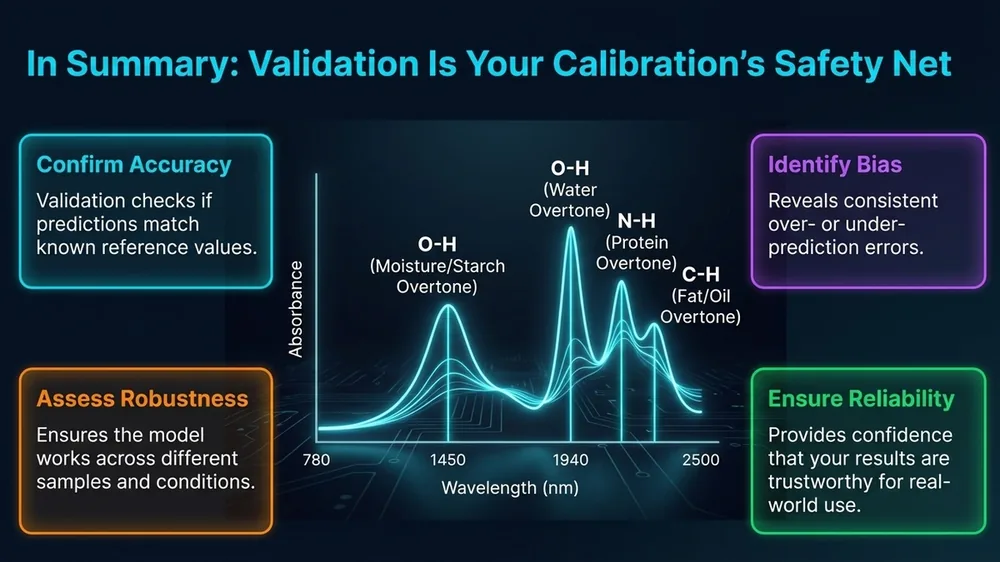
The practical takeaway: build a monitoring routine before it is needed. A small set of stable control samples, a residual chart updated weekly, and a clear trigger point for when to investigate — that system keeps a lab from discovering drift through a customer complaint or a failed audit. Set it up early, and NIR calibration stays an asset instead of becoming a liability.
\nRelated Articles
\n\nFurther Reading
Selected references drawn from the NIR Accuracy Course supplemental materials.
- (n.d.). NIR method validation: critical performance parameters. This conference paper discusses critical performance parameters for NIR method validation, referencing regulatory guidelines and technical standards. https://www.spiedigitallibrary.org/conference-proceedings-of-spie/4626/1/NIR-method-validation-critical-performance-parameters/10.1117/12.491167.full
- Sadergaski, L. (2022). Understanding SEP and Bias in Chemometric Models. This source clarifies that SEP is a bias-corrected version of RMSEP, explaining how bias can step by step affect prediction accuracy in chemometric models. https://pmc.ncbi.nlm.nih.gov/articles/PMC8892473/
- International Conference on Harmonisation (ICH). (1995). Validation of Analytical Procedures. This guideline discusses the characteristics to consider during the validation of analytical procedures, including definitions for accuracy, precision, specificity, detection limit, quantitation limit, linearity, and range. https://www.ema.europa.eu/en/documents/scientific-guideline/ich-guideline-q2r1-validation-analytical-procedures-text-methodology-step-5-first-version_en.pdf
SpectroScience students get access to the Calibration Validation Tracker — track RMSECV, RMSEP, bias, and slope correction across calibration updates and instrument transfers. Available as a free download in the student resource library.
\nAccess the Excel library\n\n\nFree tool — Calibration Metrics Calculator: Enter your reference values and NIR predictions in the Calibration Metrics Calculator to compute RMSEP, RPD, R², and bias the way our course teaches it — with interpretation thresholds for grain, dairy, and feed. Open the Metrics Calculator →
Free tool — NIR Glossary: Unfamiliar with a term? The SpectroScience NIR Glossary defines every chemometrics, calibration, and instrument term used in this article in plain language with worked examples. Open the Glossary →
Free tool — NIR ROI Calculator: Plug your sample volume, current method cost, and analyte spec into the SpectroScience NIR ROI Calculator to see annual savings and payback period for your operation. Open the ROI Calculator →
Free tool — Beer-Lambert Calculator: The Beer-Lambert Calculator works the absorbance = ε·b·c relationship in both directions — useful when sizing path length for a new sample type or sanity-checking a calibration curve. Open the Beer-Lambert Calculator →
NIR Fundamentals Course — Lesson 24: Validation Techniques
This lesson focuses on various validation techniques needed for ensuring the reliability of NIR calibrations over time. It emphasizes the importance of regular validation checks and the need to adapt models based on real-world sample variations to prevent performance degradation.
Explore Lesson 24 in the NIR Fundamentals courseWant to Master NIR Spectroscopy?
Our 32-lesson online course covers everything from Beer-Lambert Law to PLS calibration — built for food, grain, feed, and dairy professionals.