NIR Calibration Overfitting: Why It Happens and Three Validation Methods
Learn how nir calibration overfitting happens in food and feed labs and how to catch it using cross-validation, test sets, and external validation.
· 8 min read · Vitaly Kirkpatrick

Here's the thing — I've seen this exact scenario at grain elevators and feed mills more times than I can count. A calibration goes into routine use. R² is 0.99, RMSEC looks perfect. Three days later, operators are flagging predictions that don't match the reference lab, and the quality manager is on the phone wondering what went wrong. The answer is almost always the same: the team skipped proper validation before deployment. That's how overfitting costs you real money — not in a theoretical sense, but in bad batch decisions, protein giveaway, and the time it takes to explain incorrect results to your auditors.
Calibration models don't fail on samples they've already seen. They fail on new ones. That's overfitting: the model memorized the calibration set instead of learning the underlying spectral-chemical relationship. Validation is how you catch that before it causes real damage in your lab. For teams building their first calibrations or troubleshooting existing ones, the guidance at NIR Calibration: Why It's needed and How It Works provides a useful starting point.
Calibration stats like R² and RMSEC only confirm the model fits data it has already seen. Validation metrics test on data the model hasn't seen — and that difference is everything when it comes to real-world performance.
Why Overfitting Is the Most Common NIR Calibration Failure
Overfitting happens when a model fits training data too tightly. It learns the noise alongside the signal. In NIR work, that noise might be subtle instrument fluctuations between scans, or sample-prep inconsistencies that carry no real chemical meaning. The model doesn't know the difference — it just fits whatever pattern is there.
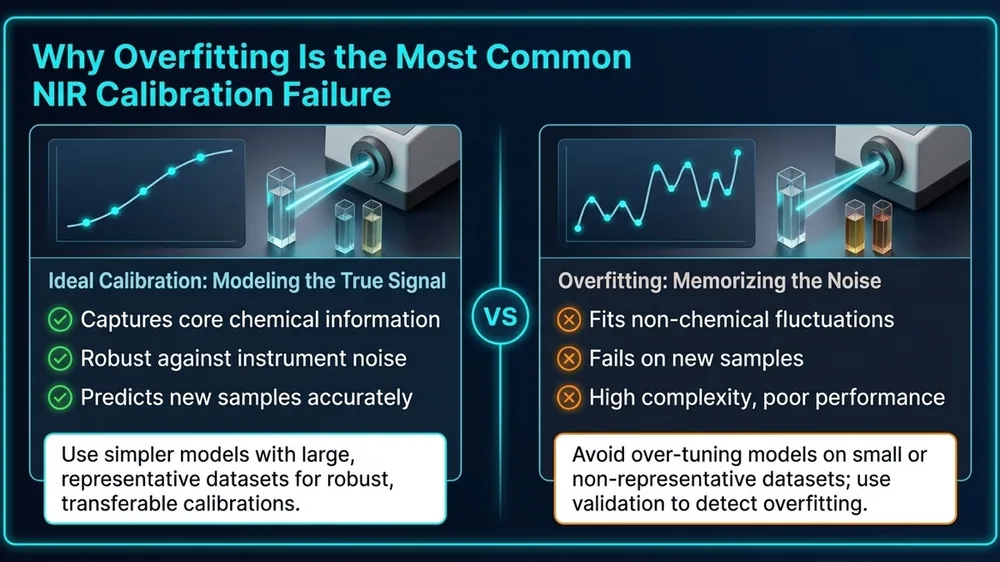
During plant visits I've observed moisture models built for grain elevators — 80 calibration samples, calibration stats that looked perfect — where errors ran nearly double the expected SEP during the first production week. The model had latched onto quirks in those specific samples, not the actual moisture signal. And that's an expensive lesson to learn in production.
Watch out: A model with a high R² and low RMSEC during calibration can still fail badly on new samples. If validation errors are a lot worse than calibration errors, the model has overfitted — and it will drift the moment real-world variation enters the picture.
Think of it like teaching someone to recognise a customer's voice by playing them the same three recordings on a loop. They'll nail those three every time. Play them a new recording from the same customer on a different phone, and they're lost. A good calibration captures the spectral patterns that genuinely predict composition — not random variation in the training set.
High R² and low RMSEC during calibration only confirm the model fits known data. They say nothing about how your calibration will perform on next month's incoming grain. The quality of the underlying reference data and how representative the sample set is are equally important factors — both covered in detail at NIR Calibration: Reference Data Quality and Sample Representation.
Key distinction: Calibration stats (R², RMSEC) are optimistic by design — they measure fit on the data used to build the model. Validation metrics (RMSECV, SEP, R²P) test on data the model hasn't seen. If validation errors are a lot worse than calibration errors, NIR calibration overfitting has occurred and the model needs to be revised before deployment.
Warning Signs of an Overfitted NIR Model
Not all overfitting is obvious in the calibration output. Knowing what to look for saves time and prevents bad results from reaching your production reports.
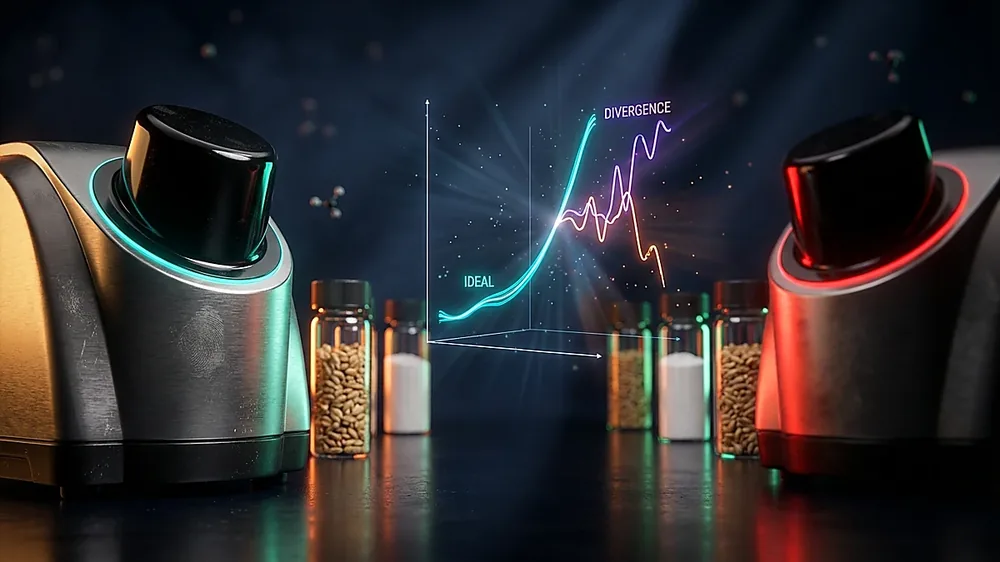
The clearest sign is a large gap between calibration error and validation error. An RMSEC of 0.08% moisture paired with an RMSECV of 0.21% is a red flag. A well-generalised model keeps those two numbers close. When they diverge by more than a factor of two, model complexity needs to be revisited.
A second warning sign is an unusually high number of latent variables in a PLS calibration. Using 12 or 15 factors to model a single constituent in grain is almost always a sign the model is chasing noise. For most food and feed applications, a well-built model uses between 4 and 8 latent variables. Teams working through PLS model construction for the first time will find the guidance at Why NIR Spectroscopy Needs Chemometrics: PLS, PCR, and Key Techniques Explained useful for understanding how factor selection affects generalisation.
A third sign appears after deployment. If SEP starts climbing within the first few weeks of routine use — without any obvious change in instrument performance — the model likely overfitted to conditions in the original calibration set. New batches, new suppliers, or even seasonal variation in raw materials are enough to expose a model that was never properly generalised.
Rule of thumb: If RMSECV is more than twice RMSEC, or if SEP degrades noticeably within the first month of production use, treat it as confirmed overfitting. Rebuild with tighter latent variable selection criteria and a broader sample set before redeployment.
How Model Complexity Drives Overfitting
One of the most actionable levers in calibration development is the number of latent variables included in the model. Adding more factors always improves fit on calibration data. That's not a sign of a better model — it's a sign of a more complex one. At some point, additional factors stop capturing real chemical information and start encoding random variation unique to that training set.

A practical check: plot RMSECV as a function of the number of latent variables. In most grain and feed applications, RMSECV drops sharply through the first four to six factors, then levels off or begins to rise slightly. The right factor count sits at or near that minimum. If RMSECV keeps falling even at 10 or 12 factors, the training set is too small or too homogeneous — the model is fitting it completely rather than finding the underlying pattern.
Sample set size directly affects overfitting risk. A model trained on 40 samples with 10 latent variables has only 30 degrees of freedom — not enough to generalise reliably. As a baseline, SpectroScience recommends a minimum of 10 to 15 samples per latent variable retained in the final model. A 6-factor protein model for soybean meal should have at least 60 to 90 calibration samples spanning the full expected composition range.
Three Ways to Validate Your NIR Calibration
Validation isn't one-size-fits-all. Depending on how many samples are available and where the process stands, one of three approaches — or a combination — will be the right fit for your lab.
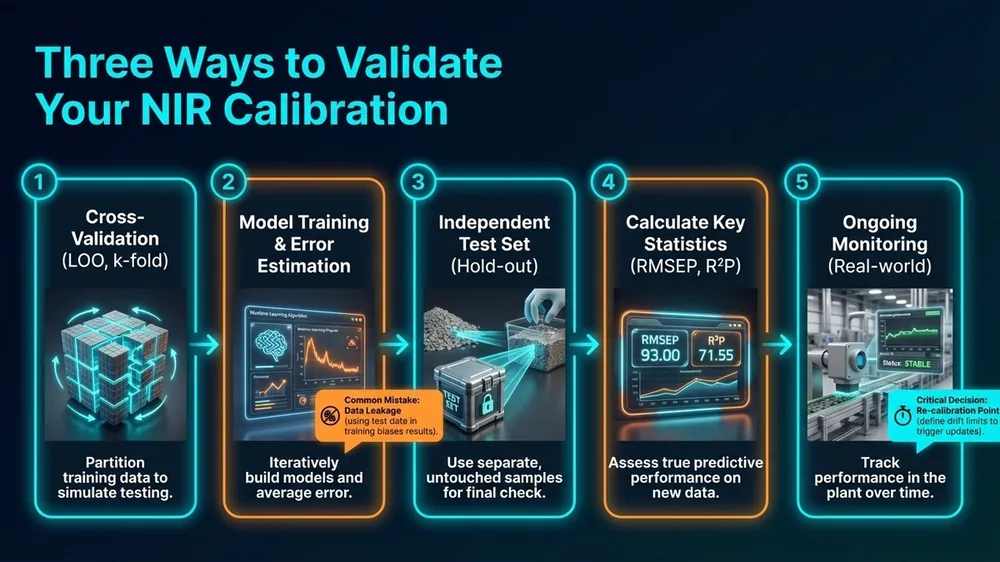
1. Cross-Validation: When Samples Can't Be Spared for Testing
Cross-validation is the practical choice when the sample set is tight. It splits calibration data into subsets, trains on most of them, tests on the rest, and rotates through every subset step by step.
Leave-One-Out (LOO) cross-validation takes it to the extreme. For N samples, N models are built — each time holding one sample out, predicting it, then rotating. After every sample has been predicted once, RMSECV is calculated. LOO uses data efficiently, which matters when working with 50 or 60 samples. The downside: it's slow, and because each training set is nearly the full dataset, it can be slightly optimistic.
K-Fold cross-validation divides data into K groups — typically 5 or 10. K models are built, each training on K-1 groups and testing on the remaining one. This method is faster than LOO and often provides more stable error estimates. The training sets differ more from one rotation to the next, which makes it a better stress test.
Cross-validation is the right tool for tuning model complexity — picking the number of latent variables, for instance. It won't show whether your calibration holds up six months from now on different-origin soybeans, though. It only tests against samples closely related to the calibration set — same batches, same instrument, same time period.
2. Independent Test Set: The Most Honest Performance Check
If you can collect a separate group of samples independently from the calibration set, set them aside before building anything. This independent test set simulates what the model will actually face in production — new batches, possibly from different suppliers, with different operators running the instrument.
The test set is predicted only after the model is fully built. Those samples are never touched during development. The SEP and R²P from this step serve as the honest report card. In one feed mill application I've seen documented, a standard of at least 30 independent test samples was required before any model went into routine use. That standard caught two overfitted models that had looked fine on cross-validation alone.
When constructing an independent test set, sample diversity matters as much as count. The test set should include samples from multiple suppliers, different production dates, and ideally different seasons. A test set drawn entirely from one week of production at a single facility won't challenge the model the way a diverse set will. If the composition range in the test set is narrower than what you expect in production, SEP will look artificially good.
This approach takes more samples and more planning. But it's the most reliable way to confirm your calibration will hold up in the real world. Where sample volume allows, it should always be the final gate before deployment.
3. External Validation: Keeping the Model Honest Over Time
Validation doesn't end at deployment. Raw materials shift, instruments age, and seasonal variation in incoming grain changes the spectral picture. A model that performed well in October may start drifting by March.
Most QC teams run periodic checks — blind samples or secondary standards measured alongside routine production. SEP should be tracked against reference lab values over time. When that number begins to creep up, it signals an investigation is needed before a real problem reaches your production reports. In high-throughput environments like pet food or dairy processing lines, reviewing model performance at least quarterly is the recommended minimum.
External validation also catches instrument drift that cross-validation and test set validation can't. A detector that's beginning to degrade, a light source that's aging, or a shift in temperature management in the sample presentation area can all introduce step-by-step error that accumulates slowly. Tracking bias — the signed difference between NIR predictions and reference values — alongside SEP makes it easier to separate model degradation from instrument issues. A rising SEP with a consistent bias points to an instrument problem. A rising SEP with random scatter suggests the model is encountering composition variation it wasn't trained on.
Field tip: Set a control chart for SEP tracked against the reference lab over time. A steady upward trend is an early warning signal. Catching drift at the 5% level is far cheaper than diagnosing it after results have been reported incorrectly for weeks.
What to Do When Validation Reveals a Problem
When validation metrics confirm NIR calibration overfitting, the path forward depends on where the failure is occurring. The most common corrective actions fall into three categories.

First, reduce model complexity. If RMSECV is climbing as factors increase, you've exceeded the right factor count. Rebuilding with fewer latent variables is often the fastest fix. A model that was using 12 factors may perform better and generalise more reliably at 5 or 6.
Second, expand the sample set. Overfitting is more likely when calibration samples don't represent the full range of variation the model will encounter. Adding samples from different suppliers, different crop years, or different processing conditions gives the model more genuine variation to learn from — and less incentive to memorise quirks in the original set. Teams that have run into this problem will find the step-by-step diagnostic approach at Diagnosing NIR Calibration Problems: A step-by-step Approach a practical guide for working through the root cause.
Third, review your reference data quality. Overfitting is sometimes driven not by too many latent variables but by errors in the reference values themselves. A model trying to fit noisy or inconsistent reference chemistry will add factors to accommodate that noise. If RMSECV is stubbornly high regardless of factor count, audit your reference lab data for outliers, instrument drift, or method inconsistencies before touching the model.
Validation Standards by Application Type
Not every NIR application carries the same performance requirement. Understanding what validation thresholds are appropriate for your context prevents both over-engineering and under-validating.

In grain receiving operations, moisture models are often held to an SEP of 0.2% or better on an as-is basis. Protein models for wheat or soybeans typically need SEP below 0.3% to be commercially useful. An independent test set of 40 to 60 samples spanning the full growing season is the baseline validation target.
In feed mill applications, where formulation accuracy depends directly on NIR-predicted composition, the bar is higher. Models predicting crude protein in mixed rations are typically expected to achieve SEP below 0.4% with bias under 0.1%. External validation with monthly blind checks against the reference lab is standard practice in well-run operations.
In dairy processing, where constituent measurements feed directly into payment calculations or regulatory reporting, cross-validation alone isn't considered sufficient. Independent test sets and external validation schedules are standard requirements. The performance benchmarks in dairy NIR applications are discussed further at NIR in Dairy Processing: Real-Time Inline Monitoring.
In oilseed processing, where oil content predictions influence extraction yield decisions worth real dollars per tonne, a combined approach is warranted: cross-validation during model development, an independent test set before deployment, and quarterly external validation checks against the primary reference method. Cutting corners on any one of those three steps is where the expensive mistakes happen.
As a general guideline across food and feed applications: RMSECV should be no more than 1.5 times RMSEC in a well-built model. An RMSECV-to-RMSEC ratio above 2.0 is a reliable indicator of NIR calibration overfitting and warrants a rebuild before the model is used in production decisions.
Free tool — NIR ROI Calculator: Plug your sample volume, current method cost, and analyte spec into the SpectroScience NIR ROI Calculator to see annual savings and payback period for your operation. Open the ROI Calculator →
Free tool — Calibration Metrics Calculator: Enter your reference values and NIR predictions in the Calibration Metrics Calculator to compute RMSEP, RPD, R², and bias the way our course teaches it — with interpretation thresholds for grain, dairy, and feed. Open the Metrics Calculator →
SpectroScience students get access to the Calibration Validation Tracker — track RMSECV, RMSEP, bias, and slope correction across calibration updates and instrument transfers. Available as a free download in the student resource library.
Access the Excel libraryNIR Fundamentals Course — Lesson 24: Validation Techniques
This lesson focuses on various validation techniques that are essential for ensuring the robustness of NIR calibration models. It emphasizes the importance of testing models on unseen data to avoid overfitting and provides practical methods to validate model performance in real-world applications.
Explore Lesson 24 in the NIR Fundamentals courseWant to Master NIR Spectroscopy?
Our 32-lesson online course covers everything from Beer-Lambert Law to PLS calibration — built for food, grain, feed, and dairy professionals.