NIR Spectroscopy: How Near-Infrared Light Becomes a Usable Measurement
Learn how NIR spectroscopy turns near-infrared light into moisture, protein, and fat readings — with calibration guidance for food and feed labs.
· 12 min read · Vitaly Kirkpatrick
NIR Spectroscopy: How Near-Infrared Light Becomes a Usable Measurement
NIR spectroscopy is one of the most practical analytical tools available to food and feed operations — but its value depends entirely on understanding what the technology is doing to your sample. A grain elevator moving 50,000 bushels of corn per day cannot wait 20 minutes on wet chemistry for every load. An NIR instrument on the intake scale delivers that same result in under 30 seconds. That is not a best-case scenario. That is a routine outcome at operations that have set up NIR spectroscopy correctly.
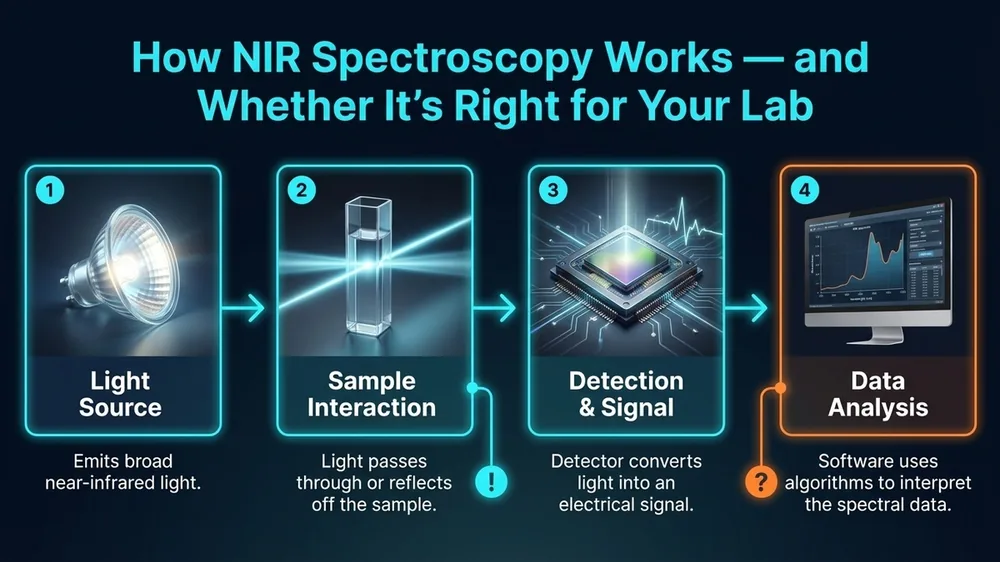
This article covers the physical process — what near-infrared light actually does when it hits a sample, and how an instrument converts that interaction into a number your QC team can act on. If you are evaluating NIR spectroscopy for the first time, or need to explain it to plant management, start here.
What NIR Light Does to a Sample
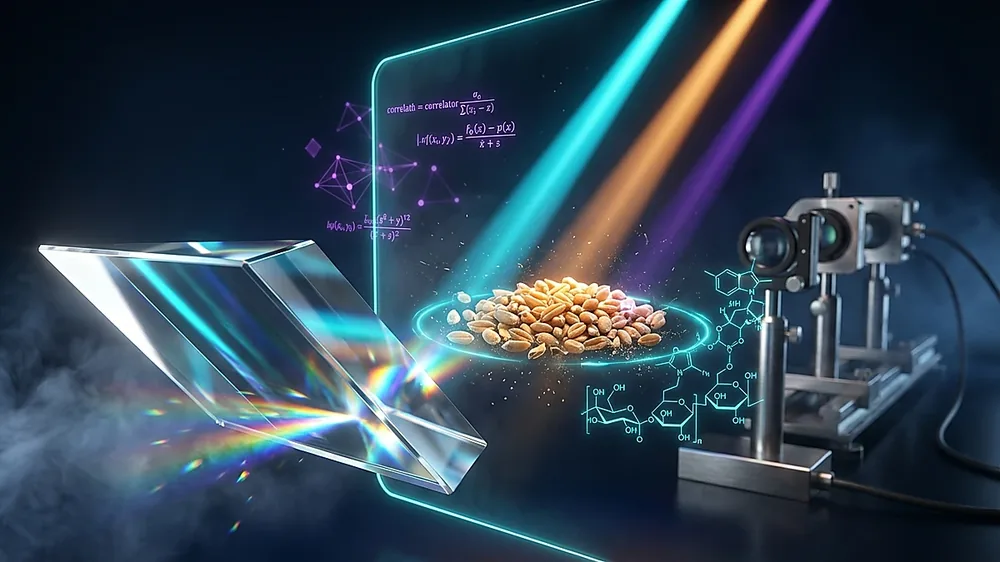
Near-infrared light sits in the 780 to 2500 nanometer range — just past what the human eye can detect. When it hits a sample, it does not simply bounce off the surface. It interacts with the molecular bonds inside the material.
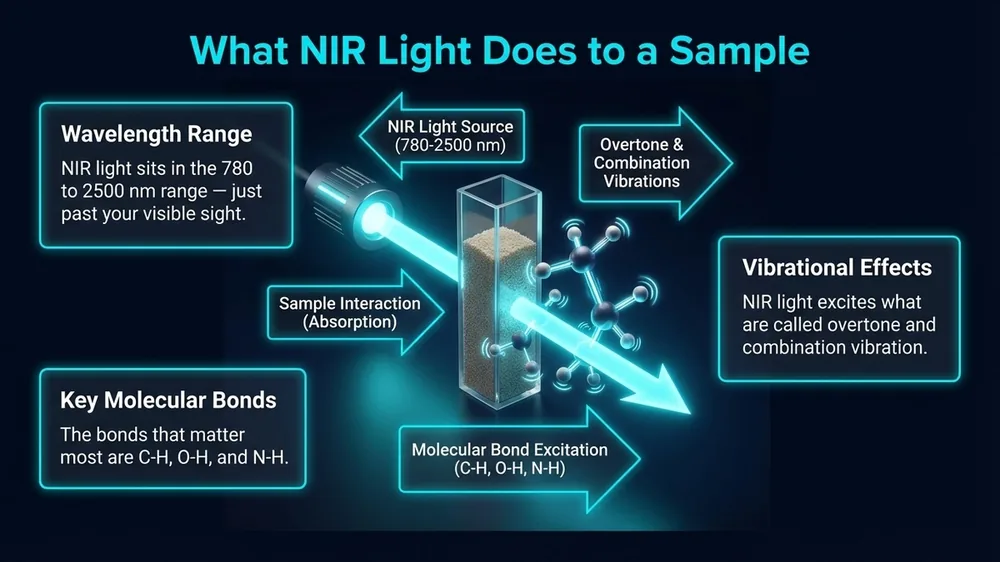
The bonds that matter most are C-H, O-H, and N-H. These vibrate at specific frequencies. NIR light excites what are called overtone and combination vibrations — harmonic responses that occur at predictable wavelengths above the basic mid-infrared region.
Each molecule produces a slightly different pattern of absorptions. That pattern is the sample's spectral fingerprint. For a deeper look at why molecular bonds vibrate and how NIR uses those vibrations, see SpectroScience's article on why molecules vibrate and how NIR uses that to predict composition.
NIR does not just reflect off the sample — it interacts with the molecular bonds inside. The unique pattern of absorptions at specific wavelengths is what makes quantitative measurement possible.
How an NIR Instrument Turns Light into a Usable Result
The process is straightforward. The instrument shines NIR light onto or through the sample. Certain wavelengths are absorbed by molecular bonds. The rest are reflected or transmitted to a detector.
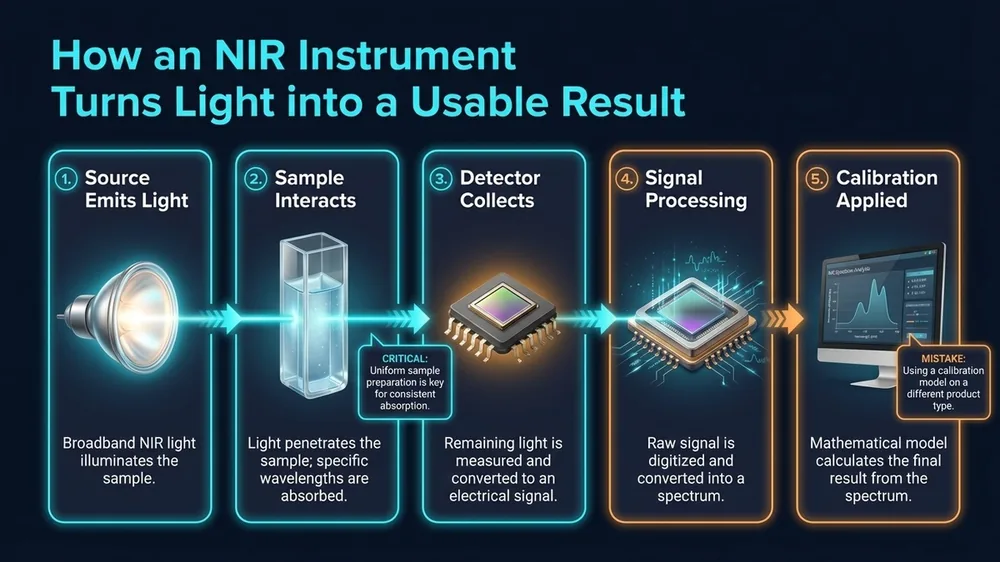
The detector logs how much light was absorbed at each wavelength. That produces a spectrum — a graph of absorption intensity across the full NIR range. Every peak and valley in that graph corresponds to something in the sample's chemistry.
Once a calibration model is in place, the instrument converts that spectral data into a number: moisture, protein, fat, or whatever parameter you are measuring. For a detailed breakdown of the physical components involved — light sources, monochromators, and detector types — SpectroScience's article on how NIR instruments work and what their key components do covers each element in practical terms.
The Role of the Spectrum: Reading the Sample's Chemical Fingerprint
One detail that surprises many QA managers is the sheer richness of data captured in a single scan. A typical NIR spectrum contains hundreds to thousands of data points across the wavelength range.
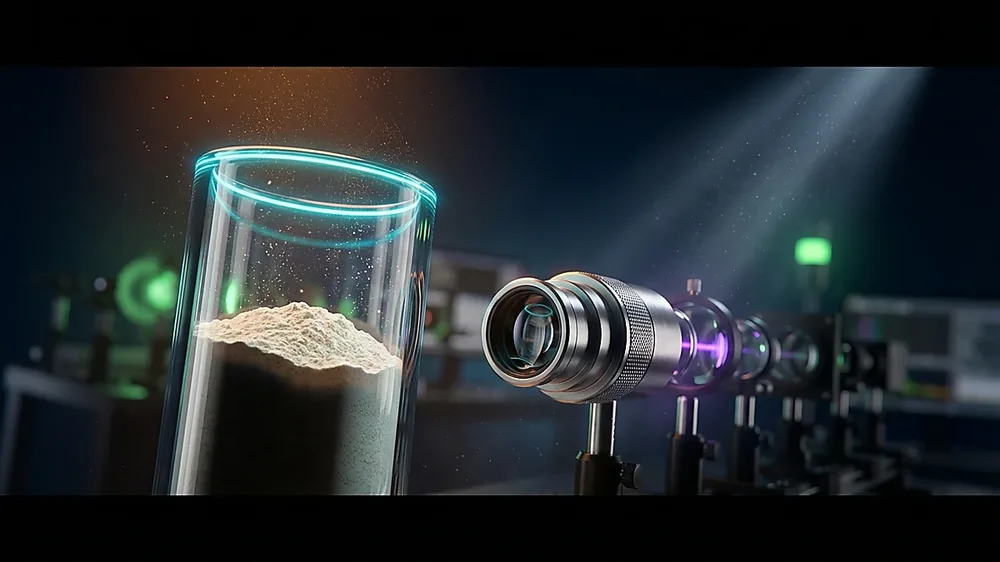
No single peak corresponds cleanly to a single analyte. In food and feed materials, the spectral bands overlap considerably:
- Protein absorbs strongly near 2050–2180 nm
- Moisture has broad O-H absorptions around 1450 and 1940 nm
- Fat shows strong C-H stretches near 1720 and 2310 nm
Because these bands overlap, the instrument cannot simply read a single wavelength to determine protein content. That is where chemometrics enters the workflow.
Think of a PLS calibration model as teaching an experienced grain buyer to identify a supplier by voice on the phone. They are not listening to one word — they are reading dozens of subtle patterns at once to arrive at a confident answer. Calibration models use multivariate mathematics — most commonly partial least squares (PLS) regression — to extract the relevant signal from overlapping spectral data and correlate it with reference chemistry values.
The accuracy of the prediction depends entirely on how well your calibration was built and how representative the training samples were of the material being tested.
What You Gain by Switching to NIR Analysis
Many labs have cut sample turnaround from 20 minutes down to under 30 seconds by moving from wet chemistry to NIR spectroscopy. That is typical across grain, feed, and dairy operations running high daily sample volumes. Here is what drives the difference:
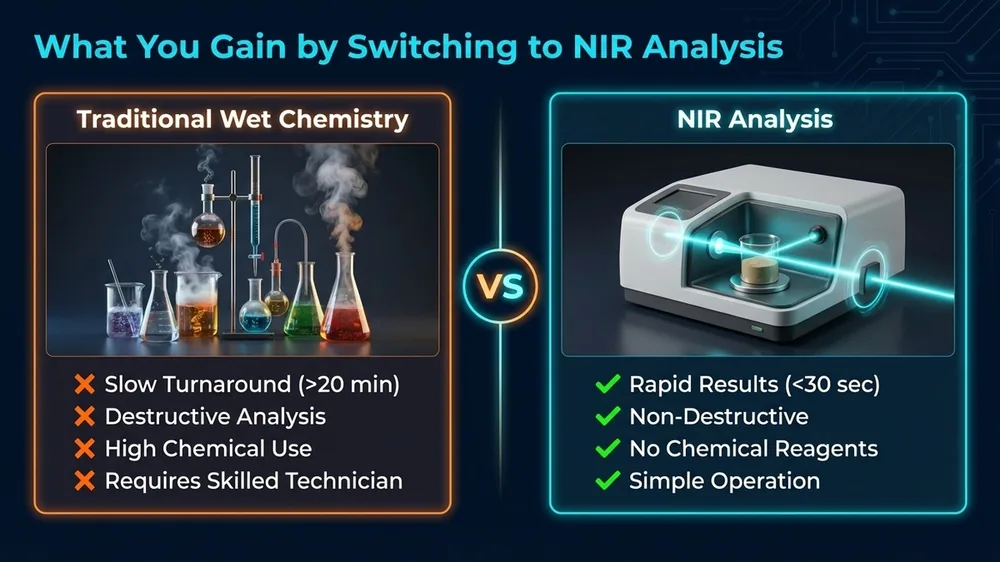
- Non-destructive testing: The sample stays intact. That matters when holding retained samples for dispute resolution or testing expensive finished products.
- Minimal sample prep: Most grain, feed, and dairy applications need no grinding, dissolving, or reagents. The sample can be presented, scanned, and results obtained in under a minute.
- Speed: Results are delivered in seconds. Dairy processing plants handling large production volumes can measure moisture and fat content in each batch without slowing down the line. A single benchtop NIR unit can process 200 or more samples per day with no analytical bottleneck.
- Multiple parameters at once: One scan provides moisture, protein, fat, and fiber simultaneously. That replaces four wet-chemistry tests with a single 15-second measurement.
- Lower cost per sample: No reagents, less labor, less waste disposal. At high sample volumes, the savings accumulate quickly. Operations running 100 or more samples per day typically recover instrument costs within 12 months.
Where NIR Fits Best in Food and Agricultural Operations
Not every application is a perfect fit for NIR spectroscopy. Across grain elevators, feed mills, and dairy plants, a clear pattern emerges in where NIR delivers the most value — and where it needs support from reference methods.
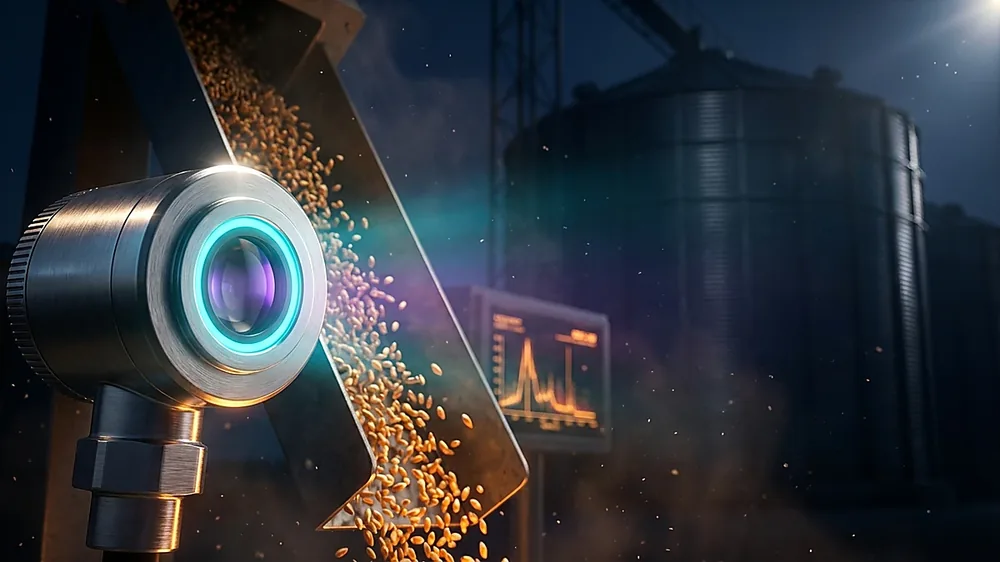
In grain handling, NIR earns its place at the intake scale. A single elevator moving 50,000 bushels of corn per day cannot afford to wait on Kjeldahl nitrogen tests for protein. NIR gives the receiving team a result in under a minute. That speeds up grading decisions and keeps trucks moving.
Facilities running 200 or more samples per day through a single benchtop unit see no bottlenecks. For a closer look at how this plays out operationally, SpectroScience's article on NIR in grain receiving operations walks through real-time quality decisions at the scale.
Feed mills benefit from NIR at two points: incoming raw material verification and finished product release. Incoming ingredient variation — especially in soybean meal and distillers grains — directly affects formula performance. NIR catches a high-moisture or low-protein lot before it enters the mixer. That one catch can prevent a full batch loss worth thousands of dollars in ingredient and processing costs.
Dairy operations use NIR heavily in both raw milk receiving and finished product QC. Fat and protein in raw milk determine payment in most markets. Having an NIR result at receiving — rather than waiting for a lab turnaround — gives procurement teams real use in acceptance decisions. Inline NIR systems in dairy processing can monitor cream separation efficiency and standardized milk composition in real time, reducing giveaway on high-value components.
Understanding NIR Calibration: The Foundation of Accurate Results
The instrument itself is only half the equation. The calibration model translates spectral data into accurate chemistry values. A model built on a narrow sample set will underperform when raw material shifts — a common situation with seasonal grain supplies and reformulated feeds.
Your calibration is only as good as the range of samples that went into building it. Good calibration practice means collecting reference samples across the full range of variability expected. That includes different origins, harvest years, and processing conditions.
Most instrument vendors provide global or regional calibrations as a starting point. But if your operation has unusual raw materials or tight specification windows, building a local calibration — or at minimum validating the global one against reference data — is worth the investment.
Calibration also requires maintenance. As ingredient supplies change, the model may drift. Running periodic check samples against a reference method is standard practice. Most operations do this monthly. Some conduct it weekly during harvest season when incoming grain variability is at its peak.
When evaluating NIR for the first time, understanding how calibration models are built and validated should be part of your procurement process. Vendors can provide SECV and R² values on the specific parameters and matrices being measured. A calibration with R² of 0.97 and SECV of 0.3% for soybean meal protein is meaningful. A calibration with R² of 0.85 on a narrow range of samples is not. Do not accept a vendor's summary slide — ask for the actual calibration statistics on your matrix. SpectroScience's guide on why NIR calibration is essential and how it works covers what those numbers mean and how to evaluate them.
Common Misunderstandings About NIR Accuracy
A frequent point of confusion for operations managers evaluating NIR spectroscopy is equating spectral measurement with absolute chemical analysis. NIR does not directly measure chemistry. It measures light absorption and uses a statistical model to predict chemistry based on correlation with reference data. That distinction matters in several practical ways.
There are three limitations worth understanding clearly:
- Reference method quality sets the ceiling. NIR accuracy is bounded by the quality of the reference method used to build the calibration. If the Kjeldahl or Dumas nitrogen results used to build a protein calibration have poor reproducibility, the NIR model will reflect that noise.
- Predictions are only reliable within the calibration range. Testing a new ingredient type or a material with an unusual composition produces results with unknown accuracy. Stay within the range of samples used to build the model.
- Sample presentation affects spectrum quality. Particle size, temperature, and surface uniformity all affect the spectral signal before any chemistry is estimated.
None of these limitations disqualify NIR as a primary analytical tool. They define the conditions under which it performs reliably. Understanding those conditions — and building operational procedures around them — is what separates labs that consistently get value from NIR from those that run into ongoing calibration frustrations. The difference usually is not the instrument.
Is NIR the Right Fit for Your Operation?
For operations running more than 30 samples per day, measuring two or more parameters, and working with materials that have reasonable compositional variability, NIR spectroscopy will almost certainly pay for itself within the first year. The technology is mature, the instruments are reliable, and the calibrations for common food and feed matrices are well established.
Where NIR is not the right primary tool: trace mineral analysis, contaminant screening at very low detection limits, and applications where sample presentation is highly inconsistent. For those, wet chemistry or other analytical methods remain necessary.
For routine moisture, protein, fat, fiber, and starch measurement in grain, feed, dairy, and related food applications — NIR spectroscopy is the most practical analytical tool available. The speed, cost profile, and multi-parameter output are not matched by any wet chemistry workflow.
Operations considering the move from wet chemistry to NIR, or looking to expand an existing NIR program, will find a detailed decision approach in SpectroScience's guide on when to use NIR instead of wet chemistry.
The practical takeaway: before your next instrument conversation, get the SECV and R² for your specific matrix and parameter range. That one number tells you more about whether NIR will work in your lab than anything else in the vendor's presentation.
Free tool — Calibration Metrics Calculator: Enter your reference values and NIR predictions in the Calibration Metrics Calculator to compute RMSEP, RPD, R², and bias the way our course teaches it — with interpretation thresholds for grain, dairy, and feed. Open the Metrics Calculator →
Free tool — As-Is ↔ Dry Matter Converter: Use the As-Is ↔ Dry Matter Converter to translate any analyte value between as-received and moisture-free basis without doing the algebra by hand. Open the Converter →
SpectroScience students get access to the Chemometrics Cheat Sheet — PLS, PCR, cross-validation, RMSECV, RMSEP, and R² explained with practical interpretation guidelines. Available as a free download in the student resource library.
Access the PDF libraryNIR Fundamentals Course — Lesson 6: Light–Matter Interaction
This lesson explores the fundamental principles of light-matter interaction, detailing how near-infrared light interacts with molecular bonds in samples. Understanding these interactions is crucial for selecting the appropriate NIR instrument and optimizing its use in food and feed quality control.
Explore Lesson 6 in the NIR Fundamentals courseWant to Master NIR Spectroscopy?
Our 32-lesson online course covers everything from Beer-Lambert Law to PLS calibration — built for food, grain, feed, and dairy professionals.