Measure Protein, Moisture, and Fat in Seconds: How NIR Reads Molecular Bonds in Your Grain and Feed
Learn how NIR spectroscopy uses molecular bond vibrations to measure moisture, protein, and fat in grain and feed in under 30 seconds.
· 12 min read · Vitaly Kirkpatrick

Measure Moisture, Protein, and Fat in Seconds: How NIR Reads Molecular Bonds
A grain elevator receiving 40 truckloads of corn in a single morning can't wait 45 minutes per sample for oven moisture. NIR instruments measure moisture in under 30 seconds — and the reason that works comes down to one physical fact: chemical bonds vibrate, and each bond vibrates at a frequency unique to its chemistry. Think of it like a guitar string after a quick pluck — the note you hear depends on the string's tension, length, and thickness. Molecular bonds work exactly the same way. They're tiny springs holding atoms together, stretching, bending, and twisting at frequencies only they can produce. Every peak in a near-infrared spectrum is that molecule "singing" an overtone or combination band of a basic vibration. Understand that, and your instrument stops being a black box.
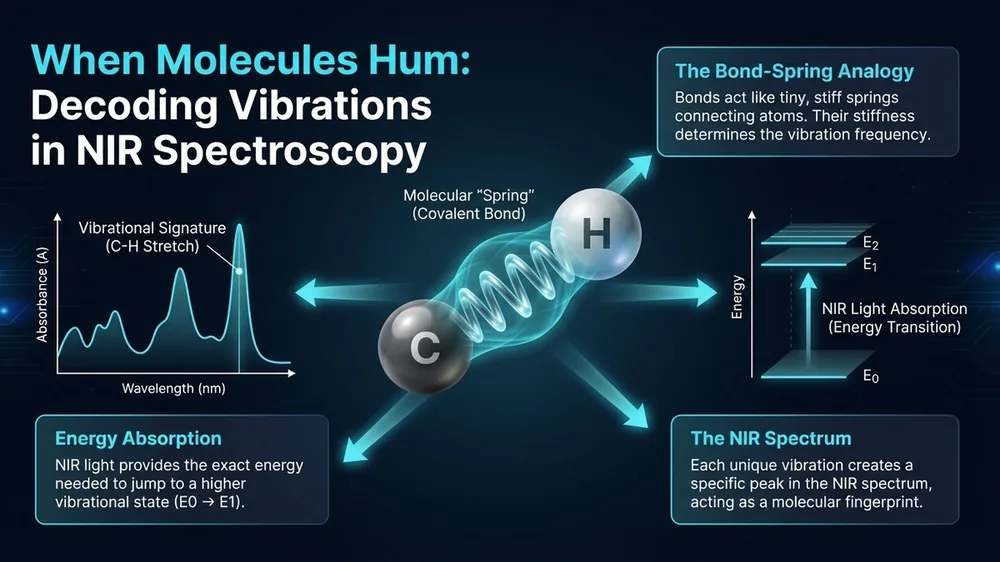
Every peak you see in a near-infrared (NIR) spectrum is the molecule "singing" a particular vibration — and that is exactly how NIR instruments measure moisture, protein, and fat simultaneously.
Types of Molecular Vibrations: More Than Just Stretching
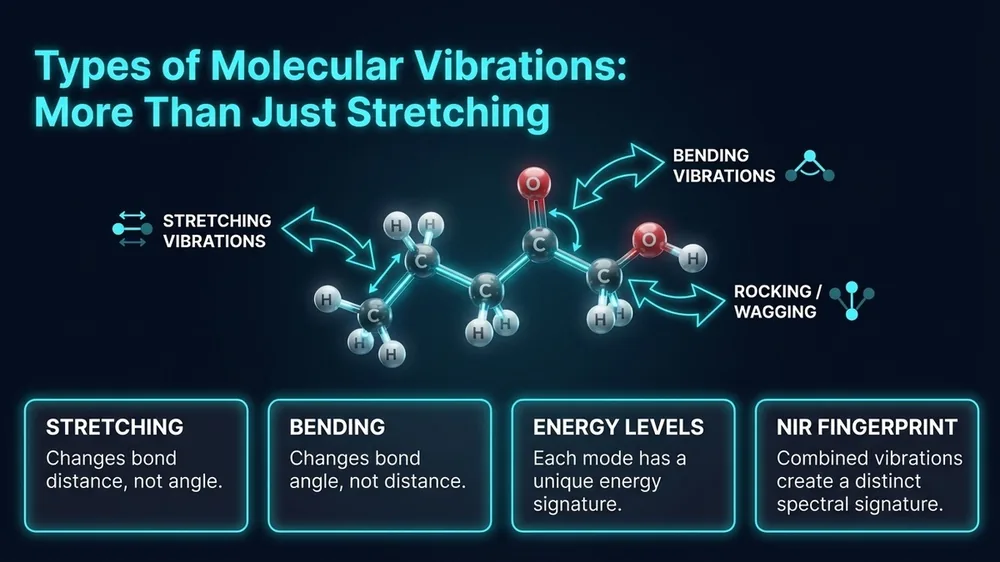
When a calibration behaves strangely across seasons — protein predictions drifting in summer, moisture readings that argue with the oven — the root cause is usually a shift in how specific bonds are vibrating in your matrix. Molecules don't vibrate in one simple way. They have a whole repertoire: stretching, which changes the distance between atoms, and bending, which tweaks the angle between bonds. Each mode carries its own energy signature.
For grain, feed, and oilseed operations, the analytically useful vibrations come from three groups: O-H bonds (moisture), N-H bonds (protein), and C-H bonds (fat and starch). These appear in every commodity you run through the instrument. Understanding which bond type corresponds to which analyte is the foundation for interpreting why your instrument responds the way it does across different commodities.
Stretching Vibrations: Pulling and Pushing Bonds
Symmetric stretching is like pulling both ends of a spring evenly. In a water molecule, both O-H bonds extend or contract together, staying in sync. This uniform motion requires a fair bit of energy because you're directly working against the bond's natural pull.
Asymmetric stretching is messier — one bond lengthens while the other shortens, like someone pushing one end of a spring while pulling the other. This uneven motion demands slightly more energy than symmetric stretching.
Because stretching changes bond length, it's more energy-intensive and shows up at higher frequencies — shorter wavelengths — on your spectrum. In practical NIR work, the first overtone of the O-H stretch sits near 1450 nm. This is one of the most reliable wavelength regions used to measure moisture in grain and dairy-ingredient sampling.
Bending Vibrations: Changing Angles, Not Lengths
Bending modes don't fight the bond's length — they alter the angle between bonds. Less energy required means they appear at lower frequencies, at longer wavelengths, than stretching.
Scissoring looks like two atoms closing toward each other in the same plane — picture the blades of scissors.
Rocking is a side-to-side sway within the molecular plane, like a rocking chair in gentle motion.
Wagging moves atoms out of the plane, similar to a dog wagging its tail. This is common in CH₂ and CH₃ groups.
Twisting involves rotation around the bond axis — atoms rotate but bond lengths stay put, like wringing a wet towel.
Why Energy Matters Here
Stretching vibrations require more energy than bending because you're directly stretching a chemical bond spring. Asymmetric stretching usually needs a bit more energy than symmetric because the motion is less uniform. This energy difference sets where peaks fall on your spectrum: stretching modes cluster at higher frequencies (shorter wavelengths), while bending modes hang out lower.
Overtones and Combination Bands: Why NIR Is Different from Mid-IR
Mid-infrared spectroscopy targets basic vibrations — the first, strongest absorption of each bond type. The NIR region works almost entirely with overtones and combination bands. An overtone occurs when a bond absorbs enough energy to jump two or more vibrational levels at once rather than just one. A combination band arises when two different vibrations within the same molecule are excited simultaneously.

Here's why this matters on the plant floor: overtone absorptions are naturally weaker than fundamentals — typically 10 to 100 times weaker. That sounds like a problem, but it's exactly what makes NIR practical in grain and feed operations. NIR light penetrates centimeters into a sample rather than micrometers. Whole-kernel corn can be scanned at-line without grinding, dissolving, or destroying a single sample. Try that with mid-IR.
The trade-off is congested spectra — bands overlap heavily — which is why chemometrics is essential to extract useful information. For a deeper look at how the physics and chemometrics connect, see How NIR Spectroscopy Works: Physics, Chemometrics, and Instrument Design.
Key NIR regions for grain, feed, and oilseed practitioners:
| Wavelength Range (nm) | Primary Bond | Analyte Relevance |
|---|---|---|
| 1400–1450 | O-H first overtone | Moisture in grain, dairy, feed |
| 1650–1700 | C-H first overtone | Fat, oil content |
| 1900–2000 | O-H combination band | Moisture, starch |
| 2050–2100 | N-H combination band | Protein in soy, corn, wheat |
| 2200–2300 | C-H combination band | Starch, fiber, fat |
These regions aren't arbitrary — they trace directly back to the bond physics described above. A quality manager who understands this table can have an informed conversation about calibration wavelength selection instead of treating the instrument as a black box.
When reviewing calibration reports, the first check is whether the model's strongest wavelength loadings align with this table. If your moisture calibration isn't pulling heavily from the 1400–1450 nm or 1900–2000 nm region, that mismatch deserves an explanation before you trust the predictions. For how this translates to what NIR actually measures in production, see what NIR spectroscopy measures in food, feed, and grain.
For operations focused specifically on how NIR is used to measure moisture across grain handling — from combine harvesting through dryer control to storage monitoring — the practical breakdown is covered in NIR for Grain Moisture: Applications in Combines, Dryers, and Storage.
What Sets the Vibration Frequency? Bond Strength and Atomic Mass
Two factors determine where a peak lands in your spectrum — and confusing them is one reason calibration troubleshooting goes sideways. Bond strength (force constant) controls how stiff the spring is. Atomic mass (reduced mass) controls how heavy the weights on that spring are. A C-H bond hums differently than an O-H bond. A C-C single bond sits at a different frequency than a C=C double bond. Both factors are always acting together.
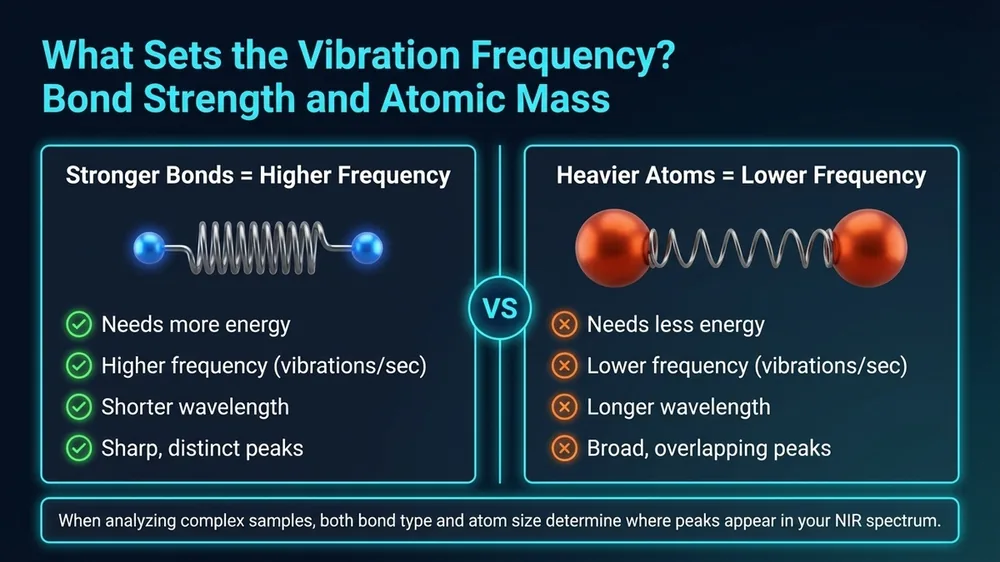
Note: These two factors — bond strength and atomic mass — are independent of each other. A bond can be strong but involve heavy atoms (shifting frequency down), or weak but involve light atoms (shifting it up). The observed frequency in your spectrum always reflects both influences acting together.
The Math Behind the Music
Hooke's Law — the physics of springs — gives a clean formula for vibrational frequency:
ν = (1/2π) × √(k / μ)
Here's what that means:
| Symbol | Meaning |
|---|---|
| ν (nu) | Vibrational frequency (Hz or cm⁻¹) |
| k | Force constant (bond strength) |
| μ (mu) | Reduced mass (weighted average mass of the two atoms) |
Two clear takeaways:
- Stronger bonds vibrate faster: The force constant k increases with bond strength. A triple bond (like C≡N) is stiffer than a double bond (C=O), which is stiffer than a single bond (C-C). C≡N stretches vibrate around 2200 cm⁻¹, C=O near 1700 cm⁻¹, and C-C closer to 1000 cm⁻¹.
- Lighter atoms vibrate faster: The reduced mass μ accounts for atomic weights. Hydrogen is light, so C-H bonds vibrate higher (around 3000 cm⁻¹) than C-C bonds, even though both are single bonds.
Bond strength and atomic mass are the two levers that place every absorption peak in your NIR spectrum. Increase bond strength — frequency goes up. Increase atomic mass — frequency goes down. Internalize this and peak assignment stops being guesswork.
Real-World Check: Isotope Substitution
Swap hydrogen (¹H) for its heavier cousin deuterium (²H), and the vibration slows down — because the reduced mass increases. This shifts a C-H stretch from about 3000 cm⁻¹ down to roughly 2100 cm⁻¹ for C-D. Researchers use this isotope effect to confirm which peaks involve hydrogen motion. If the peak shifts after substitution, the assignment is confirmed.
The Selection Rule: Why Not Every Vibration Shows Up in NIR
A symmetric bond between identical atoms is invisible to your NIR instrument — and that invisibility is one of the reasons NIR holds up reliably on a busy plant floor. A vibration must cause a change in dipole moment — the uneven distribution of electrical charge across a bond — to be infrared active.
Bonds between identical atoms, like the N≡N triple bond in atmospheric nitrogen, carry no dipole moment and produce no NIR absorption. Scan an open tray of grain in a room full of air, and the nitrogen and oxygen in that air contribute nothing to the spectrum. No interference, no correction factor needed.
The practical consequence: every bond type that does show up — O-H, N-H, C-H — does so because it has built-in asymmetry in charge distribution. Water absorbs strongly. Protein absorbs strongly. Fat absorbs strongly. That asymmetry is exactly what makes these analytes detectable at the concentrations that matter — 10% moisture, 12% protein, 3% fat in a corn-soy feed blend.
At a corn starch plant, the selection rule is the reason a transmittance scan through a starch slurry picks up water and residual protein clearly while the glucose backbone of starch itself shows up only through its C-H and O-H bonds — not through any bond between identical carbons. Every spectral feature you see earned its place by breaking molecular symmetry.
Operations teams often ask why NIR holds up so well in a dusty grain receiving pit when other analytical approaches fall apart. Part of the answer is right here: the air itself doesn't interfere, the sample matrix doesn't need to be dissolved or diluted, and the bonds the instrument is reading — O-H, N-H, C-H — are the same bonds regardless of whether the commodity is canola, distillers grains, or whole soybeans. The calibration is built on that consistency. It's the physics doing the work.
When the Physics Is Right but the Calibration Isn't
One failure mode worth naming directly: labs that expand their commodity range without updating their calibration sample set. The bond physics don't change between commodities, but the matrix around those bonds does — particle size, oil content, fiber structure. A calibration has to have seen enough of that variation to handle it.
Add high-oil sunflower to a model built on low-oil sunflower, and the C-H overtone region at 1650–1700 nm will still respond — but the model won't know how to weight it correctly. That's where an otherwise sound instrument starts producing fat predictions drifting 0.8 to 1.2 percentage points off reference values. Similarly, if the calibration doesn't include the full moisture range present in incoming grain — say, 10% to 22% for corn entering a dryer — the O-H absorption at 1940 nm will respond, but predictions at the extremes will drift. The physics are fine. The calibration coverage isn't.
For a systematic look at how to build calibration coverage that matches your actual commodity variation, see Building NIR Calibration Models and Avoiding Common Chemometric Mistakes.
Pull up any calibration report you have on hand. Find the wavelengths listed as highest in the loading weights. Cross-reference them against the table in the overtones section above. If your moisture calibration isn't centered near 1450 nm or 1940 nm, ask why — that gap between the physics and the model is where prediction errors start.
Free tool — NIR Glossary: Unfamiliar with a term? The SpectroScience NIR Glossary defines every chemometrics, calibration, and instrument term used in this article in plain language with worked examples. Open the Glossary →
SpectroScience students get access to the NIR Quality Checklist — a pre-scan checklist covering warm-up, reference scan, sample condition, and environmental factors. Available as a free download in the student resource library.
Access the PDF libraryNIR Fundamentals Course — Lesson 7: Molecular Vibrations
This lesson covers the different types of molecular vibrations in detail, explaining how each bond's unique vibrational frequency contributes to the NIR spectrum. Understanding these vibrations is essential for interpreting spectral data accurately and addressing calibration shifts across changing conditions.
Explore Lesson 7 in the NIR Fundamentals courseWant to Master NIR Spectroscopy?
Our 32-lesson online course covers everything from Beer-Lambert Law to PLS calibration — built for food, grain, feed, and dairy professionals.