Decode NIR Readings: How Feed and Grain Labs Turn Light Into Quality Data
Learn how to decode grain NIR readings in feed and grain labs. Covers instrument components, calibration, and real-world applications in 60 seconds.
· 11 min read · Vitaly Kirkpatrick
How NIR Instruments Work: Light, Spectra, and Real Results
When a grain elevator gets inconsistent protein readings across two instruments running the same calibration, the first instinct is to blame the software. Nine times out of ten, the real cause is something physical — a mismatched detector range, a lamp that hasn't warmed up, or a sample geometry that doesn't match what the calibration was built on. Learning to decode grain quality data from NIR instruments starts with understanding the components. That knowledge solves measurement mysteries faster than any troubleshooting checklist.
The underlying principle is straightforward. When near-infrared light hits a sample, different molecules absorb different wavelengths. The instrument records which wavelengths were absorbed — and how much — to determine what's in the sample. That's the foundation of every result at the receiving dock, from grain protein to fat content in finished feed. For a broader grounding in the physics behind this, NIR light-matter interaction, absorption, and instrument components covers how overtones and combination bands arise from molecular structure.
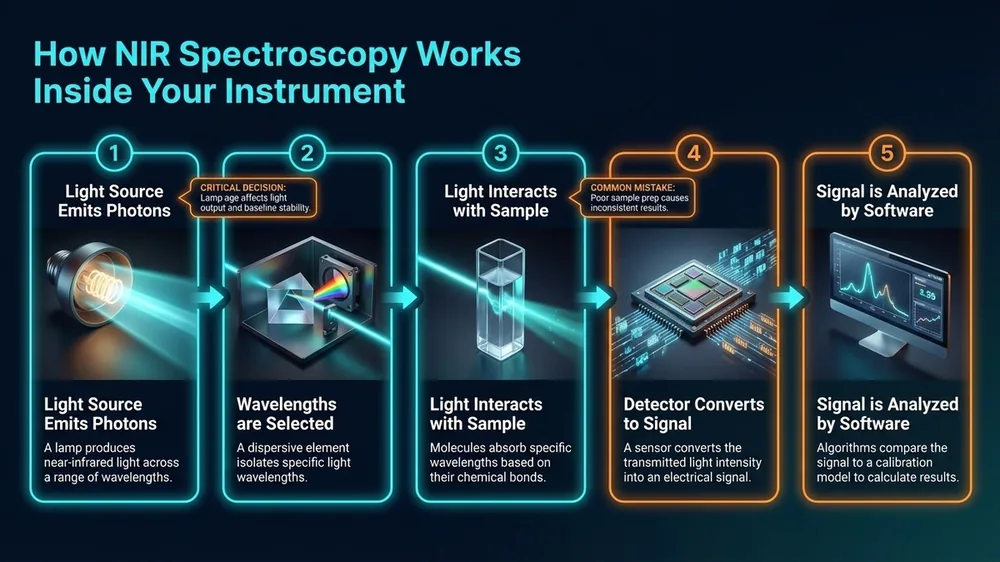
The near-infrared region sits just beyond visible red light on the electromagnetic spectrum. It spans roughly 780 to 2500 nanometers. The human eye cannot see it, but every organic molecule in the sample responds to it. Moisture, protein, fat, starch — each has a characteristic absorption pattern in this range.
What the Light Is Actually Measuring
Every chemical bond — C-H, O-H, N-H — vibrates at a specific frequency. When NIR light at the matching wavelength strikes that bond, the bond absorbs the energy. The instrument records these absorption events across hundreds or thousands of wavelengths. The result is called a spectrum.
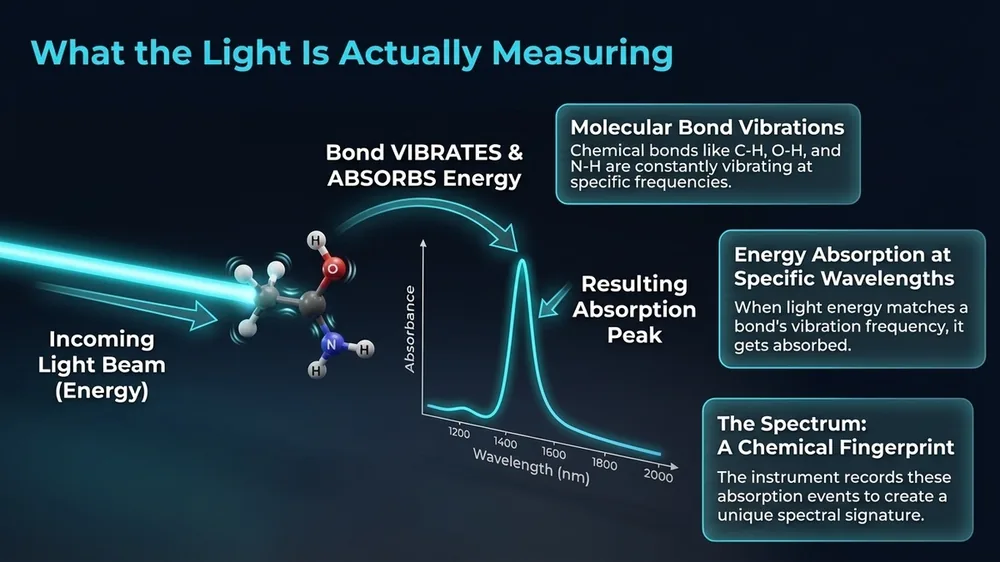
That spectrum looks like a series of broad, overlapping peaks. Nothing like the sharp lines you see in mid-infrared. The reason: this region detects overtones and combination bands, which are weaker and broader versions of the basic molecular vibration.
Think of it like trying to identify a song when three radio stations are playing at once and bleeding into each other. You can't just listen for one note — you need math to separate the signals. That's what chemometrics does with your spectrum.
When that math is wrong, even a perfectly functioning instrument delivers unreliable output. Understanding where the signal comes from — and where it can break down — is the first step to trusting your results. For a deeper look at how the physics governs reliability, how Beer-Lambert Law determines when your NIR results are reliable — and when they're not explains the limits directly.
Note: The broad, overlapping nature of NIR bands is not a flaw — it is a characteristic of the region. A single scan captures information about multiple components at once. That is exactly what makes this technology so efficient for multi-parameter analysis.
Inside the Instrument: Core Components and What They Do
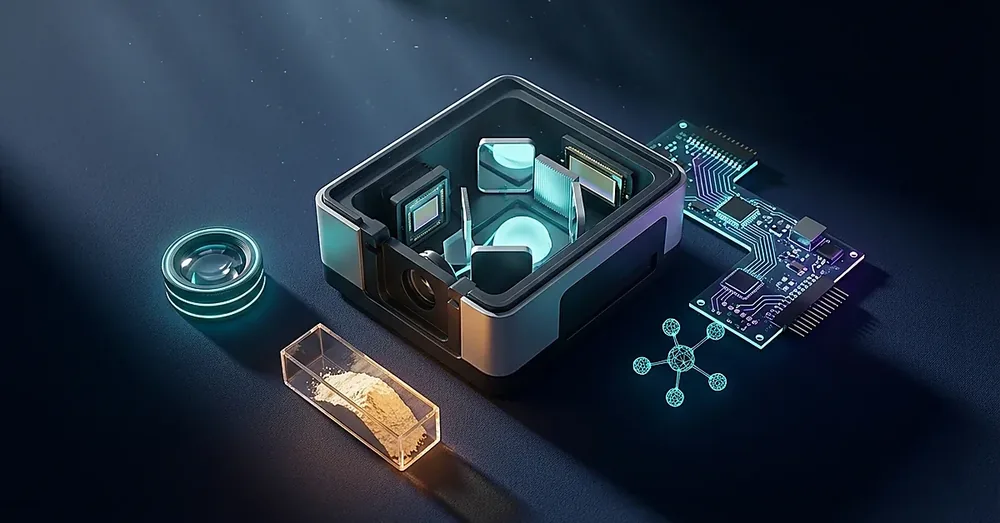
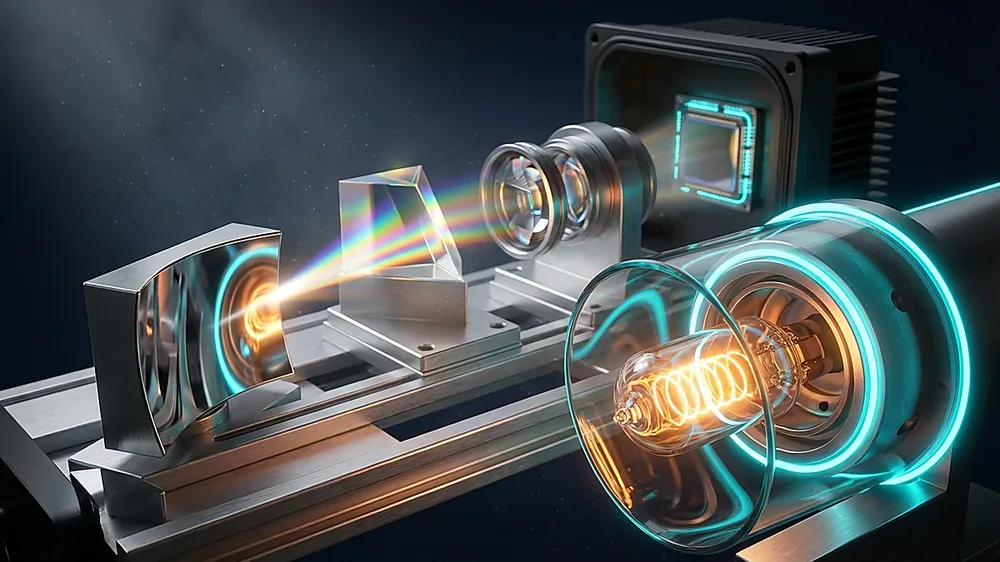
Every instrument — regardless of format or manufacturer — contains the same basic building blocks. Knowing what each component does explains why instruments behave differently under different conditions. It also explains why some configurations suit certain applications far better than others.
Light Source
Most benchtop and process instruments use a tungsten halogen lamp. It emits a broad, continuous spectrum across the full NIR range. Lamp output intensity directly affects signal-to-noise ratio — which is why warm-up time matters.
A cold lamp produces inconsistent output. Most manufacturers specify 15–30 minutes before scanning for exactly this reason. LED-based sources appear increasingly in portable units, where battery life and thermal stability drive the design.
Wavelength Selection Device
Once the lamp fires, the instrument must isolate specific wavelengths to measure absorption. Three main technologies accomplish this:
- Dispersive grating: A diffraction grating separates light into its component wavelengths. The detector scans across them sequentially or reads them simultaneously via a diode array. This is the most common configuration in modern benchtop instrument design.
- Filter-based systems: Fixed bandpass filters pass only selected wavelengths to the sample. Simpler and more robust, but limited to the wavelengths the filters were built for. Common in dedicated at-line analyzers with a narrow calibration scope.
- Fourier Transform NIR (FT-NIR): Uses an interferometer rather than a grating. Captures the full spectral range simultaneously with very high wavelength accuracy and reproducibility. The preferred choice for multi-site standardization and demanding applications requiring tight calibration transfer.
For a detailed comparison and the trade-offs involved, NIR technology types: FT-NIR, dispersive, and filter-based compared breaks down the practical implications for food and feed operations.
Sample Interface
How light reaches the sample determines what the instrument can actually measure. Reflectance measurements — the most common in grain, feed, and powdered material — direct light at the sample surface and collect what bounces back. Transmittance measurements send light through the sample, used for liquids and some slurry applications.
The geometry choice determines which calibrations are valid and how tightly sample presentation must be controlled. Your calibration is only as good as the match between how reference samples were presented and how production samples are presented today.
Detector
Silicon detectors cover the shorter NIR range, roughly 780–1100 nm. Indium gallium arsenide (InGaAs) detectors extend coverage to around 1700 nm and, in extended-range versions, to 2500 nm.
The detector type determines which molecular bonds the instrument can reliably reach. An instrument limited to silicon detection will struggle with fat and starch — whose primary NIR absorption features lie above 1600 nm. For oilseed and feed work, full-range InGaAs coverage is typically needed.
Electronics and Software
Raw detector output is an analog signal. It must be digitized, corrected for instrument response, and converted into absorbance units before chemometric models can process it. Instrument firmware handles dark current correction, reference normalization, and signal averaging.
Software then applies the calibration model and returns a predicted value to the operator. The quality of this signal processing chain determines the repeatability and noise floor of every single measurement.
How the Spectrum Becomes a Number: The Calibration Step
Getting a spectrum off the detector is only half the process. That spectrum still needs to be translated into a meaningful result — a protein percentage, a moisture value, a fat content. That translation is the job of the calibration model.
A calibration model is a mathematical relationship built from hundreds of reference samples. Each sample has a known lab value — measured by Kjeldahl, Karl Fischer, or Soxhlet — and a matching NIR spectrum. The model learns which spectral patterns correspond to which concentrations. When a new sample is scanned, the model applies that learned relationship and returns a predicted value.
The accuracy of that prediction depends entirely on the quality of the reference data and the range of samples used to build the model. A calibration built on summer corn will not reliably predict winter corn from a different supplier. A model trained on whole grain will not perform well on ground meal. These mismatches are the most common source of unexplained error in the field.
For a practical walkthrough of how models are constructed and where they go wrong, building NIR calibration models and avoiding common chemometric mistakes covers the key decisions and failure points in detail.
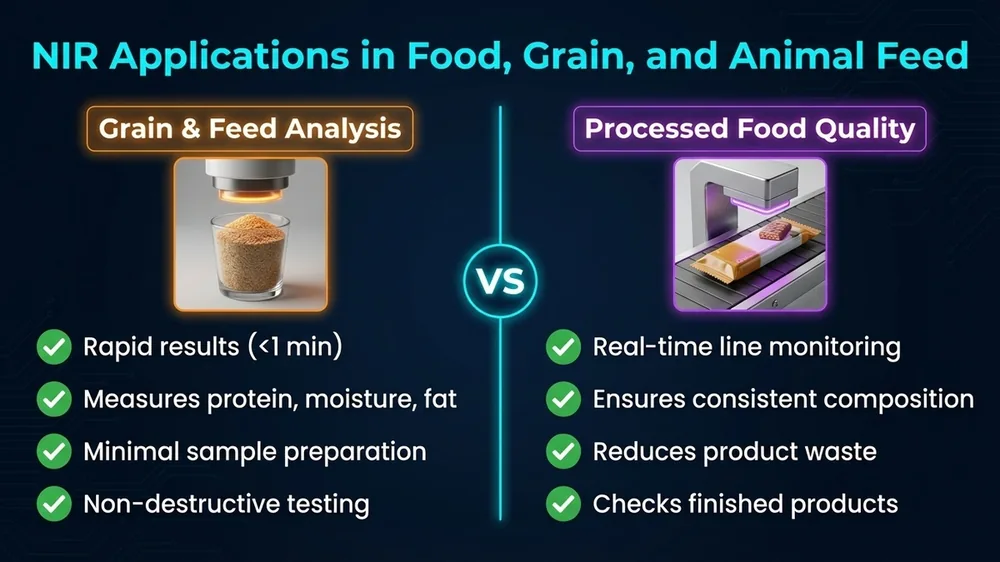
NIR Applications in Food, Grain, and Animal Feed
This technology runs across the full food supply chain — not confined to a single sector. Each application puts different demands on the instrument and the calibration behind it.
Grain Receiving and Handling
Oilseed processors use rapid analysis at intake to measure moisture, oil content, and protein on incoming seed loads. These results drive payment decisions and processing route assignment.
A 0.5% moisture error on a large shipment creates real financial discrepancy. At a facility receiving 500 truckloads of corn per harvest season, a systematic moisture bias of that magnitude affects the settlement value on every single load — not just the outlier.
Feed Mill Quality Control
Feed mills rely on rapid ingredient verification before anything enters the mixing line. That means soybean meal protein, fat in distillers grains, and moisture in corn — checked at intake, not after blending. Finished feed gets the same scrutiny against formulation targets.
Calibration failures are common at mills running 50 or more ingredient lots per week when no one has validated the model against the actual supplier base. A properly validated benchtop unit cuts turnaround from 24–48 hours to under 5 minutes per lot. That speed is enough to catch an off-spec shipment before it contaminates a full production run.
Dairy and Oilseed Processing
In dairy, rapid analysis monitors fat and protein in milk, cream, and cheese curd. In oilseed crushing, it tracks oil content and residual solvent in meal. Both are applications where real-time process feedback produces measurable improvement in yield and consistency.
A 0.2% improvement in oil extraction efficiency at a mid-size crush facility — enabled by tighter process control — can represent hundreds of thousands of dollars annually.
Pet Food Manufacturing
Pet food lines depend on moisture control in both wet and dry product. Moisture out of spec affects shelf life, texture, and declared net weight — any of which can trigger costly rework or a product hold. Dry kibble lines targeting 10% final moisture typically run inline measurement at the dryer exit to catch drift before product reaches the packaging stage.
Which Type of NIR Instrument Fits Your Operation
The first question when selecting an instrument is always: where does the measurement need to happen? That single constraint usually narrows the field before anything else does.
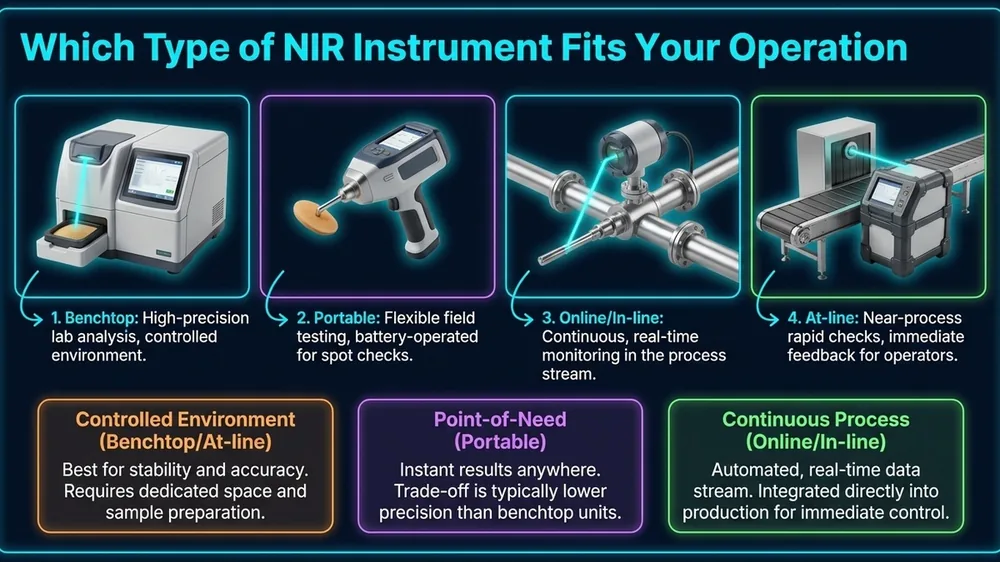
| Instrument Type | Description | Typical Applications | Key Advantages |
|---|---|---|---|
| Benchtop NIR | Full-featured lab instruments with advanced optics and software. | QC labs, method development, ingredient analysis, R&D. | High accuracy, full spectral range, strong software capability. |
| Portable/Handheld NIR | Compact, battery-operated units for field and at-line use. | Incoming grain verification, field sampling, multi-site spot-checking. | Mobility and speed — no sample transport required. |
| Process/In-line NIR | Fixed sensors integrated directly into production lines or conveyors. | Continuous moisture monitoring, dryer control, real-time blending feedback. | Non-stop measurement with no operator involvement — catches drift as it develops. |
For most grain and feed operations starting out, a benchtop unit in the QC lab is the right first step. It gives the range, software, and flexibility to build and validate calibrations before committing to process integration. Once the team knows what the instrument can and cannot do under specific sample conditions, the case for in-line investment becomes much easier to justify — and much less likely to disappoint.
Quality managers often ask whether a portable unit can replace a benchtop for routine intake analysis. The answer depends entirely on whether the portable's detector range covers the parameters being measured. If an operation needs fat in distillers grains, and the handheld tops out at 1100 nm, that instrument is not a fat analyzer — it is a moisture meter with extra steps. Check the detector specification before signing anything.
Start by listing every parameter needed and every matrix that will be run. Then check whether the detector range and geometry of each candidate instrument actually covers that list. Most mismatches between expectation and performance trace back to that gap — identified too late, after the purchase order is signed. For a structured comparison of instrument formats, NIR instrument selection for grain, feed, and dairy operations: benchtop vs at-line vs inline walks through the decision criteria in detail.
Free tool — NIR Glossary: Unfamiliar with a term? The SpectroScience NIR Glossary defines every chemometrics, calibration, and instrument term used in this article in plain language with worked examples. Open the Glossary →
SpectroScience students get access to the NIR Quality Checklist — pre-scan checklist covering warm-up, reference scan, sample condition, and environmental factors. Available as a free download in the student resource library.
Access the PDF libraryNIR Fundamentals Course — Lesson 17: Inside the NIR Instrument
This lesson provides an in-depth look at the internal workings of NIR instruments, detailing how each component contributes to the measurement of light absorption. Understanding these components is essential for troubleshooting issues like inconsistent readings, as it allows professionals to pinpoint physical discrepancies affecting their results.
Explore Lesson 17 in the NIR Fundamentals courseWant to Master NIR Spectroscopy?
Our 32-lesson online course covers everything from Beer-Lambert Law to PLS calibration — built for food, grain, feed, and dairy professionals.