How to Know When NIR Outperforms Wet Chemistry in Feed and Grain Quality Testing
Learn when to use NIR instead of wet chemistry in grain, feed, and dairy operations — with real thresholds, ROI benchmarks, and decision criteria.
· 7 min read · Vitaly Kirkpatrick

Choosing NIR: When It's the Right Tool for Your Lab
\nA dairy plant I visited was holding finished yogurt batches for six hours waiting on protein results from an external lab. Six hours. In that window, the next production run was already backing up. That kind of delay doesn't just frustrate your QC team — it costs real money in schedule disruption and expedited freight when orders slip. Bringing NIR on-site cut their hold time to under two minutes per sample. That's not a preference question. That's an operational one.
\n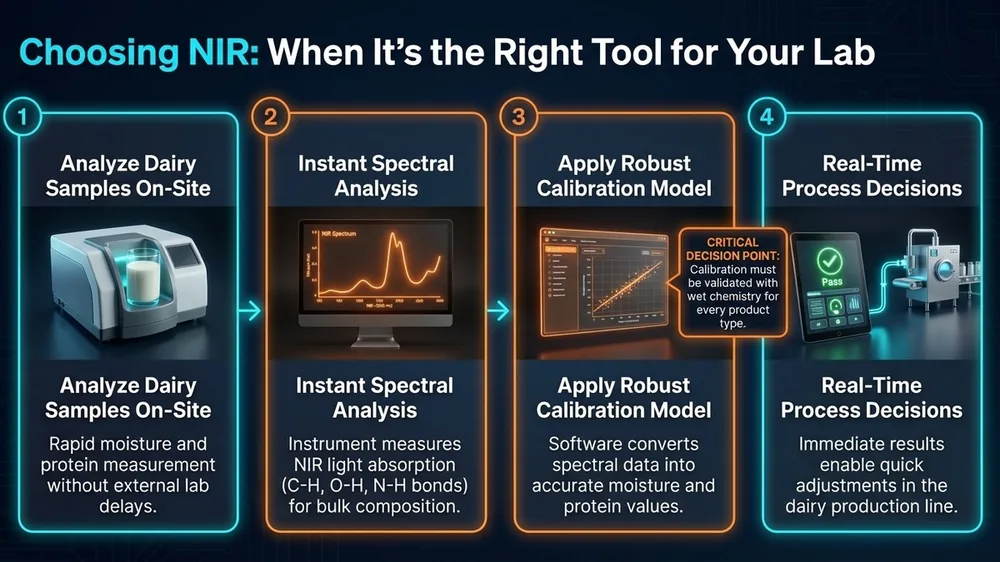
The decision to deploy NIR comes down to matching your analytical method to your operational demands. Your lab's throughput, your sample frequency, your ingredient variability — those are the factors that determine whether NIR pays off or sits underused. For a broader look at where NIR fits across grain, feed, and food workflows, see our overview of NIR spectroscopy: where it fits in grain, feed, and food operations.
\nWhere NIR Works Best
\nNIR isn't a universal solution. But in the right scenarios, it delivers a real operational shift. Here's when you should seriously consider it:
\n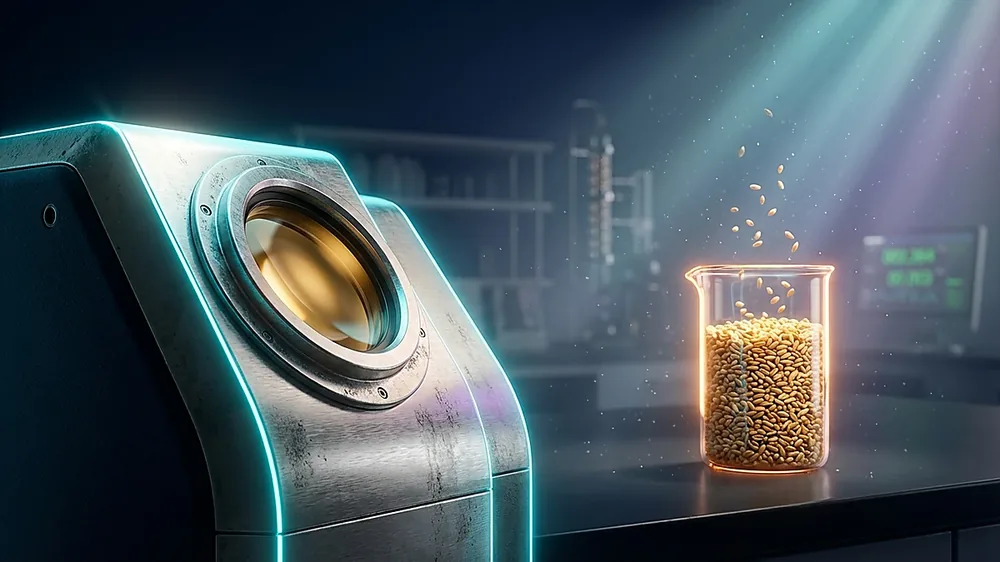
When Speed and Volume Matter
\nAn oilseed processing facility testing for oil content and moisture across dozens of samples each day can't afford 20–30 minutes per result. That pace creates bottlenecks. Lines back up. Decisions get delayed. A NIR scan cuts that analysis time to around 30 seconds per sample.
\nInstead of managing 8–10 tests per hour, operators handle over 100 samples efficiently. The process keeps moving.
\nThis speed produces real savings. At a feed mill running 50 daily tests, NIR frees up lab technicians and accelerates every downstream decision. The upfront cost becomes easier to justify when time saved translates into faster throughput and reduced labor. In many cases, payback happens within 18 months from efficiency gains alone. Our detailed guide on how to calculate NIR spectroscopy ROI walks through exactly how to build that business case for your operation.
\nDuring harvest, this cooperative switched from wet chemistry to NIR for truckload testing. Testing time dropped from 25 minutes to 2 minutes per load. Wait times fell by 90%, and customer satisfaction improved sharply. The $85,000 investment paid for itself in one harvest season through labor savings and throughput improvement.
Routine Checks on Similar Samples
\nIf your operation runs the same tests on similar materials day after day — a dairy processor tracking fat and protein in milk, or a feed mill verifying nutrient content batch after batch — NIR excels here. It measures multiple parameters simultaneously. What used to take hours becomes a 30-second scan.
\nThink of it like a experienced grain buyer who can assess moisture, test weight, and protein from a single handful — except NIR does it in seconds and gives you four numbers at once. A single scan of ground corn returns moisture, protein, oil, and fiber content all at once. Running this across hundreds of samples each week produces real time and cost savings. This is one of the core reasons high-throughput feed mill and grain receiving environments have adopted it as standard practice over conventional single-parameter methods. For a deeper look at how feed mills specifically benefit, see our article on how NIR measures feed ingredients and why mills choose it over wet chemistry.
\nReal-Time Process Monitoring
\nInline and at-line deployment is where NIR delivers its fastest value. Instead of pulling samples for lab testing, sensors monitor product quality continuously. Dairy plants adjust cream levels in real time to hit fat targets. Flour mills track protein content during milling to improve yield.
\nThis immediate feedback prevents off-spec batches before they form. For meat processors, inline detection of fat content shifts during grinding allows instant correction. The payoff isn't just faster testing — it's preventing waste and maintaining consistent quality throughout the entire production run.
\nInline and at-line monitoring shifts quality control from reactive to proactive. Problems are caught in real time rather than discovered after a batch is already complete.
Understanding NIR Calibration Requirements Before You Commit
\nMore deployments fail at calibration than at any other step — and most operations don't see it coming. Instruments don't arrive pre-configured for your exact products. A valid calibration — built from representative samples with accurate reference lab values — is what connects a spectrum to a number you can trust.
\n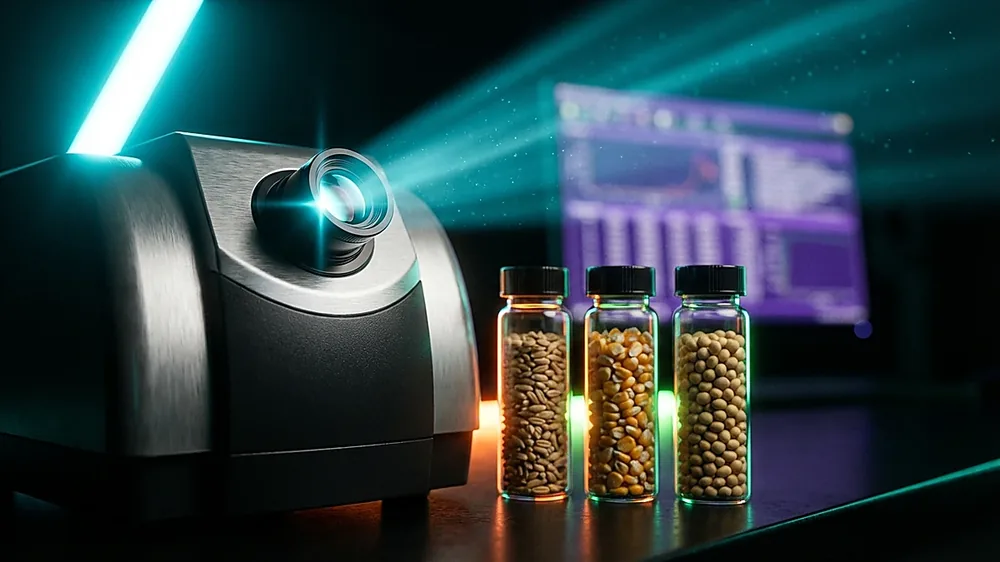
Operations that repurpose a generic global calibration without validating it against their own product range consistently see poor prediction accuracy. Before committing NIR to production decisions, your QA team needs to understand the calibration scope your operation actually requires. That means knowing your analyte range, your product variability, and how many reference samples you can commit to the calibration development process.
\nCalibration isn't a one-time event. As raw material sources shift or processing conditions change, periodic recalibration keeps predictions on target. For an in-depth walkthrough of what this involves, the NIR calibration: why it's needed and how it works guide is a practical starting point.
\nNote: A common mistake is purchasing an instrument and assuming it will work out of the box. Every deployment requires a validated calibration tied to your specific matrix, analyte range, and reference method. Budget time and reference samples accordingly.
When NIR Might Not Be the Best Fit
\nKnowing when to use NIR matters. Knowing when to walk away from it matters just as much.
\n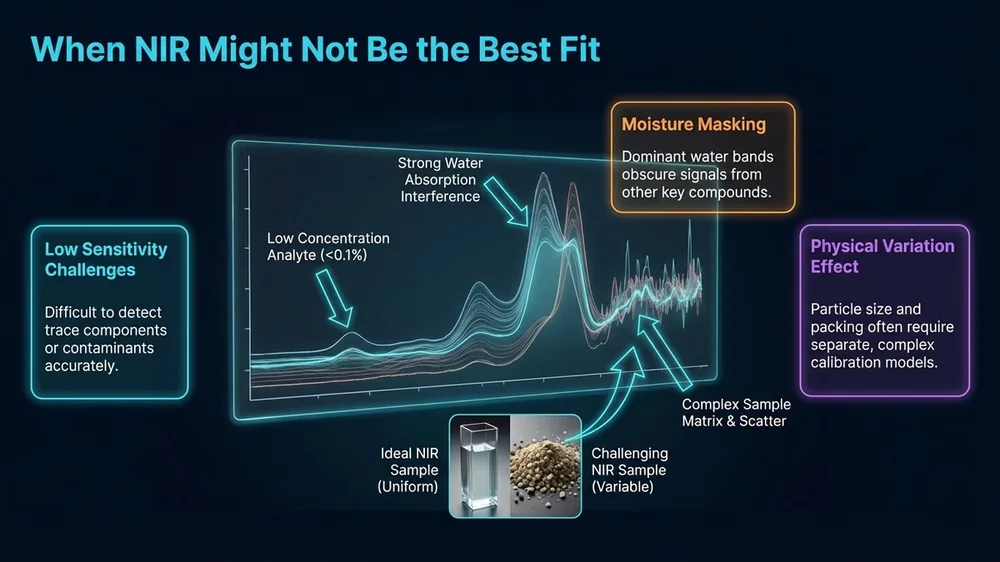
If You Test Only Occasionally
\nFor labs running only a handful of samples each week, the cost of an analyzer can easily outweigh the benefit. A specialty food processor analyzing 5–10 samples weekly will find traditional wet chemistry more economical — even accounting for the slower pace.
\nAs a general rule, fewer than 20 samples per week is where the economics favor conventional methods. That said, if faster turnaround is important or you want to eliminate hazardous chemicals from your lab, NIR may still make sense even at low volume. Review our guide on how to calculate NIR spectroscopy ROI before making that call.
\nWatch out: Fewer than 20 samples per week is a common threshold where the economics rarely work in your favor. The high upfront instrument cost and calibration effort are difficult to justify when per-test savings spread too thin.
Trace-Level Detection Needs
\nNIR handles major and minor components well. Trace-level contaminants are a different matter entirely. Detecting mycotoxins, pesticides, or heavy metals at parts-per-billion levels requires sensitivity that NIR simply can't deliver.
\nHPLC, GC-MS, and atomic absorption spectroscopy remain the standard tools for trace detection. As a practical benchmark, NIR reliably quantifies components down to roughly 0.1–0.5% concentration. Measuring protein at 12%? That's its sweet spot. Detecting a toxin at 1 ppm? You need a different tool. For a deeper look at these boundaries, our article on NIR spectroscopy in food and feed: what it measures and where it fails covers detection limits and calibration range planning in practical detail.
\nNote: The practical detection floor sits at roughly 0.1–0.5% concentration. Below that threshold — mycotoxins, pesticide residues, heavy metals — a dedicated trace-analysis technique such as HPLC, GC-MS, or atomic absorption spectroscopy is required.
Highly Variable or Novel Sample Matrices
\nPredictions are only as reliable as the calibration behind them. When a sample matrix falls outside the composition range used to build that calibration, the instrument extrapolates — and extrapolation produces error. This catches operations off guard when they introduce new ingredient sources or novel formulations with no calibration history.
\nConsider a feed mill adding insect meal or a novel oilseed byproduct to its formulations. An existing corn or soybean meal calibration won't transfer. A fresh calibration set is required. The same applies to seasonal variation in raw materials that pushes values outside established calibration boundaries. In these situations, wet chemistry remains the reference anchor until enough samples exist to build a valid model.
\nQuality managers often ask me whether they can just expand an existing calibration to cover the new ingredient. Sometimes you can — if the new matrix is chemically close enough and you add enough representative samples across the full range. But if you're talking about a genuinely novel ingredient type, don't bet production decisions on a stretched calibration. Run wet chemistry in parallel until your model is validated. That parallel testing phase isn't wasted time — it's the data that makes your calibration defensible to your auditors.
\nA Practical Decision approach
\nWhen evaluating NIR against traditional laboratory methods, three questions structure the decision clearly:
\n- \n
- How many samples does your lab run per day? Below 20 per week, wet chemistry is almost always more economical. Above 50 per day, NIR pays back fast. \n
- What concentration range are you measuring? NIR works well at 0.1–0.5% and above. Below that, you're in trace-analysis territory where NIR doesn't belong. \n
- How consistent is your sample matrix? Routine materials with known variability are where your NIR calibration will hold up. Novel ingredients or highly inconsistent sources will challenge it immediately. \n
Here's the thing — NIR doesn't replace wet chemistry for every task. It handles the high-frequency, same-matrix, major-component testing that wet chemistry makes slow and expensive. Wet chemistry stays in the picture for validation, for trace detection, and for any matrix your calibration hasn't seen before. The operations that get the most out of NIR are the ones that understand that boundary clearly and don't push the instrument past it.
\nFree tool — NIR ROI Calculator: Plug your sample volume, current method cost, and analyte spec into the SpectroScience NIR ROI Calculator to see annual savings and payback period for your operation. Open the ROI Calculator →
Free tool — NIR vs Wet Chemistry Tool: Compare NIR side-by-side against Kjeldahl, Soxhlet, Karl Fischer, and Dumas in our interactive NIR vs Wet Chemistry tool — speed, cost per sample, accuracy, and where each method still wins. Compare the methods →
SpectroScience students get access to the NIR Decision Tree — step-by-step framework for deciding when NIR is the right measurement tool vs. wet chemistry. Available as a free download in the student resource library.
\n Access the PDF library\n\nNIR Fundamentals Course — Lesson 9: NIR vs. Wet Chemistry
This lesson explores the key differences between NIR and wet chemistry, highlighting the scenarios where NIR can be more efficient and cost-effective. It provides insights into the strengths and limitations of each method, helping QC professionals make informed decisions about which analytical approach best suits their operational needs.
Explore Lesson 9 in the NIR Fundamentals courseWant to Master NIR Spectroscopy?
Our 32-lesson online course covers everything from Beer-Lambert Law to PLS calibration — built for food, grain, feed, and dairy professionals.