AI and Machine Learning in NIR: Practical Applications for Food and Feed Labs
Learn how AI and machine learning improve NIR calibration, machine feed analysis, and anomaly detection in food and feed lab operations.
· 10 min read · Vitaly Kirkpatrick
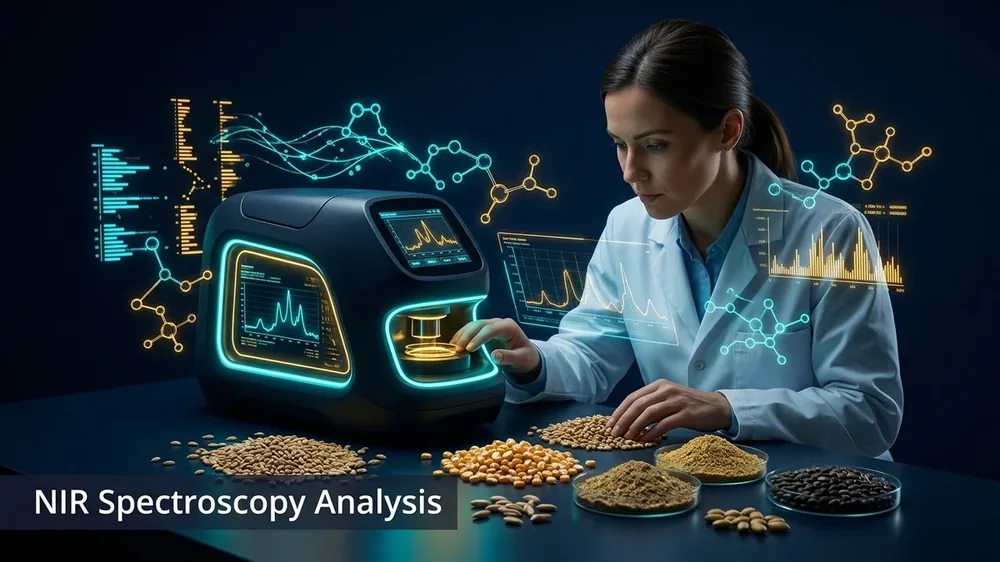
Quality managers frequently ask whether AI and machine learning deliver real value in NIR programs, or whether the buzz is mostly vendor marketing. The answer depends on the specific problem. A grain elevator receiving 40 trucks a day has a different answer than a pet food line managing eight ingredient streams. For machine feed operations and high-throughput food labs, the gains are measurable when AI targets a specific, well-defined challenge. When applied broadly without a clear goal, labs spend more time troubleshooting than predicting.
How Does AI Enhance NIR Calibration in Food and Feed Labs?
Traditional calibration models drift over time. That is not a flaw — it is reality. Seasonal ingredient changes, new suppliers, and shifts in particle size distribution all nudge a model off its original path. The manual fix is to collect new reference samples, run wet chemistry, and update the model. That process can take days. In a high-throughput grain elevator, days matter.
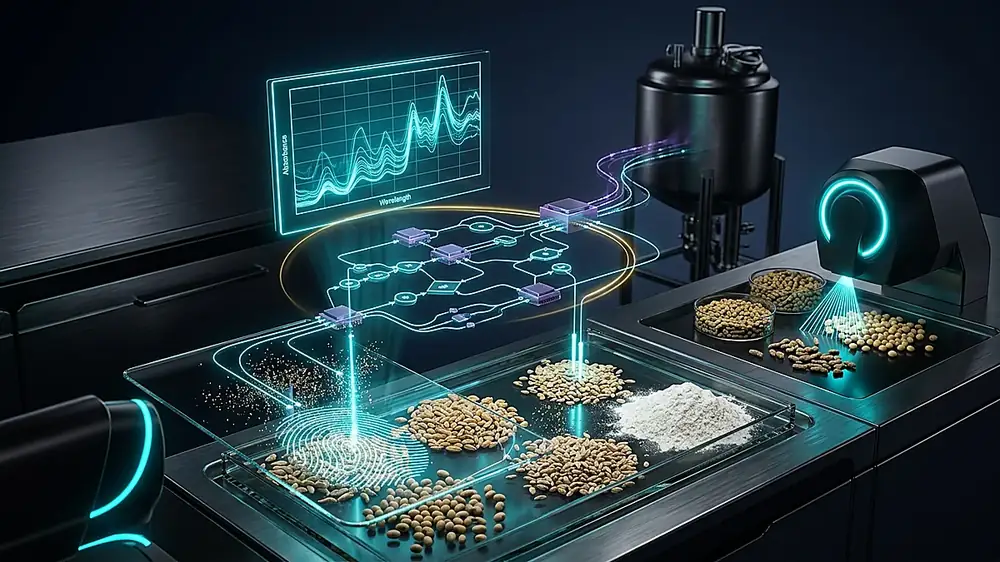
Think of AI-assisted calibration like teaching a technician to recognize a regular customer's voice on the phone — even through background noise, even when the customer has a cold. The system learns patterns across a wide population of spectra and improves at separating real variation from noise.
Applied to NIR, this means RMSEP values under 0.5% for moisture content are achievable in well-maintained models. That benchmark tightens your confidence interval and reduces the number of flag-and-retest events your lab handles daily.
What AI adds specifically is the ability to scan a large pool of historical spectral data and identify which subpopulations are dragging down prediction accuracy. Your calibration team does not have to guess where outliers originate. The algorithm flags them. That compresses hours of diagnostic work into minutes.
AI does not replace good calibration practice — it accelerates the diagnostic step. You still need clean reference data and representative samples. What changes is how fast your model identifies where it is underperforming and why.
What Role Does Machine Learning Play in NIR Data Management?
The data bottleneck in many operations is not the instrument — it is everything that happens after the scan. A mid-size feed mill running 15 to 20 ingredient types per shift generates hundreds of spectral records per day. Sorting those records manually, flagging anomalies, and connecting scan results to batch records is time-consuming work that adds no analytical value.
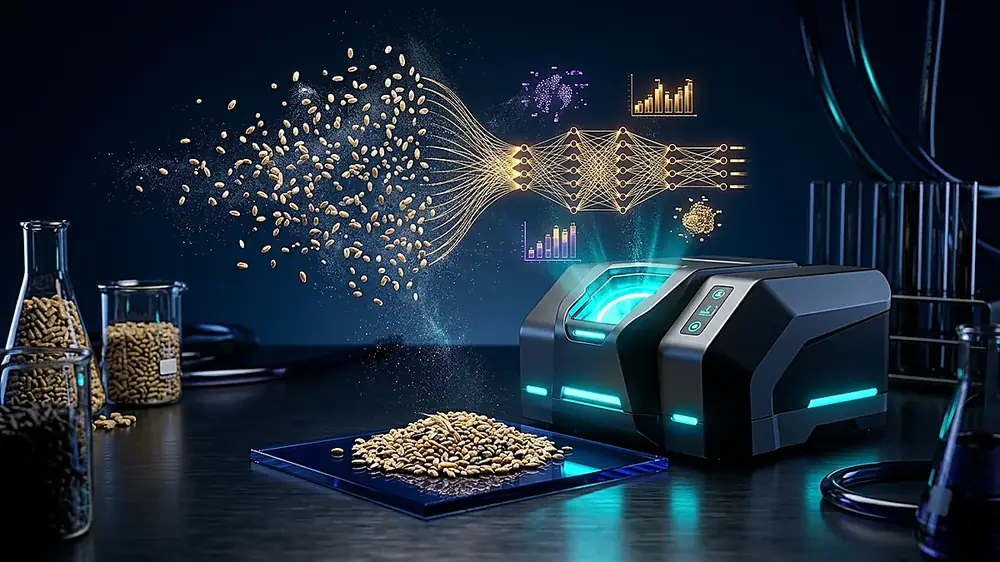
Machine learning algorithms handle that categorization layer automatically. In dairy intake, fat content variation across milk batches from different farm suppliers is a known challenge. A machine learning layer trained on historical intake data can alert your QC team to an incoming batch that looks spectrally different from the norm — before it reaches the processing line, not after.
That timing matters. Catching a high-fat deviation at intake versus discovering it post-pasteurization is the difference between a rerouting decision and a full batch hold. One costs 10 minutes. The other can cost an entire production run.
The pattern-detection capability also surfaces trends that are easy to miss in daily review. If your oat ingredient is slowly shifting in starch content over a six-week window, a machine learning layer watching your NIR data stream catches that trend long before a technician notices it in a weekly report. At an oilseed crusher, that kind of early warning on oil content drift can prevent weeks of extraction yield losses that only become visible at month-end reconciliation.
For teams managing multiple machine feed ingredient lines, this automated monitoring layer is one of the clearest places where machine learning earns its place in the workflow. It is not replacing analyst judgment — it is making sure the right information reaches the analyst at the right time.
Field tip: Before adding a machine learning layer to your NIR data pipeline, audit your existing spectral archive for labeling consistency. ML tools trained on mislabeled or incomplete historical records will reproduce those errors at scale — quickly. Clean data in, reliable alerts out.
When Should Food and Feed Labs Integrate AI into Their NIR Systems?
Not every lab needs this right now. Feed mill operations that are still building out their reference sample libraries are better served by getting that foundation right first. AI does not fix a sparse calibration set — it amplifies whatever data you feed it. If your data is thin, AI amplifies the gaps.
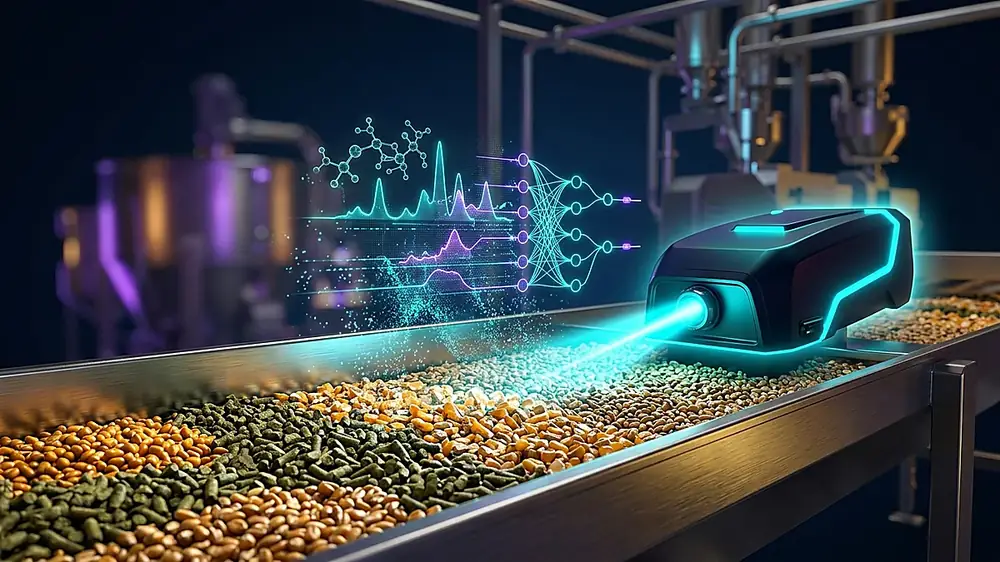
The right time to evaluate AI integration is when you have a specific, repeating problem. Calibration drift on a high-volume line, anomaly detection across multiple ingredient streams, or connecting NIR results to downstream process outcomes — these are defined targets. Start with one product line or one parameter. Measure the impact over 60 to 90 days. Reduced flag rates, tighter RMSEP, and fewer manual rechecks are the numbers that tell you whether to expand.
Flour mills running high-speed inline NIR on multiple extraction streams are a good early-adoption case. The spectral volume is high, ingredient variability is real, and a mispredicted ash or protein value shows up directly in extraction yield and customer complaints. One flour mill tracked protein giveaway at roughly $180,000 per year before tightening model performance. That is a problem with a measurable cost, which means AI ROI is calculable — not theoretical.
For context on how NIR connects to formulation software and broader process integration, see Connecting NIR to Formulation Software and Implementing NIR in Agricultural Operations. That integration layer is often where AI-generated predictions deliver the most visible operational value.
Watch out: Do not let a vendor demo on a clean, curated dataset convince you that the same performance will transfer to your lab immediately. Ask to see validation results on data that reflects your ingredient range, your suppliers, and your moisture variation. If they cannot show you that, the demo number is not your number.
What Are the Limitations of AI in NIR for Food Labs?
Labs that rush AI adoption after a conference presentation, skip the data quality audit, and spend six months wondering why predictions got worse — not better — share a common root cause. AI requires high-quality data to function well. Poor data input leads directly to incorrect predictions. That is not a caveat — it is the main event. Garbage in, garbage out applies here more than almost anywhere else in analytical chemistry.
There is also a personnel gap to account for. Managing an AI-assisted NIR system requires someone who understands both the chemistry and the algorithm. Not at a deep research level, but enough to recognize when a model is behaving oddly and know who to contact.
In the pet food industry, ingredient substitutions happen fast. A new protein source hitting your line this quarter did not exist in your training data last year. The AI will not know what it does not know. It will not alert you that it is operating outside its training range unless someone is monitoring Mahalanobis distance or residual plots on a regular schedule. That is a workflow step your team needs to own — not assume the software handles automatically.
Understanding NIR data quality and the GIGO principle is essential before any AI layer is added. The same sources of garbage data that undermine traditional calibration will undermine AI-assisted models — often more severely, because the errors propagate across a larger prediction volume.
AI requires high-quality data to function effectively. Poor data input leads to incorrect predictions — at scale and at speed.
Practical Takeaways for Implementing AI in NIR
- 1Identify specific challenges — Focus AI efforts on areas with the most variability or calibration drift. A broad "let's modernize" goal does not give the algorithm a useful target.
- 2Start with a pilot — Implement AI on one line or one parameter. Measure the impact over 60 to 90 days, then decide whether to expand.
- 3Ensure data quality first — Clean, accurately labeled spectral and reference data is required before any AI layer can deliver reliable predictions.
- 4Train your team — Staff do not need to be data scientists, but they do need to recognize when a model is operating outside its valid range and how to respond.
- 5Update systems regularly — Keep AI algorithms and NIR models current when new ingredient sources, seasonal shifts, or supplier changes alter your spectral population.
AI and machine learning are useful additions to an NIR program that already has solid calibration practices, good reference data, and a team that can interpret spectral diagnostics. They are not a shortcut past those foundations.
If your lab is ready, the specific gains — tighter RMSEP, faster anomaly detection, fewer manual interventions — are real and worth pursuing. If you are still building that base, the calibration fundamentals are the better investment right now. Build those first, then let AI extend what you have already built.
For operations evaluating where NIR delivers the clearest returns across grain, feed, and dairy — including where AI-assisted models have the most impact — NIR Spectroscopy Applications: Where It Pays for Itself in Food and Feed provides a practical overview organized by application type and measurable outcome.
Free tool — NIR ROI Calculator: Plug your sample volume, current method cost, and analyte spec into the SpectroScience NIR ROI Calculator to see annual savings and payback period for your operation. Open the ROI Calculator →
Free tool — Calibration Metrics Calculator: Enter your reference values and NIR predictions in the Calibration Metrics Calculator to compute RMSEP, RPD, R², and bias the way our course teaches it — with interpretation thresholds for grain, dairy, and feed. Open the Metrics Calculator →
Free tool — Model Diagnostics Calculator: Drop your spectra and predictions into the Model Diagnostics Calculator to flag outliers via Mahalanobis distance, leverage, and Q-residuals — the same diagnostics we walk through in Lesson 25. Open the Diagnostics Calculator →
SpectroScience students get access to the NIR Quick Reference Guide — wavelength assignments, key absorption peaks, and common parameter ranges for food and feed analysis. Available as a free download in the student resource library.
Access the PDF libraryNIR Fundamentals Course — Lesson 22: What Is Chemometrics?
This lesson covers chemometrics — the analytical foundation for understanding how NIR data becomes reliable predictions. By applying chemometric techniques, food and feed labs can build calibration models that hold up against ingredient source variation and processing changes.
Explore Lesson 22 in the NIR Fundamentals courseWant to Master NIR Spectroscopy?
Our 32-lesson online course covers everything from Beer-Lambert Law to PLS calibration — built for food, grain, feed, and dairy professionals.