NIR Data Quality: The GIGO Principle and Sources of Garbage Data in NIR Analysis
Master NIR data quality with the GIGO principle. Learn the six sources of garbage data that ruin NIR results in food and feed analysis.
· 7 min read · Vitaly Kirkpatrick
Why NIR Data Quality Determines Everything in NIR Analysis
⚠️ The basic Truth of NIR Spectroscopy
"Garbage In, Garbage Out"
Poor quality inputs always produce poor quality outputs. No algorithm, however advanced, can compensate for poor inputs. No amount of processing can fix basically flawed input.
NIR data quality is the single most important factor in whether your spectroscopy results are reliable or worthless. The GIGO principle — "Garbage In, Garbage Out" — applies directly to every spectroscopy workflow in the food and feed industry. Poor sample preparation, contamination, or reference errors will undermine even the best calibration model. Understanding where data quality fails is not an academic exercise. It is the difference between results you can act on and costly analytical failures that damage decisions across your entire operation. For a broader foundation on what NIR actually measures and where its limits lie, see NIR Spectroscopy: How It Works, What It Measures, and Where It Has Limits.
This article covers the main sources of garbage data in NIR workflows, what separates quality data from garbage, how to prevent data quality problems before they compound, and the real business impact of getting this right.
Understanding the GIGO Principle in NIR
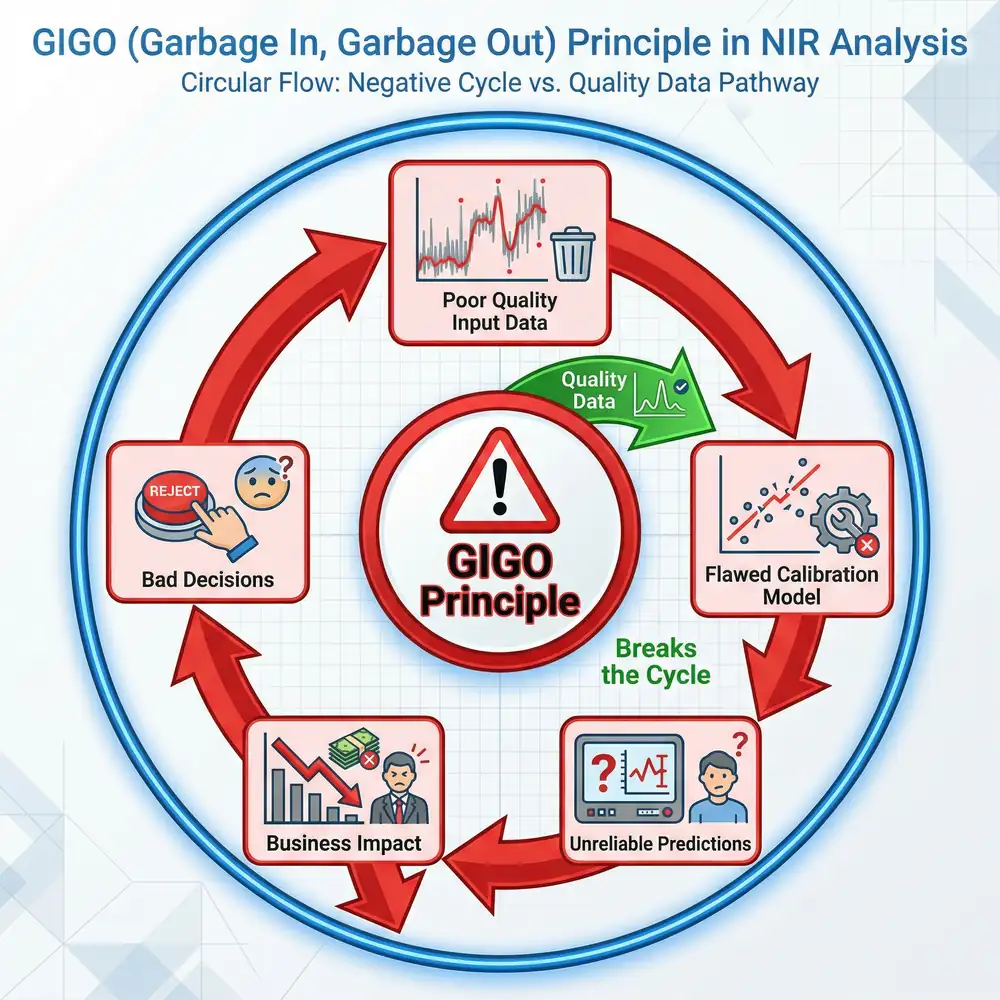
The GIGO principle is simple: poor quality inputs produce poor quality outputs. It does not matter how advanced your processing algorithms or instruments are. In NIR spectroscopy, contaminated samples, improper preparation, environmental problems, instrument faults, reference errors, and operator mistakes all produce unreliable spectra. Those spectra lead to weak calibrations and inaccurate predictions.
The Illusion of Algorithmic Salvation
A common misconception is that advanced chemometric algorithms can rescue flawed readings. They cannot.
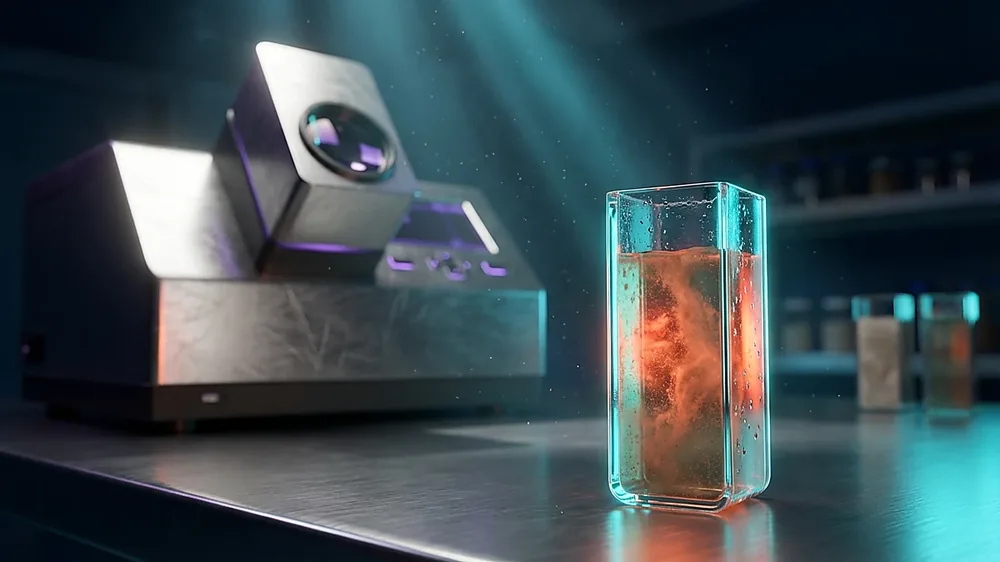
Consider a real scenario: contaminated grain samples with visible mold produce noisy, erratic spectra. Even when processed through principal component analysis, partial least squares regression, and Savitzky-Golay smoothing on a modern instrument, the results remain flawed.
A protein prediction of 8.2% when the true value is 12.5% — or a moisture prediction of 18.9% against a true value of 13.2% — shows clearly that mathematics cannot fix bad input. Algorithms process whatever readings they receive. The output reflects input quality, not sample composition.
Six Sources of Garbage in NIR Analysis
NIR data quality problems arise at multiple points in the workflow. Knowing where they originate makes prevention straightforward.
1. Poor Sample Preparation
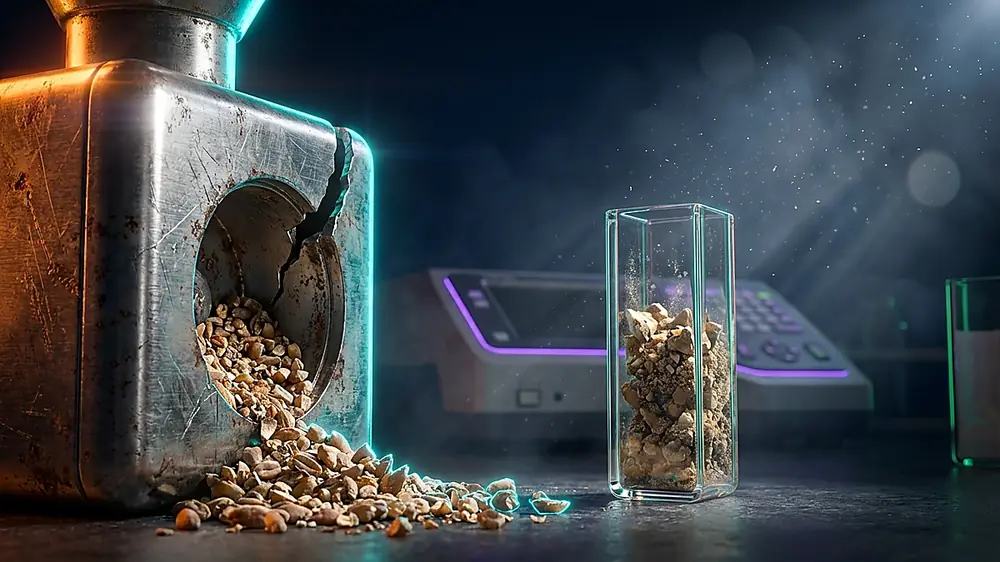
Sample preparation is one of the most common sources of bad results. Whole grain samples analyzed without grinding produce spectra that reflect particle size and surface texture — not composition. A broken or worn grinder introduces inconsistent particle sizes that add spectral noise unrelated to any compositional difference.
Uniform, fine grinding is not optional. It is a prerequisite for reliable NIR data quality. For most grain applications, a consistent grind below 0.5 mm particle size is the standard target. Skipping this step is one of the fastest ways to generate predictions you cannot trust. The practical implications of sample handling extend well beyond grinding — particle size, moisture equilibration, and cup-filling technique all contribute to spectral variance. For a complete breakdown of how each of these variables affects results, see NIR Sample Preparation: Why It Determines Your Results and How to Handle Different Sample Types.
In oilseed operations, sample preparation carries additional complexity. High-oil materials like full-fat soybeans or sunflower seeds require temperature control during grinding to prevent lipid oxidation and heat-induced moisture loss — both of which alter the true composition before scanning begins. Even a 0.3% moisture loss between grinding and scanning can produce a protein prediction error that exceeds acceptable process tolerances.
2. Contamination
Biological contamination — mold, bacteria, insect fragments — introduces spectral features that interfere with compositional analysis. A grain sample with visible mold growth produces spectra dominated by fungal biomass, not grain chemistry. Dirty liquid samples with particulates or chemical residues have the same effect.
Contamination always represents an analytical hazard that invalidates results. In some cases it also represents a food safety concern. At grain receiving operations running high-throughput NIR workflows, where hundreds of truck samples may be scanned per day, even a small percentage of contaminated samples entering the calibration database can degrade model performance across the entire operation. One facility tracking corn aflatoxin contamination found that including visibly compromised samples in their protein calibration set increased SEC by 0.18% — a figure that translates directly to misclassified loads and financial exposure at the scale.
3. Environmental Problems
Uncontrolled laboratory conditions introduce step-by-step errors that compound over time. Temperature above 30°C causes spectral baseline shifts that push predictions outside calibration limits. High humidity causes moisture absorption in hygroscopic samples. This changes the actual composition between reference measurement and NIR analysis.
Both effects corrupt the relationship between reference values and spectra. Once that relationship breaks down, calibration validity is compromised — often without any obvious warning in the measurements.
Seasonal temperature swings are a particular concern in feed mill laboratories without climate control. When ambient lab temperature rises 10°C between winter and summer, instruments that were not temperature-stabilized before scanning will produce spectra that look subtly different from those collected during calibration development — even on identical samples. The result is a step-by-step bias that drifts slowly enough to be missed during routine checks but large enough to affect formulation decisions. For detailed guidance on controlling these variables, see NIR Sample Presentation and Environmental Control for Consistent Spectra.
4. Instrument Faults
A malfunctioning instrument produces garbage readings regardless of sample quality. Misaligned optics, failing detectors, or dirty optical windows all distort spectral output.
Any instrument displaying alignment or optics errors should be taken offline immediately. Continuing to collect readings on a faulty instrument wastes time and produces results that cannot be trusted or corrected after the fact.
Dirty optical windows are among the most underreported sources of instrument-related signal degradation. In grain receiving environments, fine dust accumulates rapidly on scanning windows. Even a partial film of particulate matter can reduce apparent absorbance by measurable amounts, creating a step-by-step low-bias across moisture and protein predictions. A simple cleaning protocol performed at the start of each shift — documented in the daily log — eliminates most of this risk. Instruments should also complete a full warm-up cycle before any reference scans are collected; the thermal stabilization period is not negotiable for instruments that use thermally sensitive detectors.
5. Reference Value Errors
Calibration models are only as accurate as the reference values used to build them. Transcription errors, unit conversion mistakes, or mislabeled samples corrupt the entire model.
When a calibration dataset contains even a small number of incorrect reference values — as few as 5% of the total — the resulting model will show inflated errors and reduced prediction accuracy across all future samples. Reference data management deserves the same rigor as the NIR analysis itself.
In practice, reference value errors fall into two categories: random errors and step-by-step errors. Random errors — a transposed digit, a mislabeled vial — create high-use outliers that inflate calibration error and are usually detectable during model diagnostics. step-by-step errors are more dangerous. If a reference lab consistently reports crude protein on a different moisture basis than assumed, or if unit conversion from dry matter to as-received is applied inconsistently, the entire calibration dataset is corrupted in a way that diagnostics may not flag clearly. Every reference dataset should be audited for unit consistency, moisture basis, and method identity before calibration development begins.
6. Operator Mistakes
Human error introduces garbage at multiple points. Inconsistent sample packing, spilled transfers, skipped calibration checks, and undocumented procedural shortcuts all degrade NIR data quality.
Standard operating procedures and routine operator training are not bureaucratic overhead. They are the primary defense against the most preventable source of poor data quality in any spectroscopy program.
Operator-introduced variance is often invisible in aggregate statistics but visible at the individual measurement level. In one dairy ingredient testing scenario, two operators scanning the same whey permeate concentrate produced replicate spectra with a standard deviation difference of 0.08 absorbance units — entirely attributable to differences in sample cup filling technique. That variance translated to a lactose prediction spread of nearly 0.4%, which exceeded the facility's release tolerance. Standardizing the fill procedure and adding a visual depth gauge to the sample cup eliminated the discrepancy entirely.
⚠️ Critical Understanding
Each source of garbage multiplies through your entire workflow.
A contaminated sample produces a poor spectrum. That spectrum contributes to a weak calibration. That calibration generates inaccurate predictions — on every future sample it scores. The error compounds at each step. Prevention at the source is always more effective than trying to correct problems downstream.
How Garbage Data Compounds Across the Calibration Pipeline
It is worth understanding the mechanics of how a single data quality failure propagates through a spectroscopy program. When a contaminated or improperly prepared sample enters a calibration dataset, it contributes a spectrum that does not accurately represent the sample's true composition. During model development, the calibration algorithm attempts to build a mathematical relationship between that spectrum and its associated reference value. Because the spectrum is anomalous, the algorithm must either accommodate the outlier — which distorts the model — or the outlier must be identified and removed.
If the outlier is not caught during calibration development, it reduces model accuracy across the full prediction range. An SEC that should be 0.12% for crude protein may inflate to 0.22% or higher. In a feed mill environment where ration formulation tolerances are set at ±0.2% protein, that difference alone can push predictions outside acceptable limits — triggering either unnecessary reformulation costs or, worse, out-of-spec product released without detection.
This is why the investment in data quality at the front end of this analytical program delivers returns that scale with usage. A well-managed calibration dataset built on clean, representative samples performs reliably for years. A dataset built on marginal inputs requires constant intervention, revalidation, and troubleshooting — at costs that dwarf the original data quality investment.
What Good NIR Data Quality Looks Like
Quality spectral measurements share consistent characteristics. Spectra from well-prepared samples show smooth baselines, low noise, and repeatable absorbance values across replicate measurements.
Reference values are traceable, properly documented, and measured using validated methods. Environmental conditions are logged and within defined limits. Instruments pass daily performance verification before measurements begin.
When all these conditions are met, calibration models perform predictably. Prediction errors stay within acceptable limits. For finished feed applications, that typically means below 0.2% for moisture and below 0.3% for protein. For grain receiving, moisture prediction accuracy below 0.15% and protein below 0.25% on a dry matter basis are achievable standards on well-maintained calibrations with clean data foundations. Results remain consistent across instruments and operators when the foundation is sound.
Good measurement quality also produces stable calibration performance over time. A model built on clean, representative samples should not require major recalibration more than once or twice per year under normal operating conditions. If a calibration is drifting every few weeks, the root cause is almost always data quality — not the algorithm or the instrument hardware.
A Practical NIR Data Quality Checklist
The following checks apply before every analytical session. Each one addresses a known source of garbage results.
- Sample preparation: Grind to target particle size. Verify grinder condition and screen integrity before use.
- Contamination check: Inspect samples visually. Reject any showing mold, discoloration, or foreign material.
- Environmental log: Record temperature and relative humidity. Confirm both are within lab operating limits.
- Instrument verification: Run the daily performance check. Do not collect data on an instrument that fails verification.
- Reference data review: Confirm reference values are entered correctly and units are consistent before adding new samples to a calibration set.
- Operator sign-off: Document who performed the analysis and confirm SOP steps were followed.
This checklist does not replace a full SOP. It reinforces the habit of treating NIR data quality as a precondition — not an afterthought.
The Business Impact of Getting NIR Data Quality Right
The cost of poor NIR data quality is rarely captured in a single line item. It accumulates across misclassified grain loads, reformulated feed batches, failed audits, and the labor hours spent troubleshooting calibrations that should not need troubleshooting.
A grain elevator running 400 truck samples per day through spectroscopic analysis — where moisture prediction errors average 0.4% above acceptable limits due to uncontrolled sample preparation — may be making step-by-step docking or premium decisions based on flawed results. At commercial grain prices and that volume, even a 0.2% step-by-step moisture bias can represent tens of thousands of dollars in misallocated payments over a single harvest season.
Feed mills face a parallel exposure. Protein overestimation caused by contaminated calibration samples leads to under-inclusion of expensive protein ingredients — producing out-of-spec product that either fails customer specification checks or requires costly reformulation. The instrument itself is rarely the problem. The data quality infrastructure around it is.
Investing in sample preparation equipment, environmental controls, operator training, and reference data management is not overhead. It is the foundation that determines whether your spectroscopy investment delivers the return it was designed to deliver.
Free tool — Calibration Metrics Calculator: Enter your reference values and NIR predictions in the Calibration Metrics Calculator to compute RMSEP, RPD, R², and bias the way our course teaches it — with interpretation thresholds for grain, dairy, and feed. Open the Metrics Calculator →
Free tool — Model Diagnostics Calculator: Drop your spectra and predictions into the Model Diagnostics Calculator to flag outliers via Mahalanobis distance, use, and Q-residuals — the same diagnostics we walk through in Lesson 25. Open the Diagnostics Calculator →
SpectroScience students get access to the NIR Troubleshooting Guide — systematic approach to diagnosing poor predictions, instrument drift, and calibration failures. Available as a free download in the student resource library.
Access the PDF libraryNIR Fundamentals Course — Lesson 27: The GIGO Principle
This lesson focuses on the GIGO principle in near-infrared analysis, detailing how poor quality inputs can lead to unreliable outputs. It emphasizes the importance of identifying and mitigating sources of garbage data to ensure that analytical results are valid and actionable.
Explore Lesson 27 in the NIR Fundamentals courseWant to Master NIR Spectroscopy?
Our 32-lesson online course covers everything from Beer-Lambert Law to PLS calibration — built for food, grain, feed, and dairy professionals.