Connecting NIR to Formulation Software and Implementing NIR in Agricultural Operations
Getting NIR data is one thing — connecting it to your formulation software and building a reliable implementation process is where real gains come from.
· 5 min read · Vitaly Kirkpatrick
Getting NIR data is one thing — connecting it to your formulation software and building a reliable implementation process is where real gains come from. This article covers how to link NIR data into least-cost formulation systems, how to implement NIR in an agricultural setting, and how to get more from your program over time.
Connecting NIR Data to Formulation Software
Having accurate NIR data is necessary. Acting on it quickly is what separates good operations from ones that are leaving money on the table. The biggest missed opportunity I see in feed mills and grain processors is the lag between measurement and decision.
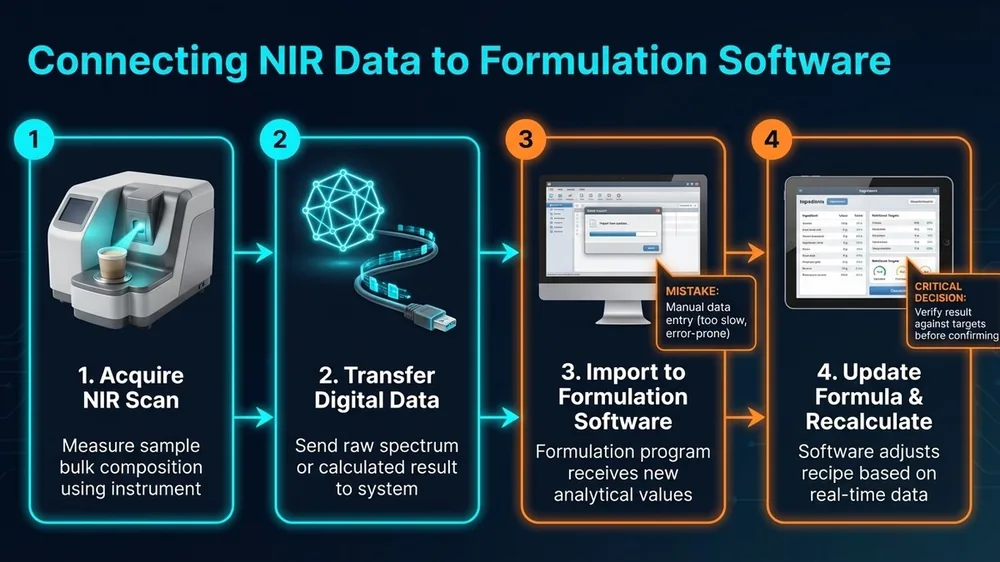
Treat your NIR as a real-time sensor feeding a decision system, not a standalone instrument generating a printout someone files in a binder.
Here's what that lag costs: feed mills that move from fixed ingredient specification tables updated monthly to NIR-updated specs refreshed weekly typically see meaningful reductions in formula cost without any change in nutritional outcome — the savings come from formulating closer to actual incoming nutrient content rather than to a conservative spec assumption. Across a large mill, that compounds every month you're running on stale specs.
The fix is straightforward: connect your NIR results directly to your formulation software. Manual data entry introduces transcription errors and time delays. Automated data transfer eliminates both. Most modern NIR instruments support direct export to LIMS or formulation platforms. If yours doesn't, that's a workflow problem worth solving before anything else.
How to Implement NIR in an Agricultural Setting: A Practical Checklist
Whether you're evaluating NIR for the first time or trying to get more out of an existing instrument, here's where I tell clients to focus:
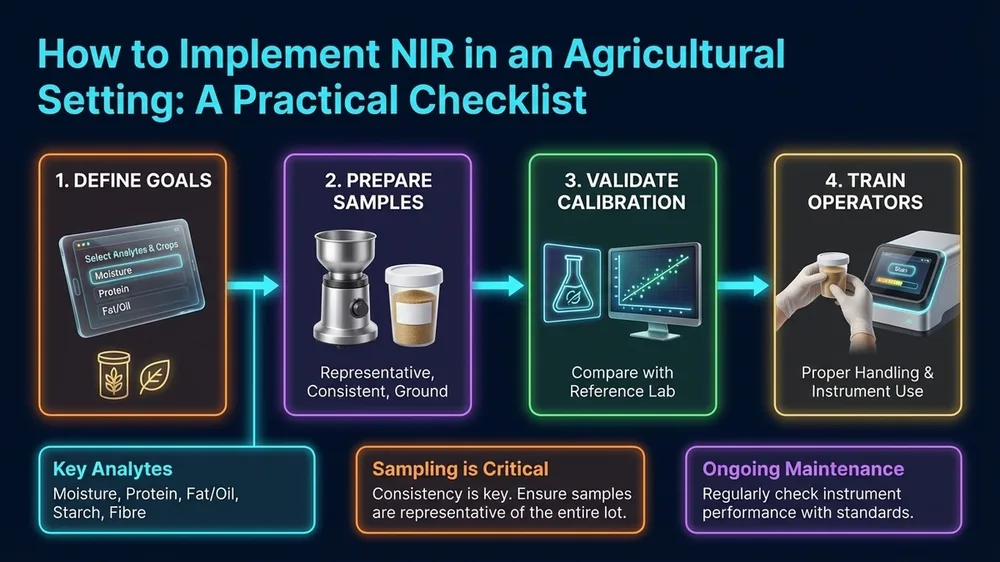
- Define your measurement points first. Don't buy an instrument and then figure out where it goes. Map every point in your process where a quality decision is made, then instrument accordingly.
- Build calibrations on your materials. Generic global calibrations are a starting point, not a finish line. Collect local samples, run reference analyses, and build or refine calibrations against your actual product range.
- Validate against AOAC methods if you need regulatory defensibility. Document everything — sample set size, reference method used, and statistical performance metrics.
- Automate the data flow. Manual entry is the enemy of fast decisions. Connect NIR output to your LIMS or formulation system from the start.
- Set up performance monitoring. Run check standards daily. Track bias drift over time. Calibrations don't stay valid forever — raw material composition shifts seasonally, and your calibration needs to track with it.
- Calculate your ROI baseline before you start. Know what moisture giveaway, protein over-formulation, or off-spec rejections are costing you today. Then you can measure what NIR actually delivers.
Note: Calibration maintenance is not optional — it's part of the operating cost. Build it into your annual budget and assign ownership to a specific person. Instruments that drift without anyone noticing are worse than no instrument at all, because they generate false confidence.
Getting More from NIR in Agricultural Quality Programs
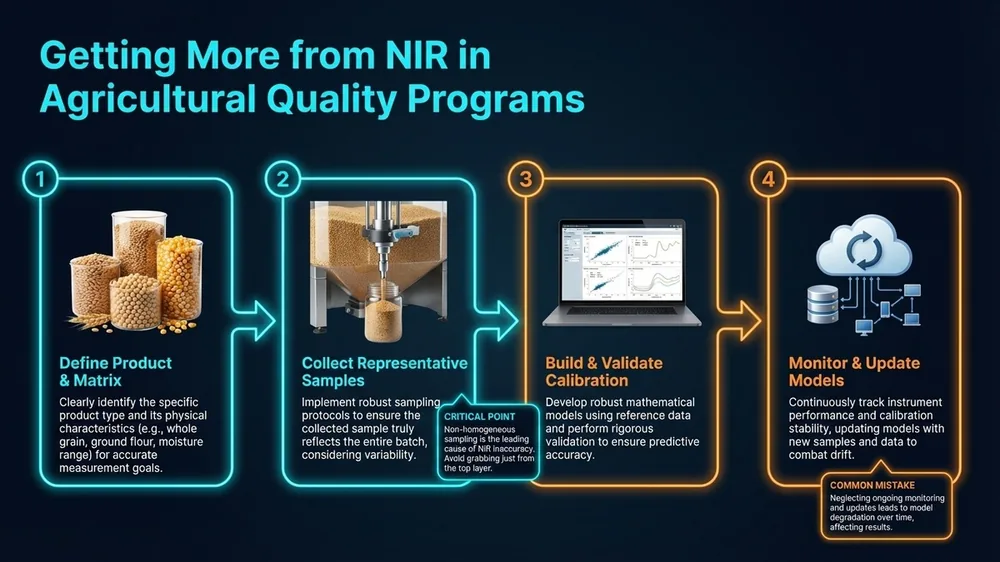
NIR spectroscopy is one of the most effective tools in agricultural quality management — but only when you understand how it works, where it can fail, and how to build calibrations that hold up in the real world. Knowing which AOAC method applies, how to document a defensible validation, or why your combine-mounted sensor drifts in wet conditions requires more than reading the instrument manual.
Related Articles
- NIR Spectroscopy Applications: Grain, Feed, Dairy, and Oilseed in Practice — See Article A for detailed discussion on inline NIR benefits in dairy fat standardization and proces
Further Reading
Selected references drawn from the NIR Accuracy Course supplemental materials.
- (n.d.). NIR Instruments and Prediction Methods for Rapid Access to Grain Protein Content. Application of NIR Spectroscopy to the Analysis of Grain https://pmc.ncbi.nlm.nih.gov/articles/PMC9146900/
- IAS Analytics. (2024). Cost Savings in Feed Manufacturing with NIR. This article explains how Near-Infrared (NIR) spectroscopy offers significant cost savings for feed manufacturers by improving production steps and ensuring quality control. https://www.iasanalytics.com/post/change-feed-quality-control-an-introduction-to-nir-technology
- (n.d.). NIR Offers Potential for Feed Cost Saving. An older but still relevant article discussing the potential of NIR spectroscopy to reduce feeding costs in the livestock industry. https://www.thepigsite.com/news/2013/03/nir-offers-potential-for-feed-cost-saving-1
- NIR-Online Process Analyzers (leading instrument manufacturer, accessed March ). (2026). Online/Inline NIR Process Control. This page outlines the features and benefits of online/inline NIR instruments for real-time process control, emphasizing continuous monitoring of key parameters like moisture, fat, and protein to maximize production efficiency and ensure product quality. https://www.buchi.com/en/products/instruments/nir-online-process-analyzer
SpectroScience students get access to the NIR Troubleshooting Guide — systematic approach to diagnosing poor predictions, instrument drift, and calibration failures. Available as a free download in the student resource library.
Access the PDF libraryFree tool — NIR ROI Calculator: Plug your sample volume, current method cost, and analyte spec into the SpectroScience NIR ROI Calculator to see annual savings and payback period for your operation. Open the ROI Calculator →
Free tool — Calibration Metrics Calculator: Enter your reference values and NIR predictions in the Calibration Metrics Calculator to compute RMSEP, RPD, R², and bias the way our course teaches it — with interpretation thresholds for grain, dairy, and feed. Open the Metrics Calculator →
NIR Fundamentals Course — Lesson 13: NIR in Agriculture
This lesson focuses on the application of NIR technology specifically in agricultural settings, detailing how to effectively integrate NIR data into operational workflows. It emphasizes the importance of real-time data usage for improving formulation accuracy and decision-making processes in feed and grain quality control.
Explore Lesson 13 in the NIR Fundamentals courseWant to Master NIR Spectroscopy?
Our 32-lesson online course covers everything from Beer-Lambert Law to PLS calibration — built for food, grain, feed, and dairy professionals.