Read a spectrum. Trust the number.
Learn NIR spectroscopy online: 32 animated lessons over 8 weeks for food, grain, feed and dairy labs. Course $99 one time, lifetime access, 14-day refund.
Animated lessons, interactive spectra and a 32-lesson course for food, grain, feed and dairy labs.
$99one time, lifetime access · 14-day refund
Start here: who are you?
Pick the door that sounds like you. Each one opens the page that answers your first question.
From sample to answer in five steps
A sample goes in
Grain, milk, feed or meat. No chemicals, no waiting.
Light hits it
Near-infrared light sweeps across the sample.
A spectrum appears
Bonds absorb some colors. The curve is the fingerprint.
A model reads it
A calibration links the curve to a lab number.
You get the result
Protein, moisture or fat in seconds, and you trust it.
Move the slider. Watch the NIR bands change.
Water absorbs near 1450 and 1940 nm. Fat absorbs near 1210, 1725 and 2310 nm. This is how one scan reads both.
Illustrative model for teaching, not measured data. Fat band positions are flagged for a lesson cross-check.
Start with a tool, not a lecture
Every concept has a playable version: the explorer here, the calculators below, and quick checks that point to the lesson to study next.
See a real model at work
Spectra and results below come from the demo dataset in Spectra Lab. It is a built-in synthetic practice set, so the numbers show how the method works, not how a real product behaves.
Real demo data from Spectra Lab. Try it with your own data in Spectra Lab or see the pricing.
NIR for your industry
Pick your product. Tap a card to flip it for the one thing to watch, then open the guide for real numbers, a spectrum you can scan, and a quick check.
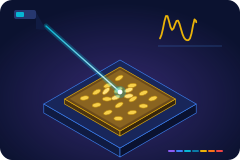
Grain and oilseed
Protein, moisture, starch at intake.
Sample temperature and moisture shift the spectrum. Scan at a steady temperature and keep moisture inside the calibration range.
Open the grain and oilseed guide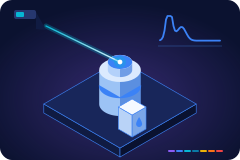
Dairy
Fat, protein, lactose, milk to powder.
Milk temperature and fat globule size change the reading. Warm and mix samples the same way every time.
Open the dairy guide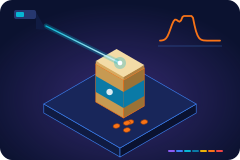
Feed and pet food
Ingredients and finished product QC.
Grind size and an uneven mix move the result more than the instrument does. Grind and sub-sample consistently.
Open the feed and pet food guide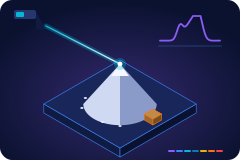
Flour milling
Protein, ash, moisture control.
Ash is read through its link to other constituents, not seen directly. Check it against the reference method often.
Open the flour milling guide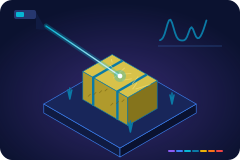
Forage and silage
Dry matter and quality on the farm.
Very wet, uneven silage is hard to present well. Pack the cup the same way and scan several sub-samples.
Open the forage and silage guide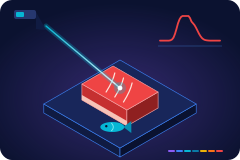
Meat and seafood
Fat and moisture in mince.
Fat is not spread evenly through mince. Mix well and scan enough sample to average it out.
Open the meat and seafood guide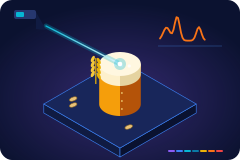
Brewing and malting
Barley and malt specs.
Barley and malt from a new crop year can fall outside the model. Watch new-season samples closely.
Open the brewing and malting guide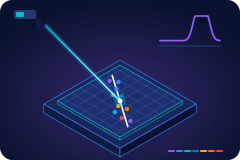
Calibration and chemometrics
PLS, validation, drift.
A high R² can hide a model that fails on new samples. Validate on samples the model has never seen.
Open the calibration and chemometrics guideSpectra Lab: a real virtual NIR lab
The lab is hands-on software, not course material. Practice data, no physical instrument. Work with:
- Instrument profiles
- Live spectra
- PCA and PLS modeling
- Practice datasets
$199 one time, lifetime access · 14-day refund
Or the course + lab bundle for $249 · 14-day refund
Join the lab waitlist Compare course, lab and bundle
Founding offer for existing students: lab for $149, valid 30 days.
What you can do after 8 weeks
- Week 1
Foundations
Lessons 1 to 4. After it: explain NIR in plain words. - Week 2
Light and matter
Lessons 5 to 8. After it: say what light does to a sample. - Week 3
NIR vs other methods
Lessons 9 to 12. After it: judge when NIR fits and when it does not. - Week 4
Applications
Lessons 13 to 16. After it: name where NIR earns its keep. - Week 5
Instrument design
Lessons 17 to 20. After it: compare FT-NIR, dispersive and diode array. - Week 6
Calibration
Lessons 21 to 24. After it: describe how PCA and PLS calibrations are built. - Week 7
Practical issues
Lessons 25 to 28. After it: spot bad samples and garbage-in risk. - Week 8
Advanced topics
Lessons 29 to 32. After it: map your next steps in NIR.
Enroll $99one time, lifetime access · 14-day refund
- Grain elevators
- Dairy plants
- Feed mills
- Oilseed processors
- Food manufacturing
Taught by a working NIR consultant
10+ years in food, grain, feed and dairy plants. Independent and vendor-neutral. Lessons come from real client questions.
Not ready to enroll?
Get one sample lesson by email.
Questions
Is the course vendor-neutral?
Yes. It teaches universal NIR principles that apply to Bruker, FOSS, Metrohm, PerkinElmer and other brands. No vendor lock-in.
Do I need a chemistry degree?
No. The course starts from the basics and is built for people working in food, feed and grain labs. No chemistry PhD required.
Which industries does it cover?
Grain and oilseed, dairy, feed and pet food, flour milling, and food analysis, plus calibration and chemometrics for any product.
What does it cost?
$99, one time, with lifetime access. There is no subscription. A 14-day refund applies.