NIR fundamentals · step 4 of 7
How does particle size affect NIR accuracy?
How Does Particle Size Affect NIR Accuracy?
NIR spectroscopy measures how near-infrared light interacts with your sample across approximately 780–2500 nm, typically capturing diffuse-reflected light from solids. You interpret the resulting reflectance or transmission spectrum through wavelength-specific absorption, scattering, and molecular overtone or combination bands. [85] Your target chemistry determines which wavelengths the instrument reads. Physical traits like particle size also shape how cleanly those chemical signals come through.
Picture reading text through frosted glass instead of clear panes: the words are there, but scattered light blurs them. Large, irregular particles do the same thing in your sample, creating uneven scattering that hides the true chemical signal and throws off accuracy. When you grind material down to smaller, more uniform pieces, you give the NIR beam a consistent optical surface. That steady surface lets the instrument lock onto the chemistry with much tighter precision.
Say you analyze grain samples in a feed mill, running coarsely cracked kernels and finely ground flour back-to-back. Particle-size differences shift your moisture readings even when both samples come from the same batch. That inconsistency drives quality-control decisions and shapes your financial outcomes. [86]
- Sample
- NIR Light
- Scattering
- Chemical Signal
- Absorption Measurement
Inconsistent milling drives most particle-size shifts. Roller gaps in flour mills widen from routine wear, throwing off grind consistency. Hammer mill screens crack or clog under pressure, letting wider particle spreads slip past inspection. You maintain NIR accuracy by locking in particle size through strict grinding protocols and scheduled equipment checks.
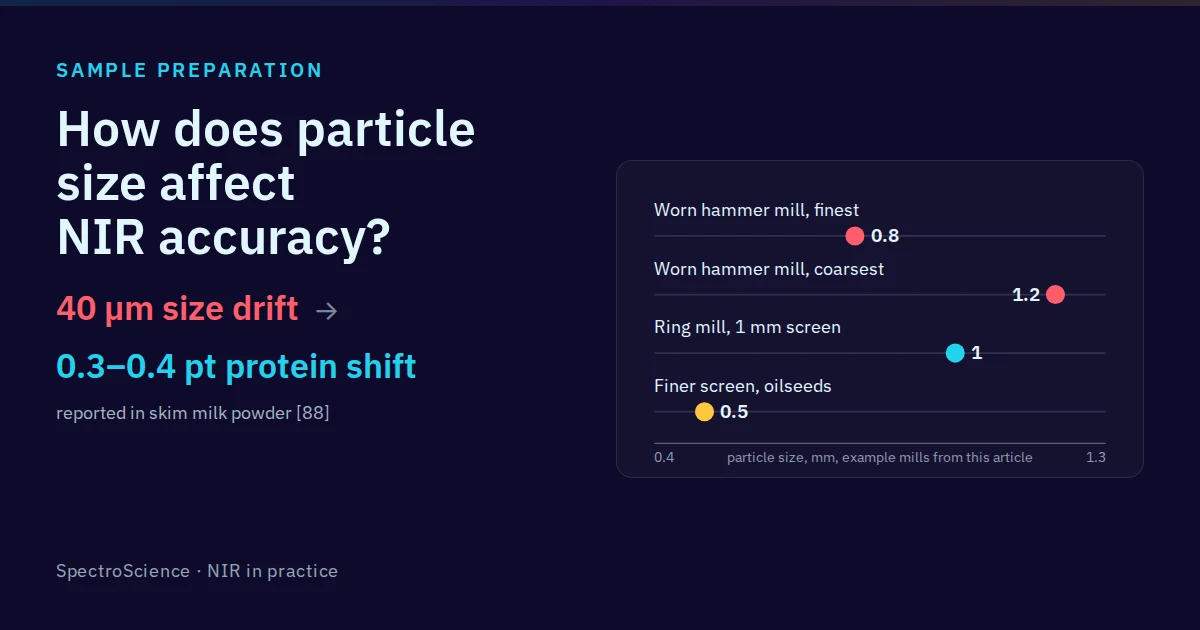
Field tip: Run a ring mill or Cyclotec-type grinder on a 1 mm screen as your baseline for most ground grain and feed products. Some labs push oilseeds through a finer 0.5 mm screen to tame the steep moisture and fat gradients found in coarse cuts.
Wear on roller gaps
Correct. Inconsistent milling, such as widening roller gaps due to wear over time, alters grind consistency.Changes in temperature
Not quite. Inconsistent milling, such as widening roller gaps due to wear over time, alters grind consistency.Variation in sample composition
Not quite. Inconsistent milling, such as widening roller gaps due to wear over time, alters grind consistency.What Causes Variability in Particle Size?
Inconsistent milling drives most particle size variability. Hammer mills and roller mills wear down over time, shifting your particle size distribution before you even notice it. Cracked or clogged hammer mill screens let particles run wild in a single batch. Roller gaps in flour mills also drift with wear, delivering coarser grinds than you set.
Raw material hardness shifts results too. Hard corn grinds differently than soft corn, even if you keep every machine setting identical. That variability creates measurement errors that look like calibration drift, often triggering false readings and costing you money.
Say a feed mill runs a hammer mill with screens used for months without maintenance. Worn screens pass larger particles, creating wide particle size swings within each batch. Changes in sample presentation, temperature, instrument response, or calibration transfer can push predicted moisture readings, potentially approaching 1 percentage point in some applications, even when the underlying chemistry stays unchanged. [87]
- Raw Material
- Milling Equipment
- Particle Size Distribution
- NIR Analysis
- Measurement Error
Standardize your milling equipment and inspect it regularly to curb these problems. Stick to the same mill type and screen size for every batch to lock in consistent particle sizes. Run periodic sieve tests or laser diffraction checks on ground samples to catch deviations early.
Inconsistent milling drives particle size variability straight into your NIR accuracy readings. Routine maintenance and tight procedures keep those particle sizes steady and your NIR measurements trustworthy.
Inconsistent raw material hardness
Not quite. Over time, equipment such as hammer mills or roller mills can wear down, leading to changes in particle size distribution without immediate notice.Wear and tear of milling equipment
Correct. Over time, equipment such as hammer mills or roller mills can wear down, leading to changes in particle size distribution without immediate notice.Incorrect calibration settings
Not quite. Over time, equipment such as hammer mills or roller mills can wear down, leading to changes in particle size distribution without immediate notice.When to Use Consistent Particle Size in NIR Analysis?
Consistent particle size drives accurate Near-Infrared (NIR) analysis across applications, and it matters most when your results demand high precision. Take protein testing in dairy intake, for example. Those sensitive measurements require meticulous sample preparation.
Say your dairy plant analyzes skim milk powder for protein via NIR. Particle-size variation can alter NIR scattering and introduce bias into your predicted protein values. In one reported skim-milk-powder application, about 40 µm of batch-to-batch variation was associated with a 0.3–0.4 percentage-point shift. [88] Those tiny differences may look minor, but they directly influence purchasing decisions tied to strict protein specifications.
You also need tight particle-size control in oilseed crushing to get accurate moisture and oil predictions. Those measurements drive yield calculations with heavy financial implications per tonne of product. Particle sizes that fall outside your calibration range can drop NIR prediction accuracy, sometimes substantially, since both particle size and sample presentation alter the measured spectrum. [87]
Pet food manufacturing faces similar hurdles because blend ingredients vary widely in composition. Meat meal, corn, and soy differ widely in hardness and density, which creates uneven grinding patterns. That inconsistency leaves you with uneven particle fractions. Your NIR analyzer struggles to deliver reliable predictions unless you homogenize those samples thoroughly.
Whether you analyze dairy protein, track oilseed moisture and oil, or manage pet food ingredient blending, consistent particle size protocols stay non-negotiable. Uniform sample preparation boosts your measurement accuracy and protects the integrity of your NIR calibration models.
Particle size variation of about 40 microns
Correct. If the particle size varies by approximately 40 microns from batch to batch, this inconsistency can cause predicted protein levels to shift by 0.3–0.4 percentage points.Temperature changes during analysis
Not quite. If the particle size varies by approximately 40 microns from batch to batch, this inconsistency can cause predicted protein levels to shift by 0.3–0.4 percentage points.Humidity fluctuations
Not quite. If the particle size varies by approximately 40 microns from batch to batch, this inconsistency can cause predicted protein levels to shift by 0.3–0.4 percentage points.Practical Takeaways for Improving Particle Size
Improve the accuracy of your near-infrared (NIR) analysis by standardizing particle size across all samples. Try these steps to get consistent results:
Standardize Milling Equipment — Run every batch through the same mill type and screen size. A ring mill or Cyclotec grinder set to a 1 mm screen is commonly used for most ground grain and feed. Lock these settings into your standard operating procedures (SOPs) to keep everything uniform.
Regular Maintenance — Check hammer mill screens and roller gaps on a strict schedule. Worn screens throw off particle size and break alignment with your calibration standards. Say you find your hammer mill screens wear out every six months; booking replacements ahead of time stops unpredictable sample prep variability.
Conduct Particle Size Analysis — Test ground samples with sieves or laser diffraction regularly. Quarterly checks serve as your minimum baseline, but monthly inspections might be necessary when your raw materials shift often. Monthly testing can catch deviations early and prevent calibration drift.
Train Staff — Show your technicians how careful sample prep drives accurate NIR readings. Even visually consistent grinds may not meet your method’s specs. Make training sessions stress that proper grinding belongs in the measurement cycle, not just before it.
Implement Quality Control Checks — Weave certified reference materials into your monthly routine. Predictions that shift while your reference stays steady indicate an issue with sample preparation rather than calibration drift. Say you spot a 0.5% variation in moisture content readings despite consistent reference standards; this could signal a need to inspect grinding equipment.
Consistent particle size keeps your NIR analysis reliable. Stabilize your milling process first, then decide whether to recalibrate or call the vendor. Correcting sample preparation can often resolve these issues more efficiently than adjusting calibration settings.
Comparison of Grinding Methods
Consistent particle size drives accurate NIR analysis, and different grinding methods reach that target differently. Here’s how common techniques stack up in food, feed, and agriculture:
- Hammer Mill
- Ring Mill
- Roller Mills
- Hammer Mill: Effective for coarse grinding but can introduce variability due to screen wear or blockages.
- Ring Mill (or Cyclotec-Type Grinder): Provides consistent particle size when set correctly, making it ideal for most applications requiring uniformity.
- Roller Mills: Common in flour milling; maintain consistency with regular maintenance and calibration of roller gaps.
| Grinding Method | Consistency | Maintenance Requirements | Ideal Sample Type |
|---|---|---|---|
| Hammer Mill | Variable | High (screen inspection) | Coarse grains, feed |
| Ring Mill | High | Moderate | Ground grain, feed |
| Roller Mills | High | High | Flour, fine grains |
Say a feed mill runs both hammer and ring mills. A worn hammer mill might produce particles spanning 0.8 mm to 1.2 mm, which skews your NIR readings. The ring mill, set at 1 mm, reliably keeps particles within ±0.1 mm of that target and ensures steadier NIR results.
Field tip: Pick a grinder that limits variability and aligns tightly with your calibration standards. Run routine maintenance and verify particle sizes regularly to maintain accuracy.
FAQ
What are common causes of variability in particle size?
Worn equipment or shifting raw material hardness disrupts milling consistency, creating significant variations across your batches.
How does inconsistent particle size affect NIR predictions?
That inconsistency spawns measurement errors that mimic calibration drift, skewing your readings and exposing you to potential financial losses.
Why is consistent particle size crucial for accurate NIR analysis?
A uniform particle size keeps your chemical signal sharp and inside the model's valid range, stopping SEP from climbing unnecessarily.
What steps can be taken to ensure consistent particle size in samples?
Standardize milling equipment, conduct regular maintenance, analyze particle sizes periodically, train staff on sample prep importance, and implement quality control checks.
How does particle size impact moisture readings in grain intake lines?
Drifting particle size alone can push moisture readings off by 0.8–1.2 percentage points, triggering incorrect payments or rejected loads based on inaccurate NIR predictions.
Your next question
Build calibrations that hold up
See the NIR calibration courseAsk a questionSources
- Transparent Photothermal Superhydrophobic Coating With Structured Micrometer-Scale Regular Arrays for Anti-/De-Icing.
- Next-Generation Harvester Technologies: Synergizing Smart Grading and Biomechanical Damage Control in Mechanized Tomato Production.
- A self-regulated photothermal anti-/deicing film for all-season applications.
- Photothermal Superhydrophobic Textiles: An Emerging Paradigm from Passive Water Repellency to Active Thermal Management.
- Sensing and Perception in Robotic Weeding: Innovations and Limitations for Digital Agriculture.
- Stimuli-Responsive Materials for Biomedical Applications.
- Film Recovery Constraints on Optical and Gravimetric Assessment of Pulsed Gas-Solid Cleaning of Model Plastic Films.
- A LoRaWAN-Enabled Capacitive Sensor Network for Soil Moisture and Groundwater Monitoring.
- Waste-Derived Fine-Milled Bone Char for Apparent Cr (VI) Removal From Water and Preliminary Asphalt-Compatible Processing of the Recovered R
- Dataset on the reproducibility of UHPC mechanical properties under a fixed recipe with controlled production variability.
- <i>Gracilaria gracilis</i> Aqueous Extract and White <i>Chlorella</i> as Functional Ingredients in Yogurt: Effects o
- The Particle Size to Modulate the Techno-Functional Properties of Fava Bean Pod Powder
- Influence of Grinding-Induced Particle Size Reduction on the Physicochemical, Functional, and Sensory Properties of Moringa oleifera Leaf Po
- Developing a procedure to measure grinding energy of forages as a predictor of forage fragility
- Enhancing digestibility of corn fed to pigs at two stages of growth through management of particle size using a hammermill or a roller mill
- Validation of methodologies for sizing a high pressure grinding roll
- Effect of Particle Size on Compost Analysis by Portable X-ray Fluorescence
- Influence of surface pretreatments on the repair bond strength of 3D-printed resin used for permanent restorations: an <i>in vitro<
- <i>In vitro</i> characterization of tooth-derived and dentin-derived graft particles: Comparative analysis of particle size, min
- Characterization and technical evaluation of physicochemical properties of Tibetan medicine Zuotai via modern processing.
- Design and characterization of visually opaque but near-infrared transparent coatings for better barcode readability.
- Potential risk of occupational exposure to respirable crystalline silica in Saudi Arabia: a comprehensive review of the current status and f
- Refined Separation Treatment for Reclaimed Asphalt Pavement (RAP) Processing: A Review.
- Beyond the Status Quo: Particulate Matter Standards in Oral Dosage Forms.
- Emerging Technologies in Granulation: Process Analytical Technologies and Modeling Approaches in Pharmaceutical Development and Manufacturin
- Innovative Emerging Technologies for Pulse Flour Functionalization: A Comparison With Conventional Thermal and Biological Techniques.
- Traditional and Non-Conventional Methods of Pre-Treatment of Biological Raw Materials for Drying Food.
- A Review of the Structure and Physical Properties of Fluorozirconate and Rare-Earth-Doped ZBLAN Glasses.
- Novel Er<sup>3+</sup>/Nd<sup>3+</sup>-doped borofluoride glass materials for NIR optical fiber applications with sui
- Bioinspired Regenerative Lignification Enables Ultra-Hard and Sustainable Bamboo Structural Materials.
- An experiment-informed discrete element modelling study of knife milling for flexural biomass feedstocks
- Process and machine improvements and process condition monitoring for a deep-hole internal milling machine
- Invited review: Recommendations for reporting intervention studies on reproductive performance in dairy cattle: Improving design, analysis,
- Electromechanical characterization of individual micron-sized metal coated polymer particles
- On Free Moving Micron-Sized Droplet-Particle Collisions
- Micron-bubble streaming flow towards micron to sub-micron sized sorting
- Reconstruction and Microstructure Characterization of Tailings Materials with Varying Particle Sizes
- Synthesis methods for uniform particles of nano and micron sized apatite of various structures
- Cellulose Nanocrystals Mimicking Micron-Sized Fibers to Assess the Deposition of Latex Particles on Cotton
- From Micromeritics to Nanomeritics: A Review and Integrative Framework for Bridging the Physicochemical-Biological Continuum.
- Valorization of Olive Pomace into Functional Hydrochars for Dye Removal from Water: Effects of Hydrothermal Carbonization and Soft Alkaline
- Sub-nanometer 3D morphometric precision of polarisation-resolved wide-field optical extinction microscopy determines the roundness of indivi
- Impact of Raw Material Particle Size on Processing, Physical Quality and In Vivo Performance of Grain Sorghum and Wheat-Based Extruded Feed
- The Impact of Dust Particles on the Function of Screen-Printed Triple-Mesoscopic Perovskite Solar Cells.
- Optimizing key parameters for grinding energy efficiency and modeling of particle size distribution in a stirred ball mill.
- Fishing Net-Gravel Interlocking Mechanism to Investigate Molecular Dynamics of Physical Gel Formation in Oil-Water Emulsions: A Simulation S
- Experimental Evaluation of Wi-Fi and BLE Smart Particles in a Rotating Drum: Link-Budget-Normalised RSSI Characterisation and IMU Validation
- Chrysin-loaded PCL nanocapsule spray as a topical strategy against cutaneous candidiasis.
- A Material-Process-Equipment Integrated Design Method for Accelerating the Process Development of Twin-Screw Wet Granulation.
- A Multi-Physics Modeling Framework for Optimizing Spreading and Sintering Parameters in Powder Bed Fusion.
- Body-Worn Sensors for Recognizing Physical Sports Activities in Exergaming via Deep Learning Model
- Experimental study on erosion and wear law of metal screen under spraying condition
- Surface Modification of Screen-Printed Carbon Electrodes
- Chewing performance of patients with worn dentition before and after restorations: A scoping review
- Determination of drainage rates of heavy media for different aperture sizes on a vibrating screen
- Advances and Challenges in Wearable Sensors for Health Monitoring.
- Advancing transistor-based point-of-care (POC) biosensors: additive manufacturing technologies and device integration strategies for real-li
- Development of a Body-Worn Textile-Based Strain Sensor: Application to Diabetic Foot Assessment.
- Effects of Low-Load Blood-Flow Restriction Training Versus High-Load Resistance Training on Neuromuscular Performance and Neuromuscular Acti
- DELTA: Strengthening human biological resilience with an N=1 digital health and dynamic biomarker protocol.
- Machine-Learning-Aided Advanced Electrochemical Biosensors.
- Effectiveness of mucoactives (carbocisteine and hypertonic saline) in addition to usual airway clearance management with usual airway cleara
- Quality Management System in Clinical Digital Pathology Operations at a Tertiary Cancer Center.
- Drug supply management at first-level public health facilities: Case of Pyay District, Myanmar.
- Development of quality assurance program for digital pathology by the Korean Society of Pathologists.
- Towards an extensive set of criteria for safety and cyber-security evaluation of cyber-physical systems.
- High-Resolution CSRR-Based Microwave Sensor for Soil Moisture Content Monitoring.
- A deep neural network-enhanced multi-scale coupled model of patient-specific acoustic wave propagation for mechanotransduction stimulation o
- Modeling freshwater inflow to a tropical estuary using stochastic and neural-network approaches under contrasting hydroclimatic conditions i
- CRC-TrustBench: benchmarking cross-study and cross-country generalization in gut metagenomic colorectal cancer prediction.
- AI Can Predict, but Experiments Must Test: A New Role for Neutron Facilities in a Materials AI World.
- Element accumulation patterns and bioindicator potential of Soldanella carpatica along a montane-alpine gradient.
- Advancements in Sustainable Livestock Feed: Harnessing Drought-Tolerant Crops.
- Sustainable valorization of mango peel waste by extracting bioactive compounds for functional applications.
- Sustainable Management of Photovoltaic Waste Through Recycling and Material Use in the Construction Industry.
- Biomass Demineralization: A Critical Need for Future Biorefineries.
- An Overview of the Application of Multivariate Analysis to the Evaluation of Beer Sensory Quality and Shelf-Life Stability.
- A 3D printed grinder adaptor for streamlined sample processing.
- Occupational health and safety in flour Mills: A research and risk assessment
- Development of sourdough bread from roll-milled and stone-ground soft (Triticum aestivum) wheat flours milled to different extraction rates
- Occupational exposure to flour dust and the associated respiratory outcomes among workers at a selected flour mill in KwaZulu-Natal
- Cold plasma treatment of chickpeas: disinfestation potential, milling and baking quality of the flour
- Nutritional guide to feeding wheat and wheat co-products to swine: a review.
- Leading Edge Technologies and Perspectives in Industrial Oilseed Extraction.
- https://link.springer.com/article/10.1007/s44378-026-00314-w?error=cookies_not_supported&code=6497da1d-23f2-4500-baa5-915a62c91db4
- https://pmc.ncbi.nlm.nih.gov/articles/PMC13073678/
- https://agricultureid.com/quality-measurements/near-infrared-spectroscopy
- https://www.tandfonline.com/doi/abs/10.1080/10739149.2025.2608094
Draft, not published. $0 fact-check against the original's own sources: gate FIX. Template gate: worked example.