NIR fundamentals · step 4 of 7
How does reference method accuracy affect NIR predictions?
Calibration Model
Your near-infrared (NIR) prediction accuracy depends entirely on the quality of your reference data. You use that data to build a calibration model—a mathematical link between the raw spectral readings from your instrument and the chemical results you generate with traditional wet chemistry, like Kjeldahl for protein or Soxhlet for fat.
Say you need to calibrate an NIR instrument for wheat moisture. You collect hundreds of samples, test each one with the NIR unit and a reference method like Karl Fischer titration, then feed those paired results into the model. The software learns to tie specific spectral patterns to actual moisture levels.
You must keep those reference values tight and repeatable. Inconsistent sample prep or routine operator mistakes in the reference lab seep straight into the calibration model. The NIR unit then chases that built-up noise alongside the real chemical signal, producing predictions that mirror human error rather than the true composition.
- Sample
- NIR Spectra
- Reference Lab Values
- Calibration Model
- Predictions
Key insight: Your NIR's accuracy matches the quality of the reference values it's calibrated against. Inconsistent lab methods force the calibration model to absorb that variability, which directly translates to less reliable predictions.
Keep your reference method tight by running regular quality control checks, enforcing standardized sample prep and analysis procedures, and maintaining ongoing technician training. Clean, precise reference data gives your calibration model a stable baseline to work from, securing more reliable NIR predictions down the line.
Regular equipment maintenance
Not quite. If the reference lab introduces variability through inconsistent sample preparation or technician error, this noise gets incorporated into the calibration model.Minimizing error in reference methods
Correct. If the reference lab introduces variability through inconsistent sample preparation or technician error, this noise gets incorporated into the calibration model.Increasing sample size
Not quite. If the reference lab introduces variability through inconsistent sample preparation or technician error, this noise gets incorporated into the calibration model.Reference Lab Errors
Inconsistent sample prep and technician variability can significantly degrade the reference values you use to calibrate NIR instruments. Say a feed mill runs Kjeldahl digestion times that vary by several minutes from batch to batch. That inconsistency injects noise into your reference data and directly weakens the calibration model's reliability.
Key insight: Your NIR’s accuracy depends entirely on the reference values it uses for calibration.
- Sample Prep
- Tech Variation
- Reference Values
- NIR Calibration
- Prediction Accuracy
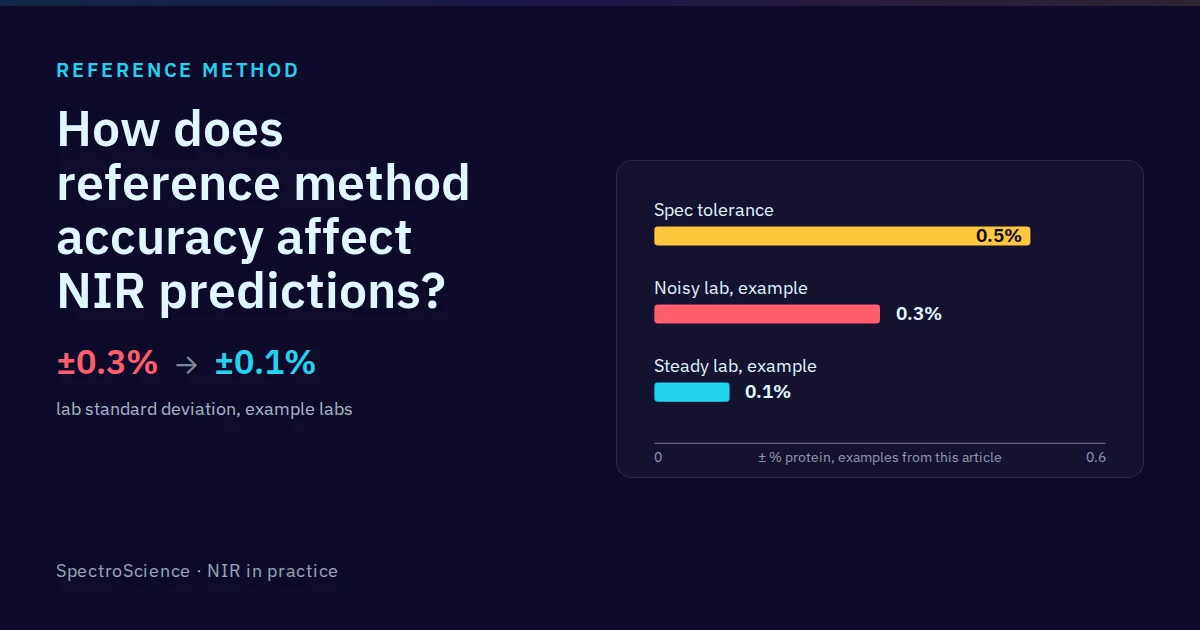
Monitor standard deviation closely. If your lab's protein analysis shows a standard deviation of ±0.3% against a specification tolerance of ±0.5%, you have very little margin for error in the NIR model. Feed mills often face additional challenges from particle-size variation and sample heterogeneity, which drive inconsistent reference values even within the same batch.
Watch out: Verify your reference method maintains a low standard deviation to protect your NIR accuracy.
Inconsistent reference methods can create blurry averages in your calibration models, training the NIR to predict laboratory errors alongside true analyte concentrations. That upstream quality drop directly impacts your downstream predictions, so you should audit and improve your reference labs before blaming instrument inaccuracies.
Mean
Not quite. Standard deviation is a critical metric to monitor.Variance
Not quite. Standard deviation is a critical metric to monitor.Standard deviation
Correct. Standard deviation is a critical metric to monitor.Accuracy Comparison
A well-built NIR calibration model can match or exceed the repeatability of traditional wet chemistry methods when trained on clean, consistent reference data. That precision matters in food and feed processing, where rapid, reliable testing sets the pace.
- Ensure high-quality reference methods
- Regular calibration updates
- Monitor standard deviation
- Conduct routine validation
Example Scenario:
Say a grain mill uses both NIR spectroscopy and Kjeldahl analysis to measure protein in incoming wheat. Your quality control team flags discrepancies between the two methods. Investigation shows the Kjeldahl method yields a standard deviation of ±0.3% against a ±0.5% tolerance limit. That variability injects noise into the reference data your NIR instrument relies on for calibration.
Comparison Table: Reference Method vs. NIR Spectroscopy
| Metric | Wet Chemistry (Kjeldahl) | NIR Spectroscopy |
|---|---|---|
| Sample Analysis Time | 45 minutes or more | ~30 seconds |
| Standard Deviation | ±0.3% | Depends on reference data quality |
| Repeatability | Variable due to human error | High, if calibrated correctly |
Key Insight:
Your NIR prediction accuracy depends entirely on the consistency and reliability of your reference method. When a reference lab introduces variability through uneven procedures or equipment drift, that noise hardwires itself straight into your calibration model.
Lock in high NIR accuracy by tightly controlling your reference methods and driving down standard deviation. Run regular quality checks like blind duplicates and certified reference materials, then document analyst training and performance records thoroughly.
Practical Steps:
- Ensure High-Quality Reference Methods: Regularly validate and calibrate your reference methods.
- Regular Calibration Updates: Update NIR calibration models when sample composition changes.
- Monitor Standard Deviation: Track the standard deviation separately from NIR performance to catch issues early.
- Conduct Routine Validation: Use certified reference materials for monthly validation checks.
Focus on these steps, and your NIR spectroscopy will deliver accurate, reliable results that match or even surpass traditional wet chemistry methods in repeatability.
Regular calibration updates
Not quite. The accuracy of your NIR predictions is directly tied to the consistency and reliability of your reference method.Ensuring high-quality reference methods
Correct. The accuracy of your NIR predictions is directly tied to the consistency and reliability of your reference method.Conducting routine validation
Not quite. The accuracy of your NIR predictions is directly tied to the consistency and reliability of your reference method.Detection Limit
NIR spectroscopy measures macrocomponents like moisture, protein, and fat accurately because these compounds absorb near-infrared light strongly. Under optimal conditions, you can predict grain moisture content within ±0.1%. When you shift focus to trace elements or compounds at very low concentrations, though, physical constraints inherently limit NIR’s performance.
Trace components often lack the chemical bonds needed to interact strongly with near-infrared light, which makes accurate detection difficult. Say you need to measure a micronutrient at 0.01% concentration. That level sits well below what NIR can reliably detect, since the weak absorption signature simply does not carry enough signal.
These physical limits mean NIR delivers rapid, accurate results for major components but may struggle with trace elements unless you put in significant extra effort or switch methods. You should map out these detection limits before deciding to replace traditional wet chemistry with NIR entirely. Run your models against calibration metrics like RPD (Ratio of Performance Deviation) and R² (coefficient of determination) to verify they hold enough statistical power across the exact concentration range your specifications demand.
NIR delivers exceptional speed and accuracy for macrocomponents, but physical constraints cap its detection ability for trace elements. Evaluate those limits before rolling out NIR as your only analytical tool.
Worked Example (Illustrative Values)
Take a plant that uses near-infrared spectroscopy (NIR) to predict protein in incoming grain. If its reference method shows a standard deviation of ±0.3% for protein, that variability injects significant noise into the calibration model. You get less accurate NIR predictions as a direct result.
- Reference Method Consistency
- Inconsistent
- Calibration Model Quality
- Lower
- NIR Prediction Accuracy
- Less Accurate
- Reference Method Consistency
- Consistent
- Calibration Model Quality
- Higher
- NIR Prediction Accuracy
- More Precise
Step 1: Identify Reference Method Variability
Say your lab's reference method for measuring protein in grain shows a standard deviation of ±0.3%. That variation means two repeat tests on the same sample will often disagree by several tenths of a percent.
Step 2: Assess Impact on NIR Calibration Model
Your calibration model absorbs those inconsistencies directly. Consequently, your NIR predictions may not accurately reflect true protein content but instead track an average of your lab's measurement errors.
Step 3: Compare to Lower Variability Scenario
Now picture a facility where the reference method hits a standard deviation of ±0.1% for protein. That lower variability signals steadier, more reliable reference values and builds a higher quality calibration model for your NIR predictions.
Step 4: Evaluate NIR Performance
Under that ±0.1% standard deviation, your NIR system can maintain high precision in protein predictions. Reduced noise from the reference method lets the calibration model better correlate NIR spectra with true analyte concentrations.
Conclusion
Your NIR system’s accuracy heavily depends on the consistency and reliability of your reference methods. A standard deviation of ±0.3% introduces too much variability, whereas a lower value like ±0.1% supports more accurate and reliable NIR predictions. Regularly monitoring and improving the quality of your reference methods can significantly enhance the performance of your NIR calibration models.
FAQ
How does sample composition change affect calibration?
Update your NIR model whenever sample matrices shift, such as with new crop years or different suppliers.
What is the key to maintaining NIR accuracy?
Run regular validations against certified reference materials, and monitor the standard deviation of your reference methods.
Why is technician training important for NIR?
Train your technicians to deliver consistent reference data, since that consistency directly impacts your calibration quality and model reliability.
How does wet chemistry compare to NIR in repeatability?
A well-built NIR model can match or exceed traditional wet chemistry accuracy when you validate it against robust reference methods.
What metrics indicate a useful calibration model?
Ensure your RPD, R², and RMSEP values show statistical separation within the concentration range your spec covers, so your predictions stay reliable.
Your next question
Build calibrations that hold up
See the NIR calibration courseAsk a questionSources
- Advancing Egg Freshness Evaluation with Integrated AI and Spectroscopy.
- Hyperspectral Imaging for Agricultural and Food Sensing: Applications, Data Analytics, and Deployment Challenges.
- Near-Infrared Spectroscopy in Food Analysis: Applications, Chemometric Strategies, and Technological Advances.
- Postharvest Management of Fruits: Navigating the Affordability, Efficacy, and Non-Destructive Quality Evaluation of Thermal Versus Non-Therm
- Computer Vision from Tea Cultivation to Quality Evaluation.
- Nanotechnology in Prostate Cancer: PSMA-Targeted Nanoplatforms, TME-Responsive Therapy, Immunomodulation, and Clinical Translation Challenge
- Loss contexts enhance dorsolateral prefrontal interpersonal neural synchrony during successful human deceptive recommendations.
- SAW YOLO lightweight network for fire hazard detection in ancient wooden structures.
- On-chip electrocatalytic microcells for high-throughput experimentation of electrocatalysts.
- A Rapid Cortical Learning Process Supporting Students' Knowledge Construction During Real Classroom Teaching.
- 2D-to-3D Image Reconstruction in Agriculture: A Review of Methods, Challenges, and AI-Driven Opportunities.
- Towards neuromorphic neurotechnologies: integrating brain-inspired computing with brain-computer interfaces.
- A novel image-based algorithm to support future remote assessment of chewing function.
- Biophysics-informed computational framework for predicting antisense oligonucleotide knockdown efficacy under small-data constraints.
- Multi-Center Study on Sample Preparation and Feature Selection Effects in Reproducible Mass Spectrometry Imaging for Clinical Translation.
- A multi-center study on the consistency of drug sensitivity testing in patients with acute myeloid leukemia.
- A genus-labeled dataset of individual trees outside forests in Baden-Württemberg, Germany.
- Tri-Band Vis-NIR Spectroscopy with Color Residual-Variance Gated Attention Fusion for Rapid Assessment of Hongmeiren (<i>Citrus reticu
- Non-Destructive Sensing and Intelligent Quality Prediction During Fruit Drying: From Quality Formation to Decision Support.
- Artificial intelligence in poultry processing: applications, validation gaps, and pathways toward intelligent and autonomous processing syst
- Physiological information in near-infrared spectroscopy
- Direct comparison of near-infrared spectroscopy with near-infrared spatially resolved spectroscopy for monitoring active pharmaceutical ingr
- Demonstration of Quantitative Mid-Infrared Hydrocarbon Aerosol Absorption Spectroscopy Using a Dual-Cell Photoacoustic System.
- Clinical Validation on Healthy Humans of a Portable Non-Invasive Continuous Glucose Monitor Based on Transdermal Band-Pass Raman Spectroscop
- Microfluidics-Integrated Spectroscopic Technologies for Food Safety and Quality Assessment: From Complex-Matrix Processing to On-Site Decisi
- Artificial Intelligence-Driven Dairy Quality Assessment: From Advanced Sensing Technologies to Explainable Intelligence.
- Portable near-infrared spectroscopy combined with machine learning for rapid detection of broiler breast myopathies.
- High precision and efficiency robotic milling of complex parts: Challenges, approaches and trends
- Challenges of Pasture Feeding Systems—Opportunities and Constraints
- Investigation of Cutting Force Coefficient Variation in Milling
- Machine-learning for automatic prediction of flatness deviation considering the wear of the face mill teeth
- Preliminary Experimental Comparison of Plunge Milling and Face Milling: Influences of Cutting Parameters on Cutting Force and Surface Roughn
- Predictive Artificial Intelligence Models for Mycotoxin Surveillance and Mitigation in Poultry Production Systems.
- Understanding donkey value chain in Kenya: mapping, governance, challenges, and equity.
- Performance Optimization of Novel Laser Hybrid Ultrasonic Vibration Assisted Micro Milling for Inconel 718.
- Experimental Analysis of the Correlation Between Cutting Parameters and Recurrence Measures During End Mill Flute Grinding.
- Reclassifying hospital energy demand toward industry-like requirements for hygienic and resilient indoor environments.
- Moderate Processing of Rice: Processing Technology, Quality Evaluation, and Reflections Precision.
- Can we do better in identifying child developmental conditions early? Sensitivity and specificity of the Watch Me Grow Integrated (WMG-I) di
- HEART-Watch: A multimodal physiological dataset from a Google Pixel Watch across different physical states.
- A Wearable Respiratory Monitor for Home-Based Screening and Stratification of Obstructive Sleep Apnea: A Pilot Study in Participants with In
- Reliability and Safety of Smartwatch Blood Pressure and Oxygen Saturation Measurements in Older Adults: Instrument Validation Study.
- Alternative digital secondary education for marginalized, out-of-school youth in low- and middle-income countries: Protocol for a scoping re
- Research integrity within systematic reviews: investigating the prevalence of studies by authors with multiple retraction histories in Cochr
- Applications of NIR Spectroscopy and Chemometrics for Food Authentication and Safety: Detection of Adulterants and Contaminants.
- Quality by Design and Process Analytical Technology for On-Demand Drug Manufacturing Through 3D Printing.
- Quantum dot sensors for heavy metal detection: from mechanistic design to field deployment: a review.
- Empowering photodynamic therapy with artificial intelligence: current trends and future directions.
- Advancements in 3D field-crop phenotyping using point clouds: a comparative review of sensor technology, target traits, and challenges under
- Laser-based mid-IR spectroscopy as a rapid analytical technique for the quantification of human milk proteins.
- Prediction of Chemical Composition of Alfalfa Blocks Using FTIR Spectroscopy and Machine Learning Models.
- Establishment of a Near-Infrared Spectroscopy-Based Screening Framework for Key Quality Indicators of Cassava Varieties.
- Rapid Determination of Soybean Protein Content by Near-Infrared Spectroscopy Coupled with Multi-Learner Ensemble Wavelength Selection.
- Assessing the Feasibility of Mid- and Near-Infrared Spectroscopy for Classifying Plant-Based Beverages and Predicting Nutrient Content.
- Non-destructive quality assessment and species identification of blood tofu using portable visible/near-infrared spectroscopy.
- Novel Artificial Intelligence Approach For nsLTP Early Detection Using NIRs Data
- How Are Chemometric Models Validated? A Systematic Review of Linear Regression Models for NIRS Data in Food Analysis
- Feasibility of cross-calibrating ocean-color sensors in polar orbit using an intermediary geostationary sensor of reference
- NIR-Sensor Based Microplastic Analyser
- Cross-Scale Spectral Calibration for Spatiotemporal Fusion of Remote Sensing Images.
- SERS-Based Detection of Food Contaminants: From Laboratory Sensitivity to Practical Implementation-Bottlenecks and Pathways to Standardizati
- Multi-Source Remote Sensing Fusion and Deep Learning for Intelligent Precision Agriculture.
- A deep learning architecture for leaf water potential prediction in <i>Populus euramericana</i> 'I-214' from hyperspectral refle
- Intelligent Compaction System for Soil-Rock Mixture Subgrades: Real-Time Moisture-CMV Fusion Control and Embedded Edge Computing.
- A Systematic Literature Review on Biometric Authentication in Mobile Banking.
- Near-infrared fluorescence lifetime imaging: fluorophores, methods, and applications.
- Differential pathlength factor model for near-infrared diffuse optical imaging.
- Assessment of Grain Harvest Moisture Content Using Machine Learning on Smartphone Images for Optimal Harvest Timing
- The influence of nitrogen and variety on rice grain moisture content dry-down
- Surrogate models to predict maximum dry unit weight, optimum moisture content and California bearing ratio form grain size distribution curv
- MOISTURE CONTENT DETECTION OF SOYBEAN GRAINS BASED ON HYPERSPECTRAL IMAGING
- Forecasting field rice grain moisture content using Sentinel-2 and weather data
- Method Adaptation Patterns and a Selection Framework for Near-Infrared Spectroscopy-Based Moisture Prediction of Major Grain Crops.
- Influence of Interannual Climate Variability on Wheat Quality During Long-Term Storage: Comparative Analysis and Mathematical Modeling.
- Rapid Physicochemical Screening of Parboiled Rice Using VNIR-SWIR Spectroscopy and Chemometrics.
- Wheat forage quality: significance, genetic and genomic advances, knowledge gaps, and future directions.
- Predicting wheat yield and grain quality with UAV multispectral imagery and deep learning.
- Monitoring plant moisture content and optimizing irrigation prescriptions based on UAV multimodal data.
- COMPLAX: A Python Tool Package for Automated Microsolvation of Organic Molecules.
- l-Rhamnose from Seaweeds, Microalgae, and Cyanobacteria: Sourcing, Production, and Bioprocessing Strategies.
- From "Undetectable" to "Sensitive Detection": Advances in Derivatization Techniques for LC-MS Analysis of Genotoxic Impurities.
- Simultaneous hyperspectral quantitative analysis of amylose and amylopectin in foxtail millet using a heterogeneous stacking ensemble with a
- Non-destructive assessment of soluble solids content and firmness in tomatoes using dual-mode hyperspectral imaging technology.
- Rapid Analysis of Caffeine, Protein and Trigonelline in Ugandan Arabica Coffee Using NIRS and Machine Learning Algorithms.
- Nondestructive determination of ash content in wheat flour via terahertz time-domain spectroscopy.
- Windows into Planetary Science: A Review of Advances in Raman Spectroscopy, Laser-Induced Breakdown Spectroscopy, and Photoluminescence Spec
- Biophotonics point-of-care diagnostics in low-resource settings: a South African perspective.
- The Evolution of Next-Generation Glucose Monitoring Systems: Developments from Conventional Diagnostics to Wearable and Continuous Sensing P
- Red-to-NIR-Fluorescent Graphene Quantum Dots for Biomedical Applications.
- From Fingerprint Spectra to Intelligent Perception: Research Advances in Spectral Techniques for Ginseng Species Identification.
Draft, not published. $0 fact-check against the original's own sources: gate FIX. Template gate: all sections present.