What Questions Should You Ask a NIR Vendor Before You Sign?
The questions NIR buyers ask before signing determine ROI or regret. Get the calibration, TCO, and vendor vetting checklist for food and feed labs.
· 8 min read · Vitaly Kirkpatrick
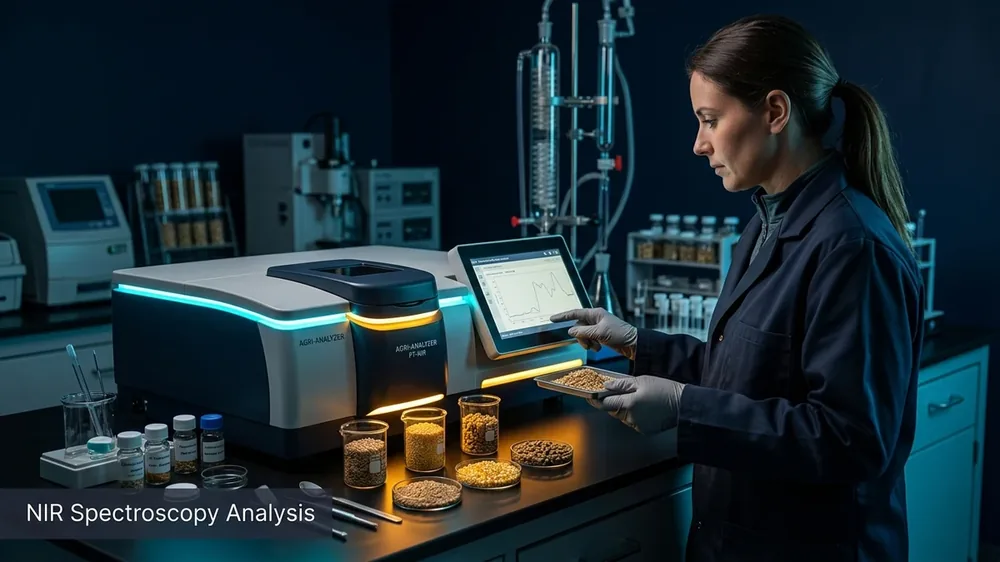
When evaluating supplier quotes, the questions NIR buyers ask before signing often determine whether a system delivers ROI or becomes a recurring problem. Three vendor quotes on the table can look nearly identical on paper. A $45,000 instrument can become a $90,000 headache within two years if calibration support collapses, software licenses pile up, or the vendor has never worked with your product matrix. The right questions protect your operation from that outcome.
What Questions to Ask a NIR Vendor?
Start with calibration support — and be specific. Don't ask "do you support calibration?" Ask: "Who builds and maintains the calibration models for my application? What does that cost annually? What RMSEP values have you achieved for moisture and protein in my matrix?" A vendor who cannot answer that last part with real numbers is telling you something important about their depth of experience.
Field tip: Ask if the vendor provides industry-specific calibration models. This reduces setup time and improves accuracy for your specific application.
Then ask about hidden costs — directly. Software licensing, annual calibration updates, hardware service contracts, and technician training often do not appear on the proposal sheet. At one grain elevator, the operations team found that annual calibration update fees added roughly 12% to their first-year cost beyond the purchase price. Get a line-by-line breakdown before anything is signed.
Understanding why NIR calibration matters and how it works will help you ask sharper questions and spot vague vendor answers before they cost you time and money.
Calibration support and hidden costs are the two areas where vendor contracts most often surprise buyers after the sale.
What Is a Vendor Vetting Process?
Think of vetting a NIR vendor the way a grain elevator vets a new grain supplier. You do not just look at the price per bushel. You check delivery history, grading accuracy, and whether they have served operations your size before. With NIR vendors, that means asking for references from plants running your specific commodity or product type — not a generic customer list.
Note: A vendor with direct experience in your industry can provide tailored solutions. That makes integration faster and reduces early calibration problems.
Request actual case studies. If a vendor claims their system works well for soybean meal at a crush plant, ask for the RMSEP values achieved in that deployment and how long the calibration held before drift required maintenance. Vague answers here usually mean limited real-world experience with that application.
Post-purchase support matters as much as the instrument itself. Ask specifically: what is the typical response time for a support call, and do they offer on-site troubleshooting or remote only? Your lab does not stop running because an instrument is misbehaving. You need to know the vendor can respond at the pace your operation requires.
How Does NIR Spectroscopy Work for Quality Control?
NIR measures the absorbance of near-infrared light by chemical bonds in your sample. O-H, N-H, and C-H bonds are the most analytically useful. A chemometric model then converts that absorbance pattern into a number your QC team can act on. In grain receiving, that means a protein or moisture result in 30 seconds rather than the 45 minutes a wet chemistry method requires. That speed difference is what makes NIR viable for high-throughput intake decisions.
For a plain-language explanation of this process, see what NIR spectroscopy is and how near-infrared light works in food and feed analysis.
Before you engage a vendor, get a clear picture of your own analytical range. Your calibration is only as good as the samples used to build it. If your production matrix sits at the edge of the model's training range, prediction error rises fast. Ask vendors what concentration ranges their existing calibrations cover and how they handle samples that fall outside those ranges.
Watch out: If your samples fall outside the NIR's analytical range, results drift toward inaccuracy and your QC decisions suffer. Confirm range coverage before committing to a calibration approach.
For quality control, calibration accuracy and system reliability are what matter most. Push vendors for RMSEP values they have actually achieved — not theoretical performance from a product sheet — for applications comparable to yours. That is the number your auditors will eventually care about too.
Understanding Total Cost of Ownership
Total cost of ownership (TCO) covers everything: purchase price, installation, initial calibration development, annual calibration updates, software licenses, preventive maintenance contracts, and staff training. One oilseed crusher found their five-year TCO was nearly 1.8× the sticker price of the instrument. That is not unusual — it is just not discussed enough during vendor conversations.
Ask your vendor to provide a written, itemized TCO estimate covering at least five years. If they will not, that hesitation is itself a data point. Calibration maintenance costs alone can vary by a factor of three or four depending on how frequently your product matrix changes and how much hands-on support the vendor includes.
Also ask about the upgrade path. NIR hardware cycles are long — 10 to 15 years in many plants — but software and chemometrics tools evolve faster. Will your vendor support calibration transfer if you add a second instrument later? That question alone can save your lab from rebuilding models from scratch years down the road. For a detailed look at what that process involves, see how to transfer NIR calibration between instruments effectively.
To build a rigorous business case before you buy, the SpectroScience guide to calculating NIR spectroscopy ROI walks through the full cost and savings framework step by step.
A written, five-year TCO estimate is one of the most useful documents you can request from a vendor — and one of the least often volunteered.
Practical Takeaways: Vendor Evaluation Checklist
- 1Assess Calibration Support — Ensure ongoing calibration assistance is included and get the annual cost in writing.
- 2Identify Hidden Costs — Look beyond the price tag for software, training, and maintenance fees. Ask for a five-year itemized estimate.
- 3Evaluate Vendor Experience — Verify industry-specific experience and request case studies with real RMSEP numbers from comparable applications.
- 4Understand Total Cost of Ownership — Account for all operational costs and confirm the vendor's upgrade and calibration transfer policy.
- 5Check Analytical Range Fit — Confirm your samples fall within the NIR's analytical range before committing to a calibration approach.
Vendors who can answer these questions clearly and back them up with real data are usually the ones worth working with. Vendors who deflect, generalize, or quote theoretical performance numbers without application context are showing you their support culture before you have even bought the instrument. Go into those conversations prepared, get the answers in writing, and your calibration will be on far firmer ground from day one. For more on NIR technology and how it fits your operation, check out the NIR Fundamentals course at SpectroScience.com.
Free tool — NIR ROI Calculator: Plug your sample volume, current method cost, and analyte spec into the SpectroScience NIR ROI Calculator to see annual savings and payback period for your operation. Open the ROI Calculator →
Free tool — Calibration Metrics Calculator: Enter your reference values and NIR predictions in the Calibration Metrics Calculator to compute RMSEP, RPD, R², and bias the way our course teaches it — with interpretation thresholds for grain, dairy, and feed. Open the Metrics Calculator →
Free tool — As-Is ↔ Dry Matter Converter: Use the As-Is ↔ Dry Matter Converter to translate any analyte value between as-received and moisture-free basis without doing the algebra by hand. Open the Converter →
Free tool — NIR Glossary: Unfamiliar with a term? The SpectroScience NIR Glossary defines every chemometrics, calibration, and instrument term used in this article in plain language with worked examples. Open the Glossary →
SpectroScience students get access to the NIR Vendor Comparison Matrix — evaluate NIR vendors across wavelength range, detector type, throughput, and support criteria. Available as a free download in the student resource library.
Access the Excel libraryNIR Fundamentals Course — Lesson 28: Working with Vendors
This lesson focuses on the critical aspects of working with NIR vendors, emphasizing the importance of clear communication about calibration models and hidden costs. It provides practical insights into evaluating vendor capabilities and understanding the long-term implications of service agreements, which aligns directly with the concerns raised about vendor selection in this article.
Explore Lesson 28 in the NIR Fundamentals courseWant to Master NIR Spectroscopy?
Our 32-lesson online course covers everything from Beer-Lambert Law to PLS calibration — built for food, grain, feed, and dairy professionals.