How to Calculate NIR Spectroscopy ROI: Building the Business Case
Learn how to calculate NIR spectroscopy ROI with real feed mill examples, over-formulation savings, and a payback approach your CFO will approve.
· 8 min read · Vitaly Kirkpatrick
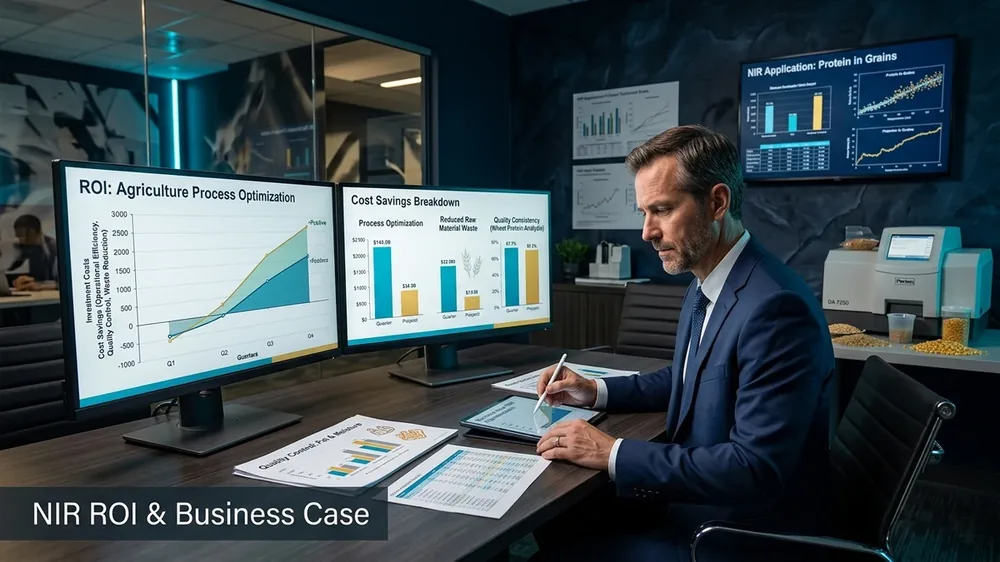
A feed mill running 50,000 tons per year and over-formulating protein by just 0.3% is burning through roughly $180,000 annually — not because anyone made a bad decision, but because the lab data arrives too late to act on. That's the core problem NIR solves. And it's exactly the kind of number that gets a capital equipment request approved. Most NIR proposals fail not because the investment doesn't pencil out, but because whoever builds the case leads with technology instead of money. This article walks through how to build the financial argument in terms your CFO and operations manager will actually respond to. For a broader look at where NIR delivers the fastest returns by operation type, see NIR Spectroscopy Applications: Where It Pays for Itself in Food and Feed.
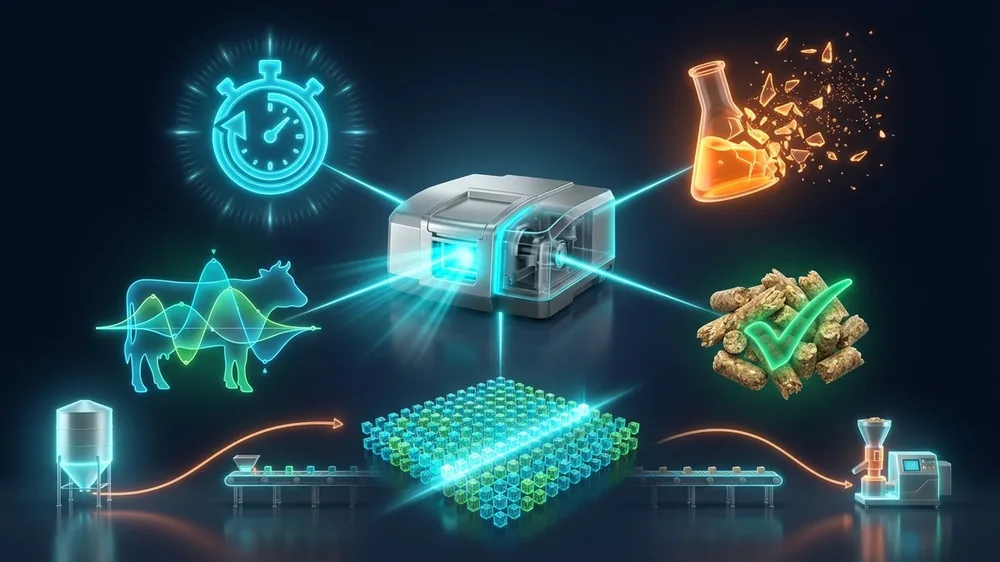
What Is Really Lost Without NIR
The cost of not having an NIR analyzer almost always exceeds the purchase price. When your lab relies on Kjeldahl protein tests, you're operating with a data delay measured in hours — sometimes a full business day. The production line doesn't wait. Trucks are unloaded. Batches are blended. Decisions get made without the information needed to make them well.
During that window, over-formulation is the only rational response. You add extra soybean meal — or whichever expensive ingredient anchors your formula — as a buffer against the uncertainty. Half a percent of extra protein sounds minor. Multiply it across thousands of tons per week and your margin takes a hit that never shows up as a single line item. It just quietly bleeds.
Incoming ingredient quality is another exposure point. If a supplier ships low-quality grain and your lab doesn't flag it until the material is already in the silos, the damage is done. NIR at the receiving dock catches those problems in real time — sometimes saving enough in a single afternoon to justify the instrument cost. The operational mechanics of how this works are covered in NIR in Grain Receiving Operations: Real-Time Quality at the Scale.
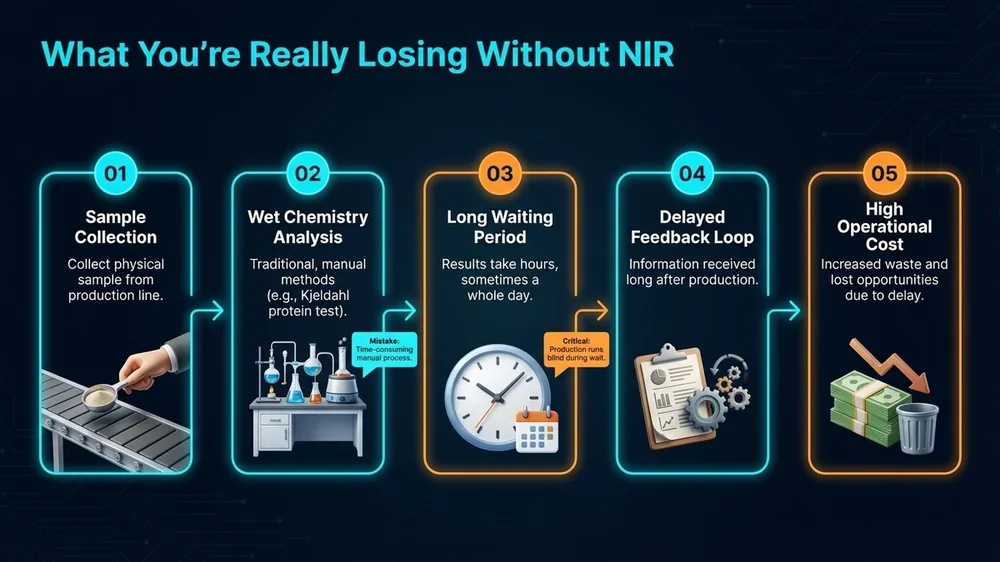
The cost of not having an NIR analyzer is not zero. It's the sum of over-formulation waste, wet chemistry operating costs, and quality failures absorbed every year. That total almost always exceeds the instrument price.
Crunching the Numbers: Building the NIR ROI Calculation
To make a compelling financial case, speak the CFO's language. Set aside chemometrics and calibration curves. Focus on payback periods and verifiable savings. The calculation has three components.
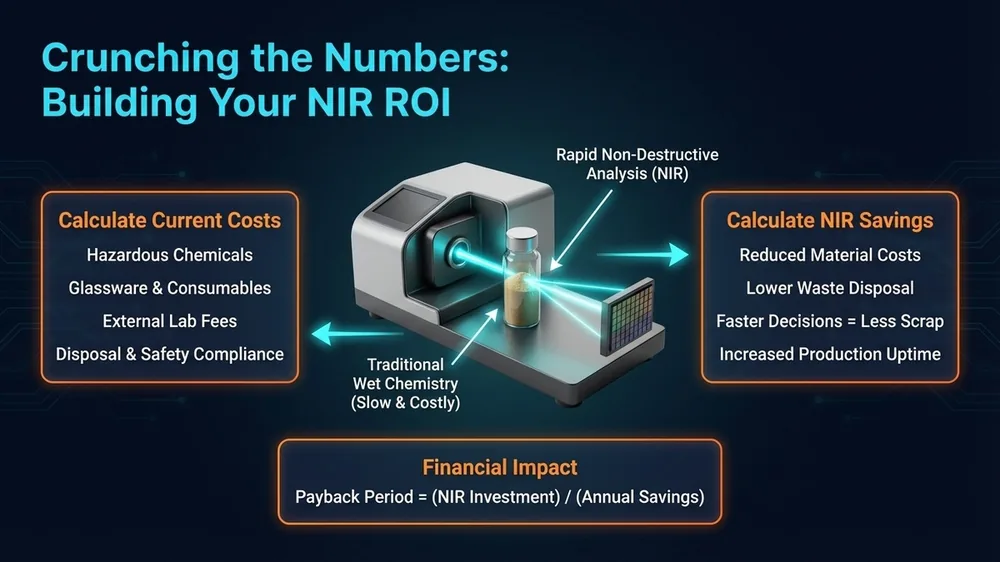
Step 1 — Current lab costs. Tally what your operation spends monthly on hazardous chemicals, glassware, external lab fees, and disposal. Wet chemistry is not just slow — it's expensive and generates ongoing waste disposal costs. A mid-sized feed mill running 20 to 30 Kjeldahl protein tests per day can easily accumulate $40,000 to $60,000 per year in reagent costs, labor, and third-party confirmation testing alone. And that's before you count the cost of the time lost waiting for results.
Step 2 — Over-formulation cost. Identify the most expensive ingredient in your formula, estimate the safety margin being added, and multiply by annual production volume. This figure routinely dwarfs lab operating expenses. For operations using soybean meal as their primary protein source, the math is stark: at $400 per ton, a 0.3% protein safety buffer across 50,000 annual tons translates directly into six-figure waste. Reducing that buffer — even partially — generates immediate, recurring savings with no change to nutritional guarantees.
Step 3 — Quality failures. Count how many loads last year were discounted, scrapped, or returned. Add any customer complaints tied to inconsistent product quality. In feed and grain operations, a single rejected truckload or discounted grain purchase can represent $5,000 to $20,000 depending on commodity and volume. Even two or three preventable incidents per year contribute materially to your ROI calculation.
Add those three figures together. The cost of the NIR instrument will look small by comparison. Most feed mills and grain elevators recover their investment within 6 to 18 months. After that, the instrument operates as a recurring profit center.
Real Numbers That Stop CFOs in Their Tracks
Here's a worked example you can adapt for your operation.
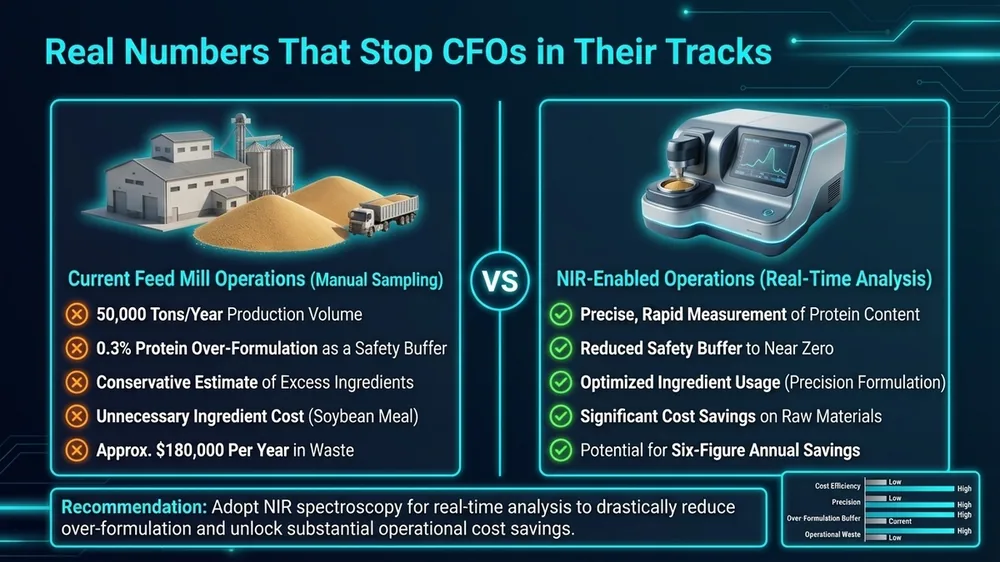
Consider a feed mill running 50,000 tons per year. Protein is over-formulated by just 0.3% as a safety buffer — a conservative estimate. The unnecessary soybean meal cost alone reaches roughly $180,000 per year. That's not a rounding error. It's a full salary plus benefits walking out the door every twelve months — caused entirely by insufficient real-time data.
Now compare that to what NIR actually costs. A well-specified NIR analyzer — including calibration development and annual maintenance, amortized over its useful life — runs approximately $45,000 per year. The math is direct: spend $45K to eliminate $180K in waste. Payback in under three months.
Grain trading operations face a parallel situation. Buying at a stated moisture of 13% when actual moisture is 12.5% means overpaying on 0.5% of every load. Across 100,000 tons per year, that moisture give-away costs $150,000 annually. One NIR instrument at the intake point removes that exposure almost entirely. These aren't hypothetical projections. They're figures validated repeatedly across real operations.
Oilseed processors run into a third version of the same problem. Oil content variability in incoming canola or soybeans directly affects extraction yield. Without real-time NIR measurement, processors either pay a premium for assumed quality that isn't consistently delivered, or they miss opportunities to improve extraction parameters when high-oil batches arrive. For a detailed look at how NIR handles oilseed measurement across multiple parameters, see How NIR Spectroscopy Measures Oil, Protein, and Moisture in Oilseed Processing.
These are not hypothetical projections — they are figures validated repeatedly across real operations.
Strengthening the Case: Soft Savings Worth Documenting
Hard dollar savings are the foundation of any NIR ROI argument. But several additional benefits deserve a line in the business case — especially when the hard savings calculation falls just short of the approval threshold.
Faster production release. When results come back in under 60 seconds instead of hours, production holds disappear. For high-throughput operations, that time compression translates directly into throughput gains. A facility running three production shifts per day can recover meaningful uptime simply by eliminating the analysis bottleneck at shift changeover or batch release.
Reduced regulatory risk. Consistent product composition data creates an audit trail that has real value during customer or regulatory inspections — and it costs nothing extra once the NIR system is in place. Operations that can show continuous monitoring records rather than periodic spot checks typically face fewer compliance questions and faster audit resolution. Your auditors will notice the difference.
Staff reallocation. Lab technicians freed from repetitive wet chemistry work can be redeployed to higher-value tasks. In tight labor markets, that flexibility carries measurable operational value. Some facilities have eliminated one part-time lab position entirely following NIR implementation — a saving that compounds year over year.
Supplier accountability. With NIR data at the receiving dock, every incoming load gets verified against specification. Suppliers delivering below-spec material are identified immediately rather than discovered weeks later. Over time, that data feeds directly into supplier negotiations and helps establish preferred-supplier relationships with vendors whose quality is consistently verified.
Documenting these secondary benefits alongside the core financial figures produces a more complete picture — and a harder proposal to reject.
The Hidden Multiplier: Dynamic Formulation with Live NIR Data
NIR is widely understood as a quality control tool. That's accurate but incomplete. The larger profit opportunity comes when NIR data feeds directly into least-cost formulation software. Think of it like the difference between navigating with last month's road map versus a live GPS feed — both get you somewhere, but only one responds to what's actually happening right now.
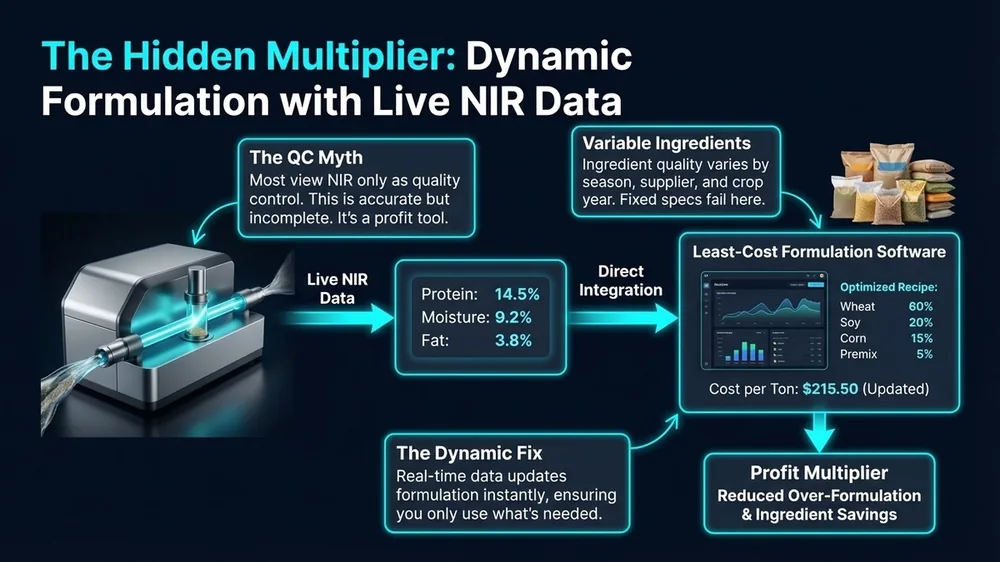
The problem with fixed ingredient specification tables is straightforward. Ingredient quality shifts by season, supplier, and crop year. If your spec tables are updated monthly — or quarterly — the formulation model is almost always running on stale data. The result is either under-delivered nutrition or unnecessary ingredient padding. And that padding costs real money every single day.
In a documented trial across six feed mills, switching from fixed spec tables to NIR-updated specifications — refreshed weekly instead of monthly — reduced formula cost by 1.2% with no change in nutritional outcome. On a $10 million annual ingredient spend, that's $120,000 returned every year, on a recurring basis.
The same principle applies in dairy operations, where ration formulation accuracy directly affects milk yield and feed conversion efficiency. Dairy nutritionists who update forage dry matter and protein values daily using NIR data consistently outperform operations relying on monthly lab averages. For a detailed look at how inline NIR measurement changes dairy QC, see NIR in Dairy Processing: Real-Time Inline Monitoring.
The implementation detail that matters most: NIR data must flow directly into formulation software. Manual data entry introduces lag and transcription errors that erode most of the benefit. If your NIR system and feed management software don't communicate automatically, a large portion of the financial gain disappears before it ever reaches your bottom line. Ask about automated integration before you select an instrument — not after.
Watch out: Manual data entry between the NIR system and formulation software introduces transcription errors and time lag that erode most of the dynamic formulation benefit. Confirm automated integration is possible before selecting an instrument.
Matching the ROI Case to the Operation Type
Not every facility calculates NIR ROI the same way. The dominant savings category shifts depending on operation type, and your business case should reflect that — not default to a generic template.
Feed mills typically find their largest savings in over-formulation reduction and wet chemistry elimination. The combination of high ingredient costs and frequent batch changeovers makes NIR especially valuable here. A mill producing five or more distinct ration types per day benefits from NIR on nearly every batch.
Grain elevators and trading operations find the ROI case almost entirely in moisture and protein accuracy at intake. Even modest improvements in measurement precision — reducing the uncertainty band on a moisture reading from ±0.5% to ±0.1% — generate large savings across high annual volumes.
Oilseed processors benefit most from oil content accuracy, both at intake and in-process. When NIR data is used to adjust extraction parameters in real time, yield improvements of 0.5% to 1% are achievable — figures that represent significant dollar value at scale.
Dairy processors find ROI in both QC throughput and real-time process monitoring. Eliminating lab holds on incoming milk, standardizing fat and protein content before processing, and reducing giveaway on finished products all contribute to a strong financial case.
Framing the ROI proposal around the specific cost drivers in your operation — rather than generic industry averages — increases the likelihood of approval and sets accurate expectations for what NIR will actually deliver in your plant.
Presenting the Case: What Leadership Actually Needs to See
A well-built NIR ROI proposal follows a simple structure. State the current annual cost of operating without NIR — broken into over-formulation, lab costs, and quality failures. Then present the annualized instrument cost. Finally, show the payback period and the recurring annual benefit beyond year one. That's the whole argument. Keep it on one page if you can.
Keep the numbers conservative. Decision-makers are more likely to approve a proposal built on defensible, understated figures than one that looks optimistic. If the conservative case still shows a six-month payback, that's the stronger argument. Use internal data wherever possible — actual lab invoices, real ingredient pricing, documented quality incidents from the past 12 months. Numbers drawn from your facility's own records are far more persuasive than industry averages your finance team can't verify.
Frame NIR not as a capital equipment purchase but as a cost reduction initiative with a defined payback window. That framing is familiar to finance teams and removes much of the friction that stalls equipment approvals. A simple table — current annual cost, NIR annual cost, net annual saving, months to payback — is often more effective than a detailed written narrative. Leadership wants to see the decision clearly, not work through pages of explanation to find the number.
Quality managers often ask me whether to include a sensitivity analysis. Yes — always. Show what happens to payback period if savings come in 20% lower than projected. If the case still holds at reduced savings, that resilience is itself a selling point. The goal isn't to oversell NIR. It's to show that the investment makes financial sense even under conservative assumptions. That's the version of the case that gets signed off.
Free tool — NIR ROI Calculator: Plug your sample volume, current method cost, and analyte spec into the SpectroScience NIR ROI Calculator to see annual savings and payback period for your operation. Open the ROI Calculator →
Free tool — NIR Glossary: Unfamiliar with a term? The SpectroScience NIR Glossary defines every chemometrics, calibration, and instrument term used in this article in plain language with worked examples. Open the Glossary →
SpectroScience students get access to the SEL Lab Error Calculator — calculate the maximum allowable NIR prediction error based on your reference method's own variability. Available as a free download in the student resource library.
Access the Excel libraryNIR Fundamentals Course — Lesson 14: Food & Feed Industry
This lesson explores the specific applications of NIR spectroscopy within the food and feed industry, highlighting its role in quality control and efficiency improvements. By understanding these applications, professionals can better articulate the financial benefits and return on investment associated with NIR technology in their operations.
Explore Lesson 14 in the NIR Fundamentals courseWant to Master NIR Spectroscopy?
Our 32-lesson online course covers everything from Beer-Lambert Law to PLS calibration — built for food, grain, feed, and dairy professionals.