Food and feed applications · step 4 of 7
How does NIR improve fat coating consistency?
Fat Coating
Fat coating is essential for boosting palatability and nutrition in pet food. Quality managers often seek ways to lock in consistent fat application throughout the manufacturing process. Near-Infrared (NIR) spectroscopy offers a rapid, precise solution, letting you adjust in real time and maintain product quality.
Immediate Adjustments with NIR
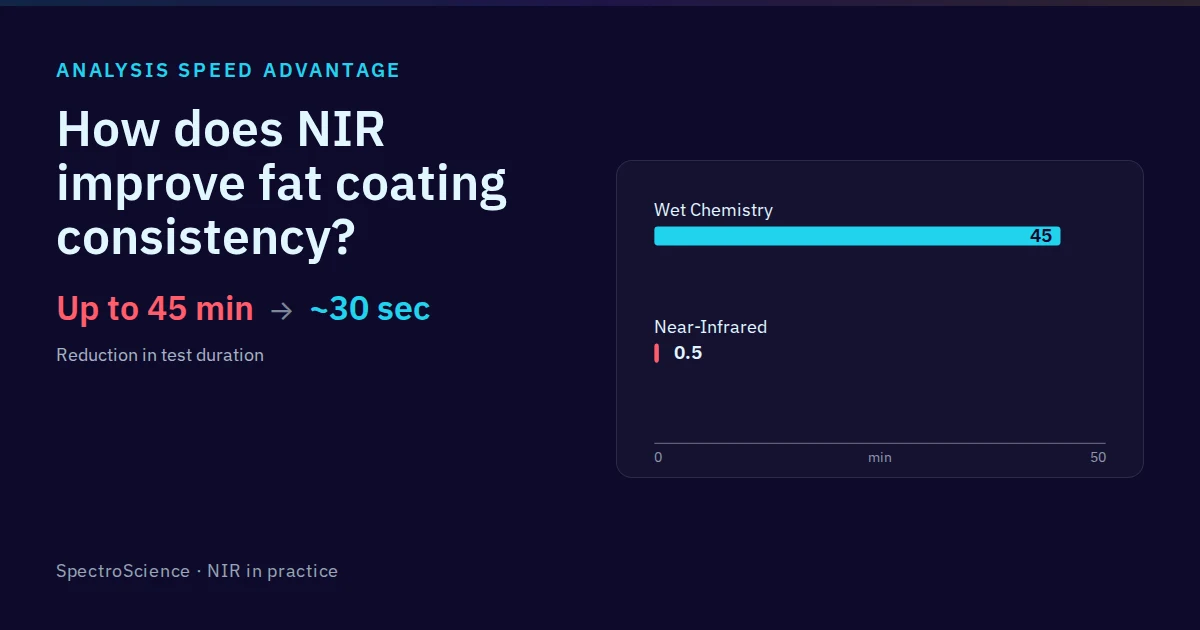
NIR measures fat content within 30 seconds, giving you immediate production feedback. This speed catches small drifts, like a drop from 10% to 9.5%, before they compound. Operators can adjust settings on the spot to keep batches on track.
Ensuring Uniform Application
You ensure uniform fat coating across every batch by running NIR scans at several process points. Say your pet food line applies fat in stages; scanning at each step flags inconsistencies early so you can fix them right away.
Key Benefits of Real-Time Monitoring
You calibrate NIR systems to detect even minor fat variations, enabling real-time process control. This proactive approach keeps the final product meeting quality standards consistently. Pet food manufacturers can enhance customer satisfaction by delivering consistently reliable product quality.
- Start
- NIR Scan
- Fat Level OK?
- End
- Adjust Coating Parameters
- NIR Rescan
This diagram maps your fat coating control workflow with NIR. Start with an initial scan, then verify whether the fat level hits specifications. Production moves forward if it matches; otherwise, you adjust the line and run another scan until you reach the target fat content.
Integrating NIR into your pet food manufacturing operations locks in consistent fat coating, driving better product quality and customer satisfaction.
Drying Control
Monitoring moisture levels is essential to prevent spoilage and texture problems in pet food manufacturing. Near-Infrared (NIR) technology delivers a rapid solution, offering quick readings that keep moisture content steady through the drying stage.
Say your target moisture sits at 10%. Traditional methods might require sending samples to a lab and waiting up to an hour for results. NIR can deliver those measurements in just seconds. That speed lets you make immediate adjustments whenever moisture drifts outside your target range.
NIR systems use validated calibration models to estimate analyte levels, flagging deviations reliably only when changes exceed the method's demonstrated measurement uncertainty and predefined decision thresholds [12]. This built-in precision keeps drying processes tightly controlled. If your NIR system catches a moisture spike to 12%, you can adjust drying parameters right away to return the batch to the 8–12% optimal range.
- Start
- Moisture Level
- Continue Drying
- Adjust Parameters
- Monitor Again
Using NIR lets you fine-tune the drying process to lower energy costs and boost product consistency. Locking moisture inside the optimal range prevents spoilage and texture defects before they affect your batch.
Key Insight: NIR drives real-time adjustments during drying, locking in consistent quality while cutting waste.
Up to an hour
Not quite. In contrast, NIR can provide these measurements in just seconds.Just seconds
Correct. In contrast, NIR can provide these measurements in just seconds.Several minutes
Not quite. In contrast, NIR can provide these measurements in just seconds.Blend Uniformity
You need uniform blends in pet food manufacturing so every batch hits its nutritional specs without triggering deficiencies or excesses. Uneven mixing or ingredient segregation breaks that consistency, but NIR technology spots and fixes those problems in real time.
Your QA team and lab techs often raise the same question during training: how do you hold consistent blends together through production? Say your facility targets a recipe with 30% protein, 25% carbohydrates, and 15% fat. You can run NIR scans at key stages to verify that every batch matches that profile.
NIR systems calibrate to catch even minor shifts in how ingredients distribute. If your first scan lands a batch at 24% protein against a 30% target, you can tweak the mix right away. That real-time feedback lets you make quick corrections and keep product quality steady.
A solid NIR calibration needs an RMSEP low enough for your specific analytical decision, backed by representative samples and check metrics like RPD and bias instead of chasing a universal 0.5% threshold. [13] Watch those metrics closely, and your team can tweak mixing parameters fast to guarantee every batch's nutritional profile meets specifications.
Practically speaking, you should run NIR checks only at critical production points, setting the frequency based on process risk and your control strategy instead of scanning at every stage. [14] Proper calibration keeps your equipment sensitive enough to spot small ingredient shifts and delivers accurate readings. Review that data regularly, and you’ll track emerging trends before they impact output.
Integrate NIR into your pet food lines to boost both product quality and operational efficiency. That proactive stance cuts down on inconsistencies and keeps customers happy with reliable nutrition in every batch.
Calibration Metrics
Calibration metrics tell you whether your Near-Infrared (NIR) system actually delivers reliable results in pet food manufacturing. The Root Mean Square Error of Prediction (RMSEP) serves as the headline gauge for how well your model predicts unknown samples. You will want that RMSEP value to stay below 0.5%, which gives you the headroom to catch blend variations and keep product quality steady.
Say your pet food production line targets a tight 10% fat coating. An RMSEP under 0.5% lets your NIR system flag real deviations from that benchmark, like a dip to 9.5%, so you can intervene immediately. That kind of precision protects your nutritional standards and keeps customers satisfied.
For moisture typically running from 8–12%, an externally validated RMSEP below 0.5 percentage points indicates relatively low prediction error and can support drying-process monitoring, though it does not automatically prove reliable change detection. [15] Say your target moisture sits at 10%. An RMSEP under that threshold catches deviations early, giving you time to correct them.
You need to set your RMSEP targets using analyte-specific specification limits and reference-method uncertainty instead of chasing a fixed 0.5% threshold. Consistent product quality also demands regular reviews of bias, slope, RPD, and routine QC checks. [16]
NIR vs Wet Chemistry
Near-Infrared (NIR) spectroscopy beats traditional wet chemistry for monitoring fat coating, drying control, and blend uniformity in pet food manufacturing. Speed stands out immediately. Wet chemistry can take up to 45 minutes per sample, while NIR delivers results within seconds.
- Wet Chemistry
- Up to 45 min
- NIR
- ~30 sec
Speed Comparison
| Method | Analysis Time |
|---|---|
| Wet Chemistry | Up to 45 min |
| Near-Infrared (NIR) | ~30 sec |
That speed drives real-time process control. Say your target fat content sits at 10%. When NIR flags a quick dip to 9.5%, you correct the line immediately instead of waiting for lab results.
Real-Time Adjustments
NIR's fast detection enables operators to maintain consistent quality across the line. Wet chemistry delays that feedback loop, leaving plants guessing until finished—and sometimes packaged—batches fail specification.
Say you monitor moisture during drying. NIR can deliver immediate readings to hold the product inside the 8-12% target window. That early warning prevents over- or under-drying issues that could damage texture and shelf life.
Calibration Accuracy
A properly calibrated NIR system typically posts an RMSEP (Root Mean Square Error of Prediction) below 0.5%, flagging inconsistencies with tight accuracy. That precision keeps blends uniform so every batch hits nutritional targets without running high or low.
Wet chemistry still works for routine checks, but its slow pace and lagged feedback fall short in facilities where real-time tweaks matter. NIR speeds up analysis and tightens quality control by catching deviations the moment they happen.
Speed
Correct. While wet chemistry can take up to 45 minutes per analysis, NIR provides results within seconds.Cost-effectiveness
Not quite. While wet chemistry can take up to 45 minutes per analysis, NIR provides results within seconds.Simplicity
Not quite. While wet chemistry can take up to 45 minutes per analysis, NIR provides results within seconds.FAQ
What is the typical moisture content range for pet food?
Industry standards recommend 8-12% moisture. You hit that range to lock in optimal texture and prevent spoilage.
How does NIR detect fat coating inconsistencies?
You can calibrate NIR systems to catch minor fat shifts. The setup flags small departures from targets—for example, dropping from 10% to 9.5%—and lets you adjust in real time.
Why is blend uniformity critical in pet food manufacturing?
Inconsistent blends may lead to nutritional deficiencies or excesses, impacting product quality and customer satisfaction.
What are practical takeaways for using NIR technology?
Run regular scans, calibrate equipment properly, monitor moisture levels, review data frequently, and train staff to interpret NIR results. Those habits keep your workflow tight.
How does NIR improve drying control efficiency?
Instant moisture readings let you fine-tune the drying process. That precision reduces energy costs and enhances product consistency.
Your next question
Build calibrations that hold up
See the NIR calibration courseAsk a questionSources
- Fat replacing strategies for full-fat ice cream : Role of fat, polysaccharide structure andprotein dispersibility
- The role of infrared thermography (IRT) and magnetic resonance imaging (MRI) in brown fat evaluation and their application to study the effe
- Agentic Model Checking
- Supporting the Logistics of Lab Sample Transportation with Mobile Technology
- Automated sample preparation using adaptive digital microfluidics for lab-on-chip devices
- 221 223 Research Method and Design I and Lab
- Robustness of NIR calibrations for assessing fruit quality
- Robustness of calibration model for prediction of lignin content in different batches of snow pears based on NIR spectroscopy
- Modeling of table grape soluble solids content, titratable acidity and pH prediction during storage based on Vis-NIR spectroscopy
- Enhancing the robustness of a near-infrared (NIR) model for determining the blending proportion of cut tobacco by accounting for variations
- Integrating Fusion Strategies and Calibration Transfer Models to Detect Total Nitrogen of Soil Using Vis-NIR Spectroscopy
- https://link.springer.com/article/10.1007/s12355-026-01759-7
- https://onlinelibrary.wiley.com/doi/abs/10.1155/jspe/8896459
- https://trungtamthuoc.com/usp-en/near-infrared-spectroscopytheory-and-practice
- https://onlinelibrary.wiley.com/doi/10.1002/cem.70124
- https://pmc.ncbi.nlm.nih.gov/articles/PMC13425625/
Draft, not published. $0 fact-check against the original's own sources: gate FIX. Template gate: worked example.