Food and feed applications · step 3 of 7
How does NIR detect protein discrepancies in soybean meal?
The Raw Material Intake Problem
You price commodity feed ingredients like soybean meal, corn, DDGS (dried distillers grains with solubles), canola meal, and fish meal by protein content. Suppliers declare a specification for each ingredient, and you pay against that number. The problem surfaces when delivered shipments fall short of the stated spec.
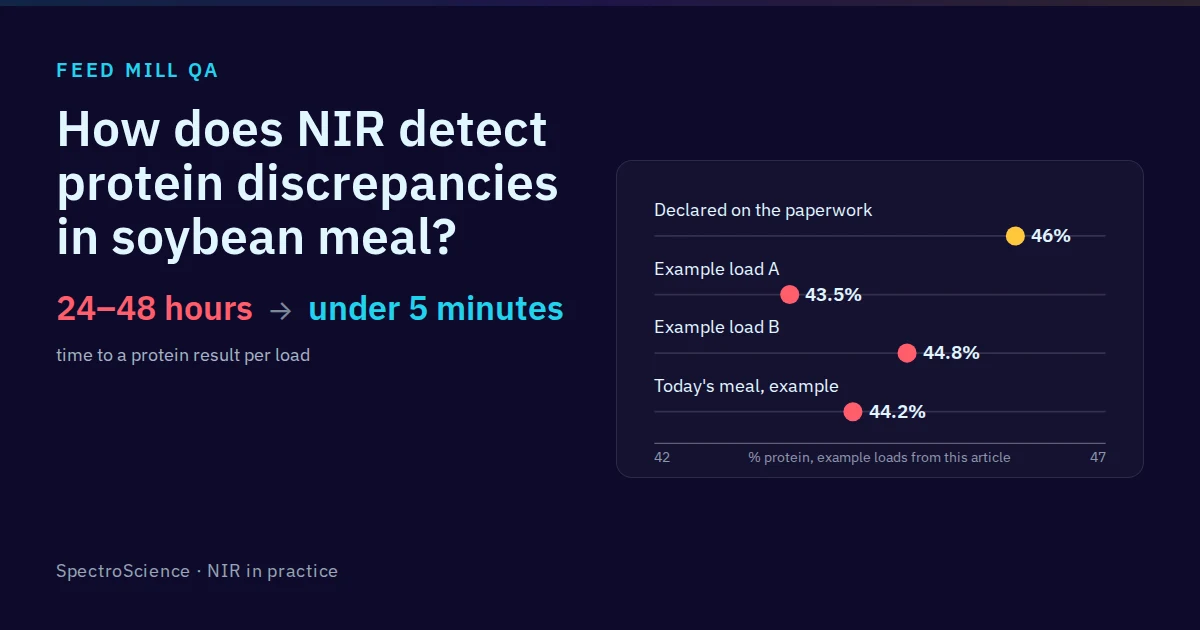
Wet chemistry testing runs slow (24–48 hours) and costs too much per sample, so you cannot test every delivery. That gap in real-time quality control lets declared and actual protein levels drift apart. Say a feed mill receives soybean meal billed at 46% protein, but lab results show just 43.5%. Over time, that discrepancy can drain your margins.
These discrepancies rarely signal intentional fraud; they usually stem from natural production variations that slip through because your testing capacity stays limited. A load averaging 44.8% protein against a declared 46% might not involve deliberate deception, yet you still overpay for lower-quality ingredients.
- Declared Specification
- Actual Content
- Test Results
- NIR Scan
- Decision Making
The diagram above maps the typical flow from declared specifications to decision-making using NIR scan results. Run NIR at intake, and you measure every incoming load while directly comparing it to the supplier’s declaration.
NIR delivers a rapid solution by scanning each load in 30–60 seconds, giving immediate feedback on protein content alongside moisture, fat, starch, fiber, and ash. That real-time data puts you in position to accept or reject shipments quickly, strictly within your preset tolerance limits.
Slow testing
Not quite. NIR technology offers rapid solutions by scanning each load in 30–60 seconds, providing immediate feedback.High cost per sample
Not quite. NIR technology offers rapid solutions by scanning each load in 30–60 seconds, providing immediate feedback.Immediate feedback
Correct. NIR technology offers rapid solutions by scanning each load in 30–60 seconds, providing immediate feedback.How NIR Catches This in Real Time
NIR can scan every incoming load of raw materials, delivering immediate results that drive better supplier performance. At your feed mill, this means testing each delivery as it arrives instead of relying on slow, expensive wet chemistry methods that only cover a small slice of shipments.
The operational protocol is straightforward:
Collecting Samples: Pull a representative composite sample during unloading with an automatic probe sampler or manual multi-point technique.
Scanning: Grind the samples when needed, then scan them with your NIR instrument. Aim for a total turnaround from truck arrival to final result in under 5 minutes.
Comparing Results: Stack your test results against the supplier’s declared spec within your pre-set tolerance limits.
Flagging Anomalies: Put any loads that fall outside those tolerances on hold until wet chemistry confirms the values before you accept them.
Testing every load shifts how suppliers behave. They meet specs more consistently when they know your team will catch deviations. Say a feed mill starts running NIR and notices the average protein in soybean meal sits 1.8 percentage points below the declared spec across three months of storage samples.
- Collect Sample
- Grind & Scan
- Compare Results
- Accept Load
- Hold for Wet Chemistry
That rapid feedback loop keeps you from overpaying for substandard ingredients, tightening both your finances and daily operations.
Immediate financial savings
Not quite. Suppliers are more likely to meet specifications when they know their deliveries will be thoroughly checked.Improved supplier behavior
Correct. Suppliers are more likely to meet specifications when they know their deliveries will be thoroughly checked.Reduced sample size needed
Not quite. Suppliers are more likely to meet specifications when they know their deliveries will be thoroughly checked.NIR and Least-Cost Formulation
Upgrading your formulations ranks as a second major value driver for NIR in feed mills. Least-cost formulation software calculates the cheapest ingredient mix to meet nutritional targets, but it only delivers when your input data hits the mark. Many mills still plug in static library numbers, like "soybean meal = 46% protein, 1.5% fat," straight from published tables. Your incoming ingredients frequently deviate from those averages, so relying on them introduces drift.
Say your soybean meal runs 44.2% protein today rather than the declared 46%. Formulating around that static library number inflates your nutrient estimates and under-delivers on animal nutrition. Flip the scenario, and actual protein sits higher than expected, meaning you pay premiums for nutrients the diet already contains.
Scanning raw materials at the intake point lets you swap static table values for live batch measurements. Your formulation software then builds recipes around hard data instead of guessed averages. When your NIR system reads a soybean meal load at 44.2% protein, you tweak the formula to match. Tightening those calculations lifts feed quality consistency and shrinks the need for safety margin overages that many plants add just to hit minimum nutritional standards.
Linking your NIR instrument directly to your laboratory information management system (LIMS) or formulation platform ensures those live readings refresh your matrix values without delay. Manual data entry wipes out most of those efficiency gains, so you must automate the workflow to capture the full benefit of NIR in least-cost formulation.
Improves nutrient content estimation
Correct. By integrating NIR, feed mills can replace static library values with real-time measurements.Reduces manual labor costs
Not quite. By integrating NIR, feed mills can replace static library values with real-time measurements.Increases static library value precision
Not quite. By integrating NIR, feed mills can replace static library values with real-time measurements.Implementation Steps
Set up an NIR system at your feed mill’s raw material intake to secure accurate, efficient, and reliable operations. Here’s your straightforward guide:
- Choose Instrument Type
- Define Priority Analytes
- Build Calibrations
- Establish Acceptance Criteria
- Integrate with LIMS/Software
Choose Your Instrument Type: Pick between a benchtop reflectance instrument for ground samples and an at-line/online system for whole grains. Benchtop models are generally more reliable, but they require grinding the sample first. At-line or online setups skip that step, though they may demand extra calibration effort.
Define Priority Analytes: Start with moisture, protein, and fat, since those variables directly drive formulation costs. Build a solid foundation there before rolling out starch, fiber, and ash in later phases to sharpen your analysis.
Build Calibrations: Launch with global calibrations to get started, then transition to local models built on your own samples and reference lab data. Those local calibrations deliver tighter accuracy tailored specifically to your incoming materials.
Establish Acceptance Criteria: Set explicit rules for approving or rejecting incoming loads based on analyte levels before you go live. Define tolerance limits for every ingredient type so your team can act quickly on marginal shipments instead of second-guessing.
Integrate with LIMS/Software: Link your NIR system directly to your Laboratory Information Management System (LIMS) or formulation software to automate data feeds. Relying on manual entry kills the benefit of real-time analysis and erodes efficiency.
Follow these steps to roll out an NIR system that monitors incoming raw materials in real time. You’ll secure accurate quality checks and keep feed formulation costs under control.
Comparison of Wet Chemistry vs. NIR Testing
Wet chemistry slows your workflow and bloats budgets, while NIR delivers rapid results.
| Method | Time to result | Cost per Sample |
|---|---|---|
| Wet Chem | 24–48 hours | High |
| NIR | under 5 minutes | Low |
Use this table to pick the method that fits your real-time quality control needs.
FAQ
What is the main issue with wet chemistry testing?
Wet chemistry testing takes 24–48 hours, remains expensive per sample, and typically covers only a fraction of deliveries.
How does NIR improve supplier behavior?
Scanning every load shifts supplier behavior. Once they know you're measuring, your average incoming quality improves consistently.
What are the priority analytes for NIR in feed mills?
Prioritize moisture, protein, and fat, since these drive formulation cost most directly. You can add starch, fiber, and ash later.
How does NIR enhance least-cost formulation accuracy?
Replace library values with actual measurements from each incoming batch. NIR then ensures your formulation software runs on reality instead of averages, stabilizing feed quality consistency.
What are the steps to implement an NIR system at intake?
Choose your instrument type, define priority analytes, build calibrations, establish acceptance criteria, and connect to LIMS or formulation software for real-time updates.
Your next question
Build calibrations that hold up
See the NIR calibration courseAsk a questionSources
Draft, not published. $0 fact-check against the original's own sources: gate FIX. Template gate: worked example.