Beer-Lambert Law in NIR: Fundamentals and Calibration Method Selection
The Beer-Lambert Law explained for NIR spectroscopy — including where it breaks down and how it drives calibration method selection in food and grain labs.
· 7 min read · Vitaly Kirkpatrick
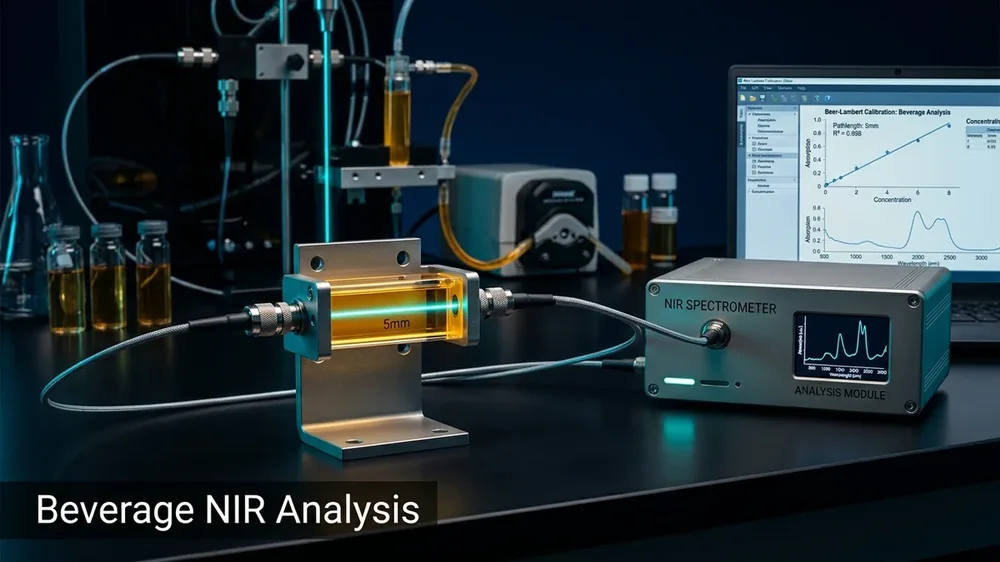
How the Beer-Lambert Law Works in NIR Spectroscopy — and Where It Breaks Down
A grain elevator technician once told me their protein calibration was "working fine" — until a wheat shipment came in with a different kernel size distribution and predictions drifted by 0.4% protein overnight. No instrument fault. No operator error. The calibration just wasn't built to handle what the Beer-Lambert Law can't handle on its own. Understanding that gap — between the law's ideal conditions and what your production samples actually deliver — is what separates a calibration that holds up from one that fails you at the worst possible moment.
What the Beer-Lambert Law Actually Says
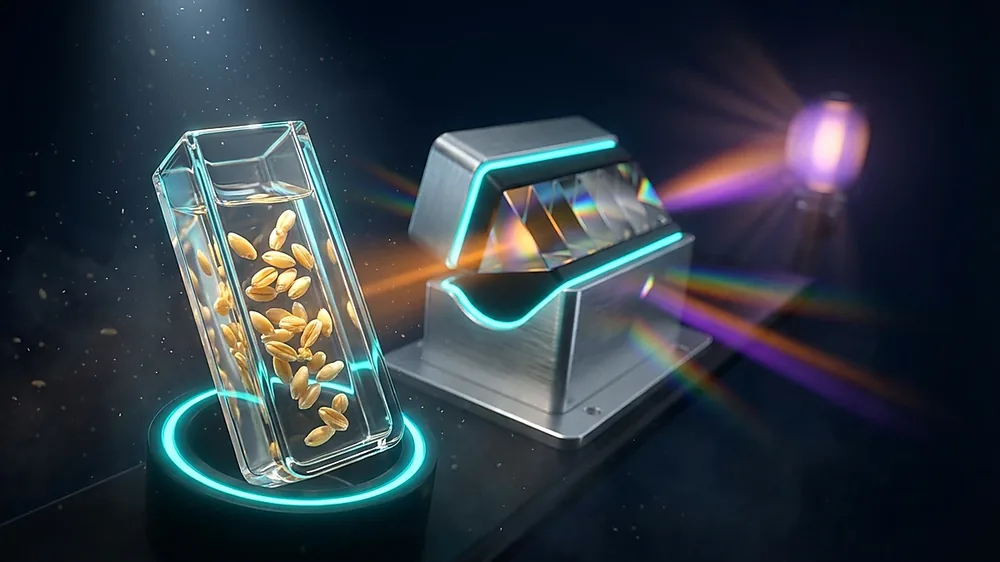
The Beer-Lambert Law describes how light intensity drops as it passes through a substance. It ties the absorption of light directly to the concentration of the analyte in the sample. The equation is A = εlc.

In that equation, A is absorbance, ε is the molar absorptivity, l is the path length, and c is the concentration being measured.
In NIR spectroscopy, a beam of near-infrared light passes through or reflects off a sample. A spectrometer measures the transmitted or reflected light. The linear relationship between absorbance and concentration is what makes NIR quantification possible in the first place. For a broader explanation of how that light becomes a usable measurement signal, see NIR Spectroscopy: How Near-Infrared Light Becomes a Usable Measurement.
Note: In A = εlc, the path length l is fixed by the instrument's sample cell. The molar absorptivity ε is specific to the analyte and wavelength. The only variable being solved for is c — concentration. This is why consistent sample presentation matters. Anything that changes the effective path length — particle size, packing density — introduces error before the math even begins.
Why the Beer-Lambert Law Doesn't Work Alone in Food and Grain Analysis
The law is straightforward. But applying it directly to real food, feed, or grain samples isn't. Non-linearity and scattering cause deviations that simple math can't handle.
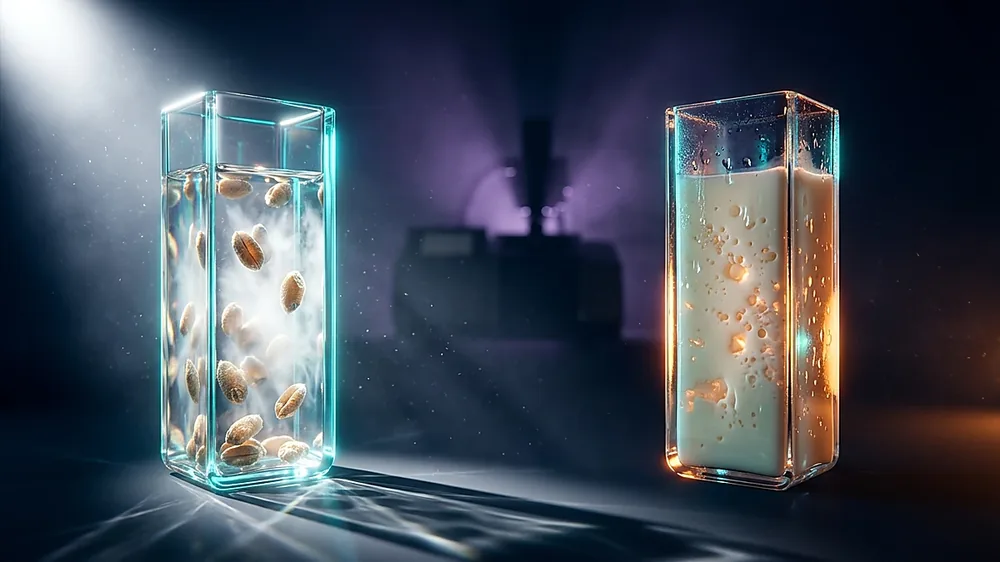
Dairy matrices are a clear example. The optical properties of cheese or butter scatter light in ways that break a direct absorbance-to-concentration calculation. Grain matrices present similar problems due to particle size variation and surface texture. A wheat sample with kernel sizes ranging from fine mill flour to coarse grist can shift baseline absorbance by 0.05–0.15 AU at 2100 nm — enough to corrupt a protein prediction if scattering isn't accounted for in the model.
This is where chemometrics comes in. Advanced regression techniques model those deviations and improve the precision of concentration measurements across the full range of production samples your lab will see. For teams building NIR fundamentals and chemometric knowledge together, understanding why NIR spectroscopy needs chemometrics and what PLS and PCR actually do is an important next step after grasping the Beer-Lambert approach.
The Three Assumptions That Break in Real NIR Work
The Beer-Lambert Law rests on three assumptions that are basically never fully met in a working food, feed, or grain lab. Knowing exactly where the law breaks down isn't academic. It directly predicts where your calibrations will struggle and why.

- Monochromatic light: The law assumes a single, pure wavelength. In practice, NIR instruments use bandpass filters or diffraction gratings. A band of wavelengths is produced, not a true monochromatic source. This broadens absorption features and introduces baseline variation that simple univariate math can't handle. A typical FT-NIR instrument operating at 8 cm⁻¹ resolution still produces a spectral bandwidth that spans several nanometres — wide enough to blend adjacent absorption peaks and reduce selectivity.
- Dilute solutions: The law assumes analyte molecules are far apart and don't interact. Solid food matrices — wheat flour, animal feed pellets, cheese — are concentrated and highly scattering. The photon path isn't straight. It's a random walk through the sample. At protein concentrations of 12–18% common in cereal grains, molecular interaction effects are measurable and must be accounted for in the regression model.
- Homogeneous samples: Particle size variation, packing density, and surface texture all break the homogeneity assumption. A wheat sample ground to 0.5 mm and one ground to 1.0 mm will produce meaningfully different spectra — even at identical moisture content. In reflectance mode, this effect is amplified because the depth of light penetration changes with particle size, altering which molecular layers are actually measured.
None of this means the Beer-Lambert Law is useless. It remains the theoretical foundation that makes NIR quantification possible. But it does explain why multivariate chemometrics became the standard approach — and why single-wavelength regression can't be trusted for solid matrices.
How Spectral Pre-Processing Compensates for Beer-Lambert Deviations
Before a regression model is even built, spectral pre-processing corrects for the physical deviations the Beer-Lambert Law can't accommodate on its own. Think of it like adjusting for ambient noise before you try to pick out a specific voice in a crowded room — you clean the signal first, then you analyse it. These transforms aren't optional refinements. In solid matrix work, they're needed.

Standard Normal Variate (SNV) transformation removes multiplicative scatter effects by normalising each spectrum to zero mean and unit variance. This directly addresses the path length variation that particle size introduces. Savitzky-Golay derivatives — typically first or second order — remove baseline offset and slope while sharpening absorption peaks that would otherwise be broadened by non-monochromatic illumination. Multiplicative Scatter Correction (MSC) takes a similar approach to SNV but references a mean spectrum rather than individual spectrum statistics.
In grain receiving applications, SNV combined with a second-derivative transform is a common starting configuration for protein and moisture calibrations. In compound feed with high fat content, MSC tends to outperform SNV because the baseline shift in fat-heavy matrices is multiplicative rather than additive. The choice of pre-processing should be driven by the dominant source of physical deviation in the specific matrix your calibration covers — not by habit or default software settings.
The Beer-Lambert Law's three core assumptions — monochromatic light, dilute solutions, and homogeneous samples — are never fully met in real food, feed, or grain matrices. This isn't a flaw to work around. It's the basic reason multivariate chemometrics exists and why single-wavelength regression fails for solid sample analysis. Spectral pre-processing is the practical bridge between the law's ideal conditions and what production samples actually deliver.
Calibration Method Selection: From MLR to ANN
Once it's clear that the Beer-Lambert Law needs chemometric support for real matrices, the next question is which regression method to use. There's no universal answer, but the decision logic is consistent across food, feed, and grain applications.

Multiple Linear Regression (MLR)
MLR is fast and interpretable. It works for simple, well-behaved matrices where two or three key wavelengths can be identified in advance. The limitation is clear: NIR data is collinear by nature. Wavelengths close together carry almost identical information. MLR breaks down quickly when collinearity is high. In practice, MLR is rarely the right choice for solid matrices — it's retained mainly for liquid applications where Beer-Lambert holds more closely and a single absorption peak dominates the analyte signal.
Partial Least Squares (PLS)
PLS is the workhorse of NIR calibration for a reason. It handles collinearity, works comfortably with hundreds of wavelengths at once, and is reliable for most food, feed, and grain matrices. Starting with PLS is the standard recommendation. Most production-grade calibrations in grain and feed labs run on PLS models with between 3 and 10 latent variables. A moisture calibration on a consistent wheat matrix might stabilise at 4 latent variables with RMSECV under 0.15% moisture. A protein calibration on a mixed grain sample set typically requires 6–8 latent variables to reach an RMSECV below 0.25% protein — which is generally the threshold for production decision-making in grain receiving.
Principal Component Regression (PCR)
PCR is structurally similar to PLS but tends to lose predictive power at the regression step. Use it for comparison purposes — not as the primary calibration tool. Where PCR does add value is in exploratory analysis: running a PCR decomposition first can reveal outlier structure and clustering in a sample set before the PLS model is built.
Artificial Neural Networks (ANN)
ANN models are powerful for highly non-linear matrices. Mixed-ingredient compound feeds with 12 or more raw materials varying simultaneously are a typical use case. But ANN requires 3 to 5 times more calibration samples than PLS. The overfitting risk is real.
The practical threshold: move to ANN only if PLS RMSECV has plateaued and at least 300 well-distributed reference samples are available. Attempting an ANN build with 80 samples because the PLS R² isn't high enough is one of the most common and costly mistakes I see in new calibration projects. Your reference lab capacity needs to be part of that decision — not just your instrument software.
Watch out: Moving to ANN before having at least 300 well-distributed reference samples is a costly mistake. An overfitted ANN model can show strong performance on calibration samples while failing badly on new production material. The failure often isn't obvious until a bad result reaches a customer. When the goal is a reliable production calibration rather than the lowest possible in-sample error, PLS with proper cross-validation will outperform an underpowered ANN on every practical metric.
Matching the Method to the Matrix: A Practical Summary
Calibration method selection isn't a one-size-fits-all decision. The matrix type, sample volume, and reference lab capacity all shape which approach will actually perform. The table below summarises the decision logic used across food and feed calibration projects.
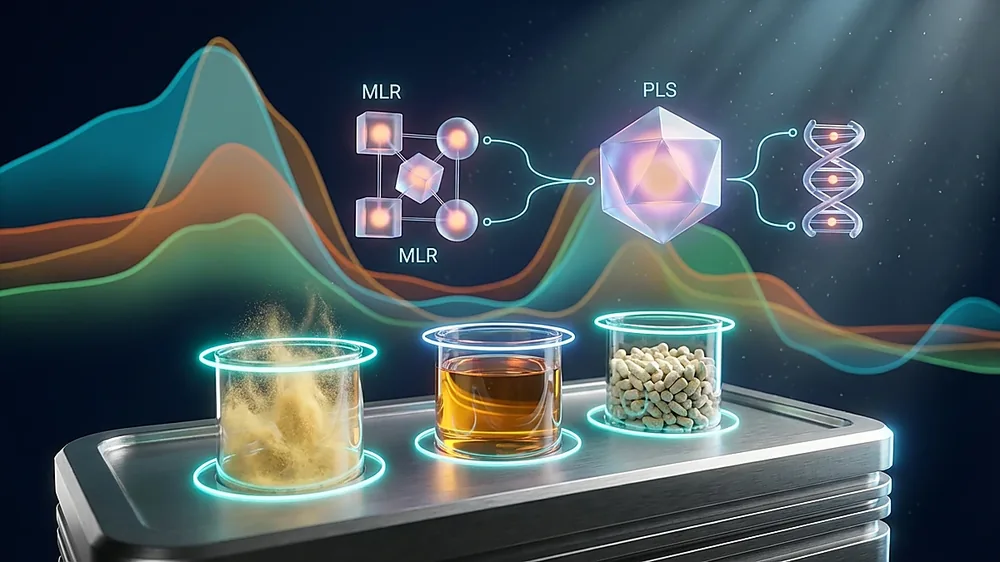
- Simple, consistent matrix (e.g., single-ingredient flour): MLR or PLS with 3–5 latent variables. Typically achievable with 60–100 reference samples. Expected RMSECV for moisture: 0.10–0.20%. For protein: 0.15–0.25%.
- Mixed grain or blended feed with moderate variation: PLS with 6–10 latent variables. Target 150–250 reference samples covering the full composition range. SNV or MSC pre-processing recommended. Reference method must be AOAC-compliant for regulatory purposes.
- Complex compound feed or highly variable raw material: PLS first, then evaluate ANN if RMSECV plateaus. Minimum 300 reference samples before ANN is viable. Cross-validation should use leave-one-out or K-fold with at least 5 folds before any external validation set is assessed.
For teams building calibrations from scratch, understanding RMSECV and RMSEP benchmarks for each matrix type is the most practical starting point before any method is selected. A well-structured approach to NIR calibration reference data quality and sample representation determines whether the chosen regression method has any chance of meeting your production accuracy targets.
Validating the Calibration Before It Goes Live
Regardless of which regression method you've selected, validation before deployment isn't optional. The distinction between RMSECV and RMSEP is important here. RMSECV measures how the model performs during internal cross-validation on the calibration sample set. RMSEP measures how it performs on a genuinely independent set of samples that weren't used in model building. Those are very different things.

A model that shows RMSECV of 0.18% protein but RMSEP of 0.45% protein is overfitted — that gap is too large to trust in production. The ratio of RMSEP to RMSECV should generally stay below 1.5 for a well-generalised calibration. If it exceeds 2.0, either the calibration sample set isn't representative of the validation material, or the model complexity — number of latent variables or ANN layers — is too high.
Slope and bias statistics on the external validation set should also be examined. A slope far from 1.0 shows the model is step by step compressing or expanding the prediction range — a sign that the calibration sample set didn't cover the full composition range present in production material. This is one of the most common failure modes when calibrations are built on laboratory reference samples rather than real production batches. If your validation samples come from the same narrow source as your calibration set, you won't catch that problem until it hits the production floor.
Free tool — Calibration Metrics Calculator: Enter your reference values and NIR predictions in the Calibration Metrics Calculator to compute RMSEP, RPD, R², and bias the way our course teaches it — with interpretation thresholds for grain, dairy, and feed. Open the Metrics Calculator →
Free tool — Beer-Lambert Calculator: The Beer-Lambert Calculator works the absorbance = ε·b·c relationship in both directions — useful when sizing path length for a new sample type or sanity-checking a calibration curve. Open the Beer-Lambert Calculator →
SpectroScience students get access to the Calibration Validation Tracker — track RMSECV, RMSEP, bias, and slope correction across calibration updates and instrument transfers. Available as a free download in the student resource library.
Access the Excel libraryNIR Fundamentals Course — Lesson 23: Introduction to Calibration
This lesson focuses on the principles of calibration in NIR spectroscopy, emphasizing how to establish reliable calibration models that account for variations in sample characteristics. It provides practical guidance on selecting appropriate calibration methods to ensure consistent and accurate predictions, addressing the limitations posed by the Beer-Lambert Law in real-world applications.
Explore Lesson 23 in the NIR Fundamentals courseWant to Master NIR Spectroscopy?
Our 32-lesson online course covers everything from Beer-Lambert Law to PLS calibration — built for food, grain, feed, and dairy professionals.