NIR vs. MIR and Raman in Oilseed Labs: Strengths, Limitations, and ROI
NIR vs MIR vs Raman for oilseed labs: compare accuracy, sample prep, water sensitivity, and ROI for crushing operations.
· 8 min read · Vitaly Kirkpatrick
When oilseed labs evaluate NIR vs. MIR vs. Raman spectroscopy, the decision comes down to three factors: measurement accuracy for your specific analytes, calibration overhead, and total cost per sample at production volume. Each technology has a different profile across those factors. This article compares them directly and makes the practical case for NIR in crushing operations.
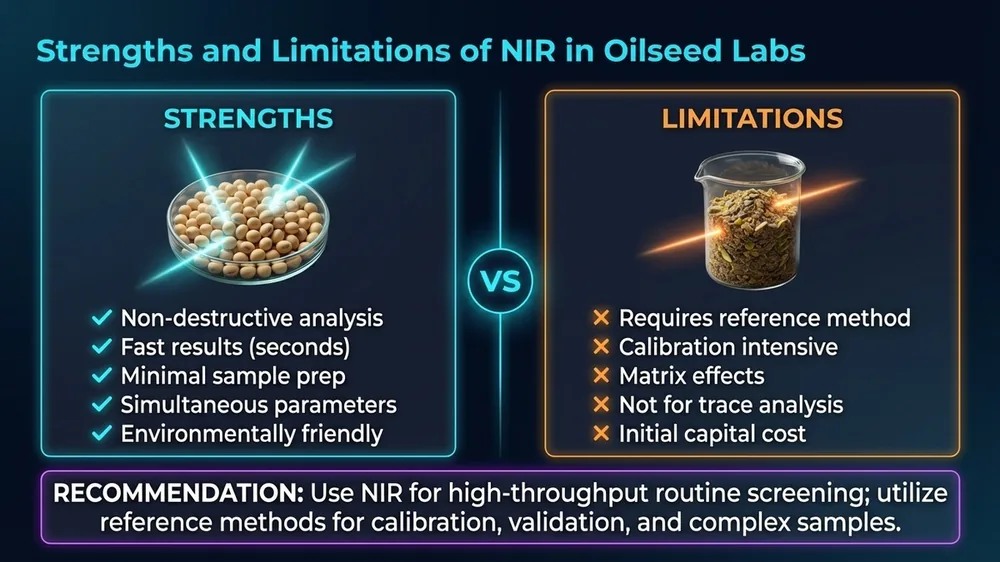
Strengths and Limitations of NIR in Oilseed Labs
NIR is not a fit for every measurement. For oilseed applications, it covers most of what labs need daily. Here is an honest look at both sides.
Advantages
Non-destructive: The sample stays intact. That matters for expensive or limited reference material.
Fast results: Seconds per sample, not hours. On a crush line running 24/7, that speed changes what is possible for process control.
Minimal sample prep: Whole soybeans, ground meal, or bulk oil can be run directly, depending on the instrument and application.
Lower ongoing cost: After initial calibration work, per-sample costs run well below wet chemistry for high-volume labs.
Works across solids, slurries, and liquids: That covers most matrices encountered in an oilseed processing facility.
Limitations
Needs calibration against reference methods: NIR does not measure chemistry directly. Without a solid calibration built on good reference data, results drift. This is the area where labs most often underinvest — and it costs them later.
Less reliable for trace components: For concentrations below approximately 1%, mid-infrared or wet chemistry is generally more dependable.
Spectral overlap: NIR bands are broad and can overlap. Good chemometric software handles most of this, but understanding what the model is doing is needed.
Matrix variation: Process conditions, particle size, and temperature all affect the spectrum. Calibration models must cover the full range of variation seen in production — not just clean lab samples.
Watch out: Calibration models built on clean lab samples often fail in production. If the model was not built on samples that reflect real process variation — different particle sizes, temperatures, and moisture ranges — results will drift when conditions change.
How NIR Compares to MIR and Raman Spectroscopy
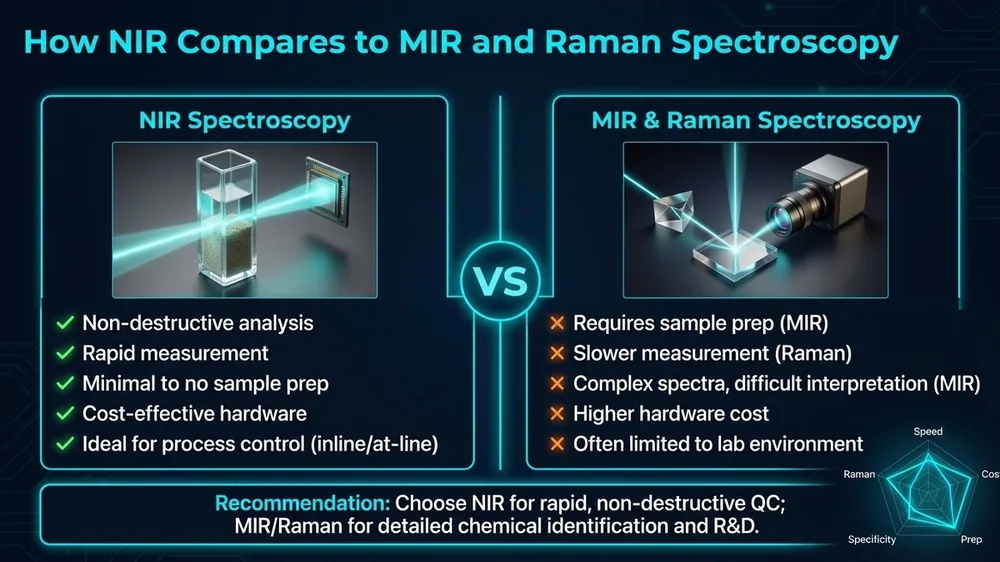
When choosing an analytical approach, NIR vs. MIR vs. Raman all come up as candidates. The table below compares them on the factors that matter most in a food or oilseed lab.
Feature | Near-Infrared (NIR) Spectroscopy | Mid-Infrared (MIR) Spectroscopy | Raman Spectroscopy |
|---|---|---|---|
Wavelength Range | 780 nm – 2500 nm | 2500 nm – 25000 nm | Visible, NIR, UV (typically 400–1000 nm) |
Information Type | Overtone and combination vibrations (quantitative) | basic vibrations (qualitative and quantitative) | Molecular vibrations (structural and quantitative) |
Penetration Depth | High (suitable for bulk analysis) | Low (surface analysis) | Moderate |
Water Sensitivity | Low (suitable for aqueous samples) | High (water absorbs strongly) | Low (water is a weak Raman scatterer) |
Sample Prep | Minimal to none | Minimal | Minimal to none |
Key Applications | Quality control, process monitoring, moisture, protein, fat | Functional group identification, reaction monitoring | Structural elucidation, polymorphs, non-polar bonds |
What the Comparison Means in Practice
MIR delivers more specific basic vibration data. That is useful for detailed structural identification. But water absorbs strongly in the MIR region. In most food and oilseed matrices, that is a significant problem.
NIR's lower water sensitivity and deeper sample penetration make it the practical choice for bulk analysis of grains, meals, and oils. A single NIR scan on whole soybeans can return moisture, protein, oil, and fiber simultaneously — with no sample destruction and no solvent use.
Raman is a solid complement for structural work and non-polar bond characterization. It is less common on oilseed processing floors because fluorescence interference from oils and pigments can reduce signal quality and complicate routine quantitative use.
The right choice depends on what is being measured and where in the process the answer is needed. For routine compositional analysis in feed and oilseed operations, NIR wins on speed, cost, and practical deployability. For trace-level structural identification, MIR or Raman may be the better tool.
NIR vs. Wet Chemistry: Cost and Throughput
The NIR vs. wet chemistry comparison matters just as much as NIR vs. MIR for most oilseed labs. Wet chemistry remains the reference standard — but at scale, it is slow and expensive.
Consider a soybean crushing facility running 1,000 tonnes per day. Intake grading alone may require 30 to 50 samples per shift. Running each through Soxhlet extraction for oil, Kjeldahl for protein, and oven drying for moisture ties up technician time and reagent costs that NIR eliminates at that volume.
A well-calibrated NIR instrument running at a facility of that size typically pays back its capital cost within 12 to 24 months through reduced reagent spend and labor reallocation. The exact figure depends on instrument price, sample volume, and how tightly the lab was running wet chemistry before. The underlying logic holds across facilities of different sizes.
Wet chemistry does not disappear when NIR is in place. It becomes the calibration backbone — the reference data source that keeps the NIR model accurate. The two methods work together, not in competition. See our article on NIR applications across grain, feed, dairy, and oilseed for more on building that reference program.
The Practical Case for NIR in Crushing Operations
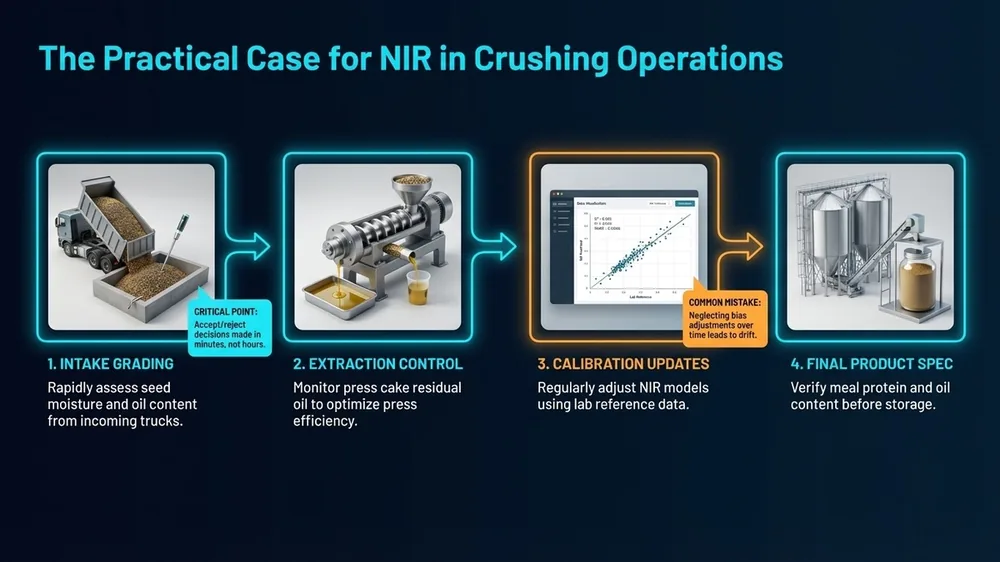
NIR spectroscopy in oilseed processing is adopted because it delivers faster decisions with fewer resources in the lab. Faster intake grading, tighter meal protein specifications, and earlier detection of extraction upsets before they become product losses — these are measurable returns in actual crushing operations.
Three areas where NIR creates direct value in a crushing plant:
Incoming grain grading: NIR results in under 60 seconds per sample allow procurement decisions to be made at the intake point rather than hours later. That prevents off-spec loads from entering the process.
Meal protein monitoring: Soybean meal protein spec is typically 46–48% on a dry matter basis. NIR running on the meal conveyor can catch deviation from target within minutes of an extraction upset — before a full batch is out of spec.
Oil content tracking: Residual oil in spent meal is a direct efficiency metric. NIR monitoring of meal oil content can identify when the extractor performance is degrading, supporting earlier maintenance intervention.
[Custom block: pull-quote]The technology works. What determines whether a lab gets value from it is the calibration and how well it covers actual process variation. Get that right, and NIR becomes one of the most reliable tools on the production floor. For guidance on choosing between benchtop and inline NIR instruments, the instrument selection article covers the tradeoffs in detail.
[Custom block: further-reading][Custom block: related-articles][Custom block: further-reading]Free tool — NIR vs Wet Chemistry Tool: Compare NIR side-by-side against Kjeldahl, Soxhlet, Karl Fischer, and Dumas in our interactive NIR vs Wet Chemistry tool — speed, cost per sample, accuracy, and where each method still wins. Compare the methods →
Free tool — NIR Glossary: Unfamiliar with a term? The SpectroScience NIR Glossary defines every chemometrics, calibration, and instrument term used in this article in plain language with worked examples. Open the Glossary →
SpectroScience students get access to the SEL Lab Error Calculator — calculate the maximum allowable NIR prediction error based on your reference method's own variability. Available as a free download in the student resource library.
Access the Excel libraryNIR Fundamentals Course — Lesson 10: NIR vs. Other Spectroscopy
This lesson provides a detailed comparison between NIR and other spectroscopic methods, focusing on their respective strengths and limitations. It emphasizes the practical applications of NIR in various laboratory settings, including its efficiency and cost-effectiveness in oilseed analysis, which aligns with the article's discussion on measurement accuracy and ROI.
Explore Lesson 10 in the NIR Fundamentals course