NIR in Grain Receiving: What It Measures and Calibration Essentials
Understanding how NIR spectroscopy works at the physics level is the foundation. But grain receiving operations need to go further — knowing exactly what…
· 6 min read · Vitaly Kirkpatrick
Understanding how NIR spectroscopy works at the physics level is the foundation. But grain receiving operations need to go further — knowing exactly what parameters NIR can reliably measure at the scale, what calibration is required, and what happens when calibration isn't maintained. This article covers practical NIR measurement in grain receiving.
What's Inside the Instrument
Every NIR spectrometer shares the same basic architecture. You've got a light source, a way to separate wavelengths, a detector, and software to process the signal. Where instruments differ is in how they separate wavelengths — and that choice has real consequences for your operation.
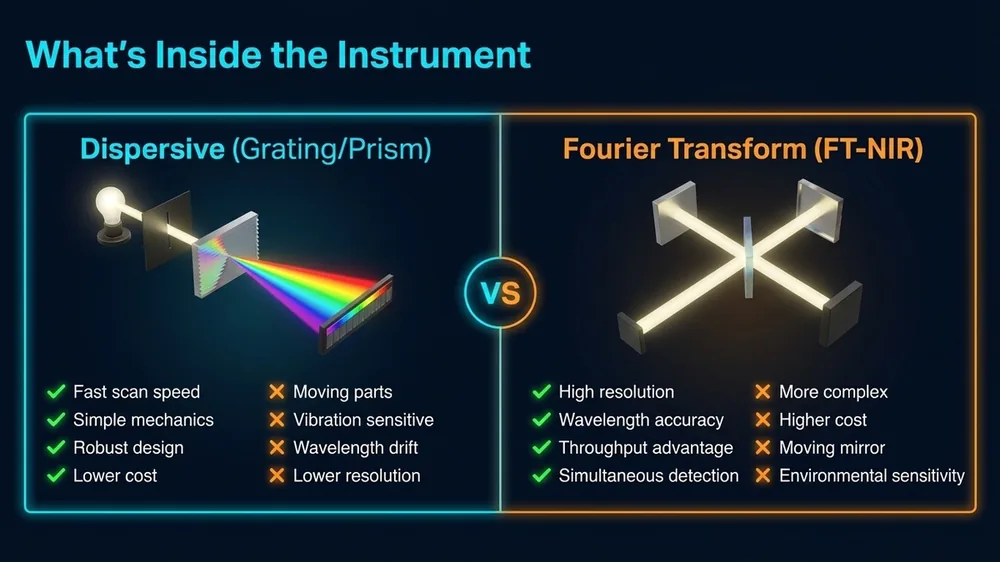
Scanning grating instruments use a moving grating to sweep through wavelengths one by one. They can cover the full NIR range with high resolution, which is useful for complex matrices. The tradeoff is moving parts — and moving parts eventually wear or drift.
Diode array instruments use a fixed grating and multiple detectors that measure simultaneously. With no moving parts, they acquire data faster and withstand harsh conditions better. That durability is needed in beverage production facilities where dust, vibration, and temperature changes are constant.
Fourier Transform NIR (FT-NIR) instruments use an interferometer to collect the full spectrum simultaneously. They're known for high resolution and excellent wavelength reproducibility — important when you need to transfer calibrations between instruments at different locations.
There's also a newer category worth knowing: filter-based and LED-based instruments. These measure only a handful of specific wavelengths rather than the full spectrum. They're smaller, cheaper, and purpose-built for specific applications — like a dedicated inline moisture sensor on a dryer. Your lab probably needs a full-spectrum instrument for flexibility. Your production floor might be well-served by something simpler and more rugged.
What NIR Measures in Grain Receiving
Let me give you the practical list. For grain and oilseeds at the receiving scale, NIR routinely measures:
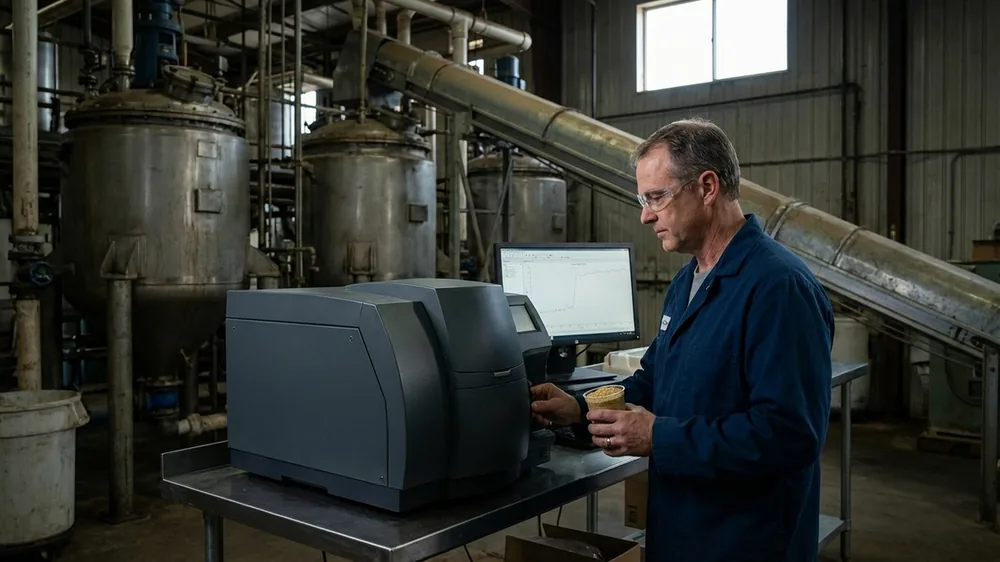
- Moisture — the most common measurement, and the one with the most direct financial consequence. A 1% moisture error on a 50,000-bushel corn purchase can cost you $8,000 to $12,000 depending on market price and drying costs.
- Protein — critical for wheat grading, milling contracts, and premium pricing. Missing a protein spec by 0.5% across a season of purchases adds up fast — I've seen operations calculate $180,000 per year in protein giveaway from poorly calibrated instruments.
- Oil content — especially important for soybeans and sunflower.
- Starch — relevant for corn destined for ethanol or wet milling.
- Test weight and density — some instruments estimate these from spectral features, though with more variability than direct measurement.
What NIR doesn't replace is visual inspection for foreign material, mold, or insect damage. Your eyes and your nose still matter at the pit. NIR handles the chemistry. You handle the rest.
The Calibration Question Nobody Asks Until It's Too Late
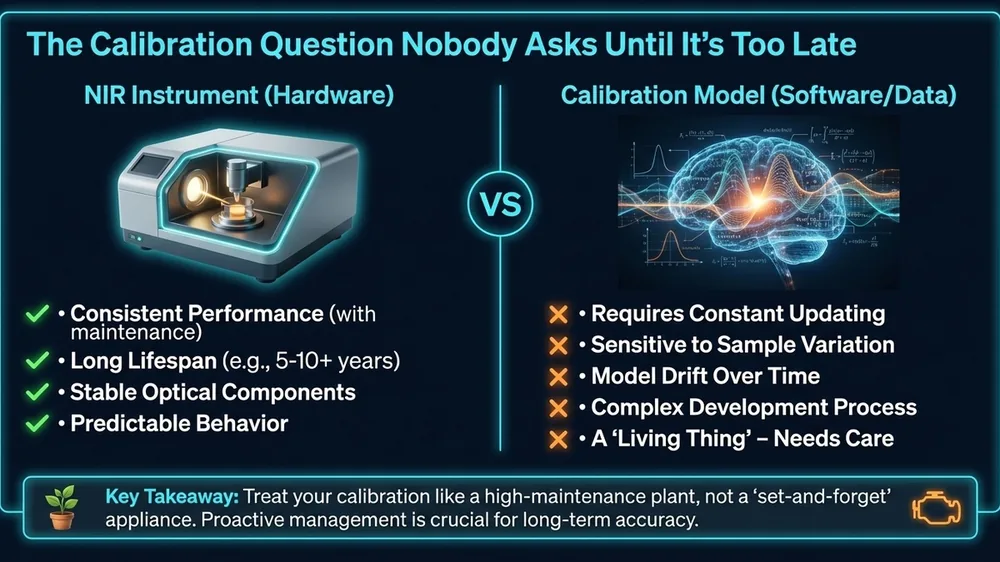
Look, I'll say this plainly because it doesn't get said enough. The instrument is not the hard part. The calibration is the hard part.
The instrument is not the hard part. The calibration is the hard part.
Your NIR instrument is hardware. It's going to perform consistently if you maintain it. But your calibration model is a living thing. It was built on a set of reference samples with a specific range of compositions. The moment your incoming grain goes outside that range — new varieties, different growing regions, unusual weather affecting grain composition — your model starts producing errors. Small errors first. Then bigger ones.
Most operations that have NIR problems don't have instrument problems. They have calibration maintenance problems. They installed the instrument, ran the factory calibration, and assumed it was done. Murphy's Law doesn't take weekends off. Grain composition shifts. Calibrations need to be monitored and updated.
The practical answer: run parallel testing. Every week or two, pull a subset of samples and run them on both NIR and wet chemistry. Plot the differences. If you see bias developing — NIR consistently reading 0.3% high on protein, for example — catch it before it costs you money, not after your auditors catch it first.
The Field Takeaway
NIR at the scale is not about technology for its own sake. It's about making better purchasing decisions faster, with real numbers instead of gut feel at 3am. It's about catching a high-moisture load before it goes into storage. It's about paying the right price for protein content you can actually verify, not protein content you assumed.
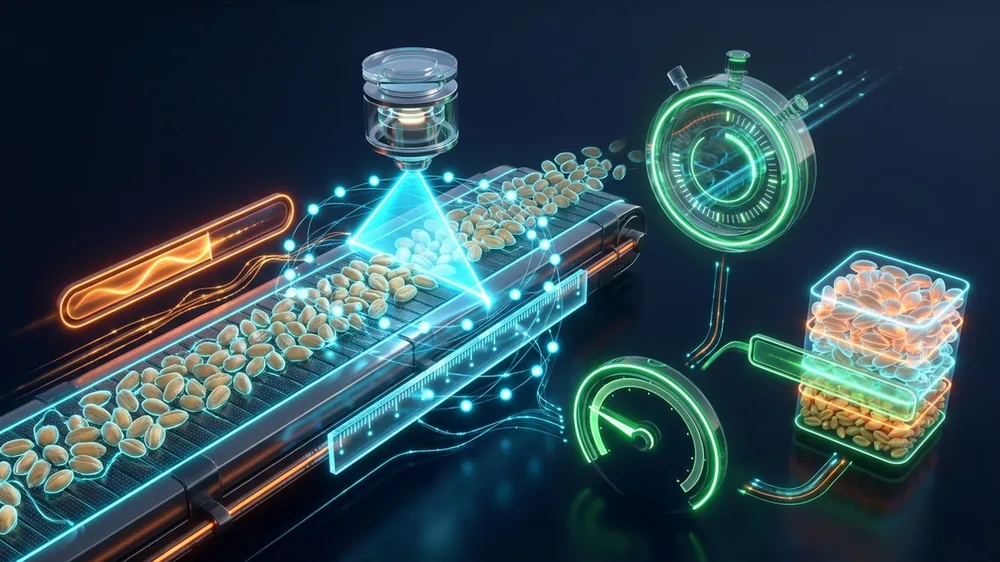
If your operation is still sending every receiving sample to a lab and waiting hours for results, you're not just slow — you're exposed. One bad load that slips through because you couldn't test fast enough will cost more than the instrument you're hesitating to buy.
Calibration is key. Establish it correctly, maintain it consistently, and verify it regularly against your reference methods. If you’re unsure whether your current calibration is drifting, identify that before the next production cycle begins—not during it.
Further Reading
Selected references drawn from the NIR Accuracy Course supplemental materials.
- (n.d.). NIR Instruments and Prediction Methods for Rapid Access to Grain Protein Content. [Application of NIR Spectroscopy to the Analysis of Grain](https://www.sciencedirect.com/science/article/pii/S2211383514000392) https://pmc.ncbi.nlm.nih.gov/articles/PMC9146900/
- NIR-Online Process Analyzers (leading instrument manufacturer, accessed March ). (2026). Online/Inline NIR Process Control. This page outlines the features and benefits of online/inline NIR instruments for real-time process control, emphasizing continuous monitoring of key parameters like moisture, fat, and protein to maximize production efficiency and ensure product quality. https://www.buchi.com/en/products/instruments/nir-online-process-analyzer
- (n.d.). Understanding the ROI of NIR analysis. An article discussing the financial benefits and return on investment of implementing NIR technology in various industries. https://www.selectscience.net/resource/understanding-the-roi-of-nir-analysis
- (n.d.). NIR vs. Wet Chemistry: Choosing the Right Analytical Technology. Practical comparison for lab managers https://www.bluesunscientific.com/post/choosing-between-nir-and-wet-chemistry-a-lab-manager-s-guide
SpectroScience students get access to the Calibration Validation Tracker — track RMSECV, RMSEP, bias, and slope correction across calibration updates and instrument transfers. Available as a free download in the student resource library.
Access the Excel libraryFree tool — NIR ROI Calculator: Plug your sample volume, current method cost, and analyte spec into the SpectroScience NIR ROI Calculator to see annual savings and payback period for your operation. Open the ROI Calculator →
Free tool — NIR vs Wet Chemistry Tool: Compare NIR side-by-side against Kjeldahl, Soxhlet, Karl Fischer, and Dumas in our interactive NIR vs Wet Chemistry tool — speed, cost per sample, accuracy, and where each method still wins. Compare the methods →
NIR Fundamentals Course — Lesson 17: Inside the NIR Instrument
This lesson explores the internal components of NIR instruments in detail, explaining how each part contributes to the overall functionality. Understanding these components is crucial for grain receiving operations to optimize their NIR measurements and ensure reliable calibration.
Explore Lesson 17 in the NIR Fundamentals course