How to Validate NIR Against Wet Chemistry: Setting Up a Parallel Testing Program
Validate your NIR against wet chemistry effectively with a parallel testing program. Learn the steps and insights from an expert consultant.
· 4 min read · Vitaly Kirkpatrick
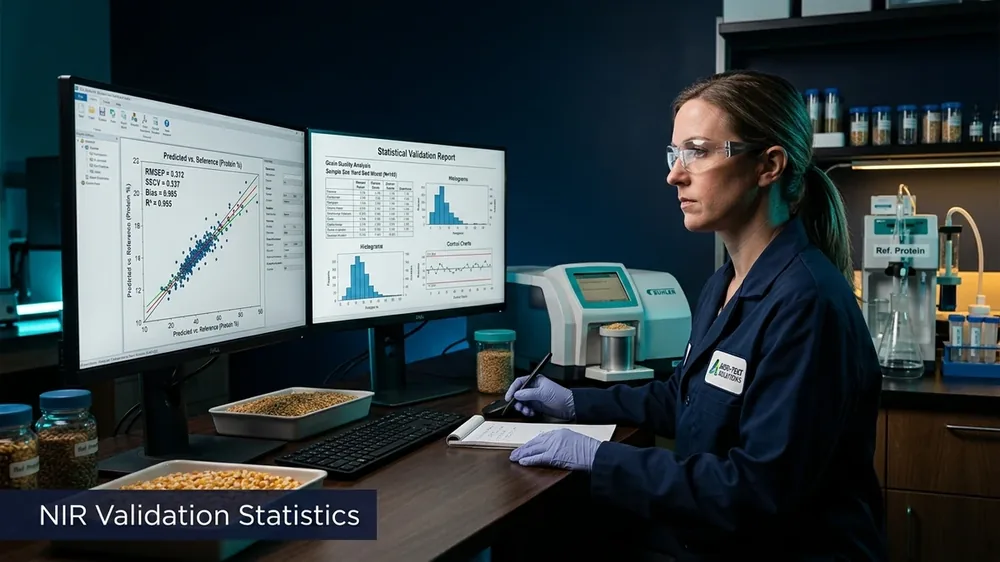
Quality managers often ask me during plant visits: "We've got NIR running, but how do we actually know it's right?" That question has real money behind it. A grain elevator trusting unvalidated NIR moisture readings can make wrong drying decisions across hundreds of truckloads — and those errors compound fast. The fix isn't complicated, but it does require a disciplined parallel testing program that compares NIR directly against your wet chemistry reference methods.
Why Validate NIR with Wet Chemistry?
Here's the thing — NIR is fast. A scan takes about 30 seconds compared to 45 minutes or more for a wet chemistry method. That speed is exactly why NIR earns its place in grain receiving, feed mill intake, and dairy processing. But speed means nothing if the numbers aren't anchored to something you can trust.
Think of parallel validation like calibrating a scale at a grain elevator. You don't assume the scale reads correctly just because it's installed — you check it against certified weights on a schedule. Parallel testing does the same thing for your NIR: it gives you documented proof that what the instrument reports matches what your reference lab finds, within an acceptable margin.
Without that documentation, your auditors won't accept NIR data as a defensible QC record. And your calibration supplier can't help you troubleshoot drift if there's no baseline comparison on file to work from.
How to Set Up a Parallel Testing Program
Start with sample selection. Your sample set needs to cover the full range of variability your facility actually sees — not just average-quality product. In a dairy intake operation, that means including batches at the low and high ends of fat and protein content, not just the typical mid-range loads. The same logic applies at a feed mill: include both high-moisture and dry incoming ingredients, because a model trained on narrow variation will fail at the edges where it matters most.
Next, lock down your sample preparation. Both the NIR subsample and the wet chemistry subsample need to come from the same homogenized parent sample, prepared the same way. If you grind for wet chemistry, grind for NIR. If one subsample sits on the bench for 20 minutes before scanning and the other goes straight to the analyzer, you've already introduced a variable that has nothing to do with the instrument. Inconsistent prep is one of the most common reasons parallel programs produce misleading disagreements.
Then run both tests simultaneously — or as close to it as your workflow allows. The goal is a direct, same-sample comparison. Log every pair of results in a dedicated spreadsheet from day one, because that data becomes the foundation of your validation report. Don't let results pile up in a drawer for a month before you transfer them — you'll lose context on anything that looked unusual at the time.
Field tip: Consistent sample prep is the single biggest factor in reducing variability between NIR and wet chemistry results. Fix prep problems before you adjust the calibration.
What to Look For in NIR vs Wet Chemistry Results
During plant visits, I've observed that comparing NIR and wet chemistry isn't just about matching numbers. It's about understanding the correlation and any consistent biases. If NIR consistently reads moisture content 0.5% higher than wet chemistry across every sample, you need to identify why before you act on it. Is it the calibration model, the sample prep, or a temperature effect?
A consistent bias — where NIR reads 0.3% high on every sample — is actually less worrying than random scatter. A consistent bias tells you the calibration slope or offset needs adjustment, and that's a straightforward fix. Random scatter with no pattern often points to a sample prep problem, a temperature effect, or a particle size issue that no calibration tweak will resolve on its own.
Pay close attention to RMSEP (Root Mean Square Error of Prediction). For grain processing, your NIR model should reach an RMSEP within 0.1–0.2% for moisture and protein content before you treat it as a reliable screening tool. If you're outside that range after 30+ sample pairs, the model needs work before you rely on it operationally. Don't round that number up and call it close enough — 0.3% RMSEP on moisture at a large grain elevator translates directly into wrong drying calls and energy cost you're not tracking back to the instrument.
Watch out: Don't ignore step-by-step biases in NIR results. They point to underlying issues with calibration or sample preparation that won't self-correct over time.
Steps to Validate NIR in Your Facility
- 1Select Diverse Samples — Choose samples that cover the range of variability you encounter daily, including edge-of-spec material your calibration has to handle.
- 2Standardize Sample Prep — Use identical methods for preparing samples for both NIR and wet chemistry. Same grind, same timing, same operator where possible.
- 3Conduct Parallel Testing — Run both tests simultaneously to ensure a direct comparison. Same parent sample, same day.
- 4Analyze Data for Biases — Look for consistent discrepancies and adjust calibration models as needed. Separate systematic bias from random scatter before deciding on a fix.
- 5Review Calibration Regularly — Check and update your NIR calibrations on a scheduled basis, not just when something looks wrong.
One step that consistently gets skipped: document the wet chemistry method you're using as your reference. Kjeldahl for protein, Karl Fischer or oven-drying for moisture, Soxhlet for fat — write it down explicitly in your validation report. Your NIR validation is only as credible as the reference method standing behind it, and auditors will ask which version of the method your lab followed.
When Do You Know Your NIR is Validated?
Validation isn't a one-time event you complete and file away. You'll know your NIR is ready for routine use when its results consistently align with your wet chemistry benchmarks within acceptable error margins across at least 30 independent sample pairs. In oilseed processing, if your NIR aligns within 0.1% for oil content across that sample set, you've hit a reliable mark for production decisions.
After initial validation, build a monitoring schedule into your workflow. Running five to ten parallel pairs per month gives you the trend data to catch calibration drift before it costs you a rejected load or a failed audit. Your calibration doesn't stay validated on its own — seasonal raw material changes, new suppliers, and equipment wear all push results off course over time. I've seen facilities go 18 months without a parallel check and then discover their NIR had drifted 0.4% on protein. By the time they found it, the giveaway had already happened.
Consistency in sample preparation and a scheduled calibration monitoring program are what keep NIR validation meaningful after the first report is signed off.
The goal was never to replace wet chemistry entirely. It's to give your lab a tool that handles the volume of routine checks at 30-second scan speed, while wet chemistry stays in the picture for dispute resolution, audits, and the edge-of-spec calls that need a defensible paper trail. Get the parallel program running properly and you get both — speed where you need it, documentation when it counts.
Free tool — Calibration Metrics Calculator: Enter your reference values and NIR predictions in the Calibration Metrics Calculator to compute RMSEP, RPD, R², and bias the way our course teaches it — with interpretation thresholds for grain, dairy, and feed. Open the Metrics Calculator →
Free tool — NIR vs Wet Chemistry Tool: Compare NIR side-by-side against Kjeldahl, Soxhlet, Karl Fischer, and Dumas in our interactive NIR vs Wet Chemistry tool — speed, cost per sample, accuracy, and where each method still wins. Compare the methods →
SpectroScience students get access to the NIR Decision Tree — step-by-step framework for deciding when NIR is the right measurement tool vs. wet chemistry. Available as a free download in the student resource library.
Access the PDF libraryNIR Fundamentals Course — Lesson 11: NIR and Lab Reference Methods
This lesson explores the relationship between NIR and wet chemistry reference methods, emphasizing the importance of establishing a reliable calibration. It provides insights into how to effectively compare NIR results with traditional methods, ensuring that your NIR data is both accurate and defensible for quality control purposes.
Explore Lesson 11 in the NIR Fundamentals courseWant to Master NIR Spectroscopy?
Our 32-lesson online course covers everything from Beer-Lambert Law to PLS calibration — built for food, grain, feed, and dairy professionals.