NIR Incoming Inspection: Crafting a Rejection Protocol That Passes Audits
Build an audit-proof NIR rejection protocol with documentation, clear criteria, and regular calibrations. Speed up inspections and ensure accuracy.
· 4 min read · Vitaly Kirkpatrick
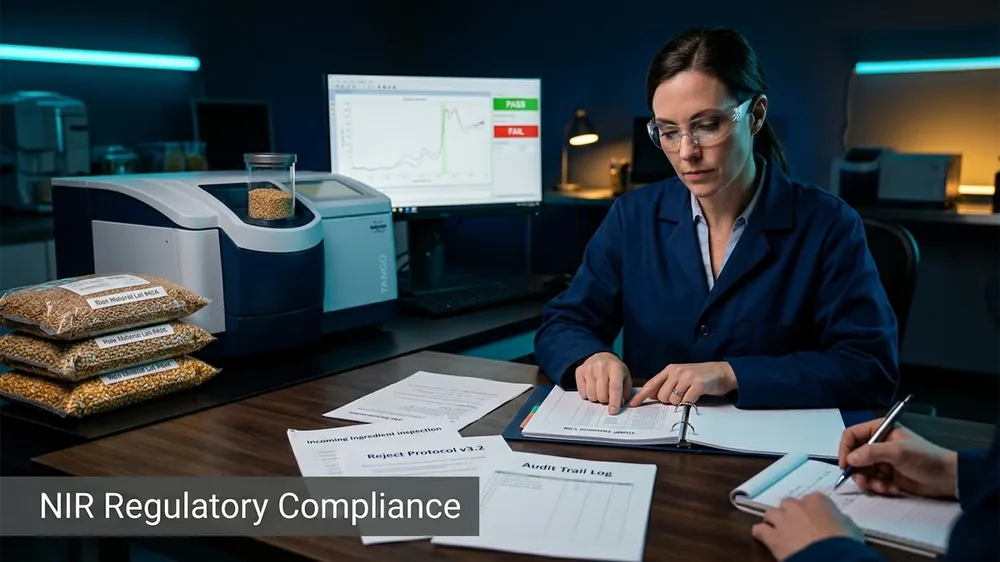
Here's the thing — I've watched a grain elevator lose a major customer contract because their rejection records couldn't hold up under a third-party audit. The NIR data was there. The decisions were right. But the paper trail was a mess, and the auditor couldn't reconstruct how a single truck had been turned away. That's a fixable problem, and it starts with building a rejection protocol before the auditor walks in the door.
Why NIR for Incoming Inspection?
Quality managers often ask me whether NIR is actually worth it at the receiving dock. The numbers answer that pretty fast: NIR scans a grain sample in under 30 seconds, while a traditional wet chemistry method takes 45 minutes or more. At a busy grain receiving operation turning around 40 trucks a day, that difference isn't a convenience — it's what makes real-time accept/reject decisions possible at all.
Think of NIR at the intake dock like a highway toll scanner that reads every plate at full speed — it doesn't slow down between vehicles, and it gives you the same read on truck 400 that it gave you on truck 1. In dairy processing, that consistency matters just as much. You can measure moisture content without altering the sample and flag a tanker before it ever hits the silo.
The speed and consistency only pay off, though, if the data feeds a protocol your team actually follows — and that your auditors can actually read.
How to Build a Rejection Protocol That Holds Up in an Audit
Document everything. That's not bureaucratic advice — it's the single point where I've seen otherwise solid NIR programs fail an audit. Your auditor wants to trace a rejected load from the raw scan result, through the calibration model that produced it, to the person who made the call and the specification it was checked against. If any link in that chain is missing, the rejection looks arbitrary.
Field tip: Keep a digital log of all NIR data and calibration updates for easy access during audits.
Set specific rejection thresholds in writing before receiving starts — not after you've already seen a problem load. Whether you're enforcing a protein floor in flour milling or a moisture ceiling in animal feed, those numbers need to be tied to a written specification, not a technician's memory. Your auditors will check whether the threshold that triggered a rejection matches the spec on file. Make sure it does.
Calibration maintenance isn't optional. A calibration drift can quietly move your predictions off-target for weeks before anyone notices — and if that drift crosses your rejection boundary in the wrong direction, you've either been accepting off-spec material or turning away good loads. Quality managers I've worked with who maintain robust calibration models catch drift through scheduled checks against reference standards, not because a complaint came in first.
Watch out: Regularly update and verify your calibration against reference standards to avoid discrepancies.
What to Include in Your NIR Rejection Protocol
Your NIR rejection protocol needs to cover more than just the pass/fail number. Start with a clear description of the instrument — model, serial number, the specific analytes being measured, and the calibration model version in use. In oilseed crushing, for example, you'd document that you're monitoring oil content and moisture, which calibration file applies to which commodity, and when that model was last verified. That level of detail is what lets an auditor reconstruct a decision six months later.
Include your sample handling procedures explicitly. How is the sample drawn from the truck or railcar? How many sub-samples? How is it stored before scanning? Inconsistencies here are where NIR results become unreliable, and auditors who understand NIR will look at this section first. Your protocol should leave no room for a technician to improvise.
Add a section on what happens after a rejection. Who gets notified? What's the hold procedure? Is there a re-test protocol — and if so, how many scans, and who authorizes accepting a borderline load? These escalation steps protect your team during audits and prevent the informal workarounds that create compliance gaps.
Training your team on both the technology and protocol ensures consistent implementation.
During plant visits I've observed a pattern worth calling out: technicians who know how to run the instrument but don't know what a suspect result actually looks like. Your staff needs to know what an out-of-range prediction value means, when to flag a scan, and when to escalate to a wet chemistry confirmation. A technician who can only read a green or red light isn't prepared for the grey areas that auditors always find.
Practical Steps for Implementing a Reliable Protocol
- 1Document Everything — Keep detailed records of every step in the process for transparency and audit readiness.
- 2Set Clear Rejection Criteria — Base these on industry standards and your specific product needs.
- 3Regular Calibration — Schedule routine checks and updates to maintain accuracy and reliability.
- 4Train Your Staff — Ensure your team understands both the NIR technology and the protocol for consistent results.
- 5Review and Revise Periodically — Regularly review your protocol to incorporate new insights and updated reference data.
One step that doesn't get enough attention: run a dry audit of your own protocol before an external auditor does it for you. Pull five historical rejections — or five accepted loads near the boundary — and try to reconstruct every decision from your records alone. If you can't do it cleanly from the documentation, your auditor won't be able to either. Fix the gaps on your own timetable, not theirs.
One more failure mode I see at feed mills specifically: the rejection threshold gets set at commissioning and never revisited when a new crop year starts or a new supplier comes on board. Your calibration model may have been built on last season's commodity range. If the new supply sits outside that range, your prediction uncertainty goes up — and your rejection boundary may no longer mean what you think it means. Build a scheduled review of both thresholds and model performance into your protocol, at minimum once per crop year or supplier change.
Conclusion
A rejection protocol that passes audits isn't built on good intentions. It's built on traceable records, written thresholds tied to real specifications, a maintained calibration process, and staff who know what to do when a result is borderline. Get those four things right in your lab, and NIR stops being a liability during audits — it becomes your strongest evidence that incoming quality is actually controlled.
SpectroScience students get access to the NIR Quick Reference Guide — wavelength assignments, key absorption peaks, and common parameter ranges for food and feed analysis. Available as a free download in the student resource library.
Access the PDF libraryNIR Fundamentals Course — Lesson 9: NIR vs. Wet Chemistry
This lesson compares NIR with traditional wet chemistry methods, highlighting the advantages of speed and efficiency in real-time decision-making. Understanding these differences is crucial for quality control professionals aiming to implement an effective rejection protocol that meets audit standards.
Explore Lesson 9 in the NIR Fundamentals courseWant to Master NIR Spectroscopy?
Our 32-lesson online course covers everything from Beer-Lambert Law to PLS calibration — built for food, grain, feed, and dairy professionals.