What NIR Spectroscopy Measures in Food, Feed, and Grain Operations
Learn what NIR spectroscopy measures in food, feed, and grain operations — moisture, protein, fat, and more with real performance benchmarks.
· 6 min read · Vitaly Kirkpatrick
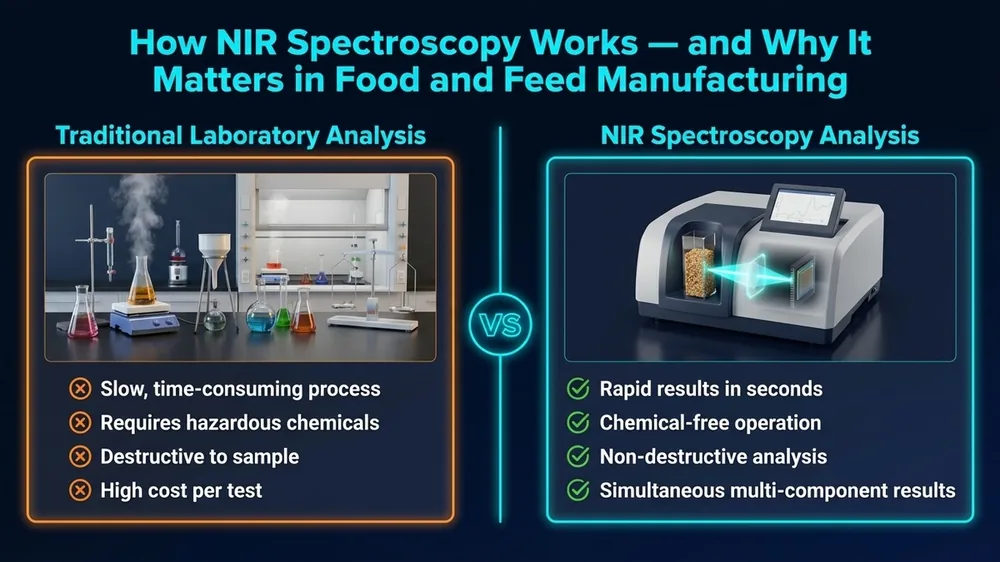
How NIR Spectroscopy Works — and Why It Matters in Food and Feed Manufacturing
A grain elevator receiving 200 truckloads a day can't run wet chemistry on every load. That's just the reality. Near-infrared spectroscopy became a standard analytical tool in dairy processing, oilseed crushing, and beverage production because it solves that exact problem — scan time drops from 45 minutes to under 60 seconds, and you get a result before the truck pulls away from the pit. It typically pays for itself in under two years when deployed correctly, but it can sit collecting dust if the implementation misses key operational needs. For operations evaluating where the technology fits in their broader quality system, the overview of NIR spectroscopy across grain, feed, and food operations provides useful context on deployment priorities.
What NIR Spectroscopy Actually Measures
Here's the thing — the instrument doesn't measure a nutrient directly. It measures how molecules interact with near-infrared light. When near-infrared light hits your sample, specific wavelengths get absorbed, and that absorption causes molecular bonds to vibrate. Each bond type — C-H, O-H, N-H — absorbs at characteristic wavelengths. Together, those absorption patterns form a chemical fingerprint of whatever material you're scanning.
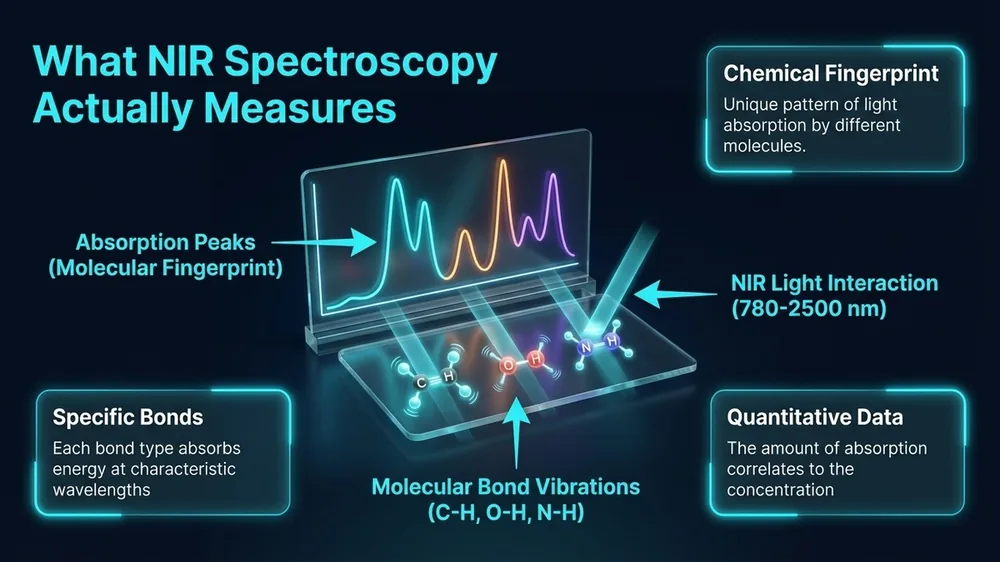
Think of it like a voiceprint. Just as a skilled operator learns to recognize a regular customer's voice on the phone without needing to see the caller's face, a calibrated analyzer learns to recognize a chemical composition from its spectral pattern — without destroying the sample or running a single reagent.
This approach works on overtones and combination bands — weaker signals than mid-infrared, but still highly informative. Because near-infrared light penetrates deeper into samples, it works well for analyzing bulk grain or pellets without complex sample preparation. That depth of penetration is one reason the technology suits high-throughput intake settings. For a full explanation of why molecular bonds vibrate and how NIR uses those vibrations to predict composition, see why molecules vibrate and how NIR uses that to predict composition.
The Core Parameters NIR Measures in Food and Feed
Quality managers often ask me which parameters the instrument handles reliably and which it doesn't. That question matters more than most people realize — because the answer shapes how your testing workflow gets designed. There are a few well-established categories here.
- Moisture: The O-H bond absorbs strongly in the NIR region. Moisture prediction is typically the most accurate NIR measurement across nearly all matrices. Results match oven-dry reference methods within 0.1–0.2 percentage points in well-maintained calibrations.
- Protein: The N-H bond signal drives protein prediction. In commodities like soybean meal, wheat, and corn, NIR protein predictions routinely achieve standard errors of prediction below 0.3% on a dry matter basis.
- Fat and oil: C-H bond overtones allow reliable fat and oil prediction. Oilseed crushers use this to monitor extraction efficiency in near-real time.
- Starch and fiber: Measurable in most grain and feed matrices, though calibration requirements are more demanding. These parameters benefit from larger reference datasets covering the full range of natural variation in the ingredient population.
- Ash: NIR doesn't directly detect inorganic minerals. Ash predictions work only when ash correlates with organic components in the calibration set — a limitation operators need to understand before relying on those results in formulation or compliance decisions.
A practical breakdown of where these measurements succeed and where they fail is covered in NIR spectroscopy in food and feed: what it measures and where it fails.
Where NIR Fits in Food, Feed, and Grain Operations
In practice, this technology shows up across a wide range of production environments. Here's where it consistently delivers value:
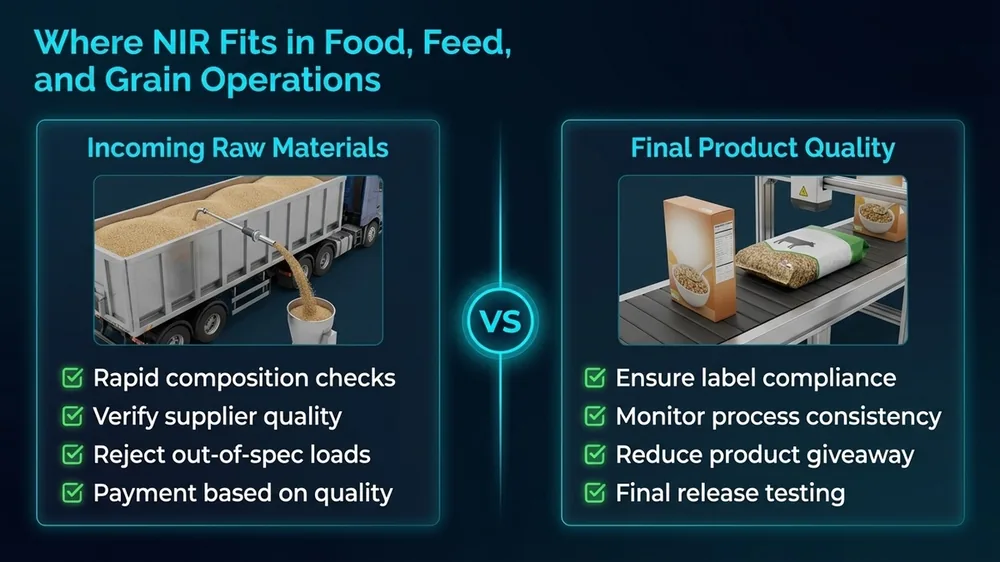
- Grain intake: Moisture, protein, and oil content measured at the elevator or crusher intake — with results in under 60 seconds compared to 45 minutes for wet chemistry. This speed allows real-time acceptance and grading decisions at the gate. A grain elevator receiving 200 truckloads per day simply can't run wet chemistry on every load; NIR makes that coverage possible.
- Food processing: Sugar levels in incoming fruit, fat content in dairy ingredients, adulteration screening in oilseeds — all without destroying the sample. Inline dairy applications, for example, allow continuous monitoring of fat and protein during processing rather than waiting for hourly grab samples.
- Animal feed production: From incoming soybean meal to finished pellets, NIR verifies nutritional composition at multiple points in the process. More detail on this appears in the next section.
- Oilseed processing: Oil content, moisture, and protein in canola, sunflower, and soy — on incoming seed and on meal after extraction. Crushers use these results to adjust process parameters and reduce over-processing losses. A 0.5% improvement in oil recovery on a 1,000 tonne per day crush adds up to real margin across a season.
- Pet food manufacturing: Protein, fat, and moisture verification on finished products, where label accuracy is both a quality issue and a regulatory requirement. NIR allows end-of-line checks on every batch rather than statistical sampling only.
NIR in the Feed Mill: Four Critical Measurement Points
Animal feed is one of the highest-value near-infrared applications in this industry. A single percentage point swing in protein on a 500-tonne soybean meal delivery represents thousands of dollars in raw material cost. During plant visits I've observed feed mills that scan at every production stage — and ones that scan only at intake and wonder why their finished product varies. Here's how disciplined operations approach it.
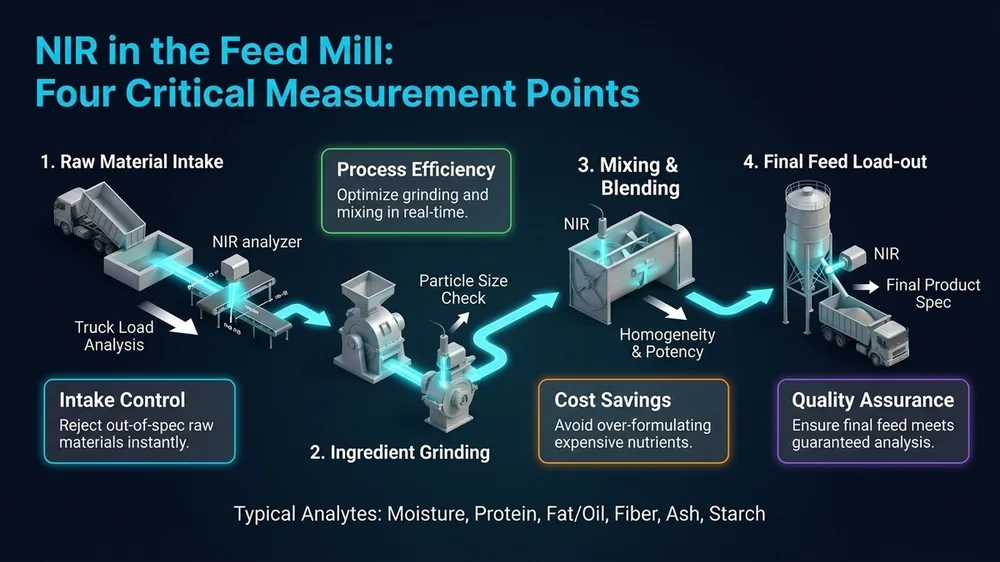
- 1Incoming raw ingredients — Verify protein, moisture, and fat before acceptance. This is the last opportunity to reject a non-conforming ingredient before it enters the process. A result in under 60 seconds allows that decision at the gate. For soybean meal specifically, protein variation between supplier loads commonly spans 2–3 percentage points — a range that changes feed formulation economics meaningfully.
- 2Post-grinding — Verify particle size consistency using spectral shape metrics as a proxy. Particle size isn't measured directly. Spectral texture changes are a reliable surrogate when the calibration is built specifically for that purpose. Mills that skip this step often discover mixing uniformity problems downstream rather than catching them at their source.
- 3Mixer output — Check blend uniformity. If the premix isn't homogeneous, no downstream test corrects that. NIR at this point catches mixing faults before they reach bagging. Coefficient of variation targets for mixer uniformity are typically below 5%; NIR-based monitoring gives you a practical way to track this at production speed.
- 4Finished pellets — Final verification of protein, fat, moisture, and starch against label specifications before the product ships. This checkpoint also serves as documentation for regulatory audits and customer quality agreements.
Watch out: Each measurement point has different sample presentation requirements and calibration needs. One calibration doesn't typically handle all four. That assumption shows up as step-by-step prediction bias at one or more points in the process. Feed mills that use a single soybean meal calibration for both raw incoming meal and pelletized finished product regularly see unexplained bias at one end of the production chain.
Practical Benchmarks for NIR Performance in Grain and Feed
Knowing what performance to expect helps your operation set realistic targets and catch calibration problems early. These benchmarks reflect typical results in well-run programs:
- Moisture in grain: Standard error of prediction (SEP) of 0.10–0.20% against oven reference methods.
- Protein in soybean meal: SEP of 0.20–0.35% on an as-is basis under stable lab conditions.
- Fat in finished feed: SEP of 0.20–0.40%, depending on matrix variability and calibration population size.
- Starch in corn: SEP of 0.30–0.50% is achievable with a well-populated calibration set covering the range of hybrids received across a season.
- Scan time per sample: 15–45 seconds for most bench-top instruments, with some at-line systems delivering continuous results.
- Sample throughput advantage: A single NIR instrument can process 80–120 samples per shift where wet chemistry handles 20–30 under the same staffing. That difference has direct implications for intake coverage and lab staffing costs.
When your results fall outside these ranges, the cause is usually one of three things: sample preparation inconsistency, calibration drift, or instrument maintenance gaps. For operations building or auditing their NIR programs, the guide to why NIR calibration is needed and how it works explains the calibration foundations that support reliable predictions across all of these parameters.
What NIR Does Not Measure Well — and Why That Matters
Setting accurate expectations is as important as understanding the technology's strengths. Your auditors and your formulation team both need to know where the technology stops. Several parameters are either unreliable or outside its detection capability entirely:

- Minerals and heavy metals: NIR has no sensitivity to inorganic elements. Calcium, phosphorus, iron, and similar minerals require atomic absorption, ICP, or classical wet chemistry methods. Any NIR "ash" prediction is indirect and needs thorough validation before use in formulation.
- Mycotoxins: Aflatoxin, deoxynivalenol, and fumonisin are present at parts-per-billion concentrations. NIR's practical detection limit is far above these levels. Dedicated immunoassay or HPLC methods remain the standard for mycotoxin screening.
- Amino acid profiles: Total crude protein is measurable; individual amino acids like lysine and methionine aren't reliably predicted without very large, purpose-built calibration sets and careful validation. If your operation uses NIR amino acid predictions, confirm those calibrations are current and validated against your specific ingredient supply.
- Microbial contamination: NIR doesn't detect pathogens, yeast, or mold counts. These require microbiological plate methods. Full stop.
Understanding these boundaries prevents over-reliance on this instrument for compliance decisions where the parameter falls outside its detection capability. The distinction between what these measurements cover reliably and where wet chemistry must fill the gap is covered in depth in the practical decision guide for when to use NIR instead of wet chemistry.
Sample Presentation and Its Effect on NIR Accuracy
The instrument measures sample composition through the spectrum — but that spectrum reflects not only chemistry but also the sample's physical state. Particle size, temperature, packing density, and surface moisture all affect the signal. Two samples with identical protein content can produce different spectra if their physical characteristics differ. This isn't a flaw in the technology. It's a property that your lab needs to manage actively, every single day.
Practical implications for grain and feed operations include:
- Ground samples should be milled to a consistent particle size — typically 0.5–1.0 mm — before scanning. A ring mill or cyclone mill maintained to a fixed screen size is the standard approach in most commercial labs.
- Sample temperature should be within 5°C of the temperature at which calibration samples were scanned. Cold grain from outdoor storage scanned immediately after collection introduces temperature-related spectral shifts that calibrations may not compensate for.
- Sample cups and cells must be filled consistently. Overfilling or underfilling a rotating cup introduces path-length variation that increases prediction error.
- For whole-grain applications using diffuse reflectance, sample orientation in the beam matters less than for transmission measurements — but consistent filling depth remains important.
The practical field takeaway here: most accuracy problems I see during plant visits aren't instrument problems. They're sample handling problems. Get your prep protocol documented, train your operators on it, and check compliance regularly. That single step resolves a large share of the prediction bias complaints I hear from quality managers across grain elevators and feed mills alike.
Free tool — Calibration Metrics Calculator: Enter your reference values and spectroscopy predictions in the Calibration Metrics Calculator to compute RMSEP, RPD, R², and bias the way our course teaches it — with interpretation thresholds for grain, dairy, and feed. Open the Metrics Calculator →
SpectroScience students get access to the NIR Quality Checklist — pre-scan checklist covering warm-up, reference scan, sample condition, and environmental factors. Available as a free download in the student resource library.
Access the PDF libraryNIR Fundamentals Course — Lesson 14: Food & Feed Industry
This lesson focuses on the application of NIR spectroscopy specifically within the food and feed industry, detailing how it enhances quality control processes. It covers the types of parameters that can be measured and the operational benchmarks that help ensure product consistency and safety.
Explore Lesson 14 in the NIR Fundamentals courseWant to Master NIR Spectroscopy?
Our 32-lesson online course covers everything from Beer-Lambert Law to PLS calibration — built for food, grain, feed, and dairy professionals.