NIR Technology Types: FT-NIR, Dispersive, and Filter-Based Compared
Compare NIR and FT-NIR instrument types — dispersive, FT-NIR, and filter-based — with real costs, applications, and selection criteria for food and feed.
· 15 min read · Vitaly Kirkpatrick
NIR Technology Types: FT-NIR, Dispersive, and Filter-Based Compared
How to Choose an NIR Instrument Without Getting Lost in the Sales Pitch
A quality manager at a feed mill spent $45,000 on an FT-NIR, installed it next to the hammer mill, and watched it drift for six months before anyone admitted the placement was the problem. The instrument was not wrong — the decision process was. That kind of expensive mistake happens when teams skip the fundamentals and go straight to vendor demos. Understanding the three main NIR technology types — and specifically how NIR FT-NIR compares to dispersive and filter-based platforms — is where any smart instrument decision starts. Pick the wrong platform for your environment and you are not just losing money on the purchase. You are losing it every day the instrument underperforms. This article walks through the decisions that actually matter: technology type, deployment location, sample matrix, and support — so you can evaluate instruments on your terms, not the vendor's. For a broader orientation to how NIR works before comparing hardware, see What Is NIR Spectroscopy? How Near-Infrared Light Works in Food and Feed Analysis.
What to Settle Before You Talk to Any Vendor
Most teams jump straight to demos and pricing. That approach is backwards. When evaluating NIR instruments for a grain processor or feed mill, the first step is to slow down. Until five basic questions have been answered, every vendor conversation is just noise.
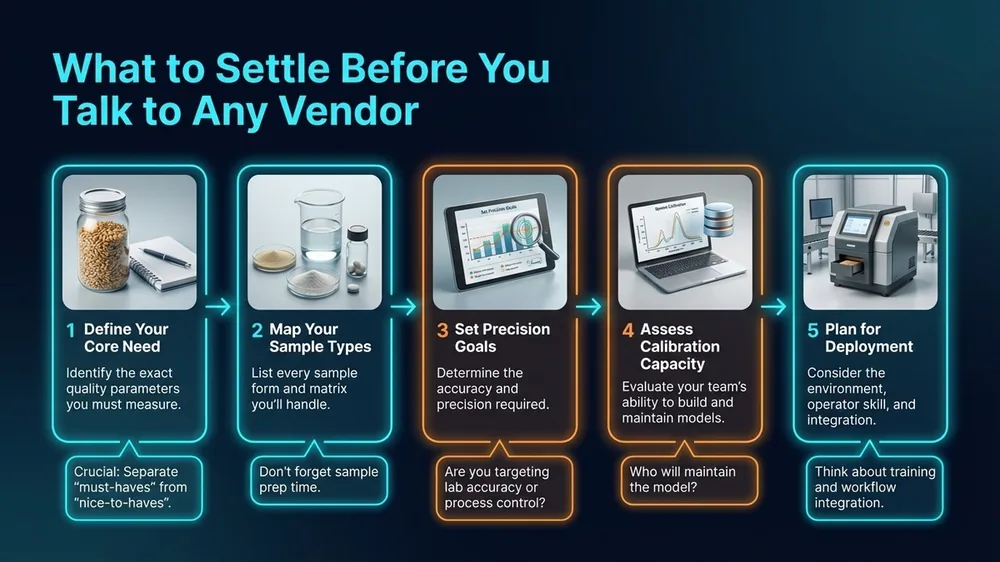
- 1Define the analyte — Know what you are measuring (protein, moisture, fat, fiber) and its expected concentration range. This narrows the spectral region and detector requirements before you look at a single spec sheet.
- 2Characterize the sample matrix — Powders, liquids, slurries, and whole grain each require different sampling accessories. A dairy operation measuring liquid whey has completely different instrument requirements than a feed mill scanning pelleted feed.
- 3Determine throughput needs — Are you testing 20 samples per day in a receiving lab, or do you need continuous monitoring on a production line running 24 hours? That answer drives the decision toward a benchtop or process analyzer. It is not negotiable.
- 4Set a realistic budget — total cost, not sticker price — Calibration transfer fees, training, maintenance contracts, and consumables all need to be factored in. Unexpected costs after the initial purchase can dramatically change the economics of any instrument choice.
- 5Evaluate vendor support before committing — Who installs the system? Who trains your team? Who answers the phone when a calibration issue arises at 6 a.m. on a Monday? Support availability determines whether the instrument delivers long-term value.
What Are You Actually Measuring?
Protein in hard red wheat, moisture in soybean meal, fat in pet food kibble — each analyte has its own spectral signature. The concentration range matters too.
Measuring moisture at 10–14% in grain is a different problem than detecting a trace component at under 1%. Know your target analyte and its expected range before asking about any instrument's capabilities. That single step keeps your evaluation focused and prevents spec-sheet confusion.
For a detailed breakdown of what NIR reliably measures across food, feed, and grain matrices, see What NIR Spectroscopy Measures in Food, Feed, and Grain Operations.
What Does Your Sample Look Like?
The sample matrix drives nearly every hardware decision. Measuring a liquid in a flow cell is a different setup than scanning whole soybeans on a conveyor or scooping ground premix into a cup.
Your sample type determines the accessories you need and how rugged the instrument has to be. A handheld that survives a humid dairy processing plant will behave very differently than a precision lab unit designed for a controlled environment. Getting this wrong means buying the wrong instrument entirely.
How Many Samples, and How Fast?
A feed mill receiving 40 trucks a day needs faster turnaround than a lab running end-of-shift checks on a single product. If you are only testing a handful of samples per day, a benchtop instrument with manual sample prep is sufficient.
If production decisions depend on real-time data, inline or online deployment is necessary. Mismatching instrument speed to operational pace creates bottlenecks. Bottlenecks lead to pressure to skip testing entirely — and that is a quality risk no operation can afford.
For a practical look at how NIR fits into grain receiving workflows, see Reject or Accept in Seconds: How NIR Transforms Grain Receiving Decisions at the Intake Point.
What Is the Real Budget?
NIR instruments range from a few thousand dollars for a handheld to well over $100,000 for a full process analyzer with fiber optic probes. The purchase price is just the beginning.
Budget separately for calibration development or transfer, training, annual maintenance, and any integration work needed for a LIMS or process control system. These costs are real and they add up fast.
A complete cost-benefit approach is available in How to Calculate NIR Spectroscopy ROI: Building the Business Case.
Watch out: A low sticker price can mask a high total cost of ownership. Calibration development, consumables, maintenance contracts, and integration costs should all be factored in before comparing instrument prices head to head.
What Support Will You Actually Get?
An instrument without vendor support becomes a problem fast. Operations teams have encountered situations where a fully functional NIR sat idle for three months because no one knew how to update the calibration after a recipe change in pet food production. Three months of idle time is expensive.
Before signing any agreement, confirm who installs the unit, who trains your team, and what the service response time looks like. This is especially important for remote aquafeed facilities or smaller milling operations that do not have in-house technical staff.
For a structured set of questions to ask before you commit, see What Questions Should You Ask a NIR Vendor Before You Sign?
NIR Technology Types: FT-NIR, Dispersive, and Filter-Based
Once those basic questions are answered, the three main NIR technology types — FT-NIR, dispersive, and filter-based — can be evaluated honestly. Here is how each one actually performs in food and agricultural applications, not how the brochure describes it.
FT-NIR: High Resolution, High Demands
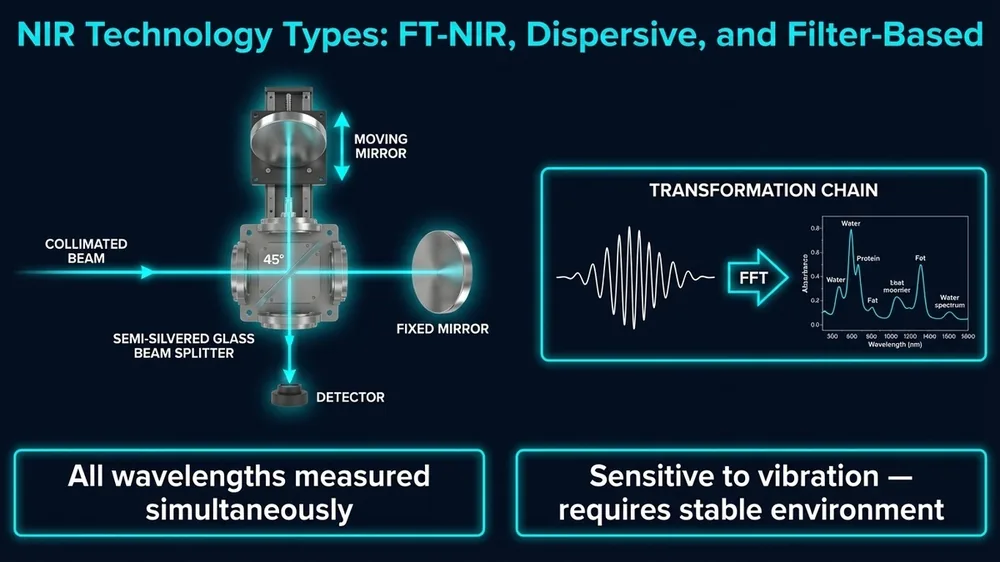
Fourier Transform NIR — commonly written as FT-NIR — delivers the widest spectral range and the highest resolution of any NIR platform. That makes it the right tool for method development, complex sample matrices, and applications where you need to measure five or six analytes simultaneously from a single scan.
FT-NIR instruments are most often found in central labs at oilseed processors and larger dairy operations. The tradeoff is real. They are sensitive to vibration and temperature fluctuations. A stable lab environment is not optional — it is required. They also cost more, both upfront and in ongoing maintenance.
In a controlled lab environment, FT-NIR can scan 800–1000 wavelength points per spectrum. That density of spectral data supports calibration development for difficult analytes like amino acids or starch digestibility. A filter-based instrument cannot address those parameters at all.
Think of FT-NIR like a high-end analytical balance: impressive in the right environment, frustrating and unreliable when conditions are not controlled. The purchase price often lands in the $40,000–$80,000 range before accessories. Annual service contracts can add $5,000–$10,000 per year. If your lab cannot guarantee temperature and vibration control, that investment will not pay off the way the spec sheet suggests.
Dispersive NIR: Reliable for Routine QC
Dispersive instruments use diffraction gratings to spread light across a detector array. They do not match FT-NIR resolution, but they do not need to for most routine quality control work.
Dispersive instruments are the most common choice at oilseed processing plants and beverage production facilities running standard moisture and fat checks. They handle the workload, tolerate less-than-ideal environments, and are competitively priced. For many food and feed operations, dispersive NIR is the practical default.
A mid-range dispersive benchtop typically measures 256–1024 data points across the NIR range. It can complete a scan in under 10 seconds. That speed is sufficient for most at-line QC workflows.
Dispersive instruments are also less mechanically complex than FT-NIR. There is no moving mirror assembly. That reduces the risk of vibration-related performance problems in semi-controlled environments. Purchase prices in the $15,000–$35,000 range are common for general-purpose dispersive benchtop units.
Filter-Based NIR: Built for Speed and Simplicity
Filter-based instruments measure only a fixed set of wavelengths. That limitation is also their strength. They are fast, mechanically simple, and highly repeatable for dedicated applications.
If measuring moisture and fat on a single product line is all you need, a filter-based instrument can reliably do that job for years. They are common in agricultural receiving stations where speed matters more than spectral breadth. When the application is narrow and well-defined, filter-based NIR is often the most cost-effective solution available.
A typical filter wheel instrument selects 6–19 discrete wavelengths matched to the target analytes during manufacturing. Once configured, those wavelengths cannot be changed in the field — which is exactly the point. The fixed design eliminates variables and produces highly stable readings over time.
Some filter-based units have been in continuous use at grain elevators for more than 15 years with minimal recalibration. Entry-level filter-based instruments start below $10,000. That makes them accessible for smaller receiving operations that need fast protein and moisture checks without the overhead of a full spectroscopic platform.
Matching Technology Type to Deployment Location
Technology type and deployment location are two separate decisions. Both must align with the application. An FT-NIR placed in a vibration-prone processing environment will underperform a filter-based instrument installed correctly in an agricultural receiving bay.
The right question is not "which technology is best?" It is "which technology fits this specific application, environment, and team?" Spec sheet rankings mean nothing if the instrument cannot survive the conditions it will actually operate in.
For a full breakdown of how deployment context — benchtop, at-line, online, and inline — shapes the selection decision, see NIR Instrument Selection for Grain, Feed, and Dairy Operations: Benchtop vs At-Line vs Inline.
Comparing NIR and FT-NIR: A Side-by-Side Summary
When operations teams ask us to compare NIR and FT-NIR directly, the answer depends entirely on what the instrument needs to do. Here is how the three technology types stack up across the criteria that matter most in food and feed environments.
| Criterion | FT-NIR | Dispersive NIR | Filter-Based NIR |
|---|---|---|---|
| Spectral resolution | Highest (800–1000 points) | Medium (256–1024 points) | Low (6–19 wavelengths) |
| Environmental sensitivity | High — needs controlled lab | Moderate | Low — tolerates harsh conditions |
| Typical purchase price | $40,000–$80,000+ | $15,000–$35,000 | Under $10,000 |
| Analytes supported | Broadest — including amino acids, starch digestibility | Most routine QC parameters | Fixed set only |
| Operator skill required | High | Moderate | Low |
| Best deployment | Central lab | At-line or benchtop QC | Receiving stations, dedicated lines |
How Environment and Operator Skill Affect Technology Choice
Technology type is not the only variable. The operating environment and the skill level of the people running the instrument both influence which platform will deliver consistent results.
FT-NIR instruments require the most operator knowledge. Interpreting spectral residuals, recognizing instrument drift, and managing calibration updates all demand someone with formal NIR training or significant hands-on experience. In a central lab with a dedicated spectroscopist, that is manageable. In a feed mill where the instrument operator also pulls samples, drives the forklift, and covers breaks, it is not.
Dispersive instruments sit in the middle. Most have software interfaces designed for non-specialist users. Guided workflows and clear pass/fail outputs keep operation straightforward. Operators at grain elevators and oilseed plants use dispersive benchtops daily with minimal formal training beyond the vendor startup session.
Filter-based instruments require the least operator skill for routine use. Scan, read, record — the workflow is designed to be simple. The tradeoff is that any analytical issue — a calibration drift, an out-of-range sample — is less visible without the full spectrum to review. Operations relying on filter-based instruments need a clear protocol for flagging questionable results and escalating to a reference method when something looks off.
Environmental conditions matter just as much. Temperature swings above 5°C during a shift can introduce measurement drift in all three technology types. FT-NIR instruments are the most sensitive. Humidity control, proximity to dust sources, and foot traffic vibration all factor into whether your chosen instrument will perform to spec after six months of real-world use.
We have documented cases where a $60,000 FT-NIR was outperformed by a $12,000 filter-based unit simply because the FT-NIR was placed in an uncontrolled environment. The smaller instrument handled those conditions without issue. Fit matters more than specs on paper.
For a deeper look at how sample conditions affect NIR accuracy, see Why Sample Temperature Affects NIR Results and How to Control It.
Calibration Transferability Across Technology Types
One practical issue that does not always appear in vendor materials is calibration transferability. If your operation has existing NIR calibrations — developed on one instrument or purchased from a global library — those calibrations may not transfer directly to a different technology type. This catches operations off guard more often than it should.
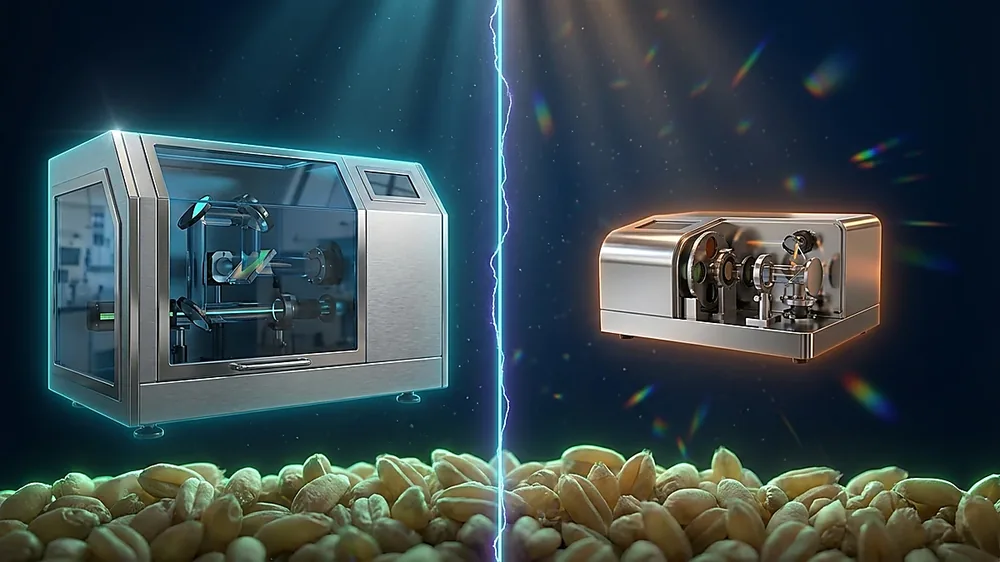
A calibration developed on an FT-NIR cannot typically be loaded onto a filter-based instrument without significant rework. The spectral resolution and wavelength coverage are fundamentally different. Calibrations developed on dispersive instruments from one manufacturer may transfer to another dispersive platform — but only after wavelength alignment and standardization procedures are completed.
This matters in three scenarios:
- When upgrading from an older instrument to a new one of a different technology type
- When a company uses multiple instruments across different plant locations and wants consistent results
- When purchasing a calibration library from a vendor or industry body — those libraries are often instrument-specific
Before committing to a technology type, confirm whether your existing calibrations can transfer and what that process involves. Some vendors charge $2,000–$8,000 for a calibration transfer project. Others include it in the instrument purchase. Either way, it needs to be in your budget before the purchase order is signed.
A common question we hear: is it worth rebuilding a calibration from scratch versus transferring from an older platform? If you are switching technology types — say, moving from dispersive to FT-NIR — plan on a rebuild. Transferring across technology types rarely delivers the accuracy you would get from a purpose-built calibration on the new instrument. Budget the time and reference samples accordingly.
For a detailed look at how calibration transfer works in practice, see How to Transfer NIR Calibration Between Instruments Effectively.
For guidance on building calibration models that hold up over time, see NIR Calibration Validation Pitfalls and Keeping Performance Reliable Over Time.
Technology type and deployment location are separate decisions that must both align with the application. An FT-NIR in the wrong environment underperforms a filter-based instrument in the right one — fit matters more than spec sheet rankings.
Free tool — NIR ROI Calculator: Plug your sample volume, current method cost, and analyte spec into the SpectroScience NIR ROI Calculator to see annual savings and payback period for your operation. Open the ROI Calculator →
Free tool — Model Diagnostics Calculator: Drop your spectra and predictions into the Model Diagnostics Calculator to flag outliers via Mahalanobis distance, leverage, and Q-residuals — the same diagnostics covered in Lesson 25. Open the Diagnostics Calculator →
SpectroScience students get access to the NIR Technology Comparison — a side-by-side comparison of FT-NIR, dispersive, and filter-based instruments across key performance criteria. Available as a free download in the student resource library.
Access the PDF libraryFree tool — Beer-Lambert Calculator: The Beer-Lambert Calculator works the absorbance = ε·b·c relationship in both directions — useful when sizing path length for a new sample type or sanity-checking a calibration curve. Open the Beer-Lambert Calculator →
NIR Fundamentals Course — Lesson 19: Different Types of NIR Instruments
This lesson covers the different types of NIR instruments, including FT-NIR, dispersive, and filter-based systems, and explains their specific applications and limitations. Understanding these distinctions helps you make informed decisions about which technology best suits your quality control needs in grain, feed, and food environments.
Explore Lesson 19 in the NIR Fundamentals courseWant to Master NIR Spectroscopy?
Our 32-lesson online course covers everything from Beer-Lambert Law to PLS calibration — built for food, grain, feed, and dairy professionals.