NIR Spectroscopy Review: Measurement, Calibration Metrics, and Reference Methods
A practical nir spectroscopy review covering calibration metrics, reference method accuracy, RMSEP, RPD, and model validation for food and feed labs.
· 6 min read · Vitaly Kirkpatrick
What to Learn Next After NIR Spectroscopy Fundamentals
Quality managers at grain elevators and feed mills ask me the same question after their teams finish NIR fundamentals training: what comes next? This NIR spectroscopy review answers that directly — calibration metrics, reference data quality, model selection, and maintenance schedules that hold up in real production environments. Whether you're evaluating a new instrument purchase, troubleshooting a drifting calibration, or preparing your team for plant acceptance testing, the concepts here apply directly to grain, dairy, feed, and oilseed operations.

How NIR Spectroscopy Works at the Molecular Level
When I'm training QC teams on NIR, the same question comes up early: what is the instrument actually measuring? Without that answer, pressing buttons isn't enough. Understanding the physics behind the measurement is what separates teams that troubleshoot effectively from those that call the instrument vendor every time a result looks off.
How NIR Light Interacts with Molecules
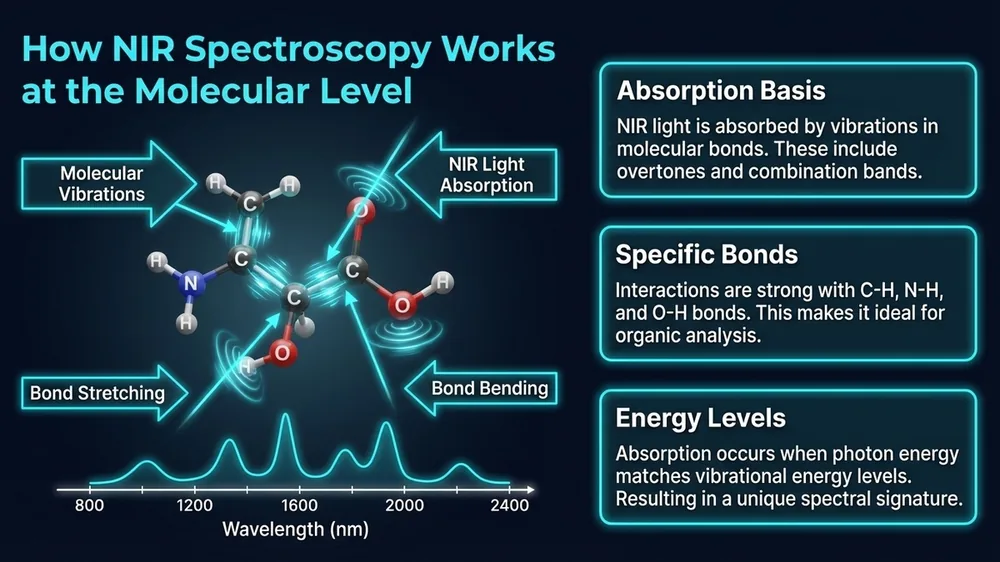
NIR spectroscopy measures vibrations in molecular bonds — overtones and combinations that absorb light between roughly 780 and 2500 nanometers. Those wavelengths capture molecular fingerprints in organic compounds: proteins, fats, and carbohydrates. Moisture absorbs strongly around 1450 nm and 1940 nm. Fat shows characteristic absorbance near 1720 nm. Protein absorbs across multiple overlapping regions, which is part of why calibration for crude protein requires careful chemometric handling.
Once you understand that, spectra stop being mysterious. The right questions follow — which vibrations are we actually observing, and how does composition shift absorption? That change in thinking matters most when you're switching between liquid samples like milk and solid ones like grain. For a detailed explanation of how molecular bond vibrations drive NIR measurement, see our guide to why molecules vibrate and how NIR uses that to predict composition.
Which Measurement Mode to Use for Different Samples
Diffuse reflectance, transmission, and transflectance each suit a different sample type. Diffuse reflectance works well for powders and solid matrices — ground grain, feed pellets, soy meal. Transmission is better for clear liquids, including juices and some dairy streams. Transflectance sits between the two and is often used for turbid liquids or slurries where full transmission isn't practical.
During plant visits I've observed labs using the wrong mode simply because it was the default instrument setting. That creates a data quality problem from the start. A feed mill running whole corn through a diffuse reflectance instrument calibrated on ground samples will see spectral noise that chemometrics can't fully compensate for. Matching technique to sample form is a basic decision that practitioners skip too often. For a full breakdown of instrument configurations and which measurement mode fits each application, see our overview of different types of NIR instruments from benchtop to process.
How NIR Instrument Design Affects Your Data
Dispersive monochromators offer sharp wavelength resolution and are common in research-grade benchtop instruments. Diode arrays provide speed — full spectrum acquisition in under a second — which makes them well-suited for inline and at-line applications. FT-NIR instruments have different noise characteristics, with high wavelength accuracy and reproducibility that makes them useful when transferring calibrations across instrument networks.
Choosing between them — for grain moisture at a silo versus ingredient verification on a pet food line — requires understanding trade-offs, not just reading a spec sheet. A filter-based instrument may be cost-effective for single-analyte moisture measurement at a grain elevator but fall short when the same operation later needs protein and oil predictions from the same scan.
Which Calibration Metrics Actually Matter in Production
Here's the thing — one of the most common mistakes I see in plant labs goes like this: a calibration is developed, an R² of 0.99 is achieved, and the job is considered done. Then the model fails its first plant acceptance test. The reason is straightforward — R² measures correlation, not accuracy.
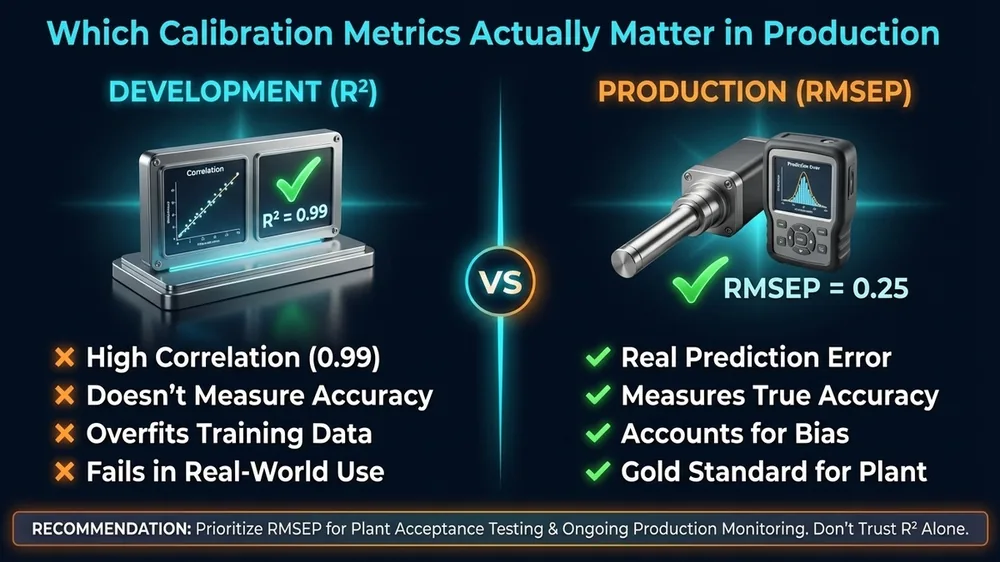
The number that matters is RMSEP (Root Mean Square Error of Prediction). That metric shows whether your model can hit the specification tolerance in production. If the protein spec is ±0.3% and the RMSEP is 0.35%, there's a problem — regardless of what R² shows. RMSEP must be calculated on an independent validation set — samples the model has never seen during development. Using the calibration set itself to validate produces optimistically low error estimates that won't hold on the plant floor.
R² measures correlation, not accuracy. RMSEP is the metric that tells whether the model can meet the specification tolerance in production — and it must be evaluated alongside bias and RPD before any deployment decision.
Bias is the other silent issue. A model can show acceptable RMSEP but carry a consistent directional error — always reading 0.15% high on moisture, for example. That compounds. Over a week of production decisions, it creates real risk. Bias is most dangerous when it's consistent enough that operators start to trust it — and then a raw material shift moves it further in the same direction.
Use RPD (Ratio of Performance to Deviation) as a quick fitness check:
| RPD Value | Interpretation | Suitable For |
|---|---|---|
| RPD > 3 | Excellent model performance | Process control, tight QC decisions |
| RPD 2–3 | Usable, with monitoring | Screening, routine QC |
| RPD < 2 | Not fit for purpose | Do not deploy — rebuild calibration |
Before signing off on any new calibration, check all three: RMSEP against the tolerance, bias across the concentration range, and RPD. If any one of these fails, the model isn't ready for plant use. A practical rule used in grain operations: validate on at least 20 independent samples spanning the full expected production range before any deployment decision is made. For a step-by-step approach to identifying and resolving calibration failures, see our article on diagnosing NIR calibration problems with a step-by-step approach.
Understanding RMSECV Versus RMSEP in Practice
Two error metrics are regularly confused during calibration development: RMSECV (Root Mean Square Error of Cross-Validation) and RMSEP (Root Mean Square Error of Prediction). RMSECV is calculated during model building using cross-validation — samples are left out in rotation and predicted by a model trained on the rest. It's useful for selecting the best number of PLS factors and catching overfitting during development. Think of it like a practice exam — it tells you how the model performs under controlled conditions, not in the field.
RMSEP, by contrast, is calculated on a truly independent test set collected after the model is finalized. It's the only metric that reflects real-world performance. A common problem in feed mill labs is deploying a model based on a low RMSECV without ever calculating RMSEP. The model looks excellent on paper and underperforms immediately in production. The gap between RMSECV and RMSEP is itself informative — a large gap suggests the calibration set didn't represent production variation adequately.
Why Your Reference Method Is Your Accuracy Ceiling
Here's something most NIR training doesn't cover: an NIR model can't outperform wet chemistry. It's mathematically impossible. If the reference method has errors, those errors get built into your calibration permanently.
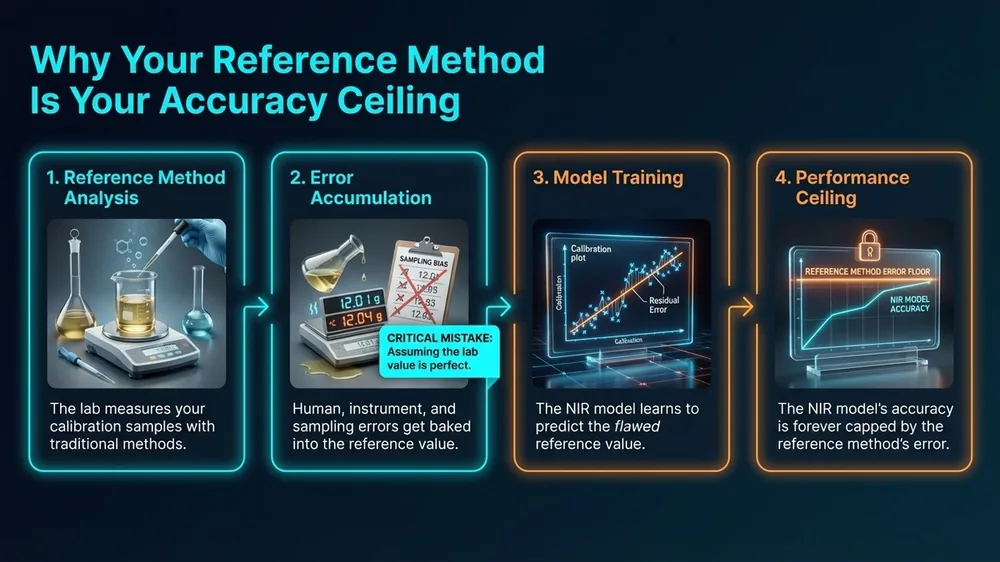
A Kjeldahl protein analysis has a repeatability of roughly ±0.2%. That's the ceiling your NIR model operates under before calibration even starts. When the reference method CV in a dairy or oilseed processing lab is running above 1%, the answer isn't better chemometrics — it's fixing the wet lab first. Soxhlet fat extraction, ether extract, and acid hydrolysis methods each carry their own repeatability characteristics that define what NIR can realistically achieve for those analytes.
The practical step: run a repeatability study before starting any calibration work. Take 10 samples, run them in duplicate across 3 separate days, and calculate the reference method CV. This 30-minute exercise has saved labs months of rework. If CV is above 1% for a critical analyte, identify whether the source of variability is analyst technique, reagent inconsistency, or instrument drift in the wet lab — and resolve it before collecting a single calibration sample.
The same garbage-in/garbage-out principle applies to sample selection. 50 well-chosen, representative samples will outperform 500 random ones every time. Your calibration set must cover the real variation the instrument will see in production — seasonal raw material shifts, supplier changes, and moisture range extremes. Samples that don't represent production reality produce models that fail in production. A calibration set built exclusively from summer corn deliveries will drift when the first fall crop arrives.
50 well-chosen, representative samples will outperform 500 random ones every time.
PLS Versus Other Model Types: Choosing the Right Approach
Partial Least Squares (PLS) regression remains the workhorse of NIR calibration in food and feed applications. It handles the high collinearity built into NIR spectra — where hundreds of wavelengths are correlated — by extracting latent variables that explain both spectral and concentration variance at the same time. For most routine applications (moisture, protein, fat, fiber in grain and feed), PLS with appropriate preprocessing delivers results that are reproducible, interpretable, and transferable across instruments.
Principal Component Regression (PCR) is conceptually similar but extracts components based on spectral variance alone, without reference to the analyte. This can produce poor models when the analyte of interest isn't the dominant source of spectral variation — a common situation in complex feed matrices where moisture variation dominates the spectra but protein is the target analyte.
Artificial Neural Networks (ANN) and other nonlinear approaches offer potential advantages in highly complex matrices, but they require larger calibration sets, carry higher overfitting risk, and are harder to validate transparently. For most production QC applications in grain elevators, feed mills, and dairy plants, PLS with thorough cross-validation and independent prediction set testing remains the recommended starting point. More complex models should only be considered after PLS has been shown to be genuinely insufficient for the application.
Calibration Maintenance: What Happens After Deployment
A calibration that passes plant acceptance testing on day one doesn't stay valid indefinitely. Raw material sources change. Suppliers rotate. Seasonal moisture ranges shift. Instrument components age. Each of these introduces spectral drift that a static calibration can't accommodate without an update.
A practical maintenance schedule for feed mill and grain applications includes three components. First, run a set of check standards — samples with known reference values — on a defined schedule. Weekly is common for high-throughput operations. Monthly is acceptable for lower-volume applications. If predictions drift beyond two times RMSEP from the reference value, the calibration needs review.
Second, monitor the H statistic (Mahalanobis distance) or T² statistic for each production scan. These outlier detection metrics flag samples that fall outside the calibration space — meaning the model is being asked to predict something it was never trained on. An increase in flagged outliers often precedes a bias shift and gives you an early warning before the problem reaches production decisions.
Third, schedule a formal calibration review at least annually, or whenever a significant raw material source change is introduced. Add new representative samples to the calibration set, revalidate, and document the update. Calibration management isn't a one-time event — it's a continuous quality process that deserves the same discipline as any other analytical method.
Sample Presentation: The Variable Most Operations Underestimate
Instrument configuration and calibration quality account for a meaningful portion of NIR measurement error. Sample presentation accounts for most of the rest — and it's the variable that operations teams most consistently underestimate.

Particle size affects path length and scattering in diffuse reflectance measurements. A grain sample ground to 0.5 mm will produce a different spectrum than the same sample ground to 1.0 mm, even at identical composition. In feed mill applications where grinding is part of sample preparation, maintaining consistent mill settings and screen sizes is as important as any chemometric decision. Temperature affects moisture equilibration and the position of water absorption bands. A sample measured immediately after removal from a dryer versus one equilibrated to lab temperature will produce different moisture predictions from the same calibration.
Packing density in cup-based measurements, fill level in flow cells, and the presence of foreign material in the optical path all contribute to spectral variability that no model can fully compensate for. These are operator-controlled variables, and they belong in the standard operating procedure for every NIR measurement in your lab — not buried in the troubleshooting guide where nobody reads them until something goes wrong.
Free tool — Calibration Metrics Calculator: Enter your reference values and NIR predictions in the Calibration Metrics Calculator to compute RMSEP, RPD, R², and bias the way our course teaches it — with interpretation thresholds for grain, dairy, and feed. Open the Metrics Calculator →
Free tool — Model Diagnostics Calculator: Drop your spectra and predictions into the Model Diagnostics Calculator to flag outliers via Mahalanobis distance, use, and Q-residuals — the same diagnostics we walk through in Lesson 25. Open the Diagnostics Calculator →
SpectroScience students get access to the Calibration Validation Tracker — track RMSECV, RMSEP, bias, and slope correction across calibration updates and instrument transfers. Available as a free download in the student resource library.
Access the Excel libraryNIR Fundamentals Course — Lesson 11: NIR and Lab Reference Methods
This lesson focuses on the relationship between NIR spectroscopy and traditional lab reference methods, emphasizing how to align NIR results with established standards. Understanding this connection is crucial for quality control professionals as they develop reliable calibration models and ensure data integrity in their grain, feed, and dairy operations.
Explore Lesson 11 in the NIR Fundamentals courseWant to Master NIR Spectroscopy?
Our 32-lesson online course covers everything from Beer-Lambert Law to PLS calibration — built for food, grain, feed, and dairy professionals.