NIR Spectroscopy in Flour Milling, Pet Food, and Grain Ethanol Applications
Learn how nir spectroscopy in flour milling, pet food, and grain ethanol works — calibration requirements, key parameters, and deployment best practices.
· 11 min read · Vitaly Kirkpatrick
Quality managers often ask me why their analyzer is performing exactly as designed — and still not delivering what they expected. I see this regularly across flour mills, pet food lines, and grain ethanol plants. The gap almost never comes from the instrument. It comes from a mismatch between what near-infrared spectroscopy physically measures and what the team assumed it would do. Get that alignment right from the start, and the technology earns its cost. Get it wrong, and you've got a fast, expensive source of misleading data. For a broader look at where NIR fits across grain, feed, and food operations, see our guide on NIR spectroscopy and where it fits in grain, feed, and food operations.
Moisture vs. Water Activity in Pet Food: What NIR Actually Measures
Pet food QA teams frequently ask whether NIR moisture readings can replace water activity (Aw) measurements for shelf-life and microbial safety decisions. The short answer is no — and understanding why protects your product from serious risk.
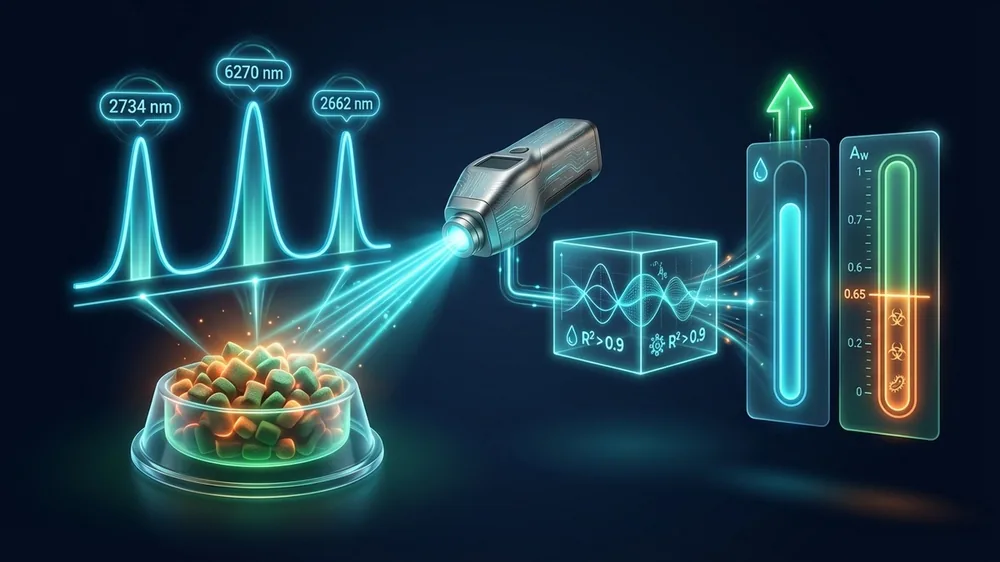
Moisture content and water activity are not interchangeable metrics. A kibble at 12% moisture content can have a water activity of 0.60 — shelf stable and mold-resistant — or a water activity of 0.75, which is a genuine mold risk. The difference comes down entirely to ingredient composition. NIR predicts moisture content reliably. It does not predict water activity.
Think of it this way: near-infrared analysis counts all the water molecules in a sample, but it can't tell you which ones are free to cause microbial trouble and which ones are locked up by humectants. Those are different questions with different answers. A humectant-heavy formula ties up free water even at higher total moisture levels. Change your humectant system or swap a protein source, and your moisture-to-Aw relationship shifts — even though spectral readings look identical to before.
This distinction matters in product development, reformulation, and QC release decisions. NIR will still give accurate moisture readings after a reformulation. But those readings won't predict the same Aw they did before. For any product where microbial stability is a release criterion, a dedicated benchtop Aw meter must run alongside NIR — not instead of it.
Watch out: Substituting NIR moisture readings for water activity measurements in microbial stability decisions is a serious formulation risk. At the same moisture percentage, Aw can vary a lot depending on ingredient composition. After any reformulation, your previous moisture-to-Aw relationship no longer applies. Always run a dedicated Aw meter alongside NIR for shelf-stability and release decisions.
Define which metric actually controls your safety and quality decision before designing your NIR application. Moisture content for nutritional labeling? NIR handles that cleanly. Shelf-stability validation? Both instruments need to be in the workflow. Your auditors will ask — and "we assumed moisture correlated with Aw" isn't a defensible answer.
NIR at Grain Ethanol Plants: Feedstock Screening and Fermentation Control
Corn receiving stations at ethanol plants use NIR to screen incoming grain for moisture content, starch concentration, and contamination levels. Feedstock quality directly determines ethanol yield. The economics are straightforward: rejecting a truckload of low-starch corn before it enters the bin is far cheaper than diagnosing a weak fermentation run two days later. At scale, even a 1% improvement in feedstock screening consistency produces measurable gains in per-gallon production cost.
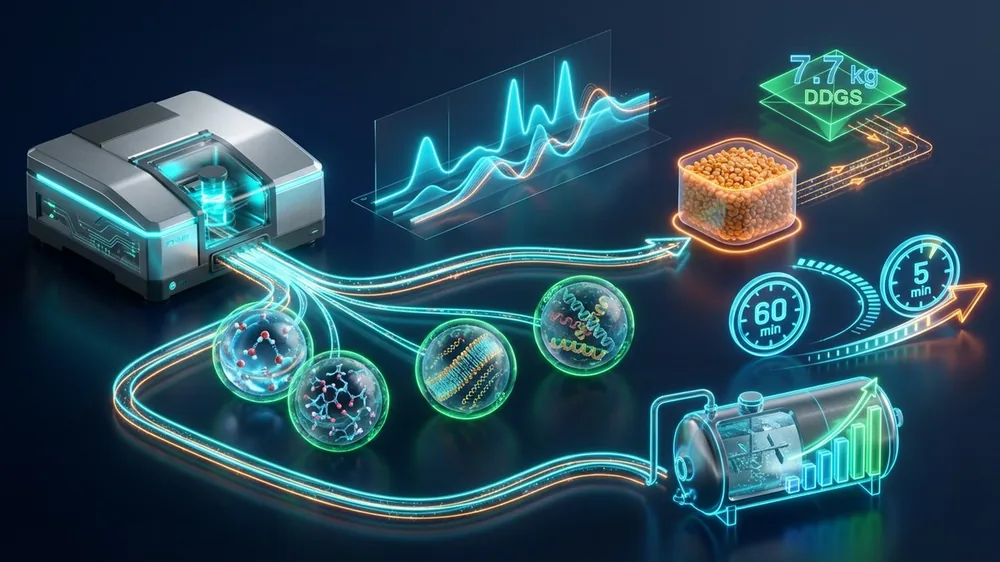
The speed advantage here is real. Cutting fermentation-relevant testing from 60 minutes to 5 minutes per load means a busy receiving station can screen far more trucks without backing up the pit. At plants running seasonal receiving campaigns, that throughput difference adds up fast. The receiving team gets a decision in the time it takes to pull and present a sample — not after the truck has already left the scale.
Beyond grain receiving, near-infrared analysis supports environmental monitoring applications including soil analysis for carbon content, organic matter, and nutrient levels — supporting precision agriculture decisions without the cost and turnaround time of running wet chemistry on every field sample. Wastewater treatment facilities have also put these instruments to work monitoring organic load and nutrient concentrations in real time, so operators can adjust treatment parameters before effluent quality degrades rather than after. These applications share the same core advantage of the technology: fast, non-destructive analysis that generates actionable data at a cost per measurement wet chemistry can't match.
For a detailed look at how NIR generates ROI at the grain intake point, see our article on NIR in grain receiving operations and real-time quality decisions at the intake scale.
NIR Spectroscopy in Flour Milling: Key Measurement Parameters
NIR in flour milling covers several parameters that directly affect milling yield and finished product quality. Moisture, protein content, ash content, and falling number are the most common targets. Each has its own calibration requirements, and each represents a different point in the milling process where NIR adds value.
Protein content is the most widely used NIR measurement in flour milling. Millers use it to blend wheat lots to hit a target protein spec for bread, cake, or pastry flour grades. A blend targeting 11.5% protein that runs at 11.2% represents lost product value in a high-volume operation. NIR gives the blending team a result in seconds rather than waiting 30–40 minutes for a Kjeldahl determination. At a mill running multiple blending decisions per shift, that time compression changes what's operationally possible.
Moisture measurement in flour controls both process efficiency and weight-based pricing. Flour at 14.5% moisture weighs more per unit volume than flour at 13.0% — and that matters in bulk sales. NIR moisture readings at the mill outlet give the process team real-time feedback without interrupting production flow. Ash content, which reflects mineral content and correlates with flour extraction rate and grade classification, is also predictable by NIR — though it needs a well-populated calibration that covers the range of wheat types and milling conditions at your specific facility.
The calibration requirements for flour milling are more demanding than for whole grain. Ground flour is a finer, more uniform matrix than whole wheat or corn, which is an advantage for optical consistency. But flour protein and moisture calibrations need to reflect seasonal wheat variation, variety differences between supplier lots, and any process changes that alter particle size distribution. A calibration built on spring wheat samples won't perform reliably on winter wheat without adjustment. Building and maintaining the right calibration is where most milling deployments either succeed or stall.
To understand the calibration practices that keep flour milling NIR results accurate over time, see our guide on NIR calibration model best practices for preventing drift and failed predictions.
NIR Implementation: What to Have in Place Before You Go Live
Deploying NIR takes more than purchasing an instrument and loading a calibration. When I work with clients planning a new deployment, these are the elements that determine whether results are trustworthy in production.
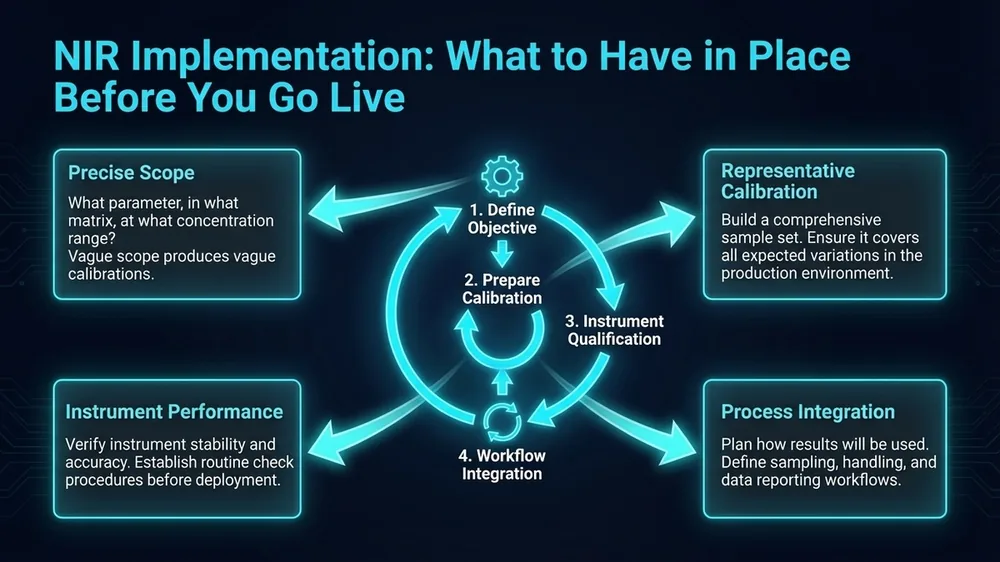
- Define the measurement objective precisely. What parameter, in what matrix, at what concentration range? Vague scope produces vague calibrations.
- Build a representative calibration sample set. Include seasonal variation, supplier variation, and process variation — not just clean standard samples from a single source.
- Validate against the appropriate reference method. For regulated applications, tie validation to the appropriate AOAC Official Method or ISO 12099 guideline for the specific parameter and matrix.
- Document sample presentation protocols. Temperature, particle size, packing density, and path length all affect results. Standardize everything operators touch.
- Establish a calibration maintenance schedule. Calibrations drift as ingredients and processes change. Plan for quarterly or semi-annual recalibration review at minimum.
- Distinguish what NIR measures from what it doesn't. Moisture content is not water activity. Spectral similarity is not particle size. Know your instrument's actual outputs.
- Train operators on interpretation, not just operation. An operator who understands why an outlier flag matters will act on it correctly. One who doesn't will dismiss it.
Here's the thing — during plant visits I've observed the same failure pattern repeatedly: a well-specified instrument, a solid calibration, and operators trained to press a button and read a number, but not to recognize when a result doesn't make sense. That gap is how a drifting model runs undetected for months. Operator understanding isn't a soft goal. It's what keeps your calibration honest in day-to-day production.
What Your NIR Investment Should Actually Deliver
Near-infrared spectroscopy is a capable technology. Its value scales directly with the understanding of the people deploying and operating it. A miscalibrated instrument, a poorly scoped application, or a team that doesn't know the difference between a screening method and a validated primary method can turn a capital investment into a source of bad data. Bad data is worse than no data — because at least with no data, you know you're guessing.
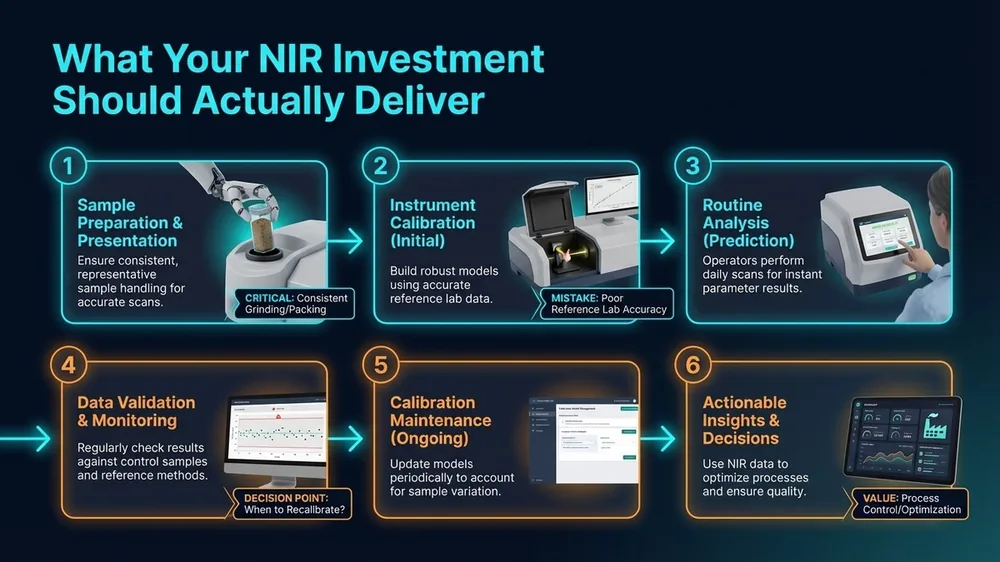
A miscalibrated instrument, a poorly scoped application, or a team that doesn't understand the difference between a screening method and a validated primary method can turn a significant capital investment into a source of bad data — which is worse than no data.
For QA managers evaluating NIR for a facility, lab analysts building or validating calibrations, or plant managers trying to understand what a new NIR system should actually deliver — structured training closes the gap between purchasing an instrument and trusting its results in production decisions. The technology doesn't fail on its own. The deployment does, when the people running it don't have the foundation to catch problems before those problems propagate into product decisions.
The practical takeaway across flour milling, pet food, and grain ethanol: each application has its own calibration requirements, its own reference method dependencies, and its own failure modes. NIR isn't a generic quality tool you can point at any matrix and trust without preparation. Know what it's measuring. Know what it isn't. Build your workflow around those boundaries — and that's when the ROI shows up.
Further Reading
Selected references drawn from the NIR Accuracy Course supplemental materials.
SpectroScience students get access to the NIR Quality Checklist — pre-scan checklist covering warm-up, reference scan, sample condition, and environmental factors. Available as a free download in the student resource library.
Access the PDF library- NIR-Online Process Analyzers (leading instrument manufacturer, accessed March 2026). Online/Inline NIR Process Control.This page outlines the features and benefits of online/inline NIR instruments for real-time process control, emphasizing continuous monitoring of key parameters like moisture, fat, and protein to maximize production efficiency and ensure product quality. https://www.buchi.com/en/products/instruments/nir-online-process-analyzer
- Benchtop NIR Analyzers (leading instrument manufacturer, accessed March 2026). Benchtop and At-line NIR Analyzers.This resource describes the versatility of benchtop and at-line NIR instruments for analyzing various sample types (grains, powders, liquids) in laboratory and industrial settings, highlighting their accuracy and ease of use for improving processing decisions. https://www.perkinelmer.com/category/benchtop-nir-analyzers
- (n.d.). ISO 12099:2010.Animal feeding stuffs, cereals and milled cereal products — Guidelines for the application of near infrared spectrometryhttps://www.iso.org/standard/51432.html
- (n.d.). NIR Instruments and Prediction Methods for Rapid Access to Grain Protein Content.Application of NIR Spectroscopy to the Analysis of Grainhttps://pmc.ncbi.nlm.nih.gov/articles/PMC9146900/
Free tool — NIR ROI Calculator: Plug your sample volume, current method cost, and analyte spec into the SpectroScience NIR ROI Calculator to see annual savings and payback period for your operation. Open the ROI Calculator →
NIR Fundamentals Course — Lesson 14: Food & Feed Industry
This lesson focuses on the applications of NIR spectroscopy specifically within the food and feed industry, detailing how it can be effectively implemented in quality control processes. It emphasizes the importance of aligning NIR measurements with the specific quality parameters required for products like flour and pet food, ensuring accurate data that supports operational decisions.
Explore Lesson 14 in the NIR Fundamentals courseWant to Master NIR Spectroscopy?
Our 32-lesson online course covers everything from Beer-Lambert Law to PLS calibration — built for food, grain, feed, and dairy professionals.