NIR Spectroscopy in Feed Mills, Meat and Dairy, and Baking Applications
Learn how NIR spectroscopy in feed mills, meat, dairy, and baking delivers real-time quality control that cuts costs and prevents off-spec production.
· 6 min read · Vitaly Kirkpatrick
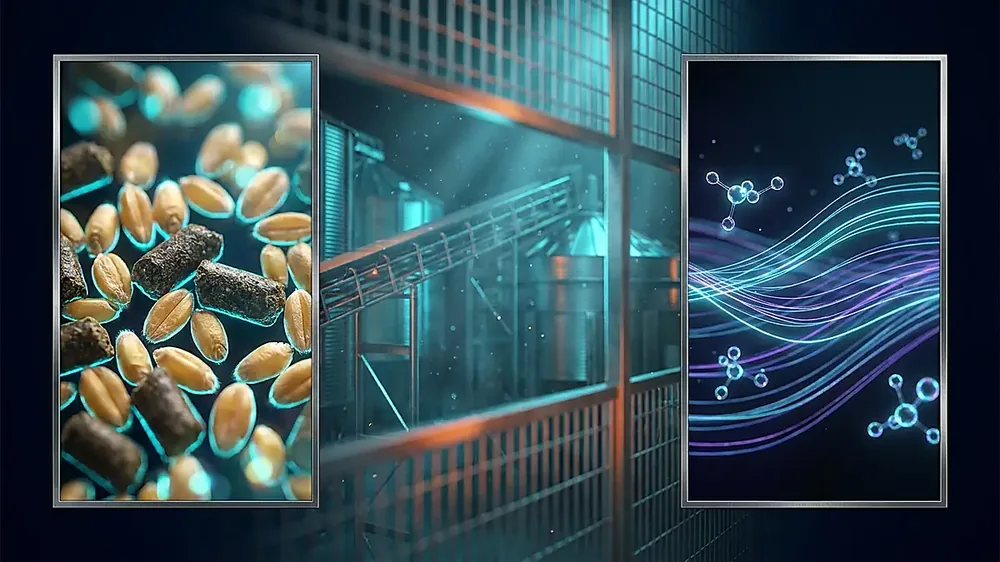
NIR Spectroscopy in Feed, Meat, Dairy, and Baking: Real-Time Quality Control
A single rejected truckload of finished poultry feed — returned because protein fell below label claim — can cost a mill $8,000 to $20,000 in direct losses. That's before you count the rework, the scheduling disruption, and the conversation with the customer. Here's the thing: in most cases I've seen, that outcome was entirely preventable. The ingredient variability was there at intake. Nobody measured it fast enough to act. NIR spectroscopy in feed and food production exists precisely to close that gap — giving your team real composition data in seconds, at the point where a decision can still be made. Feed mills, meat processors, dairy operations, and commercial bakeries all face the same core problem: traditional lab results arrive too late to prevent the mistake. NIR changes what's measurable, and when.
Why Waiting Hours for Lab Results No Longer Works
Traditional lab tests for protein, moisture, or fat take hours. Sometimes a full day. By the time results come back, the off-spec batch is already in the mixer — or worse, already shipped. That's not a hypothetical. It's the failure mode I hear about most often during plant visits, across every segment of food and feed manufacturing.
The cost of one missed correction often exceeds the annual investment in an at-line NIR instrument. A load arriving at 43% soybean meal protein, accepted and formulated as 46%, will produce under-spec finished feed. One NIR scan at intake — under 60 seconds — catches that before it reaches the mixer. The same logic applies to corn distillers dried grains (DDGS), where protein and fat variability between suppliers can exceed 6 percentage points.
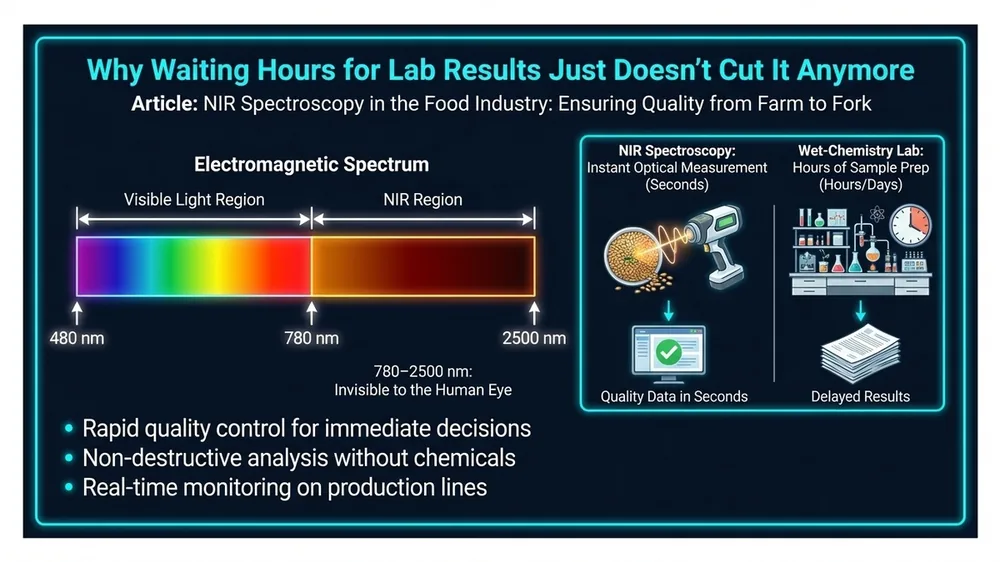
NIR delivers immediate measurements without destroying the sample, right on the production floor. Feed mills can adjust formulas on the fly. Meat processors can verify fat content as product moves down the line. Bakers can confirm flour quality before mixing begins. That speed prevents costly mistakes and keeps quality consistent across every shift, every day.
The underlying reason NIR works reliably across all these applications comes down to molecular physics: organic bonds in proteins, fats, water, and carbohydrates absorb near-infrared light at predictable wavelengths. Understanding why molecules vibrate and how NIR uses that to predict composition explains why a single scan returns protein, moisture, and fat simultaneously — no reagents, no sample destruction.
NIR spectroscopy turns quality control from a lagging indicator into a real-time production input — eliminating the hours-long wait for lab results that cause off-spec shipments, wasted materials, and costly downstream corrections.
NIR Spectroscopy in Feed Mills: Precision That Adds Up
Four Measurement Points Every Feed Mill Should Cover
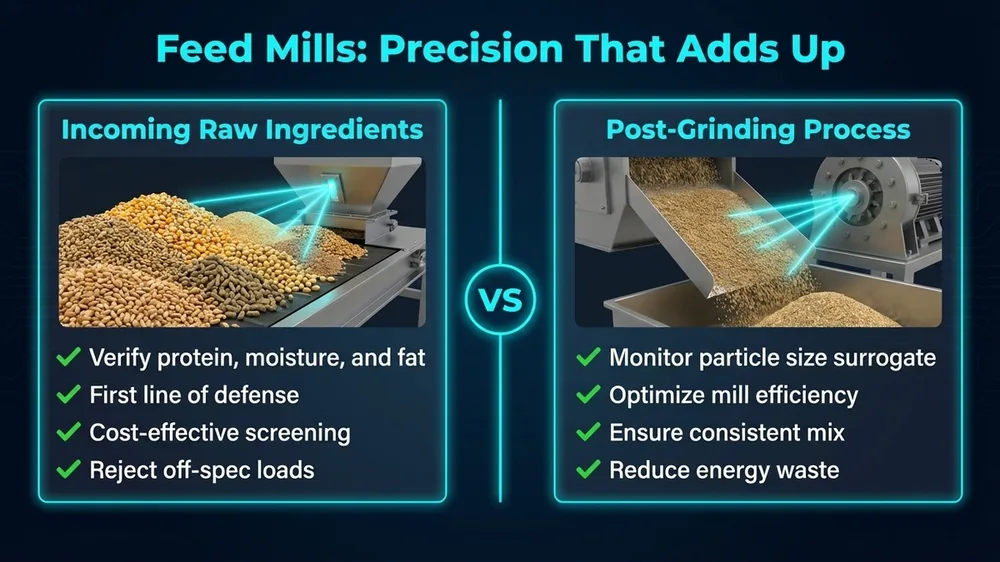
- Incoming raw ingredients: Verify protein, moisture, and fat before accepting the load. This is the first and most cost-effective line of defense against off-spec material.
- Post-grinding: Use spectral shape metrics as a surrogate for particle size consistency. Grinding variability affects pellet quality and digestibility downstream.
- Mixer output: Check blend uniformity. A mixer that looks fine mechanically can still produce inconsistent batches — NIR catches what eyes cannot.
- Finished pellets: Final verification of protein, fat, moisture, and starch before the product leaves the facility.
Each point catches a different class of problem. Skipping any one of them means operating with incomplete information. For mills running multiple species-specific formulas, consistent NIR coverage across all four points is the baseline — not the goal. Think of it like checking tire pressure, oil, coolant, and fuel before a long haul: skipping one doesn't mean you'll break down, but it's the one you skipped that usually causes the problem.
A poultry feed mill accepting soybean meal with a protein range of 44–48% loses real margin when NIR isn't in place at intake. One load correction, confirmed by NIR in under 60 seconds, avoids the entire downstream cascade. That same principle applies to DDGS, where supplier-to-supplier variability in protein and fat can swing wide enough to throw your formulation off on two fronts simultaneously.
For a detailed breakdown of how NIR handles the full range of feed ingredients — from corn and soybean meal to DDGS and canola meal — and why mills are moving away from wet chemistry for routine checks, see how NIR measures feed ingredients and why feed mills choose it over wet chemistry.
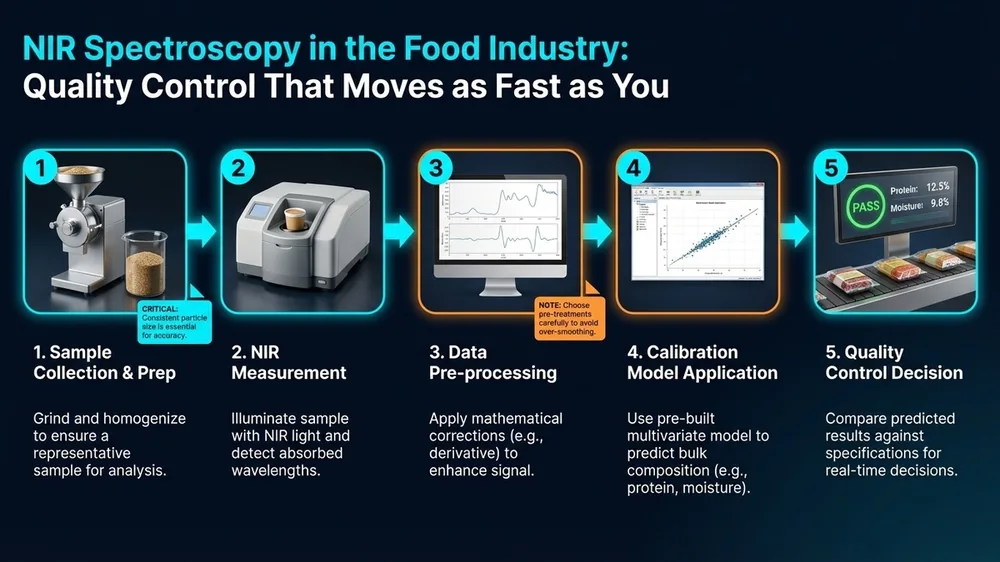
Meat and Dairy: Speed and Accuracy for Every Cut and Container
In meat processing, the fat-to-lean ratio isn't just a number. It's the difference between a profitable product and a loss. NIR testing quickly analyzes that ratio without slowing the line or damaging the product. That speed delivers consistent quality and verifiable composition — building documented trust with customers rather than relying on visual grading alone.
For ground beef operations, inline NIR on the conveyor monitors fat content continuously across the entire production run. A target of 80/20 lean-to-fat carries a premium over 73/27 — and mislabeling in either direction carries regulatory and financial consequences. Real-world deployments in beef trim operations have reduced fat content variation from ±2.5% to under ±0.8%. Multiply that across thousands of kilograms per shift and the yield improvement is direct and measurable.
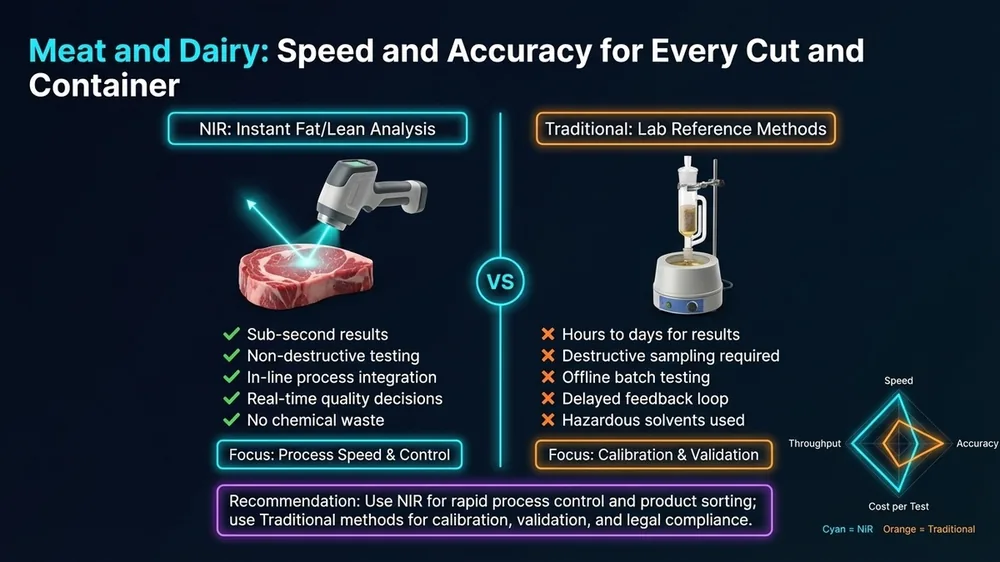
In dairy, fat, protein, and lactose levels directly affect taste, texture, and nutritional label claims. Traditional chemical tests are slow and generate chemical waste. NIR delivers those numbers in seconds, giving processors the window to adjust batches before small deviations become batch failures. Your auditors want documentation. NIR gives you that too — a time-stamped record of every measurement, not just the ones you happened to pull for wet chemistry.
For hard cheese production, fat-in-dry-matter targets are tight. Even a 0.5% deviation can affect grading and sale price. NIR monitoring at the vat stage gives cheesemakers the data they need before moisture is driven off and the product is committed. Inline NIR at the standardization step — where cream is added or removed from whole milk — is now common in large dairy operations precisely because the adjustment window is narrow and the cost of error is high.
For operations exploring how inline NIR integrates with dairy process control — including instrument placement, flow cell selection, and temperature compensation — the SpectroScience article on NIR in dairy processing and real-time inline monitoring covers the practical deployment decisions in detail.
Baking: Flour Quality Under the Microscope
Flour may look uniform coming off the mill, but it isn't. Protein variability within a single day's milling run can span 1.8%. Traditional sampling at shift change misses all of that intra-shift variation. A QC protocol that checks flour once per shift captures only one data point across potentially dozens of batches — and that one data point may not represent any of them accurately.
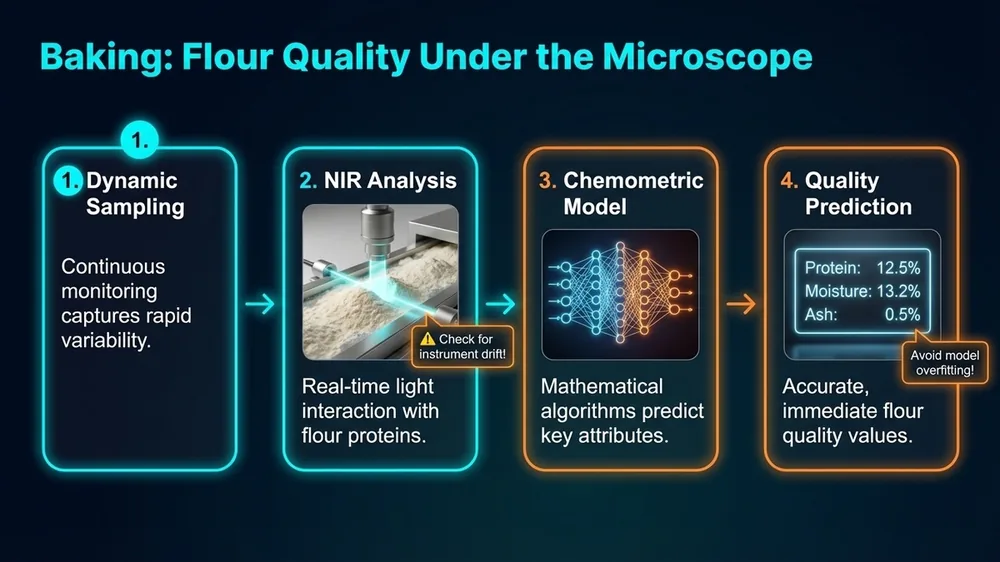
This matters practically. A 1% change in flour protein drives approximately a 1.5% change in water absorption. In a high-volume bakery, that relationship cascades directly into dough consistency, oven spring, crumb structure, and shelf life. When NIR is deployed on the conveyor at intake, your team can adjust hydration in real time — correcting for the actual flour present rather than troubleshooting failures after the mix is already running.
Ash content is a second variable worth tracking. High-ash flour — typically from harder milling or inclusion of more bran fractions — absorbs water differently and produces a denser crumb. NIR returns ash as a predicted parameter alongside protein and moisture in a single scan. That gives your bakery QC team a three-dimensional picture of incoming flour quality rather than a single number from a spec sheet that may not reflect what's actually in the delivery.
The mills supplying flour face the same variability on their end. Spec sheets shouldn't be assumed to reflect what's actually in the bag. Independent measurement at intake is the only reliable baseline. Some high-volume bakeries scan every delivery silo load individually and maintain a rolling database of supplier variability — information that feeds directly into supplier performance reviews and contract renegotiations. That's not overkill. That's what defensible procurement looks like.
Calibration: The Foundation That Determines What NIR Can and Cannot Do
Across feed, meat and dairy, and baking — the accuracy of any NIR measurement is only as good as the calibration behind it. A well-built calibration model that covers the real composition range of the materials being measured will return reliable predictions. A model built on limited reference data or an incomplete sample set will fail — not loudly, but quietly, in the form of gradual bias that takes weeks to detect. And that's expensive.
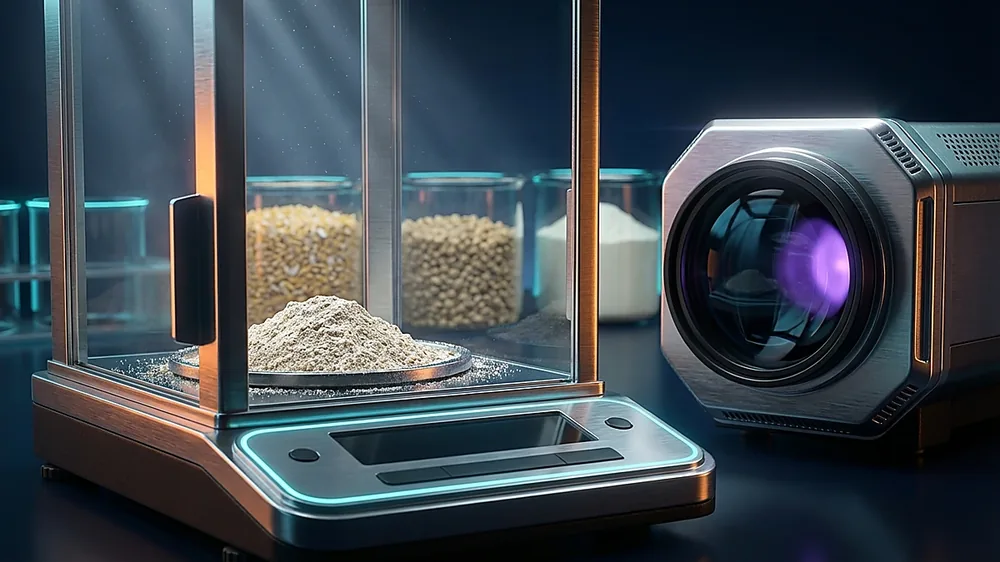
The most common calibration failure mode in food and feed operations isn't a software problem. It's a reference data problem: samples that don't represent the full variability seen in production, or reference method results that carry their own measurement error. Both feed directly into model error and inflate prediction uncertainty at exactly the moments when accuracy matters most — at ingredient intake, during a formula change, or when switching to a new supplier. Quality managers often ask me why their NIR starts drifting after a few months. More often than not, the answer traces back to the reference set, not the instrument.
Understanding when NIR is the right tool and when wet chemistry should remain the primary method is a practical decision every QA manager faces. The SpectroScience guide on when to use NIR instead of wet chemistry walks through the decision criteria — including sample type, required precision, throughput needs, and regulatory context — so the right method is matched to the right measurement point.
NIR calibration accuracy depends on the quality and range of the reference data used to build the model. In feed mills, meat processing, and baking, calibrations built on narrow or unrepresentative sample sets will underperform — and often fail silently until a significant QC event forces a review.
Choosing the Right NIR Instrument Format for Each Application
Not every application calls for the same instrument format. Feed mills checking incoming raw materials may use an at-line benchtop unit positioned at the intake pit — fast, operator-friendly, and capable of handling a wide variety of sample types across different ingredient categories. A meat processor running continuous trim on a conveyor needs an inline probe that can handle high moisture, variable particle size, and a demanding sanitation environment. A dairy operation standardizing fat in fluid milk needs a flow-cell configuration with temperature compensation built in. Your measurement environment shapes the instrument choice as much as the analyte does.
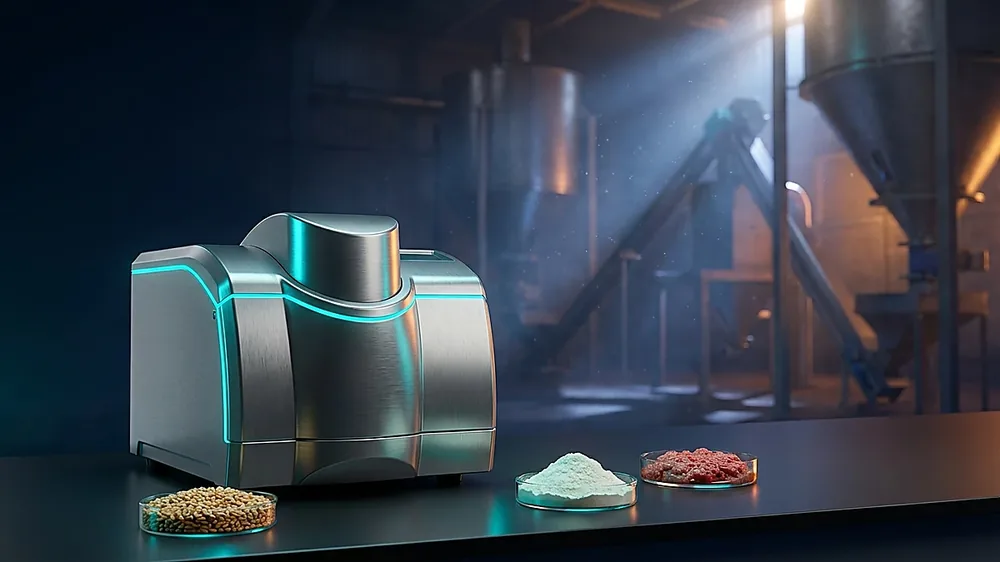
The instrument format you choose has direct consequences for calibration development, maintenance requirements, and the types of measurements that are practical to perform. Filter-based instruments are fast and rugged but locked to fixed wavelengths. FT-NIR systems offer full spectral coverage but require more careful environmental control. Dispersive grating systems sit between those extremes. Each has a place — the choice depends on what's being measured, where the instrument lives, and what your operation can realistically support in terms of maintenance and calibration upkeep.
In practice, the instrument-to-application match matters as much as the calibration itself. A well-matched instrument running a well-built calibration is what actually delivers the ROI that justifies the investment. Get one right and the other wrong, and you'll spend the next year chasing prediction errors that are really deployment errors. Both decisions compound — in your favor when they're right, and against you when they're not.
Free tool — NIR ROI Calculator: Plug your sample volume, current method cost, and analyte spec into the SpectroScience NIR ROI Calculator to see annual savings and payback period for your operation. Open the ROI Calculator →
SpectroScience students get access to the NIR Quality Checklist — pre-scan checklist covering warm-up, reference scan, sample condition, and environmental factors. Available as a free download in the student resource library.
Access the PDF libraryNIR Fundamentals Course — Lesson 14: Food & Feed Industry
This lesson explores the applications of NIR spectroscopy specifically in the food and feed industry, detailing how it enhances quality control processes. It emphasizes the importance of rapid analysis to prevent costly errors in production, aligning with the need for real-time data highlighted in the article.
Explore Lesson 14 in the NIR Fundamentals courseWant to Master NIR Spectroscopy?
Our 32-lesson online course covers everything from Beer-Lambert Law to PLS calibration — built for food, grain, feed, and dairy professionals.