NIR Spectroscopy in Agriculture: Grain Receiving, Feed Mill Measurement, and AOAC Compliance
NIR spectroscopy in agriculture explained: grain receiving accuracy, feed mill measurement points, and AOAC-approved methods for compliance. Practical guide.
· 7 min read · Vitaly Kirkpatrick
A grain elevator purchasing 100,000 tons per year and running moisture measurements that are off by just 0.5% is quietly losing around $150,000 annually. Not from equipment failure. Not from negligence. From a measurement gap that NIR closes in under 60 seconds per load. That's the conversation I end up having with feed mill managers and elevator operators more often than any other — and it's usually the number that ends the debate about whether NIR is worth it.
What I've seen across grain, feed, and oilseed operations is a consistent pattern: facilities that connect NIR results directly to intake decisions outperform those that scan loads and file the results. This article covers where NIR adds real value in agricultural settings, what the regulatory picture actually looks like for your operation, and how to tie measurements to decisions that move money. For a broader view of how NIR fits across grain, feed, and food operations, see NIR Spectroscopy: Where It Fits in Grain, Feed, and Food Operations.
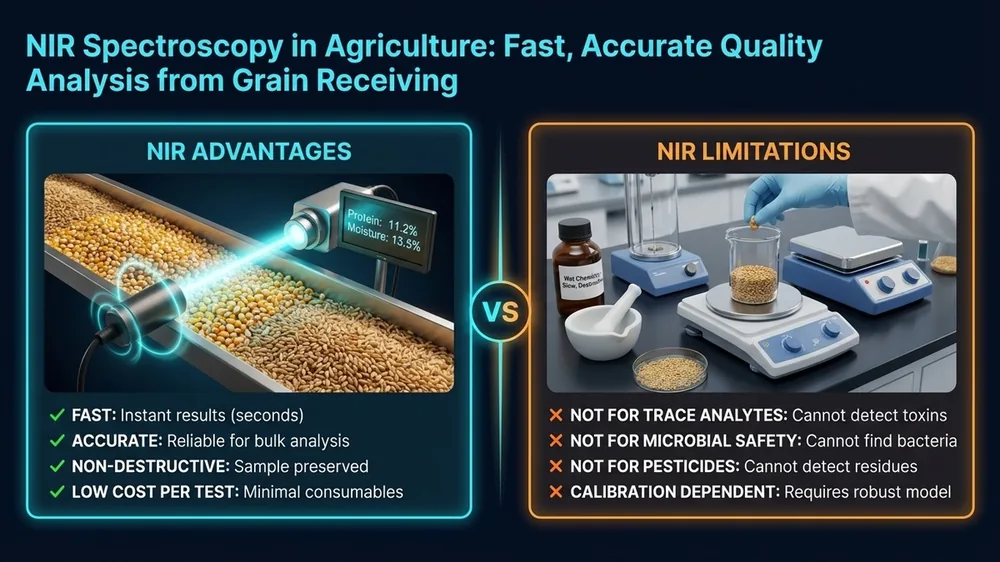
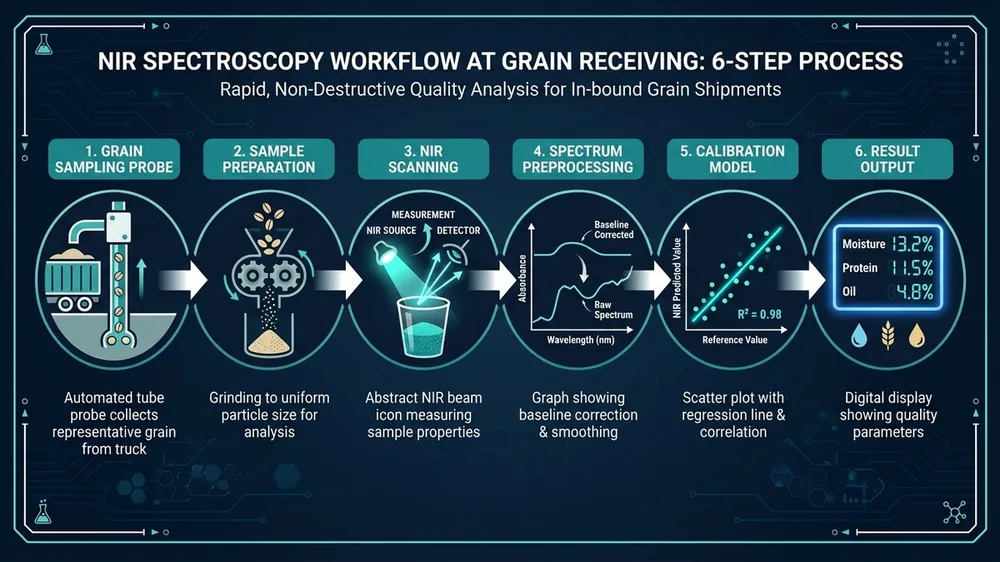
How NIR Spectroscopy Works at Grain Receiving
Feed mill managers often ask me how to justify NIR investment to ownership. One number tends to settle the conversation quickly.
A facility receiving grain at a stated 13% moisture when the actual moisture is 12.5% is overpaying on every load. At 100,000 tons per year, that 0.5% gap costs approximately $150,000 annually. That's not a rounding error. That's a budget line. NIR closes that gap by delivering repeatable, defensible measurements on every incoming load — not spot checks on a fraction of trucks.
The speed difference compounds the financial case. Wet chemistry reference methods for moisture and protein run 45 minutes or more per sample. NIR delivers the same result in under 60 seconds. At a busy receiving dock, that gap determines whether trucks back up for hours or move on schedule. Your receiving throughput is only as fast as your measurement. For a detailed look at how grain receiving operations deploy NIR at scale, see NIR in Grain Receiving Operations: Real-Time Quality at the Scale.
The Financial Case for NIR at the Receiving Dock
Beyond moisture, protein variability creates a parallel exposure. Corn purchased on a protein premium or soybean meal evaluated against a minimum crude protein spec — both require a measurement that's fast and defensible. When loads arrive faster than your wet chemistry lab can process them, quality managers face an ugly choice: hold trucks and create a bottleneck, or accept loads on visual inspection. Neither works well.
NIR at the receiving dock removes that constraint. A scan takes under a minute, the result logs automatically, and the decision to accept, reject, or reprice happens before the truck moves. Think of it like a fast lane at a weigh station — every vehicle gets checked, nothing slips through, and the line keeps moving. Over a full crop year, this means fewer overpayments, fewer contamination events from off-spec material entering the system, and a documented audit trail for every incoming load. For a structured approach to building that business case, the SpectroScience resource on How to Calculate NIR Spectroscopy ROI walks through the key variables with real grain operation benchmarks.
NIR Applications Beyond the Elevator: Soil, Seed, and In-Field Analysis
NIR's reach in agriculture extends well past the receiving dock. Portable NIR devices now let agronomists and growers run on-site analysis on soil samples — results that previously took days or weeks from a commercial lab.
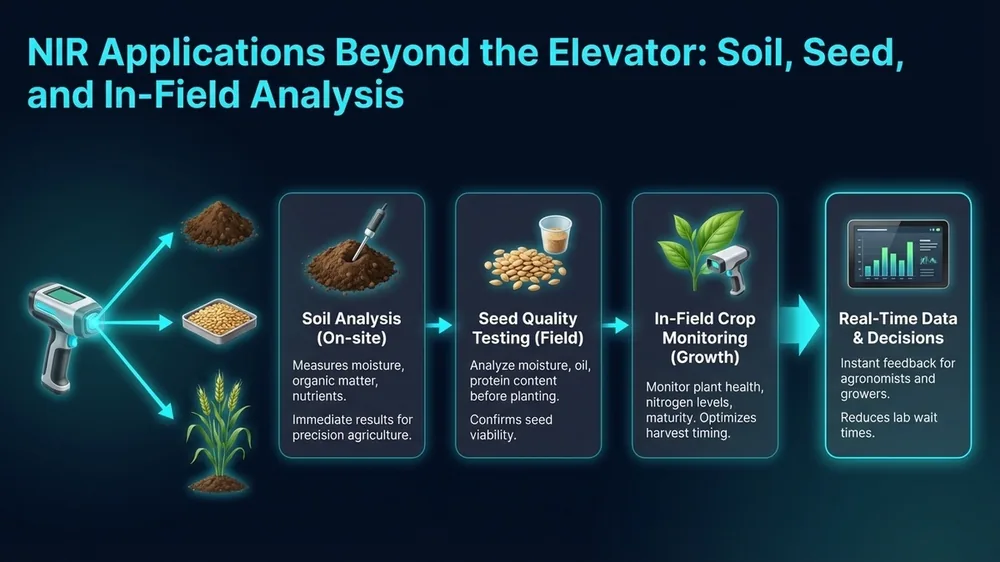
Portable NIR measures soil organic matter, nitrogen, and phosphorus directly in the field. Fertilizer applications get based on actual readings — not estimates. Input costs drop. Unnecessary runoff is reduced. It's the same underlying technology grain handlers have relied on for decades, just applied earlier in the supply chain.
Seed quality is another area where NIR pays off clearly. Before planting, growers need protein content and viability data without destroying the seed. NIR handles this non-destructively. That matters when you're evaluating expensive or limited seed stock — you can't afford to sacrifice samples just to characterize them.
Combine-mounted NIR sensors take it further. These sensors analyze grain quality in real time as the machine harvests, mapping moisture and protein variability across the field. That data feeds directly into planting and fertility decisions for the following season. Every harvest pass becomes a structured data collection event, not just a production run.
Field tip: When evaluating portable NIR for in-field soil analysis, validate it against the specific soil types in your operation before relying on results for application decisions. Soil matrix variability is real. A calibration built on samples from a different region may not hold up on local ground — and wrong fertilizer decisions made at scale are expensive to undo.
NIR Measurement Points in a Feed Mill
A feed mill has multiple locations where NIR can catch quality problems before they compound. Each point serves a different purpose. Each requires its own validated calibration.
- 1Incoming raw ingredients — Verify protein, moisture, and fat before accepting a delivery. Out-of-spec material gets rejected or repriced before it enters the process.
- 2Post-grinding — Particle size consistency affects digestibility and pellet quality. NIR tracks spectral shape metrics that correlate with grind uniformity. This cuts the need for hourly sieve analysis.
- 3Mixer output — Blend uniformity check. If micro-ingredients aren't distributed evenly, nutritional and regulatory problems follow regardless of the formula.
- 4Finished pellets — Final verification of protein, fat, moisture, and starch before product ships. This is the last line of defense before your guaranteed analysis label becomes a liability.
Each measurement point has different sample presentation requirements and different calibration needs. A calibration developed for raw soybean meal won't transfer cleanly to finished pellets. Building and validating each calibration against its actual use case isn't optional — it's the foundation your data quality sits on.
For a practical breakdown of how NIR measures feed ingredients and why feed mills consistently choose it over wet chemistry, see How NIR Measures Feed Ingredients and Why Feed Mills Choose It Over Wet Chemistry.
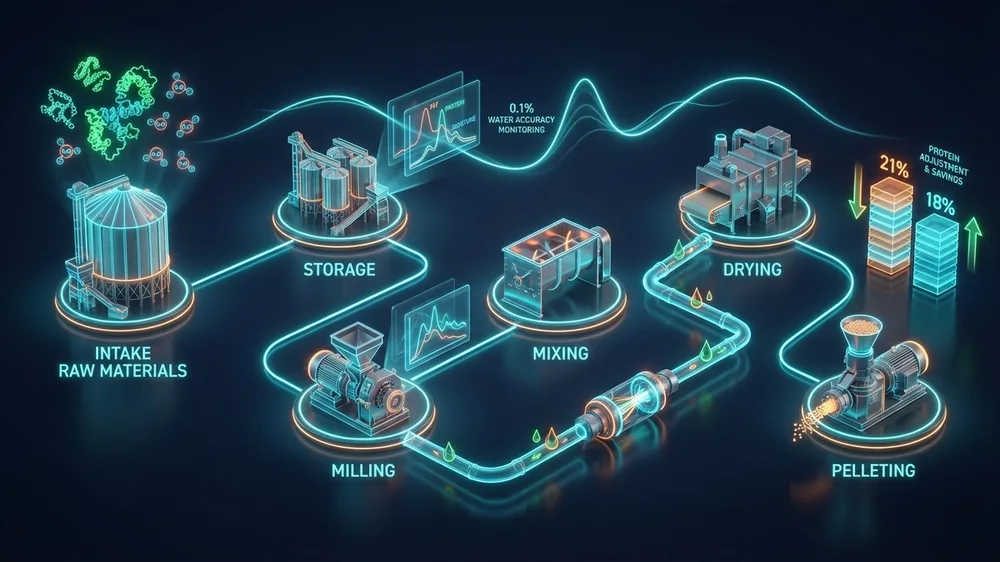
In a 50,000-ton-per-year feed mill, over-formulating protein by just 0.3% costs approximately $180,000 per year in unnecessary ingredient spend. An NIR instrument with calibration and maintenance amortized over its service life runs around $45,000 per year. Payback period: roughly three months — but only when actions are taken based on the data.
Calibration Strategy for Feed Mill NIR Deployments
The measurement points above share one common requirement: each calibration must reflect the actual sample matrix being measured. This is where feed mill NIR deployments most frequently break down. An operation may buy a quality instrument, install it correctly, and then run a global calibration developed on different ingredient sources or processing conditions. The result is step-by-step bias that often doesn't surface until an audit or a production problem forces a comparison against wet chemistry. By then, the damage is already done.
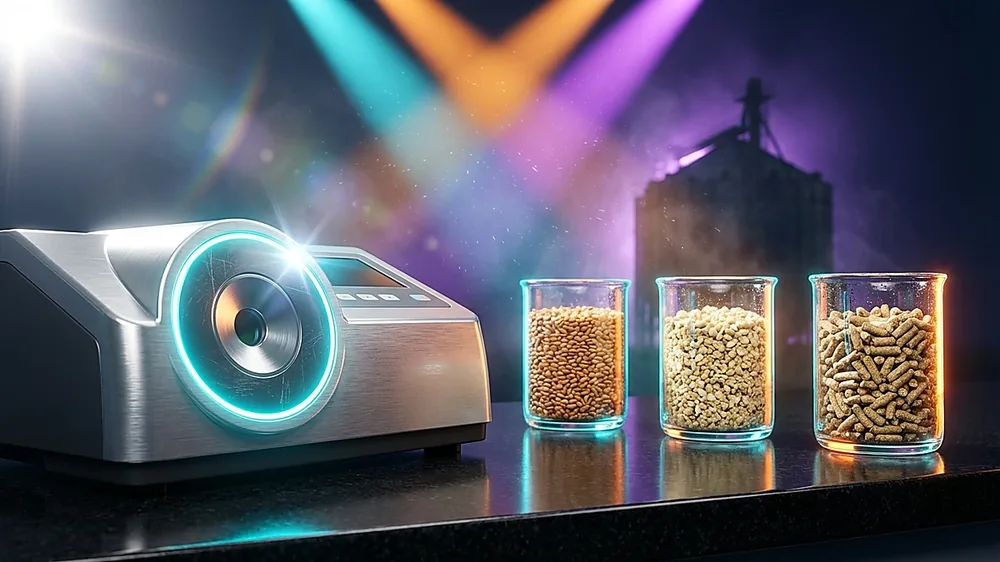
A defensible feed mill calibration program starts with representative sampling. Samples collected for calibration development need to span the full range of ingredient variation your operation actually encounters — different suppliers, different crop years, different moisture conditions. The reference data used to build the calibration must come from a validated wet chemistry method run under controlled conditions. Shortcuts here create problems that compound over time, and they're never cheaper to fix later than they would have been to prevent upfront.
Validation is separate from calibration development. Once a calibration is built, test it against a holdout sample set that wasn't used in model development. The statistical metrics that matter are RMSECV, SEP, and bias. If any of these fall outside acceptable limits, the calibration needs revision before it drives production decisions. This isn't bureaucratic overhead — it's the difference between NIR data that's actionable and NIR data that creates liability.
What AOAC-Approved NIR Methods Actually Mean for Your Operation
Quality managers often ask me whether NIR can serve as a primary method or only as a screening tool. The answer depends entirely on how the instrument is validated and which methods are referenced.
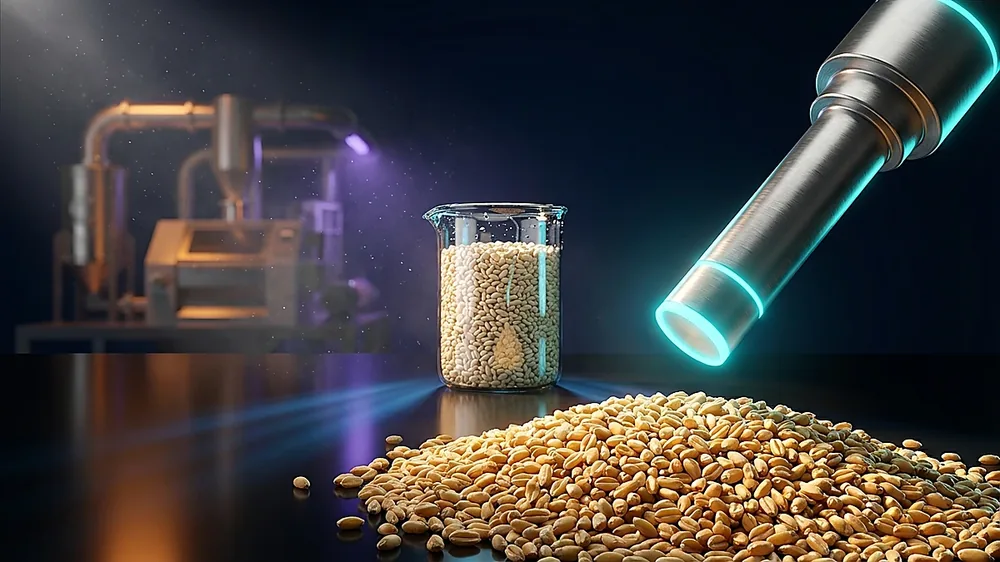
Several international standards apply directly to grain and feed NIR operations:
| Standard | Parameter | Status |
|---|---|---|
| ISO 12099 | NIR guidelines (cereals, milled products, animal feed) | International framework for NIR validation, calibration transfer, and ongoing performance monitoring |
| AOAC 989.03 | Fiber (ADF/NDF) in Forages by NIR | Established AOAC Official Method for forage NIR |
| AOAC International — Official Methods | Protein, moisture, oil by NIR (multiple methods) | NIR is recognized as a primary or alternative method when properly validated against the corresponding wet-chemistry reference |
"Properly validated" is doing a lot of work in that sentence. AOAC approval means the NIR methodology is acceptable as a primary method — not just a screening tool. But that only applies when your specific instrument, your specific sample matrix, and your specific calibration have been validated according to the AOAC standard. The approval doesn't transfer automatically from the method to your bench.
Validation isn't a one-time event. It requires a documented sample set, a traceable reference method, and clear statistical performance metrics. Minimum documentation should include RMSECV, bias, and SEP. Your auditors will ask for these. Have them ready.
Watch out: Many operations buy a calibration package off the shelf, run it on their materials without proper validation, and then find NIR results don't hold up under audit. Off-the-shelf calibrations are a starting point — not a finished product. Validation against your specific materials is required before relying on them for compliance decisions.
In regulated environments — grain trading with contractual specs, commercial feed with guaranteed analysis labels, or export grain with phytosanitary requirements — your validation documentation must be in order before NIR numbers drive compliance decisions. For a full look at how NIR fits within feed mill regulatory approach, the SpectroScience article on NIR Spectroscopy in Dairy, Feed Mills, and Regulatory Compliance covers the documentation requirements in detail.
Connecting NIR Data to Operational Decisions
The financial and compliance cases for NIR are only realized when measurement data connects to decisions in real time. This sounds obvious. But many operations fall into a pattern where NIR results are recorded and filed rather than acted on. A moisture reading at grain intake should trigger an immediate pricing adjustment if the load is outside spec. A protein result at mixer output should halt production if the blend is below guaranteed analysis minimums. A finished pellet scan should stop a shipment if fat is out of range — before the truck leaves the dock. Not after.
Building these decision triggers into your standard operating procedures is as important as the instrument installation itself. NIR is a measurement tool. The value it creates depends entirely on what your operation does with the number it produces. Facilities that treat NIR as passive record-keeping consistently underperform those that embed NIR results into go/no-go logic at each measurement point. The instrument doesn't save money. The decisions made with its output do.
One failure mode I see regularly during plant visits: a well-configured NIR system generating accurate data that nobody acts on because the SOP still says "confirm by wet chemistry before any hold decision." If your workflow routes NIR output to a filing folder instead of a decision gate, you've paid for a stopwatch and are using it as a paperweight. Wire the scan result to a specific action — or the ROI stays theoretical.
Operations early in NIR deployment often benefit from a structured review of where NIR fits relative to wet chemistry in their specific workflow. The SpectroScience guide on When Should You Use NIR Instead of Wet Chemistry? A Practical Decision Guide provides a practical approach for making those placement decisions across different measurement contexts.
Free tool — NIR ROI Calculator: Plug your sample volume, current method cost, and analyte spec into the SpectroScience NIR ROI Calculator to see annual savings and payback period for your operation. Open the ROI Calculator →
Free tool — Calibration Metrics Calculator: Enter your reference values and NIR predictions in the Calibration Metrics Calculator to compute RMSEP, RPD, R², and bias the way our course teaches it — with interpretation thresholds for grain, dairy, and feed. Open the Metrics Calculator →
SpectroScience students get access to the NIR Quality Checklist — pre-scan checklist covering warm-up, reference scan, sample condition, and environmental factors. Available as a free download in the student resource library.
Access the PDF libraryNIR Fundamentals Course — Lesson 13: NIR in Agriculture
This lesson focuses on the applications of NIR spectroscopy specifically in agriculture, detailing how it enhances grain and feed quality assessment. It also covers the practical implications of integrating NIR data into operational decision-making, which is essential for maximizing profitability in grain receiving and feed mill processes.
Explore Lesson 13 in the NIR Fundamentals courseWant to Master NIR Spectroscopy?
Our 32-lesson online course covers everything from Beer-Lambert Law to PLS calibration — built for food, grain, feed, and dairy professionals.