NIR Spectroscopy: How It Works, Instrument Components, and Wet Chemistry Comparison
NIR spectroscopy explained for food and feed professionals — how it works, key instrument components, and how it compares to wet chemistry in grain and feed…
· 6 min read · Vitaly Kirkpatrick
What NIR Spectroscopy Does for Food and Feed Quality Control
A grain elevator processing 80 trucks a day can't wait 45 minutes for a Kjeldahl result before deciding whether to accept a load. That's the reality that pushes quality managers toward NIR — not a brochure, not a trade show demo. NIR spectroscopy delivers analytical results in seconds without touching the sample, and for high-volume receiving operations, that speed changes everything at the dock. One operator can screen dozens of incoming loads per shift while the wet chemistry lab is still running its first set of samples.
What Is NIR Spectroscopy?
Near-Infrared (NIR) spectroscopy uses light in the 780–2500 nm wavelength range to analyze a sample's chemical composition. When NIR light hits a sample, specific wavelengths get absorbed by molecular bonds — primarily C-H, O-H, and N-H. That absorption pattern creates a spectral fingerprint tied directly to the sample's chemistry. Think of it the way a barcode scanner reads product information: the pattern of absorption across hundreds of wavelengths carries more information than any single measurement point.
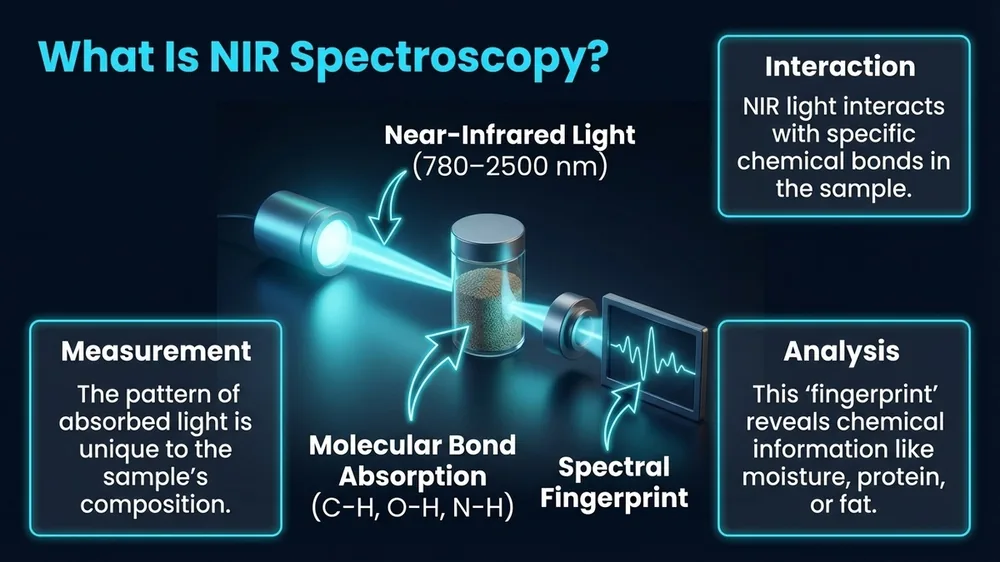
Those absorption bands are broad rather than sharp. That makes NIR well-suited for bulk quantitative analysis — it reads the full sample matrix at once rather than isolating one compound at a time. And because the method is non-destructive, every truckload of incoming grain or every batch of feed ingredient can be tested without losing product. Your sample comes back out the same way it went in.
For a broader look at how different NIR platforms handle these measurements, see the SpectroScience overview of different types of NIR instruments used in food and feed analysis.
How NIR Spectroscopy Measures What's in Your Sample
When NIR light enters a sample, some gets absorbed and some reflects back. The absorbed energy excites molecular bonds into higher vibrational states — these are called overtone and combination bands. Think of it like harmonics on a guitar string: the basic vibration happens in the mid-infrared range, and NIR captures the overtones. Your instrument is reading the echoes of those molecular vibrations across hundreds of wavelengths simultaneously.
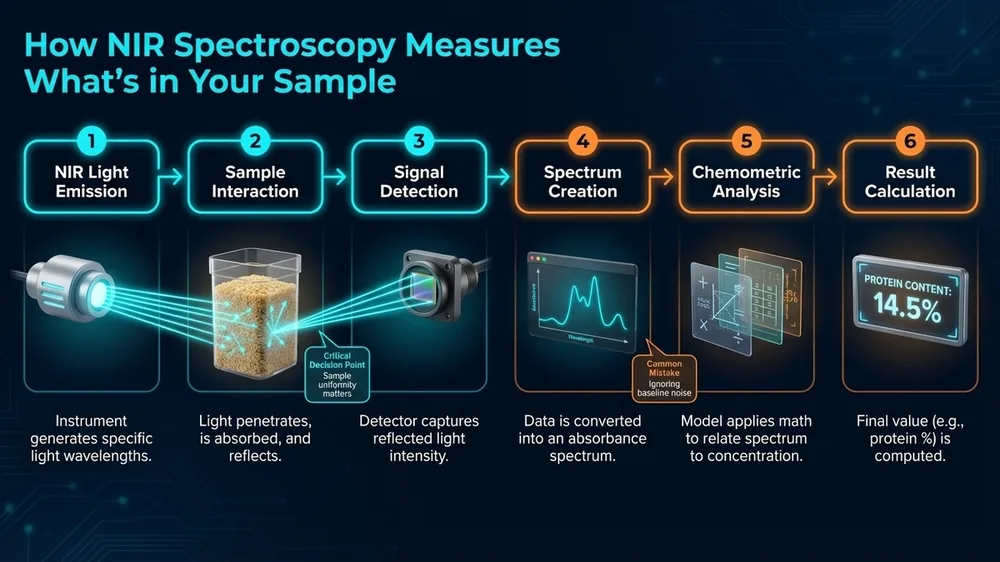
A spectrometer measures how much light is absorbed at each wavelength across the full NIR range. That produces a spectrum — a detailed curve across hundreds of data points. The spectrum alone doesn't tell you moisture or protein directly. That's where chemometrics comes in: multivariate statistical models translate spectral patterns into the numbers your quality team uses every day.
To understand the molecular mechanics behind this process — why C-H and O-H bonds respond at specific NIR wavelengths — the SpectroScience article on why molecules vibrate and how NIR uses that to predict composition provides a detailed explanation suited for both new operators and experienced lab managers.
Note: The raw NIR spectrum is not readable the way a wet chemistry result is. A validated calibration model — built from reference samples — is required before the instrument delivers usable numbers. The spectrum is the raw data; the calibration model is what turns it into a result.
Understanding how calibration models are built and maintained is one of the most practical skills for any NIR operator. The SpectroScience article on NIR calibration — why it is needed and how it works covers the core steps, including how reference sample selection affects model accuracy from the start.
The Role of Chemometrics in Converting Spectra to Results
The calibration step is where NIR earns its practical value — and where most implementation failures originate. A chemometric model is trained on a set of samples with known reference values determined by wet chemistry. The model learns which spectral patterns correspond to which concentration levels. Once trained and validated, it applies those learned relationships to new samples in real time.
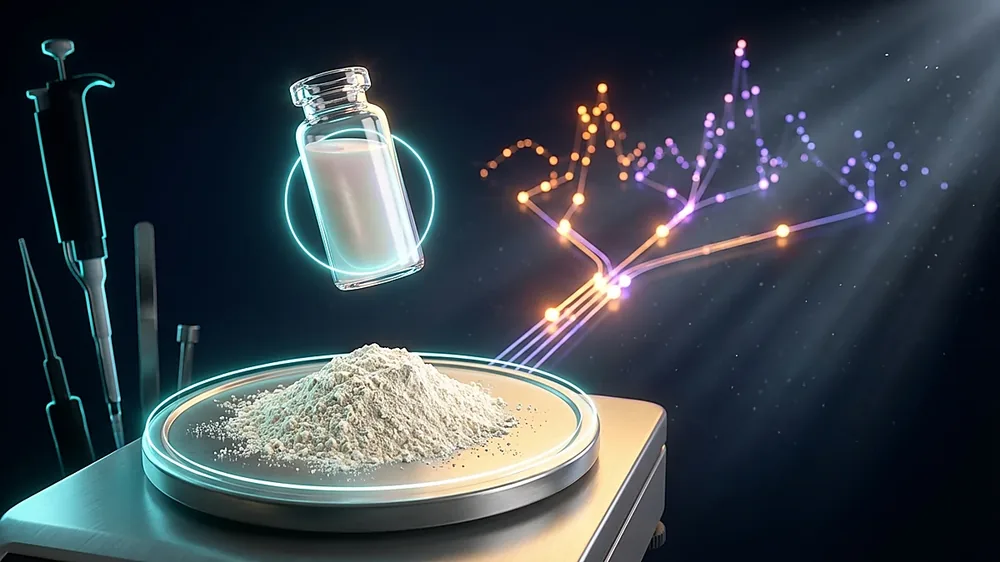
Partial Least Squares (PLS) regression is the most widely used approach in food and feed NIR applications. A well-built PLS model for wheat protein, for example, will typically achieve an RMSEP of 0.15–0.25% protein — close enough to support purchasing and blending decisions that would otherwise require laboratory turnaround times measured in hours. Artificial neural networks (ANN) and other nonlinear approaches come into play when sample sets are complex and PLS alone can't account for the variance. For a side-by-side look at these methods, the SpectroScience article on NIR calibration in practice covering PLS, ANN, outliers, and deployment provides direct comparisons with guidance on when each approach is appropriate.
One thing that catches new NIR users off guard is the scope limitation of a calibration model. A model built on samples ranging from 10% to 16% protein can't reliably predict a sample at 8% or 19%. The model has no training data in that range — it's working blind. This is why expanding calibration coverage when new suppliers or commodities come in is standard practice, not an optional refinement. Your calibration is only as good as the samples that built it.
NIR Spectrometer Components: What You're Working With
Understanding the hardware helps when troubleshooting. An NIR spectrometer has four main parts: a light source (usually a halogen lamp), a sample presentation module, a wavelength selection device, and a detector.
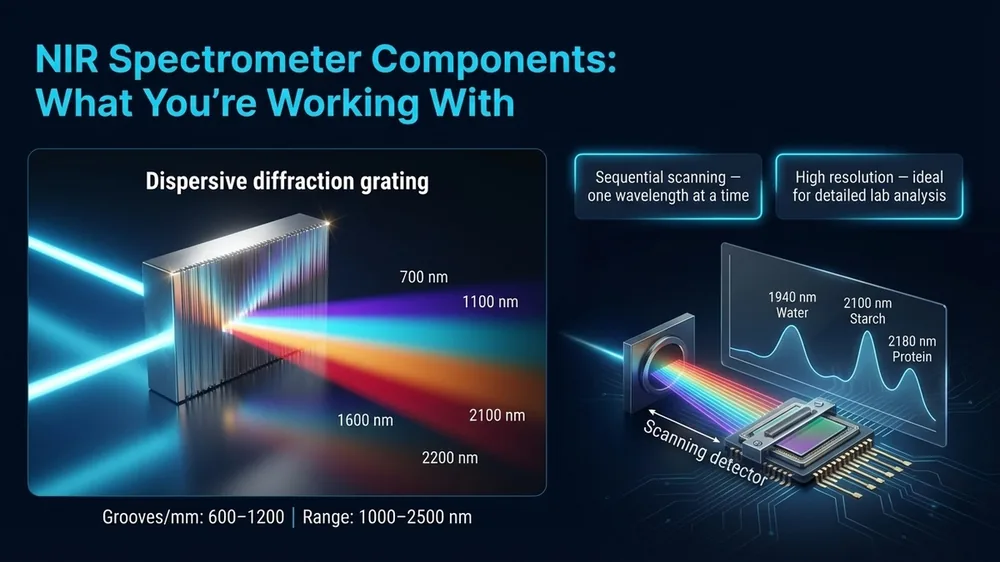
The wavelength selection device is where instruments differ most. Some use a monochromator, others use an interferometer or acousto-optic tunable filter. Each has trade-offs in speed, resolution, and durability. The detector — typically InGaAs (Indium Gallium Arsenide) — converts reflected or transmitted light into a signal the software can process.
In food and feed applications, benchtop instruments typically sit in receiving labs. At-line units are placed on processing floors. Online analyzers mount directly on conveyor belts or grain spouts. The right configuration depends on the sample type — liquid, powder, or intact whole grain. Grain elevators commonly use at-line benchtop instruments capable of handling 50 or more truck samples per day, while feed mills running continuous production benefit from inline probes that return real-time moisture readings without stopping the process.
Light Sources, Wavelength Selection, and Detector Technologies
Halogen tungsten lamps are the standard NIR light source in most benchtop and at-line instruments. They produce a broad, continuous output across the 780–2500 nm range, making them suitable for full-spectrum analysis. Lamp stability and warm-up time directly affect baseline reproducibility — an instrument that hasn't completed its warm-up cycle will produce spectra that drift over the first 15–30 minutes of operation. That's why warm-up protocols aren't optional steps, and operators who treat them as optional often spend hours chasing what looks like a calibration problem.
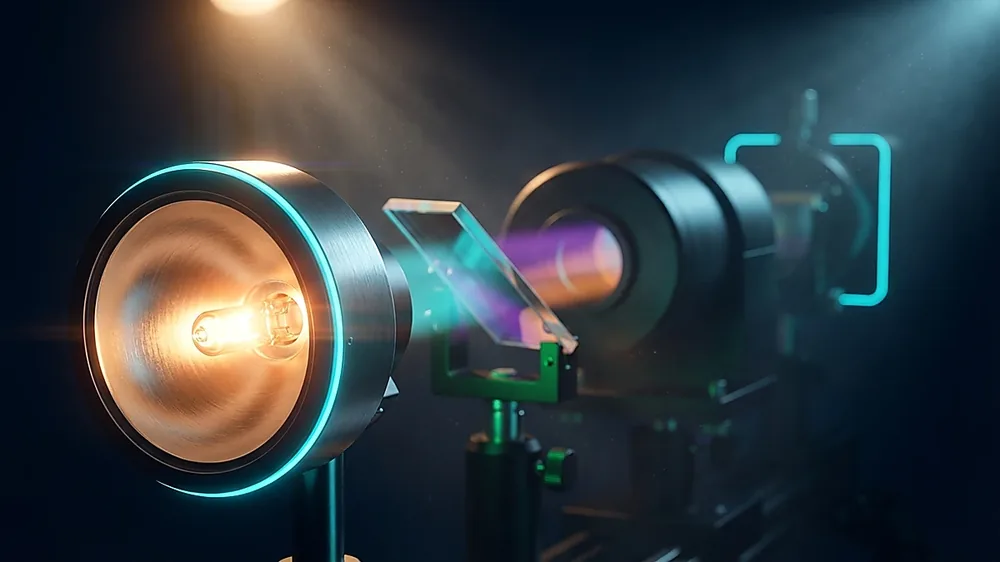
Wavelength selection technologies divide into three main categories in commercial NIR instruments. Dispersive instruments use a diffraction grating to separate wavelengths spatially, directing different wavelengths onto different detector elements. Fourier Transform NIR (FT-NIR) instruments use a Michelson interferometer and apply a mathematical transformation to recover spectral data — delivering higher wavelength accuracy and better signal-to-noise ratios at the cost of greater mechanical complexity. Filter-based instruments use a small set of fixed optical filters and are built for speed and ruggedness in process environments where full-spectrum flexibility isn't needed. The SpectroScience article on NIR technology types — FT-NIR, dispersive, and filter-based compared walks through the practical trade-offs for each platform across grain, feed, and food processing environments.
InGaAs array detectors have largely replaced older lead sulfide (PbS) detectors in modern instruments due to their faster response times and better sensitivity in the short-wave NIR region (900–1700 nm). Extended InGaAs detectors push coverage toward 2200 nm, which matters for starch and fiber measurements that rely on combination bands at longer wavelengths. Temperature stability of the detector housing affects signal quality — many process-grade instruments include thermoelectric cooling for the detector to maintain consistent sensitivity across shifts.
How Physical Sample Conditions Affect NIR Results
Hardware performance is only one variable. Sample presentation — how the material is introduced to the instrument — has an equally direct effect on measurement quality. Particle size inconsistencies in ground grain or flour cause scattering differences that shift absorbance values even when the underlying chemistry hasn't changed. When I work with clients troubleshooting unexplained prediction drift, temperature variation is one of the first things we check: a sample that's 10°C colder than the instrument's ambient environment can produce O-H band shifts that your calibration model was never built to handle.
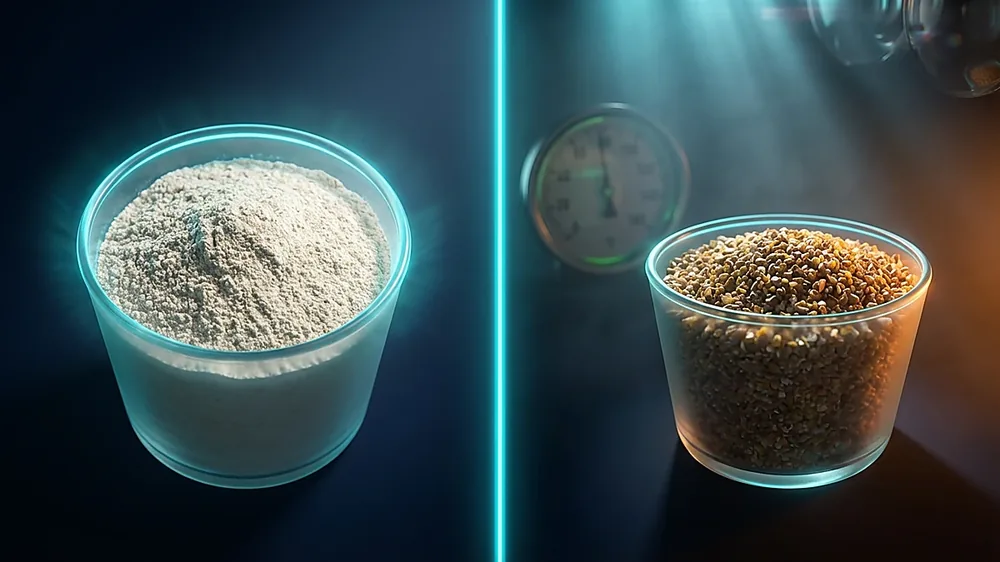
Practical controls that reduce this variability include consistent grinding protocols, allowing samples to equilibrate to room temperature before scanning, and maintaining a stable instrument environment. These aren't optional refinements — they're baseline requirements for your calibration model to perform at its published accuracy. Operators who skip equilibration steps routinely report drift that gets blamed on the model when temperature is the actual cause. The SpectroScience article on NIR sample presentation and environmental control for consistent spectra walks through the specific conditions that need to be managed across grain, powder, and liquid sample formats.
Where NIR Spectroscopy Fits in the Grain and Feed Supply Chain
NIR instruments are deployed at several points across grain and feed operations, and each deployment context puts different demands on the instrument and the calibration. At grain receiving, the primary measurements are moisture, protein, and test weight. Speed is the dominant constraint — a receiving operation processing 80 trucks per day needs results in under two minutes per sample to avoid a bottleneck at the scale. Benchtop reflectance instruments loaded with whole grain or ground subsamples are the most common solution at this stage.

Inside feed mills, NIR verifies incoming raw material composition before batching and checks finished feed pellets for nutrient content before release. A corn/soy diet formulated to 18% crude protein needs incoming ingredients that match the formulation assumptions — a soybean meal lot running 1.5 percentage points below specification pushes the final diet out of spec unless you catch it at intake. At-line instruments positioned near ingredient intake or the mixer return results fast enough to redirect a suspect lot before it enters the batch.
Oilseed processors add oil content to the measurement list, and the relationship between oil, protein, and moisture in crush margin calculations means accurate NIR readings at receiving directly affect procurement pricing. A 0.5% underestimate in soybean oil content across a thousand-tonne delivery represents a material financial difference. The SpectroScience article on how NIR spectroscopy measures oil, protein, and moisture in oilseed processing covers the specific calibration and sample handling requirements for these measurements.
How NIR Compares to Wet Chemistry in Practice
Quality managers often ask me at what point they can trust NIR as the primary method. Most teams run NIR and wet chemistry in parallel until they're confident the model is performing. Here are the factors that consistently tip the decision toward NIR:
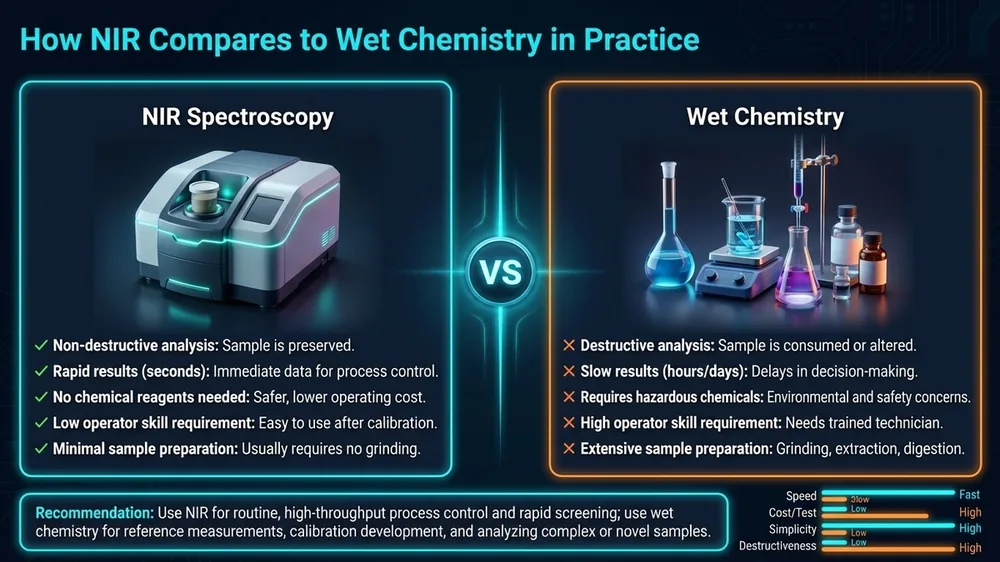
- Non-destructive analysis: The sample isn't altered. It can be retested, returned to inventory, or used in production after scanning.
- Minimal sample prep: Most grain, flour, feed pellets, and oilseeds require little to no preparation. Present the sample, scan, and get the result.
- Speed: A typical NIR scan takes 30 seconds to 2 minutes. Kjeldahl protein or Karl Fischer moisture analysis runs 30–60 minutes per sample.
- Multi-parameter results: One scan returns moisture, protein, fat, and fiber simultaneously — four separate wet chemistry tests replaced by a single measurement.
- No reagents or solvents: Nothing to dispose of. That simplifies lab operations, especially in high-volume receiving environments.
Wet chemistry remains the reference standard that NIR calibrations are built on. NIR doesn't replace wet chemistry entirely — it depends on it. Labs that cut wet chemistry too quickly often find their calibration maintenance suffers. A grain receiving operation that eliminates its Kjeldahl program entirely loses the ability to detect when a new wheat variety or new supplier has shifted the protein range outside the calibration's valid scope. And that's expensive. A sustainable approach keeps a routine wet chemistry program running alongside NIR to monitor model performance over time. For guidance on balancing both methods and deciding when each approach fits, see the SpectroScience practical decision guide on when to use NIR instead of wet chemistry.
Free tool — Calibration Metrics Calculator: Enter your reference values and NIR predictions in the Calibration Metrics Calculator to compute RMSEP, RPD, R², and bias the way our course teaches it — with interpretation thresholds for grain, dairy, and feed. Open the Metrics Calculator →
Free tool — NIR vs Wet Chemistry Tool: Compare NIR side-by-side against Kjeldahl, Soxhlet, Karl Fischer, and Dumas in our interactive NIR vs Wet Chemistry tool — speed, cost per sample, accuracy, and where each method still wins. Compare the methods →
SpectroScience students get access to the NIR Technology Comparison — side-by-side comparison of FT-NIR, dispersive, and filter-based instruments across key performance criteria. Available as a free download in the student resource library.
Access the PDF libraryNIR Fundamentals Course — Lesson 9: NIR vs. Wet Chemistry
This lesson compares NIR spectroscopy with traditional wet chemistry methods, highlighting the advantages of speed and efficiency in quality control processes. It emphasizes how NIR can provide rapid results without the need for extensive sample preparation, making it particularly beneficial for high-volume operations in the food and feed industry.
Explore Lesson 9 in the NIR Fundamentals courseWant to Master NIR Spectroscopy?
Our 32-lesson online course covers everything from Beer-Lambert Law to PLS calibration — built for food, grain, feed, and dairy professionals.