How NIR Spectroscopy Works: Physics, Chemometrics, and Instrument Design
Learn how NIR spectroscopy works — from molecular bonds to PLS calibration models — for grain receiving and feed quality decisions.
· 8 min read · Vitaly Kirkpatrick
At 3am in a feed mill, there's a line of trucks waiting and a batch of incoming soybean meal that doesn't look right. Your operator needs an accept or reject call right now — not tomorrow when the outside lab opens. Without NIR, the real choices are guesswork, discounting the load, or accepting material that fails your spec days later when it's already in the bin. I've seen all three play out across feed operations. None of them are cheap.
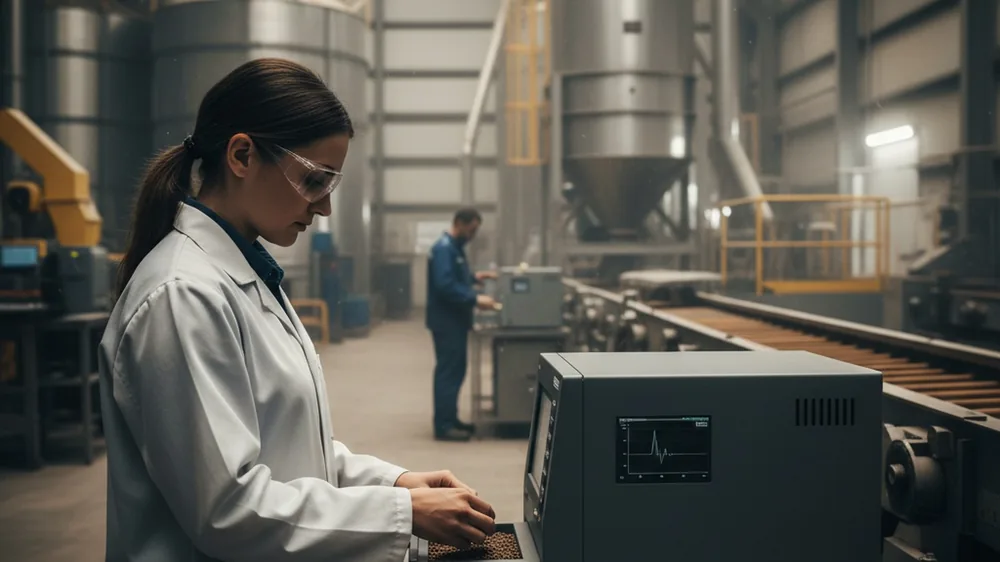
Here's the thing: that problem is solvable. Near-infrared spectroscopy returns moisture, protein, fat, and starch results in about 30 seconds, right at the receiving dock, without touching the sample with a single reagent. This isn't a lab demonstration — it's standard practice in well-run grain and feed operations today. Any facility not running it is making costly calls without complete data. For a broader look at where NIR fits across receiving and processing workflows, see NIR in Grain Receiving Operations: Real-Time Quality at the Scale.
Beyond the Visible: What NIR Actually Is
Visible light runs from roughly 380 to 780 nanometers. Just past the red end of that range — from about 780 to 2500 nanometers — sits the near-infrared region. Your eyes can't see it. Your grain samples respond to it in highly specific, chemically meaningful ways.
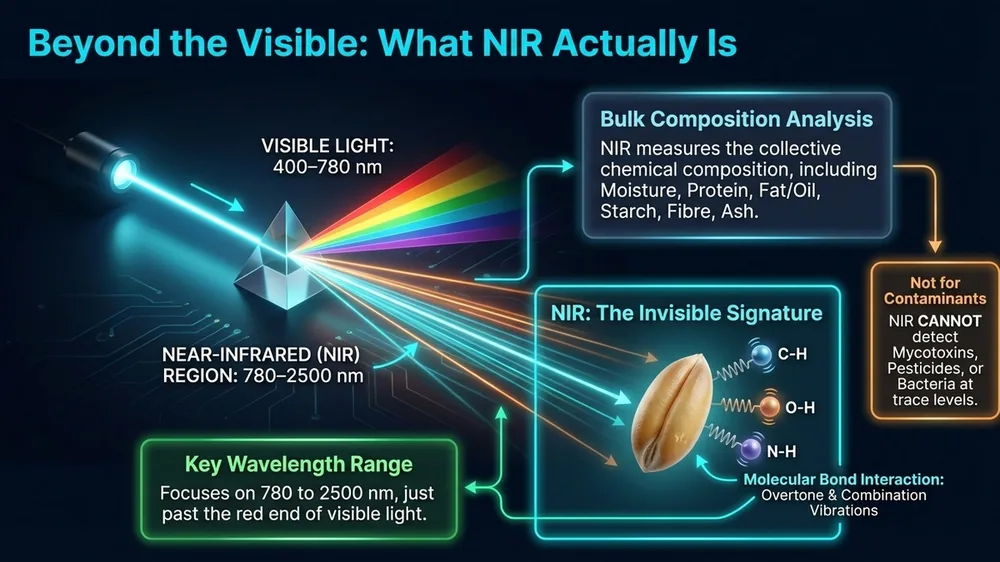
NIR light doesn't just bounce off the surface of a sample. It penetrates into the material and interacts with molecular bonds — specifically C-H, O-H, N-H, and S-H bonds. Those bonds define water, protein, fat, and starch. When NIR energy hits those bonds, they absorb it and vibrate at characteristic frequencies.
Think of it like plucking different strings on a guitar. Each string produces a different note. Each chemical bond produces a different absorption pattern. That pattern is the chemical fingerprint of your sample — and no two compositions produce exactly the same one.
NIR's real value in grain and feed isn't just which parameters it measures. It's how fast it measures them. Because NIR penetrates bulk material, a handful of grain, a powder, or an oil sample can be scanned with no grinding, no dissolving, no sample destruction at all. A wet chemistry moisture test on grain requires two or more hours of oven drying. NIR returns the same moisture value in under a minute, while the truck is still unloading.
The Molecular Basis: Why Bonds Absorb NIR Energy
Every covalent bond in a molecule behaves like a mechanical spring connecting two atoms. When incoming energy stretches or bends that spring, it vibrates. Each bond type — C-H in fat, O-H in water, N-H in protein — has a natural vibration frequency set by the masses of the atoms and the stiffness of the bond.

At the basic vibration frequency, bonds absorb mid-infrared energy strongly. In the NIR region, what gets absorbed are the overtones and combination bands of those basic vibrations — the bond vibrating at twice or three times its natural frequency. These overtones are weaker than fundamentals, which is actually useful: NIR light penetrates several millimeters into bulk grain rather than being absorbed at the surface, giving it real bulk-sampling capability.
The practical consequence for your feed mill or grain elevator is direct. Moisture absorbs strongly near 1450nm and 1940nm through O-H stretch overtones. Protein absorbs near 2050nm and 2180nm through N-H combination bands. Lipids show strong C-H overtone absorption near 1720nm and 2310nm. Starch carries its signature through O-H and C-H combination bands around 2100nm. These regions overlap — a spectrum from a wheat sample isn't a clean set of separated peaks but a complex, overlapping curve. That overlap is precisely what makes chemometrics necessary. For a deeper treatment of why molecular vibrations form the foundation of NIR measurement, see Why Do Molecules Vibrate — and How Does NIR Use That to Predict Composition?
How the Instrument Turns Light Into Numbers
An NIR spectrometer does one core job: it shines NIR light at a sample and measures how much light is absorbed at each wavelength across the full NIR range. The result is a spectrum — a curve showing absorption intensity from roughly 780nm to 2500nm. Every chemical compound in that sample leaves its own mark on that curve.
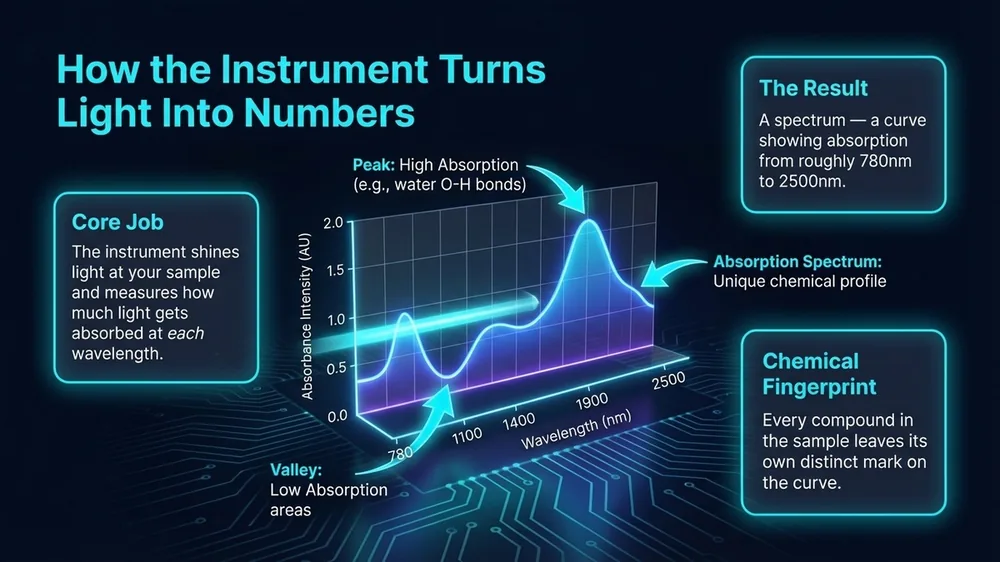
One thing to keep in mind: the absorptions you see in NIR aren't the clean, basic vibrations from a chemistry textbook. They're overtones and combination bands — weaker, broader, and overlapping with each other. A moisture peak doesn't sit cleanly by itself. It blends with signals from protein and starch.
Visually, two spectra can look nearly identical even when the samples have meaningfully different compositions. That's not a flaw in the technology. It's a reality of NIR physics — and it's exactly why chemometrics exists.
The instrument records these differences as absorbance values, calculated from the ratio of incident light to transmitted or reflected light at each wavelength. This ratio is the foundation of the Beer-Lambert relationship, which states that absorbance is proportional to concentration. In a single-component system with no scattering, that holds cleanly. In a bulk grain sample with multiple overlapping absorbers and significant particle scattering, the relationship is more complex — but it remains the mathematical basis on which all NIR calibration models are built.
Instrument Design: What's Inside the Box
Not all NIR instruments are built the same way. The three most common designs in grain and feed settings are filter-based instruments, scanning monochromator instruments, and diode array instruments.
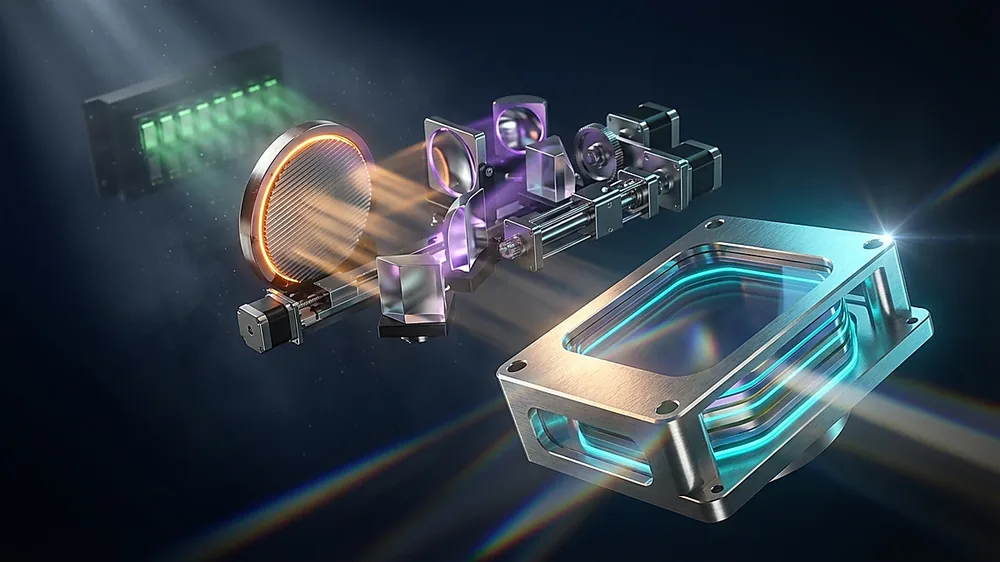
Filter-based instruments measure only a handful of fixed wavelengths. They're simple, rugged, and cost-effective for single-parameter work. Scanning monochromators sweep across the full NIR range using a moving grating — they collect complete spectra and handle complex multicomponent analysis well. Diode array instruments collect the full spectrum simultaneously with no moving parts, which improves speed and mechanical reliability in dusty mill environments where moving parts wear fast.
Fourier Transform NIR (FT-NIR) instruments represent a fourth category, used primarily in higher-throughput or central laboratory settings. They use an interferometer to collect all wavelengths simultaneously and offer very high spectral resolution. In a grain elevator, FT-NIR instruments are less common than diode array or scanning designs, but they're increasingly found in central labs that support multiple receiving sites.
For most grain receiving and feed quality applications, full-spectrum instruments are preferred. They carry more spectral information, which supports more accurate and flexible calibration models. A filter-based instrument with five fixed wavelengths can't capture the full spectral complexity of a soybean meal sample where protein, moisture, fat, and fiber all vary at once. Full-spectrum instruments measure hundreds or thousands of wavelength points per scan, giving the chemometric model far more to work with. For a detailed comparison of instrument categories and when each fits, see Different Types of NIR Instruments: From Benchtop to Process.
Reflectance vs. Transmittance: How Measurement Geometry Affects Results
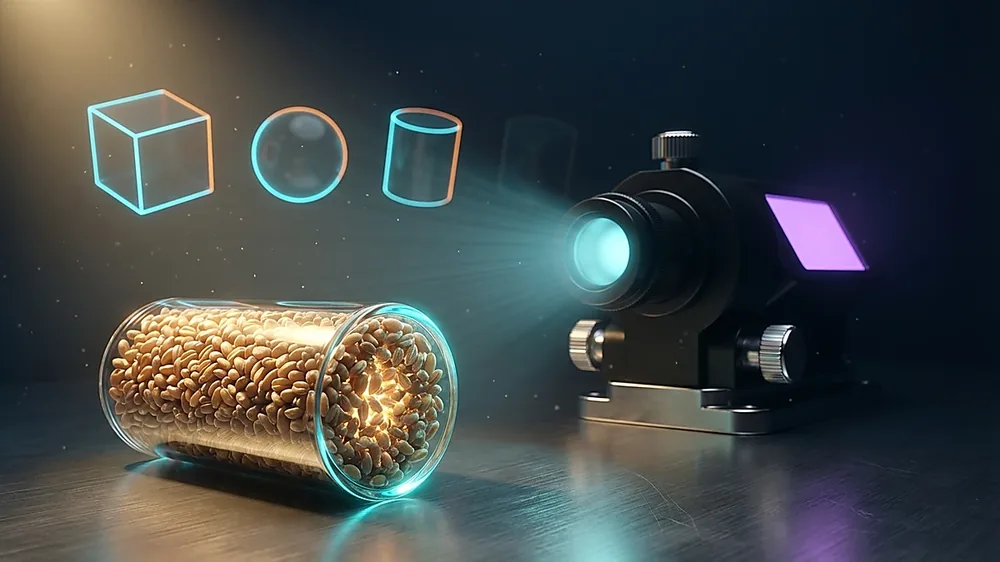
Grain and feed NIR instruments typically operate in one of two measurement geometries: diffuse reflectance or transmittance. The choice matters more than most operators realize — and getting it wrong for your sample type will quietly undermine your calibration accuracy.
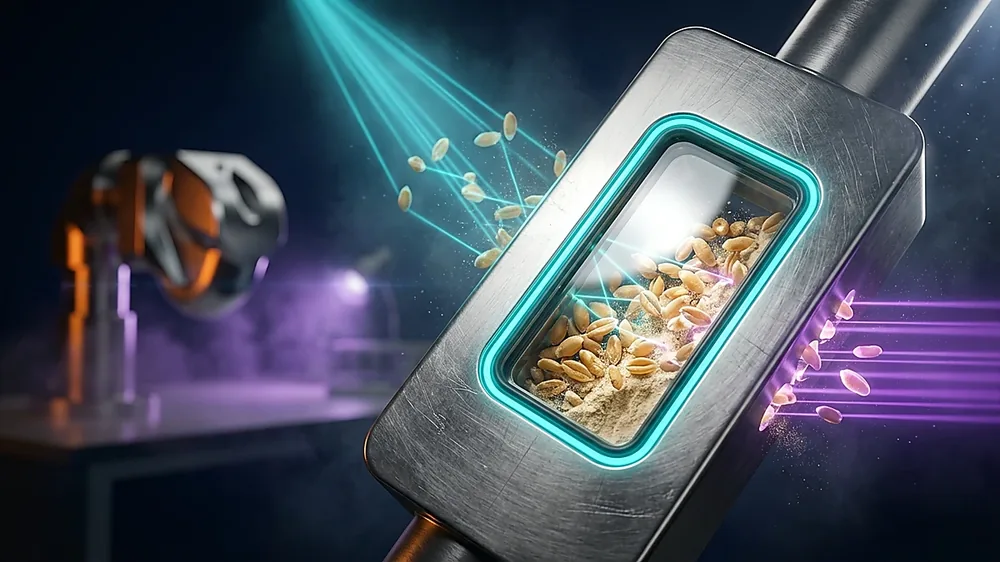
In diffuse reflectance mode — the most common configuration for solid grain and powders — NIR light illuminates the sample surface, scatters through the upper layers of the material, and the reflected light is captured by a detector. Penetration depth is typically a few millimeters, which means sample presentation must be consistent. A thin, poorly packed layer of grain in a reflectance cup won't produce the same spectrum as a properly filled, leveled sample. That's an operator training issue, and it shows up as unexplained prediction scatter.
Transmittance mode sends NIR light directly through the sample. It's standard for liquids and for whole-grain instruments that analyze individual kernels. Whole-grain transmittance NIR is widely used for wheat and corn in elevator settings because it avoids grinding entirely and can handle individual kernels at high throughput. Penetration depth is much greater in transmittance mode, which reduces sensitivity to surface effects but requires instrument optics matched to the optical density of the sample type.
The practical implication: an instrument suited for flour analysis in reflectance mode isn't automatically suitable for whole corn analysis. Facilities handling multiple grain types or forms — ground, whole kernel, pellet, slurry — need to confirm that both the instrument and the calibration are appropriate for each measurement geometry in use.
Chemometrics: The Brain Behind the Measurement
Chemometrics may sound complicated at first. The core idea isn't. Think of PLS regression like teaching a technician to recognize a regular customer's voice on the phone — they don't analyze every phoneme consciously, they just know the pattern from repeated exposure. A chemometric model does the same thing with spectra: it learns which patterns in absorbance data correspond to which protein levels, moisture readings, and oil percentages, purely from examples.
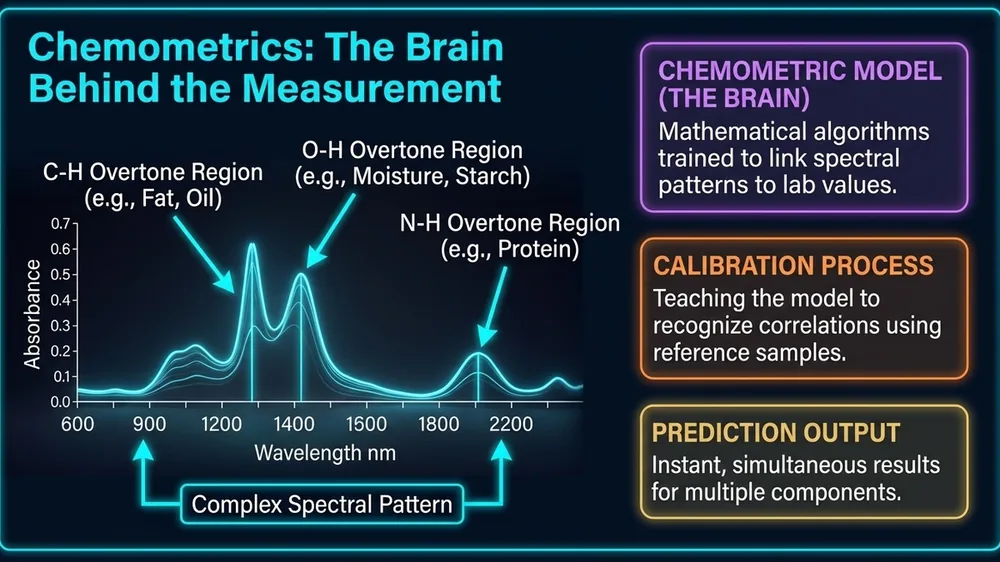
Hundreds of samples with known reference values from wet chemistry feed the model during training. Once trained, the model analyzes a new sample's spectrum and returns composition results in seconds. The most widely used approach is Partial Least Squares regression — PLS. It finds the mathematical directions in spectral data that best explain the variation in reference values.
Before PLS can be applied, raw spectra usually need preprocessing. Multiplicative Scatter Correction (MSC) and Standard Normal Variate (SNV) transformations reduce the effect of particle size variation and baseline drift. First and second derivative treatments sharpen spectral features and help separate overlapping bands. These preprocessing steps aren't optional refinements — in many grain applications, skipping them produces models with a lot higher prediction error, particularly when samples from different origins or different grinding conditions are included in the same dataset.
NIR doesn't measure chemistry directly — it measures patterns in light absorption, and chemometrics translates those patterns into numbers. The quality of that translation depends entirely on how well the calibration model was trained and how well it still matches incoming grain.
Quality managers often ask me why their NIR numbers start drifting mid-harvest. The answer is almost always this: the calibration model was trained on last year's grain, and this year's crop — different variety, different growing region, different weather stress — is pushing samples outside the range the model ever saw. Your model won't flag that visibly. It'll just quietly give you numbers that are off.
Models degrade when incoming grain drifts outside the parameters they were trained on. In a difficult harvest year, that drift can be large. Key performance metrics to monitor include RMSEP (Root Mean Square Error of Prediction) against ongoing wet chemistry checks, and the distribution of Mahalanobis distance or spectral residual scores, which show when a new sample is spectrally unusual compared to the calibration set. When those scores trend upward across a harvest season, it's a signal that the model needs new samples added and recalibration performed.
Watch out: A calibration model trained on one wheat variety or growing region will produce unreliable results when applied to different grain. Errors start small and grow — new varieties, different origins, or unusual weather all push incoming grain outside the model's trained range without any visible warning from the instrument.
Validation: How You Know the Model Is Working
Building a calibration model is only the first step. Validating it — confirming that its predictions hold up on samples it has never seen — is what determines whether it's safe to use for production decisions. Your auditors will want to see this documented. So will your own quality records when a load gets disputed.
Cross-validation is the standard first check. The calibration dataset is split into subsets; the model is trained on most of the data and tested on the held-out portion, rotating through until every sample has been used for testing once. This produces the RMSECV — Root Mean Square Error of Cross-Validation — which estimates prediction error under controlled conditions. A wheat protein model with an RMSECV of 0.25% crude protein is generally acceptable for grain receiving. An RMSECV above 0.5% in the same application warrants investigation before deployment.
External validation — testing the model on a completely independent set of samples with their own reference chemistry — is more thorough and should always happen before a model goes live on a production line. The RMSEP from external validation is the most honest estimate of real-world prediction accuracy. When RMSEP is noticeably higher than RMSECV, the model is likely overfitting the calibration data and will underperform in the field.
Ongoing validation doesn't stop at launch. Best practice in grain and feed operations is to pull 5–10% of NIR-scanned samples for confirmatory wet chemistry at regular intervals. When NIR results and wet chemistry consistently diverge beyond the model's stated accuracy limits, investigate the cause — don't adjust the acceptance threshold to paper over it.
Putting It Together: From Photons to Feed Decisions
When NIR spectroscopy works correctly in a grain receiving operation, the chain runs like this: NIR light enters the sample, molecular bonds absorb energy at specific wavelengths, a detector captures the resulting spectrum, and a calibration model converts that spectrum into moisture, protein, fat, and starch values — all within 30 seconds.
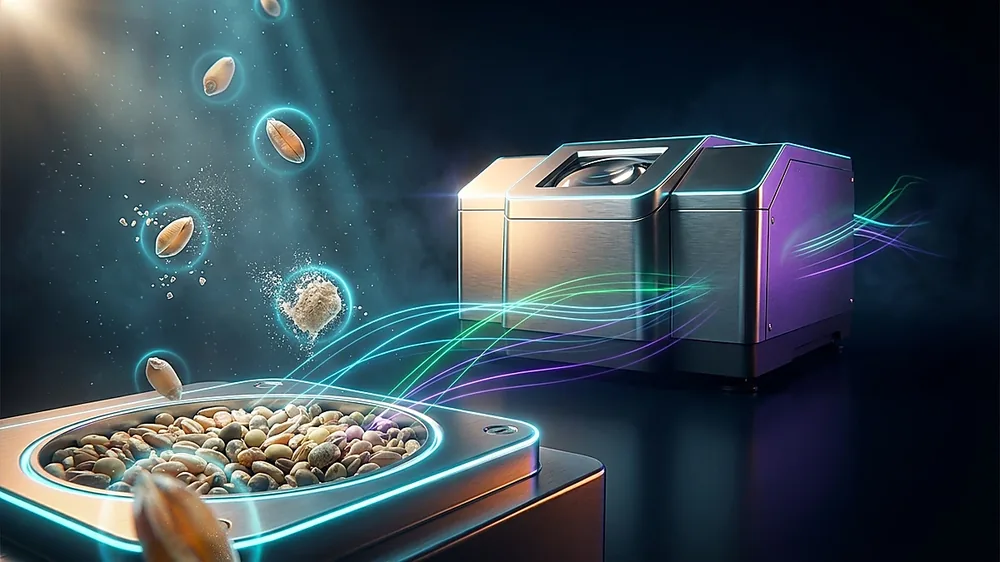
Every link in that chain matters. The instrument design determines spectral quality. The calibration model determines prediction accuracy. Sample preparation and presentation affect both. An instrument with poor sample handling will produce inconsistent spectra regardless of how good the model is. A good instrument with a poorly maintained model will drift out of spec as grain origins and harvest conditions change.
Operations that get the most from NIR treat it as an integrated system — not just a piece of hardware sitting on a bench. They track model performance over time, run periodic reference checks against wet chemistry, and update calibrations when new crop years arrive. Facilities that manage NIR this way consistently report decision turnaround times under two minutes for receiving checks — compared to same-day or next-day results from an external laboratory. At scale, that difference translates directly into load throughput, storage efficiency, and avoided rework costs.
The physics, the instrument, and the chemometrics are each necessary components. None of them alone delivers the result. Understanding how NIR works across all three layers is what separates operations that use it reliably from those that struggle with inconsistent results and unresolved calibration drift — and that's a distinction worth getting right before the next harvest season starts.
Free tool — Calibration Metrics Calculator: Enter your reference values and NIR predictions in the Calibration Metrics Calculator to compute RMSEP, RPD, R², and bias the way our course teaches it — with interpretation thresholds for grain, dairy, and feed. Open the Metrics Calculator →
Free tool — Beer-Lambert Calculator: The Beer-Lambert Calculator works the absorbance = ε·b·c relationship in both directions — useful when sizing path length for a new sample type or sanity-checking a calibration curve. Open the Beer-Lambert Calculator →
SpectroScience students get access to the Chemometrics Cheat Sheet — PLS, PCR, cross-validation, RMSECV, RMSEP, and R² explained with practical interpretation guidelines. Available as a free download in the student resource library.
Access the PDF libraryNIR Fundamentals Course — Lesson 13: NIR in Agriculture
This lesson focuses on the application of NIR spectroscopy specifically within agriculture, highlighting its role in assessing quality parameters for grains and feed. It provides insights into how real-time data from NIR can enhance decision-making processes at critical points like grain receiving, ensuring product consistency and reducing costly errors.
Explore Lesson 13 in the NIR Fundamentals courseWant to Master NIR Spectroscopy?
Our 32-lesson online course covers everything from Beer-Lambert Law to PLS calibration — built for food, grain, feed, and dairy professionals.